HomeAuto HarmonyOS 7 Beta Opens to 50 Devices: Agentic AI Arrives, App Check Required
HarmonyOS 7 Beta Opens to 50 Devices: Agentic AI Arrives, App Check Required
September 7, 2026:
harmonyos.com
Huawei opened the HarmonyOS 7 public beta on Monday to owners of more than 50 smartphone, foldable, and tablet models — the broadest first-day enrollment window the platform has offered — with a single non-negotiable condition buried in the fine print: because HarmonyOS 7 runs on a pure microkernel with no Android compatibility layer, every app that has not been explicitly rebuilt for the platform simply does not run. Before updating, owners of compatible hardware need to check their most critical apps against native HarmonyOS availability — there is no APK fallback, and no way around the gap if a must-have app has not yet been ported.
The announcement came at the all-scenario launch event in Guangzhou — the same stage where Huawei unveiled the Mate XT 2, its second-generation tri-fold flagship — and it sets up an unusually visible public test of whether HarmonyOS has matured enough to support a large-scale rollout without friction. The beta build is version 7.0.0.105 SP10, delivered over the air.
Five Features That Distinguish HarmonyOS 7 From Its Predecessor
HarmonyOS 7 is the third major release of the pure HarmonyOS NEXT series — the architecture that stripped out all Android AOSP code and replaced it with Huawei’s in-house HongMeng microkernel, first shipped commercially in late 2024. Within that unchanged foundational constraint, HarmonyOS 7 adds five substantive capabilities that prior versions did not have.
Agentic AI via Celia 2.0 and Agent Framework 2.0. The platform’s biggest architectural change is not visual — it is how the OS handles user intent. Celia, Huawei’s AI assistant, has been redesigned as a system-level agent rather than a voice command interface. The upgraded HarmonyOS Agent Framework 2.0 connects Celia to 2,000 agents and supports three call paths: direct Agent-to-Agent (A2A) communication, calls to the Celia open platform’s agent registry, and invocation of named Skill capability services. Huawei describes the paradigm as “Intent as a Service” — a user states a goal in natural language, and Celia plans and orchestrates the steps autonomously across multiple apps. Huawei states that Agent Framework 2.0 achieves over 90 percent task completion on complex multi-step requests without requiring user intervention.
Running underneath Celia is the 30-billion-parameter edge version of openPangu 2.0, Huawei’s large language model family. The 30B model uses a Mixture-of-Experts (MoE) architecture — only a subset of parameters is active during any given inference pass — which makes running a model of that total size feasible on the Da Vinci NPU in Kirin chips. OpenPangu 2.0’s 30B edge model is designed specifically for Kirin hardware and runs local task processing without sending context to a cloud server, for compatible devices. For owners of the Mate XT 2 and its Kirin 9050 Pro, this includes the Da Vinci NPU dimensioned specifically for MoE workloads (30B total / 2B active per pass, per Huawei’s chip specification). For older devices in the beta, the effective model size available on-device will depend on available NPU capacity.
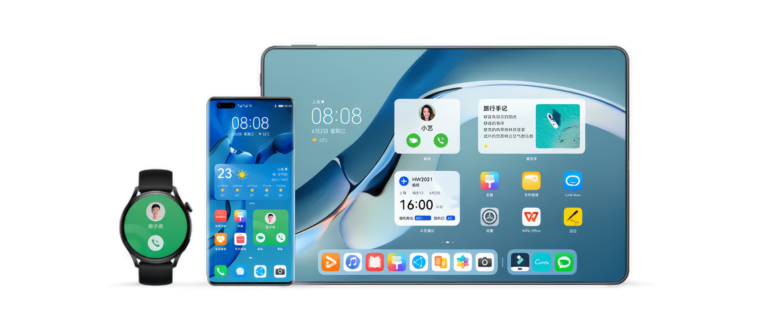
Spatial UI and liquid visuals. HarmonyOS 7 introduces a 3D rendering layer across system interfaces — lock screens, control panels, and home screen widgets all receive software-rendered depth effects. Interactive particle lighting responds when users move brightness or volume sliders; dismissed notifications dissolve as light-sensitive particles rather than disappearing abruptly. The design language is Apple’s Liquid Glass in concept and aspiration, though Huawei’s implementation is software-rendered rather than tied to specific display hardware, which means it ships to compatible existing devices in the beta.
Ultraspace Storage (deduplication and compression). This is the feature most likely to produce an immediate, tangible result for beta testers on day one. Ultraspace Storage — also described in Huawei’s Chinese materials as 超空间存储技术 (Super Space Storage Technology) — applies deduplication and compression automatically in the background. The important distinction is that this is not cache-clearing, which frees space temporarily before apps refill it. Deduplication removes duplicate data blocks; compression permanently reduces stored file size. The result is space that does not come back. Huawei’s stated storage recovery by tier: up to 22GB on 256GB devices, up to 51GB on 512GB devices, and up to 109GB on 1TB devices. The Ultraspace Storage feature also includes Super Spatial Memory, which adds up to 3GB of available running RAM compared with HarmonyOS 6 — meaning more apps can remain active in the foreground and background simultaneously.
Cross-device continuity overhaul. HarmonyOS 7 redesigns how paired devices interact across the HarmonyOS ecosystem. Under the updated system, a user can interact with a locked smartphone directly from a connected MatePad tablet or HarmonyOS PC — biometric authentication unlocks the paired phone remotely via face or fingerprint performed on the tablet without requiring the phone to be picked up. Drag-and-drop file transfers then happen across the authenticated device pair. This is an extension of HarmonyOS’s Super Device architecture, which treats all paired devices as a single computing environment; the new authentication bridging removes a previous friction point that required separately unlocking the phone before initiating a transfer.
AI Anti-Fraud. A dedicated on-device AI Anti-Fraud platform scans QR codes and flags callers, monitors web pages for impersonation patterns, and runs real-time voice-scam detection during active phone calls. The call-time scam detection is the highest-stakes addition: the system listens for linguistic and acoustic patterns associated with social engineering during live calls and can alert the user without interrupting the call. Huawei has not disclosed the false-positive rate for any of these Anti-Fraud features.
The Performance Engine: Ark Scheduling and 15% Efficiency Gain
Underlying all five visible features is a system-level change: HarmonyOS 7 is the first version to embed a performance large language model — trained on 2 billion data samples — directly into the Ark Engine, the OS’s core scheduling system. The result is a scheduler that learns per-user usage patterns and pre-allocates resources accordingly — Huawei describes this as a “thousand people, thousand faces” optimization, meaning the OS tuning adapts to individual behavior over time rather than applying a fixed scheduling policy to all users.
Huawei states a 15 percent efficiency gain over HarmonyOS 6.1 from this Ark Engine change. Measured outcomes include an Ark Scheduling Engine improvement of 40% in long-session frame-rate stability (tested up to 3.5 hours), AI Super Resolution producing images up to 1.5x clearer than HarmonyOS 6 in gaming contexts, and AI Frame Stabilization maintaining 60 frames per second during extended sessions. Hardware-accelerated real-time ray tracing is supported on devices with a Maleoon GPU (Kirin 9050 Pro in the Mate XT 2); earlier hardware in the beta receives the other engine improvements without hardware ray tracing.
The Ark Engine’s model-based scheduler is what makes the agent architecture operationally viable at scale. Agentic tasks — multi-step, multi-app orchestrations — impose irregular and hard-to-predict workload bursts on the CPU, NPU, and memory bus. A reactive scheduler would produce noticeable latency spikes; the predictive model allows the system to pre-stage resources before Celia begins executing a task.
What the App Count Actually Means for Beta Users
HarmonyOS 7 operates on the same pure microkernel that shipped with HarmonyOS 5 (NEXT) in late 2024. The absence of an Android compatibility layer is not new. What is new is that the ecosystem has had almost two years to close the gap.
As of the HarmonyOS Ecosystem Conference 2026 (held August 28–29 in Shenzhen), Huawei reported that HarmonyOS crossed 100,000 native apps and that total apps accessible on HarmonyOS smartphones — including compatible web apps and atomic services — exceed 400,000. Huawei rotating chairman Xu Zhijun set 100,000 native apps as the platform viability benchmark; by that measure, the ecosystem has cleared its own standard. HarmonyOS 6 reached 66 million devices at the time of the HDC 2026 announcement, with a target of 100 million by year-end.
Counterpoint Research’s Q2 2026 smartphone data puts HarmonyOS at 5% of global smartphone shipments in Q2 2026, and 24% of China smartphone sales in the same period — ahead of iOS (18%) in China, while Android held 58%.
For a beta tester in China, those numbers mean that WeChat, major Baidu apps, banking apps from the major state banks, mapping services, and productivity staples are overwhelmingly available natively. The gap that still exists is in international and niche-category apps — international social platforms, Western productivity software, and specialized professional tools that have not been rebuilt for ArkTS. A reader who relies on international services as part of their daily workflow should verify specific app availability before enrolling.
Celia 2.0’s Expanded Permissions and the Data-Access Context
Agentic AI requires deeper OS permissions than a voice assistant. To orchestrate multi-step tasks across apps — generating training schedules, sending files from a laptop, managing calendar events, summarizing documents — Celia 2.0 needs read and write access to calendar, contacts, files, messages, and app data. That access profile is qualitatively more expansive than a traditional assistant that answers questions.
HarmonyOS 7 runs on hardware and software built and operated by Huawei, a company headquartered in Shenzhen, China. China’s National Intelligence Law, Article 7, requires all Chinese organizations to support, assist, and cooperate with government intelligence work on demand. Article 14 grants intelligence agencies authority to compel that cooperation. This obligation applies to Huawei regardless of where its servers are located or what its privacy policy states — it is a fixed structural condition of operating under Chinese jurisdiction, not a contingent risk.
The implication for HarmonyOS 7 specifically: the data types that Celia 2.0’s agentic framework accesses — documents processed for summarization, calendar entries used for task planning, cross-device file transfers — represent a more comprehensive data profile than previous versions created through passive voice commands. For a user in mainland China whose primary workflow lives within the HarmonyOS ecosystem, this is the existing legal reality of operating on any domestically developed platform. For any reader outside mainland China who may encounter HarmonyOS 7 hardware through subsidiary offices, travel devices, or supply chain procurement, the same structural framework applies.
Devices Eligible for the HarmonyOS 7 Open Beta
The initial open beta covers Huawei’s premium lines across form factors. The open beta eligible device list includes the Mate 80, Mate 80 Pro, Mate 80 Pro+, and Mate 80 RS Ultimate Design; the foldables Mate X7 and Mate XT Master Edition; the Pura 90 series, Pura X, and Nova 15 Pro and Ultra; and the MatePad Pro 13.2-inch and 12.2-inch tablet lines. Chinese tech outlet IT之家 reported that more than 50 models received the public beta OTA on day one. Huawei has confirmed the beta program will expand to additional models as stability testing progresses. The stable release of HarmonyOS 7 is expected this fall alongside the Mate 90 series.
The Mate XT 2 — unveiled at the same Guangzhou event and priced at ¥19,999 (approximately $2,980 USD) for the base model and ¥24,999 (approximately $3,725 USD) for the premium variant — ships with HarmonyOS 7 pre-installed and will go on sale in China beginning September 12.
How to Enroll in the HarmonyOS 7 Open Beta
Enrollment is available now for compatible mainland China-spec devices through the system UI. Open the My Huawei (我的华为) app, tap the Upgrade Early Access (升级尝鲜) banner on the home screen, select Open Beta Registration, choose your enrolled device model, and accept the beta agreement. Once approved, the OTA package is available under Settings → System & Updates → Software Update.
Before enrolling: back up personal data to Huawei Cloud, verify that your most critical daily apps have updated native HarmonyOS builds, and ensure the device has at least 40% charge and sufficient free space to receive the update. Beta software may contain bugs; the stable release is expected this fall.
Frequently Asked Questions
Is HarmonyOS 7 compatible with Android apps?
No. HarmonyOS 7 is built on the HongMeng microkernel — a pure architecture with no Android AOSP code and no Linux foundation. Every app must be built natively for the platform using ArkTS. There is no APK compatibility layer and no way to sideload Android apps. Before enrolling in the beta, check that all your essential apps have native HarmonyOS versions in AppGallery. As of August 2026, Huawei reports more than 100,000 native apps on the platform; the gap is most significant for international and niche-professional software not yet rebuilt for ArkTS.
What does “agentic AI” mean in HarmonyOS 7, and how is it different from a voice assistant?
A voice assistant responds to one command at a time — it hears a request, fetches or executes a single action, and waits for the next input. An agentic AI receives a goal and plans and executes multiple steps autonomously, calling different tools, apps, or data sources as needed without user input between steps. Celia 2.0 orchestrates over 2,000 agents through Agent Framework 2.0 and executes complex tasks — generating a training plan, adding it to a calendar, and coordinating it with health data — through a single natural-language instruction. Huawei reports a task completion rate above 90% for complex multi-step requests. The distinction matters practically because agentic execution requires deeper OS permissions — calendar, files, contacts, cross-device data — than a passive voice assistant uses.
How does Ultraspace Storage actually free up space, and does the recovered storage stay free?
Ultraspace Storage uses data deduplication and compression — not cache-clearing. Deduplication identifies and removes exact duplicate copies of data blocks stored in the system; compression reduces the physical size of stored files using lossless algorithms. Both operations produce permanent space recovery that does not refill over time the way cleared cache does. Huawei’s stated storage recovery by capacity tier: up to 22GB on 256GB devices, up to 51GB on 512GB devices, and up to 109GB on 1TB devices. These are maximum figures under optimal conditions; actual recovery will depend on how much duplicate or compressible data exists on a given device.
Does enrolling in the HarmonyOS 7 beta mean my device is subject to Chinese government data access?
China’s National Intelligence Law applies to Huawei as a Chinese company regardless of which software version runs on its devices. Enrolling in the HarmonyOS 7 beta does not change that legal framework — it was already present on HarmonyOS 6. What HarmonyOS 7 does change is the scope of data that Celia 2.0’s agentic architecture accesses: document summaries, task-planning calendar data, cross-device file transfers, and other multi-step task artifacts are now part of the platform’s data profile in ways that a passive assistant did not create. China’s National Intelligence Law Article 7 requires Huawei to cooperate with government intelligence requests on demand; Article 14 grants authority to compel that cooperation. No backdoor has been confirmed in HarmonyOS 7 specifically, and the law’s applicability is a standing structural condition, not evidence of any specific incident.