HomeAuto Half Earns First Malayalam Spot in TIFF Midnight Madness with Pencak Silat Vampires
Half Earns First Malayalam Spot in TIFF Midnight Madness with Pencak Silat Vampires
September 15, 2026:
Tiff.net
Half, a Malayalam-language vampire action thriller directed by Samjad, had its world premiere at the Toronto International Film Festival’s Midnight Madness section on September 13, 2026 — becoming the first Malayalam film ever to screen in that TIFF Midnight Madness 2026 lineup. That is not a minor checkpoint. Midnight Madness is where genre cinema becomes a global commodity: last year’s section produced Obsession, which went on to become the highest-grossing independent genre acquisition in recent festival history — Obsession acquired by Focus Features for a reported $14-15 million, earning more than $475 million worldwide. The moment Kerala-based Fragrant Nature Film Creations and director Samjad landed Half in that program, Malayalam cinema proved it had built the genre infrastructure to compete not just regionally but at the point in the international film industry where genre films become global properties.
Half: Ethan, Ivy, and a Desert Highway Where Nothing Survives
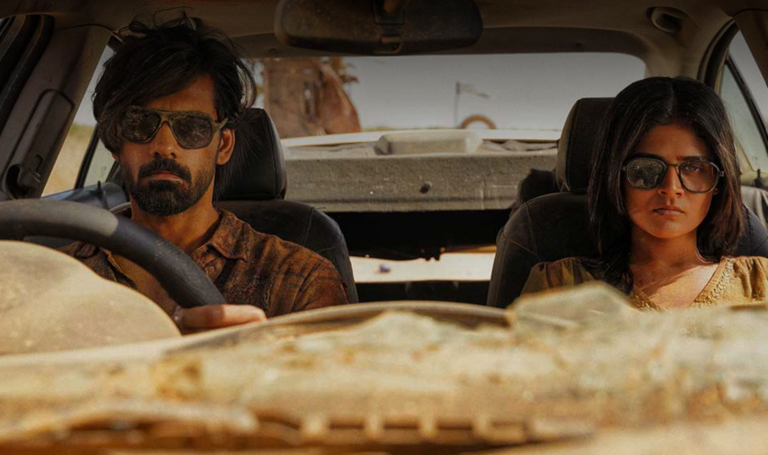
The film follows Ethan and Ivy, twin half-blooded vampires played by Ranjith Sajeev, Aiswarya Raj, who travel across the arid desert highways of Rajasthan and encounter a group of criminals. That encounter becomes a sustained exercise in graphic violence as the twins — beings who look human enough to move among ordinary travelers but who possess the strength, sensory acuity, and physical resilience of their vampiric bloodline — methodically dismantle everyone who stands in their way. The central dramatic tension is not whether they will survive. It is what the cost of survival at that level of brutality looks like on a human face, and whether beings defined by incompleteness — neither fully vampire nor fully human — can exist at all once the highway is behind them. The film operates in a register of unrelenting physical consequence: gore is not decoration but argument.
TIFF Midnight Madness curator Peter Kuplowsky has compared Half‘s starkness to Kathryn Bigelow’s Near Dark — as reported in Kuplowsky compared Half to Near Dark. The 1987 American vampire film set among drifters and dust provides a precise comparison: both films strip European vampire mythology of its Gothic architectural context and place their creatures in a landscape where daylight and distance are the actual threats.
Why Pencak Silat — and Why It Changes What Vampire Action Looks Like
Director Samjad made one decision about the action sequences that distinguishes Half from virtually every other vampire action film in recent memory: no slow-motion shots. Where most supernatural action films use ramped-down frame rates to aestheticize violence into something beautiful and slightly dreamlike — implicitly excusing the viewer from the full weight of what is happening — Half runs everything in real time. Samjad avoided all slow-motion sequences, building custom in-camera rigs rather than relying on post-production speed manipulation. The consequence of that choice is that the audience cannot aesthetically distance itself. What happens on screen carries its full physical weight.
The choreographer Samjad brought in to build those sequences is Very Tri Yulisman — Very Tri Yulisman Baseball Bat Man in Gareth Evans’s The Raid 2 (2014) — who also contributed to The Night Comes for Us (2018), two films that introduced international audiences to the specific grammar of Indonesian Pencak Silat action cinema. Yulisman trained both Ranjith Sajeev and Aiswarya Raj for several months so they could perform their own stunts, and his team reportedly built custom in-camera rigs for the fight sequences, meaning the violence in Half reads as physically real because it was physically enacted, not digitally assembled afterward.
Pencak Silat is worth understanding on its own terms, because the creative logic of choosing it for this film is more elegant than it first appears. UNESCO inscribed Pencak Silat 2019 as Intangible Cultural Heritage of Humanity. Dating back to at least the 6th century in what is now Indonesia, it encompasses hundreds of regional combat styles. The term itself is a duality: pencak refers to the choreographed, aesthetically demonstrative movements performed as art or ritual; silat denotes the practical combat application — strikes, locks, and weapons use. Together, they describe a system that refuses to separate the biomechanical from the philosophical. What practitioners call rasa — a quality of internal awareness that might be understood as highly refined proprioceptive intelligence — is the system’s most distinctive feature: the practitioner’s body is trained to read spatial and energetic cues that precede visible movement, initiating a response before the threat has completed its action.
For vampire protagonists with implied sensory enhancement, this is not an arbitrary choice. A martial art explicitly built around sensing rather than reacting maps onto the half-blood state’s internal logic: beings who can perceive what ordinary humans cannot would naturally operate at a resolution of physical prediction that human Silat practitioners can only approximate. When The Raid 2 brought Pencak Silat to international genre audiences, it did so through the lens of close-quarters law enforcement under siege. Half extends that vocabulary into a supernatural context where the practitioners are not constrained by human kinesthetic limits — and the result, according to early descriptions from the premiere, is action that reads as the consequence of those limits removed, rather than simply fast editing assembled to suggest them.
What a Curry Western With Vampires Actually Means
Samjad’s film has been described as curry western film consistently in press materials. To understand why that label matters — and why Half is something more specific than it suggests — requires a brief detour through genre history.
The curry western emerged from a specific creative moment: Ramesh Sippy’s Sholay founded curry western genre (1975), scripted by Salim-Javed, which grafted the iconography of Sergio Leone’s spaghetti westerns and Sam Peckinpah’s violent American westerns onto the pre-existing Indian dacoit cinema tradition. Dacoits — armed bandits who operated in the ravines of central India — provided an indigenous outlaw figure who could inhabit the same moral and geographic terrain as the American gunfighter, but who arrived with entirely different social logic: the dacoit story in India is inseparable from caste, land dispossession, and the legitimacy of state authority in ways that the American frontier myth is not. Sholay is the highest-grossing Indian film of its era, ranked first in the British Film Institute’s 2002 poll of “Top 10 Indian Films,” and ran continuously in Indian theaters for over 19 years. Its influence on how Indian cinema thinks about outlaw figures, desert landscapes, and moral isolation is total.
Half does not make a curry western. It takes the curry western as a given — a starting point — and mutates it further by inserting two additional cosmological systems: European vampire mythology (specifically the dhampir, or half-blood vampire, drawn from Balkan and Romani folklore) and the kinetic language of Indonesian martial arts cinema. What results is a third-generation genre hybrid. The Rajasthan desert landscape in Half is not borrowed from Leone; it is the genuine terrain of the original dacoit cinema tradition, now hosting creatures from a completely different mythological system, fighting in a style developed half a world away. That specific combination is genuinely new.
Kerala’s Own Vampire Tradition: The Yakshi Connection
Half does not directly invoke Kerala’s indigenous vampiric tradition — but for anyone who knows that tradition, the film’s central premise resonates in a way that goes beyond coincidence. Fragrant Nature Film Creations, the film’s production banner, is a Kerala-based company, and director Samjad comes from that cultural context.
Kerala has one of the richest indigenous vampire traditions in the world in the figure of the Yakshi. Scholar Corinne Dempsey, writing in the Journal of the American Academy of Religion (2005), describes the yakshi as a Dempsey shape-shifting vampiric maiden — memorialized in folklore, cinema, and as a focus for propitiation. The Yakshi is understood in centuries of Malayalam folklore as the spirit of a wronged woman transformed by violent or tragic death into a seductive, blood-seeking entity who haunts lonely pathways and sacred Pala tree groves. A 30-foot concrete sculpture of a Yakshi by artist Kanayi Kunhiraman at Malampuzha in Kerala is one of the region’s most recognized public artworks.
What makes the Yakshi structurally relevant to Half is not mythology but condition. The Yakshi is defined by her incompleteness: human in origin, monstrous by transformation, belonging fully to neither world, occupying a threshold between the living and the dead. This is precisely the condition of Ethan and Ivy in Half — beings who are “half” in every sense, whose power derives from and is inseparable from their interstitial state. A Kerala filmmaker making a film about half-blood vampires who are too human to be fully vampiric and too vampiric to be fully human is, whether consciously or not, working in a tradition that his home culture has developed over centuries.
What It Means That This Film Happened Now
The industrial story around Half is as significant as the film itself. Before the world premiere at TIFF, two distribution deals had already been announced.
Best Friend Forever, a Brussels-based international sales company, secured international sales rights for Half. Excel Entertainment first Malayalam acquisition — co-founded by Farhan Akhtar and Ritesh Sidhwani, one of Bollywood’s most creatively ambitious and commercially successful production houses, known for Dil Chahta Hai, Gully Boy, and Zindagi Na Milegi Dobara — signed on to present and distribute the Hindi-dubbed version across North India in association with AA Films. This marks Excel Entertainment’s first Malayalam-language acquisition in its 25-year history.
That combination — a Paris sales agent and Bollywood’s most internationally-oriented production house, both acquiring before the world premiere — is the international film industry’s clearest signal that a film has crossed the threshold from regional to globally exportable. It happens when distributors look at a film and see not just a good movie but a film whose combination of elements is legible in multiple markets simultaneously: the vampire genre is globally familiar; Pencak Silat action cinema has a proven international audience after The Raid franchise; and the curry western desert aesthetic is visually distinctive enough to read as exotic without being incomprehensible.
Malayalam cinema has been producing critically acclaimed films for decades — Drishyam, Jallikattu, Kumbalangi Nights, The Great Indian Kitchen — and has had individual crossover moments before. What Half represents is different: not a crossover of a drama or a thriller into national-language distribution, but a genre film that was designed for and immediately landed in the sector of the international film market where genre films become global properties. That requires a different kind of genre infrastructure — the relationships, the craft vocabulary, the production scale — and Malayalam cinema demonstrably has it now.
Farhan Akhtar, who Farhan Akhtar praised Samjad’s approach as “raw and visceral,” made a point of noting the specific creative risk Samjad took in banning slow-motion sequences. That detail matters: slow motion is insurance. It is the mechanism by which action cinema aestheticizes violence until it is beautiful rather than consequential. Choosing to remove it is choosing to be held accountable for what the action actually depicts. It is a decision that distinguishes craft from spectacle.
Does This Work as Vampire Cinema? What the Early Review Suggests
The reviewer from The HoloFiles, writing after the TIFF premiere, offered a reading that is instructive in its honesty: the film’s protagonists, they noted, are somewhat underdeveloped as vampiric beings — the mythology of their condition is not deeply interrogated on screen — and Half succeeds more compellingly as a neo-western and action film than it does as vampire horror per se.
This is not a damaging critique; it is a classification. Near Dark, Kuplowsky’s own comparison point, is also not primarily a horror film — it is a road movie about belonging and inheritance that happens to have vampires in it. The vampiric condition in that film is a social fact about the characters, not a cosmological system the film intends to explain. Half appears to operate similarly: the half-blood state is a power differential that justifies the film’s action, not a metaphysical puzzle the film has set out to solve. Whether a viewer who comes to Half wanting vampire mythology will find enough of it depends on what they prioritize. A viewer who comes wanting action that carries real physical weight, delivered at a craft level that reflects months of Pencak Silat training on an empty desert highway without a single frame of slow motion, will find exactly what they came for.
Half is planned for release in Malayalam, Tamil, Telugu, Hindi, and Kannada. No specific domestic India release date has been announced. TIFF continues through September 20, 2026.
Frequently Asked Questions
What is Pencak Silat and why did the director of Half use it instead of a more familiar action style?
Pencak Silat is an Indonesian martial art recognized by UNESCO as Intangible Cultural Heritage in 2019. It dates back to at least the 6th century and is distinguished by its integration of combat, performance, and spiritual philosophy — unlike purely sport-based systems, Pencak Silat trains practitioners to read an attacker’s intention through micro-movements before they complete their action, a quality called rasa. Director Samjad recruited Very Tri Yulisman, who appeared in The Raid 2 (2014) and The Night Comes for Us (2018), specifically because Silat’s emphasis on sensing rather than reacting maps intuitively onto the vampiric sensory enhancement at the center of the film’s premise. A martial art built around perception is the logical choice for beings who perceive more than humans do.
Is Half really the first Malayalam film at TIFF’s Midnight Madness section?
According to multiple independent sources — including TIFF’s own official press release for the 2026 Midnight Madness program and reporting from The Wrap, Hollywood Reporter India, and The News Minute — yes. Half is the first Malayalam-language film selected for Midnight Madness, which has run since the 1980s and is among the most prestigious genre film programs in the world festival circuit. Prior Malayalam films have screened at TIFF (most notably Paka in 2021, in the Discovery section), but none previously in Midnight Madness.
What is a curry western, and what makes Half something more than that?
A curry western is an Indian film that grafts the iconography and moral grammar of American or Italian westerns — arid landscapes, lone avengers, visible violence, moral isolation — onto the pre-existing Indian dacoit cinema tradition of rural bandits and social outlaws. The term comes from Ramesh Sippy’s Sholay (1975), the foundational example, which combined Sergio Leone’s spaghetti western style with Indian dacoit films and Kurosawa’s Seven Samurai. Half takes the curry western as a given and mutates it further by adding European vampire mythology (the dhampir, or half-blood vampire, from Balkan and Romani folklore) and Indonesian Pencak Silat combat choreography. The result is a third-generation genre hybrid — a film that uses three distinct cinematic cosmologies simultaneously, each with its own theory of landscape, the body, and power.
When will Half release in India, and in what languages?
As of September 14, 2026, no specific domestic India theatrical release date has been announced. The film is planned for release in Malayalam, Tamil, Telugu, Hindi, and Kannada. Excel Entertainment and AA Films will handle Hindi distribution across North India; the multilingual release strategy reflects the producers’ pan-India ambitions for the film from its earliest development. Check the film’s official channels for release date announcements as they become available.