November 15, 2026:

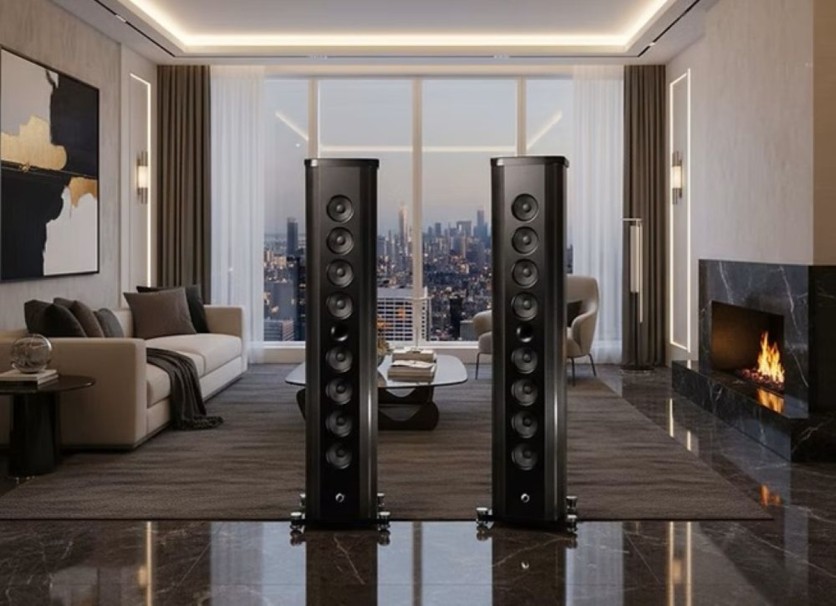
Grandinote’s Mach 8 Evoluzione speakers, priced at $128,000 per pair, sounded controlled and “remarkably easy to listen to” at Capital Audiofest 2026 in Rockville, Maryland, according to eCoustics reporter Ian White, who also said the demo playlist felt too curated for his taste. White heard the system in Room 837 on Friday, Nov. 13, the day the show opened, and published his report Saturday morning.
The speaker’s maker says it does without a conventional crossover, the filter network that divides music among drivers. That shifts the filtering job into the cabinet, the horn and the amplifier pairing, which helps explain why earlier show reports stress room and placement. One Friday demo in an average-sized hotel room says little about the speaker’s claimed deep bass or how it behaves in a larger space.
A crossover is circuitry that splits an audio signal into frequency bands so each driver handles the range it was built for. Grandinote’s manufacturer description on hifihub lists eight unfiltered, unequalized woofers and one horn compression tweeter in a cabinet measuring 190 by 43 by 44 cm (74.8 by 16.9 by 17.3 in), with a claimed response of 18 Hz to 20 kHz and 98 dB sensitivity into an 8-ohm load.
The cabinet is milled aluminum with 15 mm (0.6 in) carbon-fiber sides, and the manufacturer says it damps vibrations without absorbing material. Grandinote calls the enclosure design S.R.T., for Semi Resonant Tube. A reviewer at Enjoy the Music described the predecessor’s version as a hybrid of a transmission line and a bass-reflex port. A transmission-line enclosure routes the rear wave through a damped duct instead of sealing it in a box.
“No crossover” needs a caveat. Enjoy the Music’s review of the earlier Mach 8 XL found a single capacitor on its tweeter, which the reviewer did not treat as a formal crossover, and other sources describe the filtering in different terms. Mono and Stereo’s launch note says the drivers are cut above 7,000 Hz, and Stereophile’s show report describes a super tweeter handling harmonics above roughly 7 kHz. None of the sources cited here documents the Evoluzione’s tweeter wiring.
The stated reason is electrical: Enjoy the Music’s review notes that leaving crossover parts out can keep impedance higher and make the speaker easier to drive. Crossovers can only approximate ideal behavior, and the alternatives that skip them are complex to design. Removing the filter network does not remove the design problem. It relocates it.
Horn loading carries its own costs. Resonances can make response uneven, exponential horns narrow their beam as frequency rises, and audiophiles disagree about whether horn harmonics are a flaw or a charm.
Bass is the open question. Enjoy the Music’s reviewer found the Mach 8 XL’s bass solid into the high 20s Hz and questioned its 20 Hz rating. The Evoluzione’s claimed 18 Hz floor comes from the manufacturer, and the reviews cited here include no independent measurement of it. Enjoy the Music’s 2025 show report said the deepest bass takes careful room placement, and Positive Feedback wrote the speakers need a room matched to their size, even as it called the small-room sound surprisingly good.
White’s account fits that picture. He said the speakers did not overwhelm the room and showed no obvious strain, compression or shortage of headroom. That shows composed behavior in an average-sized room. It does not show how low the bass extends or how the speaker sounds in a hall.
Sensitivity explains the amplifier pairing. With 98 dB sensitivity measured at 1 W and 1 m, 60 W works out to about 115.8 dB at 1 m for one speaker, in idealized arithmetic that ignores room gain, stereo summing and clipping. Horn loading is a main reason for the high figure: horn speakers typically produce about 10 dB more output than a cone speaker fed the same power.
The amplifier in the demo was a Grandinote Solo, which White described as 60 W per channel, pure Class A, with no negative feedback and a 75 lb (34 kg) chassis. He wrote that its Magnetosolid topology is inspired by tube designs and output transformers. Class A keeps the output devices conducting through the whole signal, which caps theoretical efficiency at 25% (50% with transformer coupling) and draws steady power whatever the volume, so the heat is constant.
Skipping feedback is a choice with trade-offs. Negative feedback trades gain for linearity, and Wikipedia calls the idea that feedback is harmful in audio a persistent myth, while listing reduced distortion and steadier gain among its benefits. Grandinote founder Max Magri has said feedback will be prohibited as long as he leads the company.
The Solo cost $32,600 in White’s report, up $2,600 (8.7%) from the $30,000 Positive Feedback listed during the 2025 show. None of the sources cited here explains the difference.
White said the playlist leaned toward refinement, tonal balance and technical ability. He wanted unpredictable music with challenging production or complex rhythms, and said he will choose his own tracks next time. The sound was not entirely to his taste, he wrote, though he understood its appeal for buyers with a larger room and budget. A playlist built to show refinement offers little test of how the speaker handles complex or unpredictable music, which is the gap White said he wants to close with his own tracks.
High-end audio is subjective, and Wikipedia notes that measurements do not necessarily capture how equipment sounds to each listener. For a reader in a show room, the practical lesson is an inference rather than a sourced finding: ask the exhibitor to play a track you know, ask how large the room is and how the speakers are positioned, and ask which amplifier they are paired with.
The system included Kimber Kable KS6065 speaker cables, priced at $12,480 for a 2 m (6.6 ft) pair, with 16 copper and 8 silver conductors, plus a Palladian PK10 power cable at $2,336 for 3 m (9.8 ft). White describes the system as close to $180,000. The itemized prices he lists add up to $175,416, and the cabling is 8.4% of that sum.
Engineers dispute that such cables are audible. Wikipedia’s speaker-wire entry says resistance is the key property, credits industry experts, citing former McIntosh engineer Roger Russell and Jensen Transformers’ Bill Whitlock, with measurements and double-blind tests that disproved claims of better sound from costlier wire, and gives a rule of thumb of wire resistance under 5% of speaker impedance. For 8-ohm speakers, it says 16 AWG copper suffices for runs up to 48 ft. That entry covers speaker wire, not power cords.
Kimber’s side starts with the geometry. Founder Ray Kimber has said his braided designs grew out of work to cut interference from lighting equipment while wiring discotheques, and that the cable also unexpectedly improved the sound. Effortless HiFi, which calls itself Grandinote’s authorized US distributor, has shown the same trio of brands together at the Florida International Audio Expo earlier in 2026.
Capital Audiofest 2026 closes at 6 p.m. ET today, Saturday, and reopens Sunday, Nov. 15, at 10 a.m. ET, closing at 4 p.m. ET. The show runs at the Hilton Rockville, 1750 Rockville Pike. Seminars, tickets and other exhibitors are covered in the schedule article linked above.
Anyone weighing the Evoluzione from this report should note the trade: a horn-loaded system the maker describes as crossover-free, driven by Class A power, swaps conventional filter parts for dependence on room, placement and amplifier matching. The Room 837 impressions come from a single outlet, and the bass claims await independent measurement. Bring your own music if you go.
Yes, with trade-offs. Wikipedia says speakers that skip a crossover are complex to design, and their small drivers need considerable excursion for bass. Enjoy the Music’s review of the earlier Mach 8 XL found one tweeter capacitor, which the reviewer called a filter rather than a true crossover.
Its output devices conduct through the entire signal, so its power draw ignores volume, and the unused power becomes heat.
Wikipedia’s speaker-wire entry says resistance is what matters and reports double-blind tests that did not support claims of better sound from costlier wire. Founder Ray Kimber says his braided design reduced noise and improved sound.
It can show how the system behaves in that room, on that music, at that placement, with that amplifier. It cannot show bass extension in your room or how the speaker handles music the exhibitor did not choose, which is why White said he wants to test with his own collection.