October 8, 2026:


Google is putting its AI content checker in the hands of everyone, and the list of companies feeding it watermarked media keeps growing.
The expansion also points to a new partner that is lined up to join the effort.
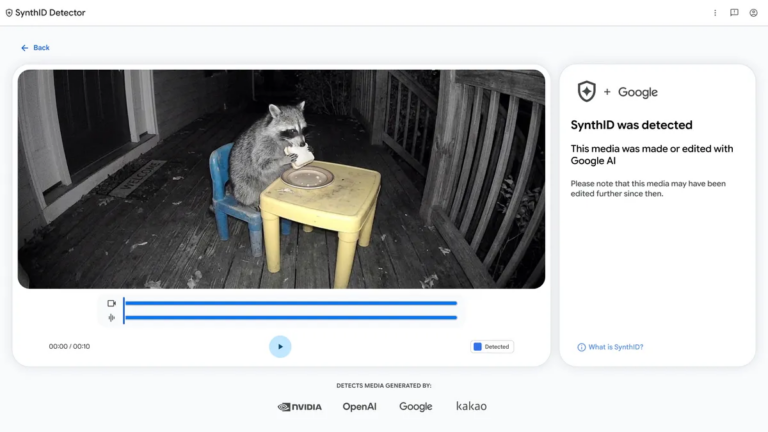
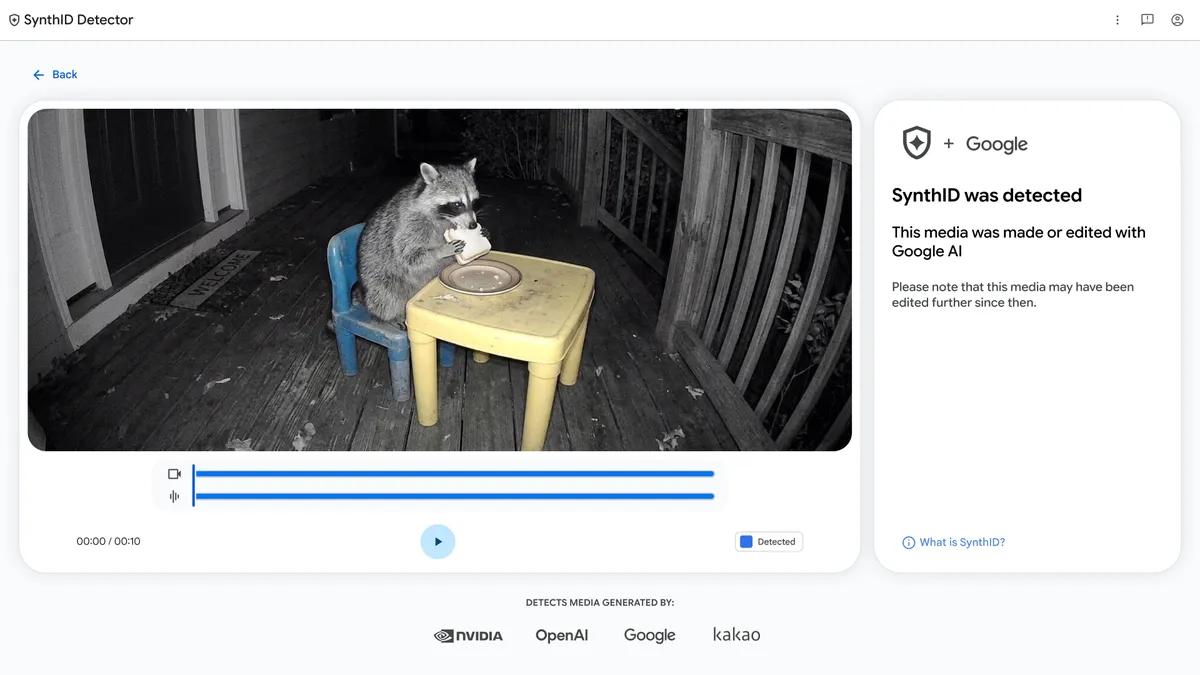
Google opened its SynthID Detector to the public, making the free web tool available worldwide in English at synthid.com. The tool checks images, video, and audio for SynthID, the invisible watermark Google adds to media made with its AI models. Until now, access was limited.
Google released an early version in May 2025 for journalists, media professionals, and researchers, and it later built similar checks into the Gemini app, Google Search, and Chrome.
The numbers show how large the effort has become. Google says it has watermarked more than 180 billion images and videos with SynthID since 2023, along with 240,000 years of audio. People are also using the checks heavily, with about one million verification requests coming in each day across Google’s products.
Google describes the release as part of an industry-wide effort to make AI-generated content more transparent. The tool now works with media from more than Google’s own models. OpenAI, NVIDIA, and Kakao apply SynthID to content from their AI tools, so the detector can flag material from those companies as well.
Using the site requires signing in with a Google, OpenAI, or Apple account. After a file is checked, the result is simple. The site reports either that a watermark was detected or that one was not.
The detector can read a wide range of files, but it is not a universal AI checker. It looks only for the SynthID watermark.
If an image came from a tool that does not use SynthID, the detector will not flag it, even when AI made the picture. A result of no watermark detected only means that SynthID was not found. It does not prove that a person created the file or that it has not been touched by generative artificial intelligence entirely.
In practice, a positive result is meaningful, while a negative result leaves the question open.
Google designed the watermark to hold up under normal handling. SynthID places a signal inside the media itself at the moment of creation, instead of attaching a label that can be stripped away. For images and video, the signal sits in the visual data. For audio, it is inaudible and built to survive changes like noise, MP3 compression, and speed changes. That approach helps the mark stay readable after a file is shared or edited, which is where simple labels often fail.
Reports on the launch also note a limit. The detector cannot separate media that AI created entirely from media that AI only edited. It confirms that a watermark is present, but it does not explain how much of the file came from a model.
Apple is the newest name on the list, though its support is not live yet. Google says images created and edited with Apple Intelligence will carry a SynthID watermark “soon.” The company did not give a release date for this yet, but as it has already mentioned the feature, Google would share it with the public.
Engadget reported that this would make the detector one of the first tools able to identify images from Apple’s AI features, such as Image Playground.
The official announcement named OpenAI, NVIDIA, and Kakao as current partners and listed Apple as a company joining later. Until Apple actually starts adding the watermark, the detector has nothing to read in those files.
Google also did not say whether the check will extend to video from Apple’s tools. That leaves a gap for now, even though the partner list is growing.
SynthID is Google DeepMind’s watermarking technology for AI generated content. It launched in 2023, starting with images, and has since expanded to text, audio, and video from Google’s Gemini, Imagen, Lyria, and Veo models. Instead of a visible stamp, SynthID embeds a signal that people cannot see or hear. By May, Google reported more than 100 billion images and videos watermarked, a figure that has since grown to more than 180 billion.
Google open sourced its text watermarking method in 2025 so other developers could use it. For text, SynthID adjusts the probability scores of word choices to form a pattern that does not affect the quality of the output. The public detector currently checks images, video, and audio rather than text.
Anyone can visit synthid.com in a web browser. The site is free and available worldwide, though it currently works in English. Users sign in with a Google, OpenAI, or Apple account, then upload an image, video, or audio file for scanning. The site returns a watermark detected or watermark not detected result.
Google also runs its own verification page, which checks images and audio for both SynthID and C2PA signals. SynthID checks also appear inside Google’s own products. Users can ask whether an image was made with AI through the Gemini app, Google Search tools like Lens and Circle to Search, and Gemini in Chrome. Google said the verification feature in Gemini had been used 50 million times as of May.
No, but it does not detect everything. The detector reads SynthID watermarks, and those now come from Google plus partners OpenAI, NVIDIA, and Kakao, with Apple expected next. OpenAI said its adoption would start with images created through ChatGPT, Codex, or the OpenAI API. ElevenLabs also committed in May to bringing SynthID to more of its generated content.
Content from any other generator, including models that never apply the watermark, will come back as not detected. Different companies rely on different watermarking standards, so there is no single checker that can identify all AI media.
Google also supports content credentials, a separate industry labeling standard. That system can add context, such as showing that a photo came from a Pixel camera before it was edited with AI tools.