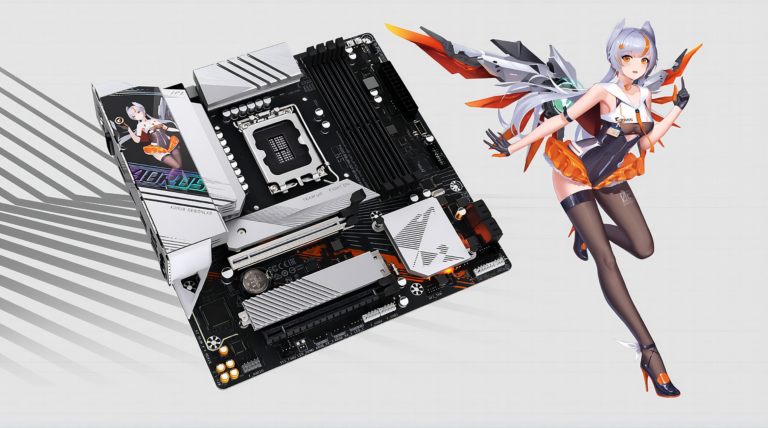
Gigabyte AORUS Ari Brings PCIe 5.0 to DDR4 Builders Fleeing $650 DDR5 Kits

October 1, 2026:

Gigabyte AORUS Ari Brings PCIe 5.0 to DDR4 Builders Fleeing $650 DDR5 Kits
B760M AORUS Ari WiFi6E DDR4
Gigabyte.com

The moment DDR5 memory became genuinely unaffordable for mainstream PC builders, Gigabyte answered with a board that sidesteps the problem entirely. The B760M AORUS Ari WiFi6E DDR4 — an anime-branded Micro-ATX board for Intel’s LGA1700 platform — is now listed on Gigabyte’s official website and carries a Japan launch price of ¥26,800 (approximately $172 USD). It offers a full-bandwidth PCIe 5.0 x16 slot for the GPU — the same interface found on premium DDR5 platforms — while running on DDR4 memory that a builder may already own. Full specifications appear on the Gigabyte B760M AORUS ARI WIFI6E DDR4 product page.

That combination, which would have seemed like a minor footnote eighteen months ago, lands in September 2026 as a genuinely useful option. A standard 32GB DDR5 kit that sold for around $95 to $250 in mid-2025 now routinely exceeds $550 to $650 if available at all, driven by AI infrastructure’s voracious appetite for High Bandwidth Memory eating into the wafer capacity that used to produce standard consumer DRAM, according to Fusion Worldwide’s analysis of why DDR5 prices nearly quadrupled in 2026. In Germany, tracked DDR5 retail prices reached nearly 486% of their July 2025 baseline by August 2026, according to TrendForce data on the German DDR5 price surge. DDR4 kits have also risen — a 32GB kit that sold for $60 to $90 in late 2025 now typically costs more than $150 — but the per-gigabyte gap between the two generations remains wide, as hwbusters.com’s price tracking shows DDR5 up 500% in twelve months.

The B760M AORUS Ari DDR4 is Gigabyte’s answer to that gap: a board that lets an LGA1700 builder access next-generation GPU bandwidth without paying for next-generation memory.

Why PCIe 5.0 Works on DDR4: The Architecture Nobody Explains

The reason this board can offer PCIe 5.0 while running DDR4 is not a workaround or a compromise — it is a feature of how Intel designed the LGA1700 platform. On 12th, 13th, and 14th generation Intel Core processors, the primary x16 PCIe lanes are provided directly by the CPU die, completely separately from the memory controller. The processor delivers 64 GB/s of bidirectional bandwidth to the GPU slot — double the 32 GB/s of PCIe 4.0 — regardless of whether the system is populated with DDR4 or DDR5. The B760 chipset itself contributes only the secondary slot (PCIe 4.0 at x4 electrical bandwidth) along with storage, USB, and peripheral connectivity. DDR4 versus DDR5 is a memory controller decision. PCIe generation is a CPU decision. They are orthogonal — and the B760M AORUS Ari DDR4 exploits that independence.

This means a builder with an existing DDR4 kit can install this board and run a GeForce RTX 5090 or AMD Radeon RX 9070 at the full interface speed the card’s architecture can consume, at an immediate saving of $150 to $480 compared to the cost of that board plus a new DDR5 kit purchased today. That arithmetic has shifted dramatically in this board’s favor over the past twelve months.

The PCIe 5.0 standard itself operates at 32 GT/s per lane, versus 16 GT/s for PCIe 4.0, using the same efficient 128b/130b encoding introduced in PCIe 3.0 (adding just 1.5% overhead). Whether any current GPU actually saturates PCIe 4.0 x16 is a live debate in the enthusiast community — most gaming benchmarks show a sub-one-percent performance difference between the two — but PCIe 5.0 provides headroom for GPU architectures and AI workloads that are increasingly bandwidth-hungry.

Specs at a Glance

Built around the Intel B760 Express chipset in a Micro-ATX (244 mm × 244 mm / 9.6 in × 9.6 in) form factor, the B760M AORUS Ari WiFi6E DDR4 accepts 12th, 13th, and 14th generation Intel Core, Pentium Gold, and Celeron processors via the LGA1700 socket. Four DDR4 DIMM slots support up to 128 GB of system memory in dual-channel configuration, with XMP overclocking profiles up to DDR4-5333 — a ceiling that sits well above what most DDR4 kits ship with and requires the highest-binned DDR4 to reach. Full specifications are listed on the Gigabyte B760M AORUS ARI WIFI6E DDR4 product page.

The VRM is a 12+1+1 hybrid design using a 6+6 parallel phase arrangement — meaning each of the twelve CPU power phases is paired with a twin, sharing a PWM signal to double the effective switching frequency without multiplying controller complexity. Each phase uses a 60A DrMOS integrated power stage. Twelve phases at that rating puts theoretical peak current delivery well above what any current LGA1700 CPU can draw, including a Core i9-14900K running at 253W. A VRM Thermal Armor Advanced heatsink with a 5 W/mK thermal pad pulls heat away from those stages, backed by a 6-layer, 2X copper PCB that Gigabyte specifies as contributing to component temperature reduction compared to standard 4-layer boards.

Storage: two M.2 PCIe 4.0 x4 slots with M.2 EZ-Latch Plus (tool-free retention), plus four SATA 6Gb/s ports with RAID 0/1/5/10 support. Connectivity: Realtek 2.5 GbE LAN and Intel Wi-Fi 6E AX210 (802.11ax, 2.4/5/6 GHz, 160 MHz channels, Bluetooth 5.3), with Gigabyte’s WIFI EZ-Plug antenna installation system. The rear panel USB loadout runs: one USB-C at 20 Gb/s (USB 3.2 Gen 2×2), one USB-A at 10 Gb/s (USB 3.2 Gen 2), and three USB-A Gen 1 ports; the front panel header adds another USB-C at 10 Gb/s internally. Audio is handled by a Realtek ALC1220 codec with 2/4/5.1/7.1-channel support and optical S/PDIF output.

Display output for integrated graphics arrives via HDMI 2.1 (up to 4096×2160 at 60 Hz) and DisplayPort 1.2. Lighting: three addressable RGB Gen2 headers and one standard RGB header for fans and strips, controlled via Gigabyte’s RGB Fusion 2.0 software. Builder-friendly features include PCIe EZ-Latch for tool-free GPU removal, Q-Flash Plus for BIOS updates without an installed CPU or RAM, and a dedicated reset button alongside the Q-Flash Plus button.

Ari, the Tech Guardian Angel: Anime Meets Mainstream Hardware

The board’s identity within Gigabyte’s lineup flows from “Ari,” an original anime character the company created and designated as the AORUS brand’s “Tech Guardian Angel.” The name ACG — anime, comics, games — describes the cultural territory Gigabyte is deliberately entering, and it is a territory that is moving upmarket fast. Gigabyte’s May 2026 press release announcing the B850 AORUS ELITE-P ICE confirmed the Ari lineup’s expansion.

The B760M Ari DDR4 is the fourth or fifth confirmed Ari-branded product in twelve months. The AORUS GeForce RTX 5060 ARI 8G GPU arrived earlier this year. The B850M AORUS Ari mATX (AMD AM5 platform) followed. The full-ATX B850 AORUS ELITE-P ICE debuted at Computex 2026 in May, where Gigabyte cited “growing demand from anime enthusiasts and the PC DIY community worldwide” as its explicit rationale for the expansion. That same show saw ASUS counter with its ROG STRIX B850-A GAMING WIFI7 S NEO “Fubuki” series — featuring its own original anime princess character on the I/O shield — signaling that both companies view the ACG hardware buyer as a real and growing demographic rather than a niche curiosity, as hardware coverage from en.kocpc.com.tw detailed the Computex 2026 head-to-head.

On the B760M Ari DDR4, the character artwork appears on the chipset heatsink, and cat-paw motif PCB accents run through the board. The overall color palette is consistent with Gigabyte’s Ari design language across other products. An exclusive ARI doll blind box accessory shipped with the B850 ATX model at Computex; whether that accessory extends to this Intel DDR4 variant has not been confirmed.

DDR4 Is Still Here: And Getting More Crowded

DDR4 has not escaped the global memory shortage unscathed. Production capacity that used to go toward standard DDR4 DRAM has been reallocated alongside DDR5, as Samsung, SK Hynix, and Micron collectively steer wafer starts toward High Bandwidth Memory and server DRAM, where AI infrastructure buyers pay margins that consumer memory cannot approach. HBM’s share of global DRAM wafer production is now estimated at approximately 23% — up from roughly 8% in 2024 — and analysts at Fusion Worldwide note that one HBM wafer consumes the manufacturing equivalent of three to four standard DRAM wafers. That reallocation affects both standards.

But DDR4 remains the lower-cost option on a per-gigabyte basis for any builder who already owns a kit — which describes a very large fraction of the installed LGA1700 base. Intel’s 12th, 13th, and 14th generation platforms shipped tens of millions of units across a four-year window, many of them on DDR4 variants of mainstream boards. Apacer’s chief executive has publicly stated he expects severe shortage conditions to persist into at least mid-2027, according to hwbusters.com’s analysis of the DDR5 memory price surge. For that installed base, any upgrade that does not require replacing memory has a pricing argument that gets stronger the longer the shortage runs.

Is DDR4 Plus PCIe 5.0 a Realistic Competitive Option?

The B760M AORUS Ari WiFi6E DDR4 does not invent the DDR4 + PCIe 5.0 category — it is not the first LGA1700 DDR4 board with a PCIe 5.0 slot, and Gigabyte itself has released non-anime-branded versions in this configuration. What it does is package that capability in a mid-range mATX form factor with a full Wi-Fi 6E and 2.5 GbE networking stack, a 12+1+1 VRM that can handle 14th gen flagship CPUs, and the Ari aesthetic — at a Japan launch price of ¥26,800 (approximately $172 USD).

For reference, the non-Ari B760M AORUS ELITE DDR4 GEN5 — a similar DDR4 board with a PCIe 5.0 primary slot but without the Ari branding — is available in Japan at approximately ¥17,800 (approximately $114 USD). The Ari branding and associated design work accounts for most of the price difference. Whether that premium is justified depends entirely on how a builder weights future-proofing for GPU bandwidth against the likelihood of remaining on this platform long enough for PCIe 5.0 to matter in practice.

The board is currently confirmed for the Japanese market. Broader regional availability and international pricing have not been announced.


Frequently Asked Questions

Does having a PCIe 5.0 slot actually improve gaming performance if the GPU itself is PCIe 4.0 compatible?

For most current GPUs, no — benchmarks consistently show less than one percent performance difference between PCIe 4.0 x16 and PCIe 5.0 x16 for 3D graphics workloads. The B760M AORUS Ari DDR4’s PCIe 5.0 slot is primarily a future-proofing measure for GPUs and AI accelerators that will increasingly use the higher bandwidth as framebuffers and compute workloads grow. The slot also supports PCIe 5.0 NVMe SSDs if the card installed in it is not a GPU.

Why do DDR5 prices keep rising while DDR5 is supposed to be the newer, more available standard?

The counterintuitive answer is AI hardware. Samsung, SK Hynix, and Micron have shifted an estimated 23% of global DRAM wafer production toward High Bandwidth Memory — the memory format used in AI accelerators like NVIDIA’s H100 and B200 series — up from roughly 8% in 2024, according to Fusion Worldwide’s analysis of the HBM wafer allocation shift. Because one HBM wafer consumes the equivalent production capacity of three to four standard DDR5 wafers, the supply left over for consumer DDR5 has shrunk sharply while demand has not. The shortage is expected to persist through at least mid-2027, according to hwbusters.com’s coverage of the Apacer CEO’s forecast.

What does the AORUS Ari character actually look like, and is this a licensed anime property or an original creation?

Ari is an entirely original character created by Gigabyte’s AORUS brand team — not a licensed anime property. The company positions her as the “Tech Guardian Angel” of AORUS, an ACG (anime/comics/games) character intended to embody the brand’s design identity. Artwork appears on the chipset heatsink, and cat-paw motifs run through the PCB. The B850 ATX version at Computex 2026 shipped with an Ari blind box figurine as a bundled accessory; whether that accessory extends to this Intel DDR4 variant has not been confirmed by Gigabyte. More information on the Gigabyte B850 AORUS ARI lineup appears in Gigabyte’s May 2026 press release.

What is the practical savings of using existing DDR4 memory instead of buying DDR5 right now?

At current retail prices, a 32GB DDR4 kit costs roughly $150 to $200. The equivalent 32GB DDR5 kit starts at approximately $350 and can exceed $650 for higher-frequency configurations, according to Tom’s Hardware’s RAM price index and hwbusters.com’s DDR5 price analysis. A builder who already owns a 32GB DDR4 kit saves the full cost of the DDR5 kit — between $150 and more than $450 depending on capacity and speed — making the $172 board considerably more attractive relative to a DDR5 alternative that requires both a new board and new memory.

Source link