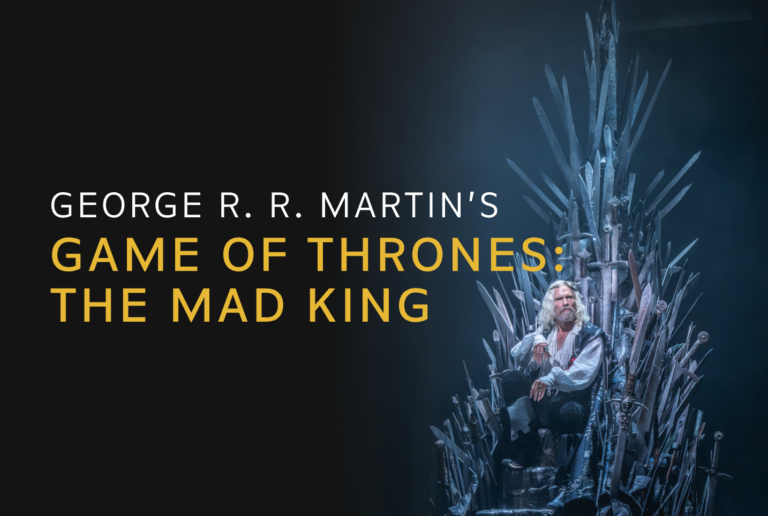
HomeAuto Game of Thrones: The Mad King Heads to London; RSC Puppetry Solved Problem Shakespeare Couldn’t
Game of Thrones: The Mad King Heads to London; RSC Puppetry Solved Problem Shakespeare Couldn’t
September 6, 2026:
Gameofthronesonstage.com
The play that George R. R. Martin spent five years bringing to the Royal Shakespeare Company concluded its completely sold-out Stratford-upon-Avon run on September 5, 2026 — and within hours, Martin and the RSC confirmed the London 2027 transfer. “I had an absolutely splendid time in Stratford-upon-Avon for the premiere and am thrilled the production will be moving to London to share the experience with a wider audience,” Martin said in a statement. “It promises to be an exhilarating journey.”
The announcement is the obvious footnote to what is not an obvious theatrical event. Game of Thrones: The Mad King — written by Duncan Macmillan (Every Brilliant Thing, his 1984 adaptation) and directed by Dominic Cooke — earned the kind of notices most productions never see: a full five stars from Sarah Crompton at WhatsOnStage, who called it a “soaring, surging spectacle” in her five-star critics round-up; four stars apiece from The Telegraph, The Stage, and The Independent. But the reviews that mattered most for a technically literate audience were the ones struggling to describe what Nick Barnes and Finn Caldwell of Lume had done with the puppetry. “War Horse puppetry scales new heights of subtlety and daring here,” wrote The Spectator in its triumphant adaptation review. That sentence is technically accurate and almost entirely inadequate.
What Barnes and Caldwell actually solved — and what makes this production worth examining for anyone who cares about how complex physical systems work in the world — is a problem that has resisted theatrical engineering since Shakespeare explicitly threw up his hands and asked audiences to imagine the horses themselves.
Stagecraft’s 360-Degree Problem: What Made This Different
The production plays in a cross-shaped colosseum configuration: the Royal Shakespeare Theatre’s auditorium divided into four sections, with the action taking place in the center, surrounded on all sides simultaneously. As the RSC colosseum stage configuration made clear to critics, this is not a thrust stage, where the audience wraps around one end. It is a full 360-degree enclosure, with spectators positioned to see every angle of every performer and every puppet from every direction at once.
Conventional large-scale theatrical puppetry — as developed by Handspring Puppet Company for the original War Horse at the National Theatre in 2007 — was designed for proscenium or thrust-stage sightlines. Joey, the production’s horse puppet operated by three puppeteers across multiple moving joints, was engineered to be read primarily from the front. The three puppeteers (designated Head, Heart, and Hind) could dress in black and position themselves within the visual grammar of a scene precisely because no audience member was positioned directly behind them throughout a performance.
On the RSC’s colosseum stage for The Mad King, that option does not exist. Every operator is visible from some angle at all times. There is no hidden wing, no privileged viewing direction, no position where a black-clad puppeteer can be coded as scenically absent.
The solution Barnes and Caldwell developed — the technical details of which have not been fully published, but which reviewers describe in behavioral terms — is what practitioners call open operation: accepting operator visibility as a design choice rather than a technical limitation, then choreographing operator movement so that human bodies become part of the visual grammar of the scene. Matt Barton of The Stage described the result in The Stage’s four-star review as “fighters taking charge of magnified puppet selves, which looks incredible and ingeniously reflects how these characters are themselves puppeteered within the political power struggle.” The puppeteers are not hidden — they are visible as a structural layer of the production’s meaning.
This is an inheritance from the Bunraku Japanese puppet theater tradition, founded in 17th-century Osaka and recognized by UNESCO as Intangible Cultural Heritage in 2003. In Bunraku, each puppet is operated by three puppeteers — primary operator controlling the right hand and head, second controlling the left hand via rod, third controlling legs and feet — who wear black robes and are formally present on stage throughout the performance. They are, by theatrical convention, invisible: audiences learn to code their presence as background in the same way film viewers learn to ignore boom mics. The RSC production does not use the Bunraku convention directly — it adapts it, making the operators characters in the political landscape rather than absent mechanisms.
The engineering implication that goes unstated in most reviews is this: the challenge Barnes and Caldwell solved is formally identical to a class of problems in collaborative robotics design, where a large, multi-operator physical mechanism must be legible, interpretable, and non-threatening to human observers surrounding it on all axes simultaneously. How a mechanism communicates its intentions through 360 degrees — how it signals what it is about to do without a privileged forward-facing direction — is an unsolved design challenge in co-working robotic systems. Theatre did not solve that problem deliberately. But The Mad King‘s stage constraints forced a solution that may have implications beyond the RSC’s season.
Wildfire’s Chemistry: What Actually Burns on Water
The most visually dominant technological element in the production is the one Martin adapted from Byzantine military history. Wildfire — the Alchemists’ Guild’s closely guarded incendiary weapon, which burns with an emerald-green flame hot enough to melt stone, continues burning on water, and detonates explosively when overheated — was explicitly inspired by Greek fire, the Byzantine Empire’s state-secret incendiary deployed from approximately 678 CE onward, as documented in World History Encyclopedia’s Greek fire entry.
Greek fire was invented or refined by Kallinikos, a refugee from Muslim-held Syria who brought the formula to Constantinople around 668 CE. The Byzantine Empire deployed it through pressurized bronze siphons — essentially flamethrowers mounted on warships — and as hand-thrown ceramic grenades. Its defining tactical property was that it burned vigorously on water, making it decisive in naval engagements. Emperor Romanos II (reigned 959–963) ranked the formula alongside the imperial regalia and royal princesses as the three things that must never fall into foreign hands. According to the Greek fire Wikipedia article, historians believe the formula likely incorporated naphtha, quicklime, sulfur, resin, and possibly potassium nitrate, but the precise combination — and what enabled the water-burning — remains unknown.
The political economy of Greek fire maps almost perfectly onto wildfire’s lore: a state monopoly on incendiary technology as a tool of deterrence, institutional control, and concentrated power. The Alchemists’ Guild in Westeros is the direct narrative parallel to the Byzantine imperial laboratory — knowledge as weaponized secret, guarded by a closed institutional hierarchy with interests aligned with whichever king currently sits the Iron Throne.
Wildfire’s specific properties — burning on water, melting stone, vivid green flames, extreme sensitivity to heat and impact — do not all map onto any single real chemical compound, but they are individually coherent when examined against the periodic table. The green-flame property is straightforward chemistry: as confirmed by trimethyl borate’s combustion properties, boron compounds (trimethyl borate, boric acid esters) emit characteristic green flames when combusted, a property exploited in fireworks and signal fires. The water-burning property is the most scientifically interesting: fluorine-based oxidizers can sustain combustion without atmospheric oxygen — technically enabling burning in aqueous environments — though at engineering costs that make stable storage essentially impossible with current materials.
The stone-melting property is achievable in principle: thermite reactions (iron oxide combined with aluminum powder) reach approximately 2,500°C (4,532°F) — as documented by McGill University’s chemistry explainer — sufficient to melt most structural materials, though thermite is not liquid and cannot be deployed as a poured or sprayed incendiary in the way wildfire is depicted. A composite system — fluorine oxidizer for water-burning, thermite for heat range, boron salts for color signature, peroxide or azide linkages for ambient instability — would theoretically approach several wildfire properties simultaneously, at catastrophic and uncontrollable engineering risk. The Alchemists’ Guild’s habit of losing control of their own product is, in this reading, technically accurate.
Rhaegar’s Error and the Oedipus Effect
The philosophical engine driving The Mad King‘s plot is a problem Karl Popper named in The Poverty of Historicism (1957): the Oedipus Effect Karl Popper named, his term for the phenomenon by which a prediction influences the events it predicts — either promoting or preventing them. Popper named it after the myth in which Laius’s attempt to prevent the oracle’s prophecy from coming true is precisely what enables it. “The effect of a prediction upon the events or objects to which the prediction refers,” Popper wrote, “I have called the Oedipus effect.”
Rhaegar Targaryen’s behavior in The Mad King is a textbook demonstration. Believing himself to be the Prince That Was Promised of prophecy — the figure destined to forestall an apocalyptic “Long Night” — Rhaegar acts on that belief with the certainty of a man who has confused a stochastic signal for a deterministic instruction. His abduction of Lyanna Stark (or, in the play’s sympathetic framing, their voluntary elopement) triggers Robert Baratheon’s Rebellion, which destroys everything Rhaegar sought to protect: his house, his father’s reign, and any chance of the political stability the prophecy was meant to preserve. He collapsed the wave function prematurely, selecting one interpretation of the oracle’s polysemous language and acting on it as fact.
The play raises the counter-position through the Heart Tree: “For what are we if not the choices we make?” — an assertion of agency against determinism, and specifically a refusal to grant Rhaegar’s prophetic certainty its claimed validity. The ASOIAF worldbuilding is consistent on this point: prophecies in Martin’s universe are systematically unreliable not because they are false but because they are interpretively open, capable of multiple retroactive vindications. This is the formal structure of oracle speech from Delphi onward — not falsifiable prediction but interpretive affordance.
Aerys II and the Psychology of Absolute Power
The play’s central performance is Michael Shaeffer’s King Aerys II — described by Dominic Cavendish in The Telegraph as having “the distracted air of Lear on the heath but the villainy of Richard III, cackling as he taunts his son.” The production depicts his deterioration as progressive: erratic but functional at the Tourney at Harrenhal, a paranoid monster by the rebellion’s end, enthroned before a glowing pit of wildfire contemplating the incineration of his own capital.
This trajectory corresponds closely to what Cornell University psychiatrist Robert B. Millman described as acquired situational narcissism (ASN): narcissistic symptoms that develop in adulthood in response to extreme power, fame, or wealth, rather than in childhood. In a 2002 NPR interview on acquired situational narcissism, Millman described how, in closed systems where all feedback is positive — where sycophants, enforced deference, and absolute life-and-death authority eliminate corrective information from the environment — an individual’s capacity to model other people’s perspectives deteriorates. In his formulation, the powerful figure gets so used to everyone looking at him that he stops looking back at other people. The surrounding environment does not merely reveal a pre-existing pathology; it actively constructs one.
Political psychologist Betty Glad’s 2002 paper “Why Tyrants Go Too Far: Malignant Narcissism and Absolute Power,” published in Political Psychology, documents this pattern across documented historical cases including Stalin and Ceaușescu — leaders whose paranoid ideation intensified precisely as their power became more absolute and their inner circles more compliant. Aerys II’s trajectory follows the same arc: as the sources of genuine challenge to his authority diminish, his perception of threat expands to fill the space.
The Targaryen worldbuilding adds a genetic dimension that the play takes seriously: the saying “every time a Targaryen is born, the gods flip a coin” encodes a heritable instability that links the capacity for “dragon dreams” (enhanced pattern recognition and prophetic cognition) to susceptibility to psychotic-spectrum conditions. Several human cognitive traits show genuine genetic correlations with both elevated pattern recognition and elevated psychosis risk — the same neural pathway, as the worldbuilding imagines it, destabilized differently depending on circumstance. The play does not resolve whether Aerys is a victim of his neurology or a perpetrator of monstrous violence. It holds both simultaneously, which is more honest than either verdict alone.
Putting Battles on Stage: From Shakespeare’s Chorus to Lume
“For me, the RSC was the obvious choice,” Martin said in the RSC official production announcement, “because Shakespeare faced similar challenges in how to put a battle on stage.” The RSC’s Co-Artistic Directors Daniel Evans and Tamara Harvey described the play as standing “in a continuum with Shakespeare’s history cycles.” The precise nature of that continuum is worth examining.
Shakespeare’s solution in Henry V was rhetorical displacement — the Chorus explicitly asks the audience to “piece out our imperfections with your thoughts” and “think, when we talk of horses, that you see them.” The imagination is recruited as a co-author of spectacle. The cognitive work of world-building is distributed outward to the audience, who supply what the stage cannot.
The Mad King‘s solution inverts this. Rather than describing what cannot be shown, it engineers a material answer: a 35-person ensemble, Chloe Lamford’s cross-shaped stage carpeted in ash, and Lume’s puppetry that makes the impossible visually real. The Arts Desk wrote that “never has disbelief been easier to suspend, as monumental sculptures come to life, dazzlingly animated by teams of actors, to fly and fight, to trot and terrify.” The cognitive scaffold has moved from linguistic to perceptual — from Shakespearean text to RSC engineering.
This shift maps onto what philosophers of mind call extended cognition: the question of where the cognitive labor of constructing an imaginative experience is distributed between performer, text, and audience. Shakespeare and Duncan Macmillan are solving the same problem. They are choosing different locations for the work.
What the London Transfer Means for Audiences
George R. R. Martin and the RSC announced the London 2027 transfer on September 4-5, 2026, coinciding with the final performances at Stratford-upon-Avon. The venue has not been announced, though the RSC’s primary London home is the Barbican. Specific dates and London casting are pending. Fans can register for priority ticket access at the official production website.
The Stratford-upon-Avon run was completely sold out from opening on August 8, 2026, through its September 5 close. The RSC reconfigured the Royal Shakespeare Theatre — capacity approximately 1,018 seats — for the colosseum configuration, which may have reduced that number. The preview period was disrupted when the first previews canceled July 2026 (scheduled July 20-24) were canceled at short notice; the RSC added a matinee on August 1 and released additional seats throughout the run.
The play is set roughly 15-17 years before the events of A Game of Thrones, centering on the Tourney at Harrenhal in 281 AC — the Year of the False Spring — and the chain of events leading to Robert’s Rebellion. It features younger versions of Ned Stark (Michael Abubakar), Jaime Lannister (Maxim Ays), Robert Baratheon (Callum Woodhouse), Rhaegar Targaryen, and Lyanna Stark, alongside Shaeffer’s Aerys II. It runs approximately four hours.
The story premise bears stating plainly for those unfamiliar with the lore: at a glittering tournament that brings all the great houses of Westeros together for the first time in years, a young prince obsessed with a prophecy decides the woman he loves is destined to be the mother of humanity’s savior — and acts on that decision in ways that will end his dynasty and set fire to the world. The emotional register is genuinely Shakespearean tragedy rather than epic adventure: a man who is not wrong about the threat he fears, but catastrophically wrong about how to prevent it.
Frequently Asked Questions
When will Game of Thrones: The Mad King open in London, and how can I get tickets?
The London 2027 transfer has been officially confirmed by George R. R. Martin and the RSC. A specific venue, performance dates, and London casting had not yet been announced as of September 6, 2026. Fans can register for priority ticket notifications at the official production website. The RSC’s primary London venue is the Barbican, though this has not been officially confirmed as the location.
What is wildfire in Game of Thrones, and does any real-world substance work the same way?
Wildfire is a fictional incendiary produced by Westeros’s Alchemists’ Guild, burning green, burning on water, and hot enough to melt stone — properties Martin has confirmed were directly inspired by Greek fire, the Byzantine Empire’s closely guarded incendiary weapon deployed from 678 CE onward. No single real compound replicates all wildfire’s properties simultaneously, but each is individually chemically coherent: boron compounds produce green flames, fluorine oxidizers can sustain combustion without atmospheric oxygen, and thermite reactions reach temperatures sufficient to melt structural materials. The political economy of wildfire — a state monopoly on incendiary technology as an instrument of power — maps almost exactly onto the documented history of Greek fire, which Byzantine emperors guarded as jealously as their throne.
How does the puppetry in The Mad King differ from earlier productions like War Horse?
War Horse (National Theatre, 2007) designed its large-scale horse puppets for proscenium and thrust-stage sightlines, where the audience primarily faces one direction and puppeteers can position themselves advantageously relative to that viewing angle. The Mad King plays on a 360-degree colosseum stage where every operator is visible from all sides simultaneously — a constraint that makes conventional positioning impossible. Puppetry directors Nick Barnes and Finn Caldwell of Lume developed an “open operation” approach inspired by the Bunraku tradition of Japanese puppet theater, in which puppeteer visibility is accepted as a design element rather than a limitation to be concealed. Critics described the result as making the puppeteers themselves visible participants in the production’s political metaphor — characters who operate characters within a power structure that operates them in turn.
What is the Oedipus Effect, and why does it explain Rhaegar Targaryen’s tragedy?
Philosopher Karl Popper named the Oedipus Effect in The Poverty of Historicism (1957) to describe predictions that influence the events they predict. In the original myth, Laius’s attempt to prevent the oracle from coming true is precisely what enables it. Rhaegar’s tragedy in The Mad King follows the same structure: his certainty that he is the Prince That Was Promised leads him to take actions that destroy everything the prophecy was meant to protect. His error is not that the prophecy was false — in Martin’s universe, prophecies are neither true nor false but interpretively open — but that he treated a stochastic, polysemous signal as a deterministic instruction and acted accordingly. He collapsed the future to a single reading and found that reading was wrong.