October 28, 2026:


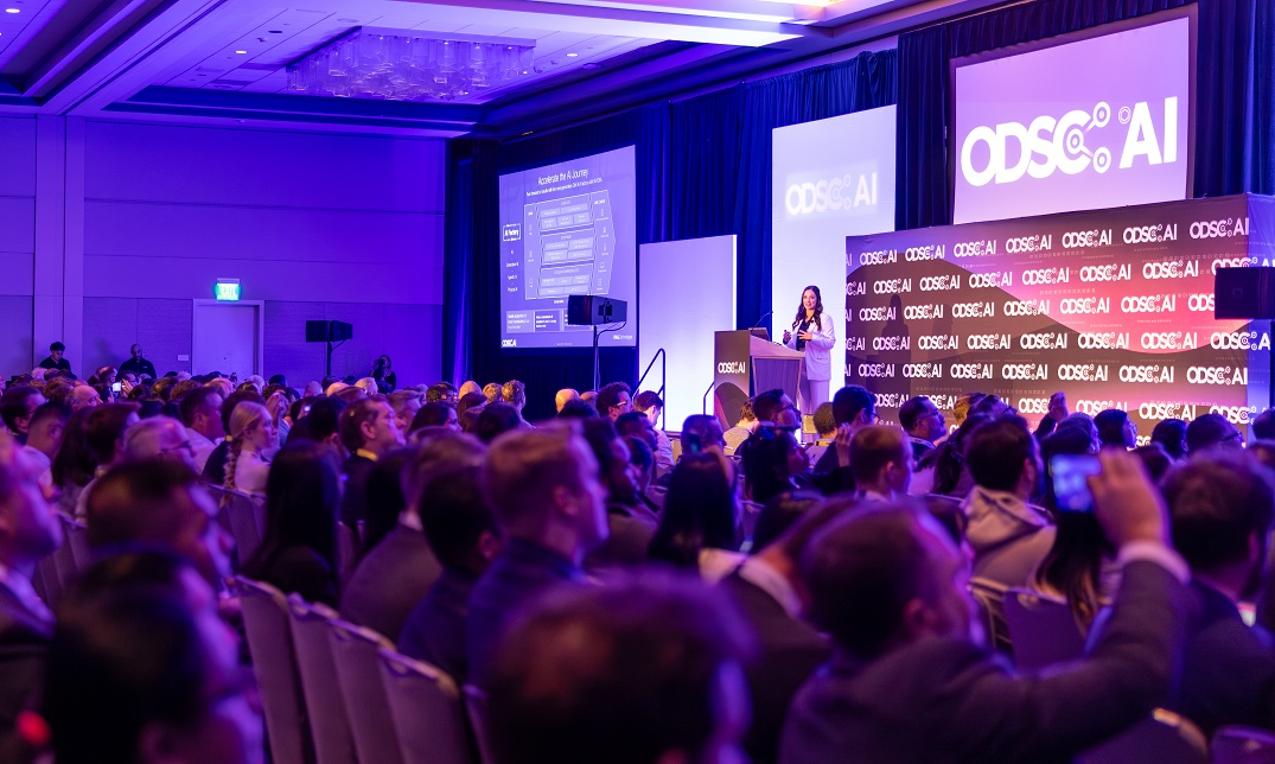
ODSC AI West 2026 is in full session on its second of three days at the Hyatt Regency San Francisco Airport in Burlingame, California — and the conference’s morning keynote block, which organizers introduced this edition to front-load the highest-signal talks, makes clear that this is the 11th installment of an event that has become less interested in AI’s promise and more focused on the scar tissue that comes from shipping it. Where previous editions tracked the emergence of machine learning as a production discipline, this year’s agenda reads like a live diagnostic of what’s breaking for the teams that moved fastest.
The second full day of programming, Wednesday, October 28, opened with a dedicated morning keynote block — a structural change ODSC made this edition to anchor its highest-profile talks at the day’s start rather than scatter them across the schedule. Running in parallel, the co-located AI X Leadership Summit designated Wednesday its “AI for Work” day, drawing finance directors, product vice presidents, and operations executives into sessions covering workforce redesign, return-on-investment accountability, and the real cost of sustaining an agentic AI program at enterprise scale.
Among Wednesday’s most closely watched sessions is a keynote from Chip Huyen, author of the practitioner reference AI Engineering and a widely cited voice on the operational realities of running foundation models at scale. Her talk — “Don’t Let Your Agents Become Autonomous Insiders” — addresses a risk pattern that is becoming harder to ignore as agent deployments grow: systems that accumulate access and operational influence well beyond their original design scope, without the oversight mechanisms needed to catch the drift before it causes damage.
The nine technical tracks at ODSC AI West 2026 function less as an academic taxonomy and more as a real-time map of where applied AI teams are hitting walls. The Agentic AI & Autonomous Systems track covers the full stack of production agent work — harness engineering, multi-agent orchestration, trajectory scoring, and agent memory management — for practitioners who have already passed “should we build this agent?” and are now deep in “how do we keep it reliable at scale?”
The AI Engineering, Evals & AIOps track is arguably the most tactically concentrated, covering context engineering, observability, red-teaming, runtime controls, and the tradeoffs between cost, latency, and reliability. It is explicitly aimed at engineers responsible for keeping AI products in production and measurably performing — not researchers scoping the next prototype.
Two newer tracks point to the domains drawing the most engineering investment heading into 2027. The Physical AI & Robotics track — new this edition — features sessions on robot foundation models, vision-language-action systems, edge inference, and the specific challenge of building reliable data pipelines from interactions with the physical world. The Graph Enhanced AI track takes aim at one of the most persistent complaints about large language models in production: hallucination and factual brittleness. Sessions explore GraphRAG architectures, hybrid vector-graph retrieval stacks, and how structured knowledge graphs can introduce accountability into LLM outputs at enterprise grade.
The remaining tracks round out a program that is intentionally practitioner-first. Data Science & Machine Learning, Data & AI Infrastructure, Personal AI & Workflow Automation, and AI for Software Developers — the last of which drills into coding agents, repository-wide context retrieval, and the emerging practice of AI-assisted CI/CD pipelines — collectively ensure that the agenda serves teams regardless of where they sit in the AI deployment stack.
The seven main-stage keynote speakers at ODSC AI West 2026 were selected to pair long-horizon research credibility with hands-on deployment experience — a combination that is harder to find on a single stage than it might appear.
Peter Norvig — co-author of the field’s foundational textbook, Artificial Intelligence: A Modern Approach, and now associated with Recursive Superintelligence, a self-improving AI startup with offices in London and San Francisco that emerged from stealth in May 2026 with $650 million in funding at a $4.65 billion valuation — represents the research end of the keynote stage. Michael I. Jordan, Pehong Chen Distinguished Professor Emeritus at UC Berkeley and a Director of Research at Inria in Paris, brings one of machine learning’s most influential statistical perspectives to a stage otherwise dominated by application-layer concerns.
Thomas Dohmke, who stepped down from GitHub at the end of 2025 after guiding the platform through its Copilot era, launched Entire in February 2026 with a $60 million seed round — a figure that Felicis, the round’s lead investor, called the largest opening check ever written to a developer tooling startup. Entire builds infrastructure for environments where human engineers and AI coding agents are generating changes in parallel. Deepak Pathak, co-founder and CEO of Skild AI and an associate professor of robotics at Carnegie Mellon University, leads the physical AI keynote agenda. Skild, which raised $1.4 billion in January 2026 at a valuation above $14 billion, is building a single foundation model designed to run across robot types and task categories.
Marius Hobbhahn, CEO and co-founder of Apollo Research, brings a safety-first lens to frontier model behavior, drawing on Apollo’s work evaluating scheming and deceptive alignment in advanced AI systems. Nouha Dziri, Senior Research Scientist at Cohere Labs, addresses the gap between how language models perform in research settings and how they hold up against the compositional reasoning demands of real deployment. And Chip Huyen — whose keynote on autonomous insider risk is drawing particular attention from teams scaling agentic deployments — rounds out a stage that covers the discipline from foundational theory to the newest class of production vulnerabilities.
The AI Solutions Expo runs alongside the main conference program on October 27 and 28, with exhibitor floor access opening at 10:30 a.m. A dedicated Startup Showcase gives early-stage companies direct access to the practitioner audience most likely to evaluate, pilot, or invest in what they are building. According to ODSC’s own figures, the organization hosted nearly 20,000 attendees across all of its events last year, with the West edition drawing the highest concentration of Bay Area practitioners.
The three-day program runs through Thursday, October 29, closing with a final keynote block and additional hands-on training sessions before the conference wraps. Registered virtual pass holders will have on-demand access to select session recordings through ODSC’s AI+ Training platform once the in-person event concludes.