September 20, 2026:


Horror games have spent thirty years figuring out how to make players feel genuinely vulnerable. Fire and Ashes, the debut title from Armenian indie studio ASDstudio, is wagering that the answer has been sitting next to most players’ computers the whole time: the microphone. The game’s PlayStation Store listing confirms publisher Axyos Games Entertainment LLC and a 2026 release window.
The game, published by Axyos Games Entertainment LLC and confirmed for release on October 14, 2026, uses real-time voice recognition not as a gimmick bolted onto conventional horror mechanics but as the structural center of how survival works. Every breath, whisper, shout, and spoken command the player makes goes directly into the game’s enemy AI system. Hold perfectly still and stay quiet — you remain invisible. Panic, gasp, or let the tension crack your silence — something in the asylum will hear it.
What separates Fire and Ashes from a decade of similar-sounding experiments is a design inversion that prior horror games never quite executed: your voice is not only a liability. It is a weapon.
The idea of microphone-reactive horror is older than most players realize. Alien: Isolation (2014) famously tracked players’ real-world sound through the Microsoft Kinect sensor and PlayStation camera on console — if you screamed on your couch, the xenomorph heard it, as the Alien: Isolation audio team confirmed in a detailed post-launch interview. But that implementation was Kinect-dependent, excluded PC players entirely, and suffered from notorious false-positive problems: ambient household noise could give away a player’s position with no input from them at all.
Don’t Scream (2023) built a microphone-restart mechanic that became a streaming hit — the entire game rests on surviving eighteen minutes of forest exploration without making a sound — but the experience runs around twenty minutes and makes no attempt at full narrative depth. Phasmophobia uses spoken keywords to interact with ghosts, but the voice recognition functions as an investigation tool rather than an active survival component. A Quiet Place: The Road Ahead (2024) reintroduced an optional microphone detection feature that recalled Alien: Isolation’s noise-detection approach but remained a single-platform add-on rather than a foundational system.
The consistent pattern across these implementations: voice as a detection input only. The game hears the player and reacts adversely. The player’s job is to produce as little voice as possible.
Fire and Ashes breaks that pattern by making voice a two-way tool — something a player can deploy offensively, not just suppress defensively.
The mechanic operates on two distinct technical layers, as described in the game’s Epic Games Store listing:
The first is volumetric detection: the game monitors ambient microphone input in real time. Controlling breathing keeps Henry Gray’s character undetected by enemies roaming the asylum. A gasp or audible exhale can alert nearby threats, making physical composure a gameplay resource that depletes under stress.
The second is semantic recognition: the game interprets spoken words and shouts as commands that trigger specific in-game responses. Players can taunt guards verbally to bait them into attack windows and create openings for melee engagement. More distinctively, the game introduces the Electric Voice pacification tool — a device Henry encounters within the hospital that subdues dangerous patients when activated through specific voice commands. This is a mechanic with no direct equivalent in prior microphone-horror games: not just detection, but a voice-powered instrument that functions as an offensive tool with real tactical applications.
This dual-pipeline architecture — volumetric input for stealth, semantic input for combat — represents a structural advance over the single-mode implementations of predecessors. Academic research on voice recognition in games has consistently identified accuracy, latency, and player resistance to speaking aloud as the primary obstacles to adoption. A well-designed bidirectional system addresses the adoption problem by giving players a reason to speak rather than only a reason to stay silent. The question Fire and Ashes will have to answer in play is whether the implementation’s accuracy holds up across the full length of a horror game — not just the curated intensity of a demo or short experience.
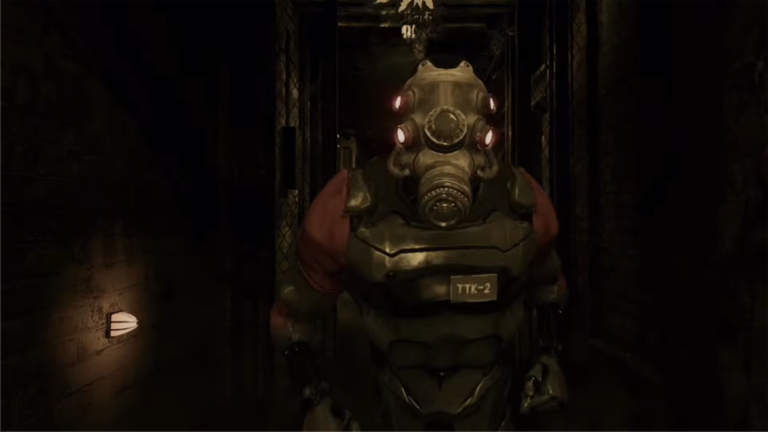
Fire and Ashes is set in 1977, inside the Paul Staderbeiger Psychiatric Hospital. Henry Gray regains consciousness in a bathtub — the water around him stained red with blood that is not his own. He has no immediate memory of how he arrived, what happened before, or whose blood it is. The hospital is not abandoned. Guards patrol its corridors. Patients, unrestrained and violent, move through its wards. The game describes additional threats it designates as “cybernetic creations” and entities it refuses to categorize — jarring presences in a 1977 institutional setting that underscore the line between what is physically real inside the hospital and what may be projections of Henry’s deteriorating mind.
The central dramatic question the game builds toward is double-layered: what personal tragedy has driven Henry to this point, and who — or what — is guiding him through the asylum toward the answers? The presence directing him is neither confirmed as ally nor adversary. Whether that guide is a person, a delusion, or something the hospital itself manufactured in its “secret laboratories” is a question the game holds back until its conclusion.
The emotional register is closer to psychological dissolution than to standard jump-scare horror. The game’s own materials describe Henry’s enemies as residing both outside him — in the corridors — and within, suggesting that some of what he encounters may be manifestations of grief, trauma, and severe emotional suffering rather than physical threats. Mature content warnings cover graphic violence, nudity, and disturbing imagery tied directly to Henry’s mental state.
Fire and Ashes will launch across PlayStation, Xbox, Nintendo Switch, and PC via Steam and Epic Games Store on October 14, 2026.
On PC, minimum system requirements call for an Intel Core i5-4440 and an Nvidia GTX 1060, with 8 GB of RAM and 12 GB of storage, per the game’s Epic Games Store listing. The recommended configuration steps up to an Intel Core i7-4770K paired with an RTX 3060. Both thresholds are accessible by a wide range of current PC hardware — the game is not targeting the cutting edge, which is consistent with a two-person indie studio working in Unreal Engine 5 and managing scope deliberately.
A microphone is recommended for the full experience but is not required. Players who prefer not to use voice input or who are playing in environments where speaking aloud is impractical can play entirely through conventional controls instead. The voice system remains an enhancement that raises the stakes of play rather than a hard gating requirement.
Audio is available in English and Russian. The interface and subtitles support ten languages including French, German, Spanish, Japanese, Simplified Chinese, and Portuguese (Brazil).
For streamers and content creators, the voice mechanic creates an additional layer of authentic, unscripted performance: genuine panic visible in every elevated breath, real tension in every suppressed gasp. That quality of performance is not engineered — it is extracted from the player directly, which is why this category of game tends to produce compelling viewing whether or not the player is skilled.
The question has been asked with every Kinect launch, every microphone optional feature, every “your voice matters” marketing push since 2003. The answer from prior implementations has consistently been: yes, when the conditions are right, and no, when they are not.
The conditions that have historically undermined the mechanic include: platform-specific hardware requirements that excluded large portions of the player base; detection-only systems that made silence the only correct choice; and short-form experiences that never tested whether the tension held across hours of play.
Fire and Ashes addresses the first two directly — standard microphone, cross-platform, bidirectional voice use. Whether it addresses the third is the open question that players will answer for themselves beginning October 14.
No. The game is fully playable using conventional controls without any microphone. A microphone is described as “recommended” by developer ASDstudio for the complete experience, but the voice recognition system is an enhancement, not a requirement. Players in shared living environments, players who are mute, or players who simply prefer traditional inputs can engage the full game without voice input.
Prior microphone-horror implementations — Alien: Isolation‘s Kinect feature, Don’t Scream, A Quiet Place: The Road Ahead‘s noise detection — were primarily detection systems: the game heard the player and penalized sound. Fire and Ashes adds a second mode in which the player’s voice is an active offensive tool. Players can shout at guards to taunt them into attack windows and use the Electric Voice pacification tool to subdue enemies through spoken commands. The voice is simultaneously a liability and a tactical resource — a combination no prior microphone-horror game has fully implemented across all platforms in a full-length release.
Henry Gray wakes in 1977 inside the Paul Staderbeiger Psychiatric Hospital with no clear memory of how he got there, in a bathtub of blood that does not belong to him. The game builds toward uncovering the personal tragedy that brought him there, while an unseen presence guides him deeper into the asylum — through secret laboratories, fractured memories, and encounters with threats that may be real, manufactured, or projections of Henry’s own psychological collapse. Whether the guide is ally or something more dangerous is a question the game withholds until the very end.
At minimum: an Intel Core i5-4440, an Nvidia GTX 1060, 8 GB of RAM, and 12 GB of storage. The recommended configuration is an Intel Core i7-4770K with an RTX 3060. Both configurations are well within reach for most current gaming PCs. The game runs on Windows 10 at minimum, with Windows 11 recommended, per the system requirements on Epic Games Store.