HomeAuto Federal Broadband Grant Fine Print Would Strip California Net Neutrality for 14 Years
Federal Broadband Grant Fine Print Would Strip California Net Neutrality for 14 Years
September 20, 2026:
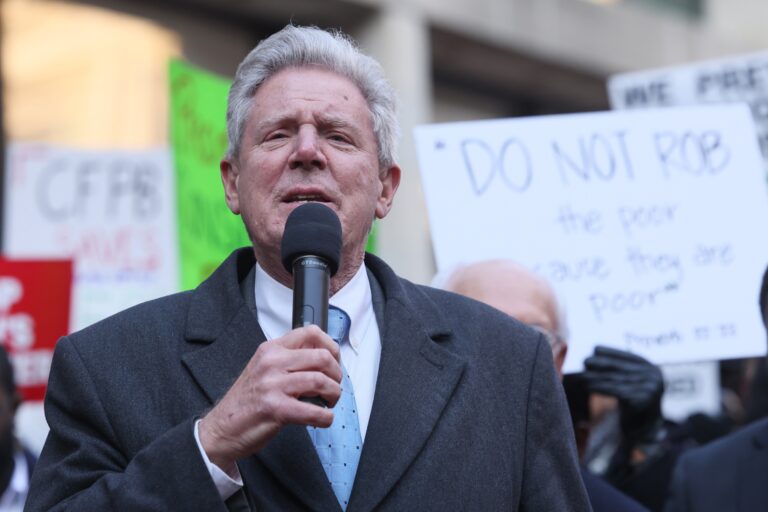
Rep. Frank Pallone (D-NJ) speaks as Congressional Democrats and CFPB workers hold a rally on February 10, 2025 in Washington, DC. Jemal Countess/Getty Images for MoveOn
California’s Public Utilities Commission is scheduled to hold its monthly voting meeting today in what amounts to a procedural formality — ratifying a broadband deployment plan that federal officials approved in July. But a Stanford law professor’s analysis published yesterday is drawing attention to a far more consequential decision lurking behind the routine vote: a federal grant clause that would bar California from enforcing its net neutrality, wildfire-response, and broadband-affordability laws against the state’s largest internet providers for the next 14 years.
The clause is called Condition 50. It appears in the general terms and conditions attached to California’s $1.42 billion award from the federal BEAD broadband grant program — the Biden-era program designed to bring high-speed internet to unserved communities, now administered by the Trump administration’s National Telecommunications and Information Administration. And it is not Governor Gavin Newsom’s decision to ignore.
What Condition 50 Actually Does
The BEAD program is a roughly $42 billion national initiative, funded by the 2021 Infrastructure Investment and Jobs Act, to bring high-speed internet to unserved and underserved communities. California’s share — originally projected at $1.86 billion before the Trump administration restructured the program’s bidding rules — was formally awarded in August 2026 at $1.42 billion, covering about 270,000 homes and businesses.
Buried in the November 2025 BEAD grant conditions is Term 50 — Condition 50 — a new provision that requires any state accepting BEAD funding to exempt all BEAD-funded internet service providers from “broadband-specific economic regulations, such as price regulation and net neutrality,” throughout the ISP’s entire state service area, for the duration of the grant period.
That period runs approximately 14 years from the date each individual ISP’s grant is finalized.
Three things about the condition stand out. First, it is not limited to the rural and underserved areas BEAD is actually funding. It covers every broadband service those ISPs offer anywhere in California — including their wireless networks. Second, California would be required to write that same promise into its subgrant contracts with each funded provider, handing every ISP its own independent contractual right to block enforcement. Third, Condition 50 does not merely freeze existing law: as Stanford Law professor Barbara van Schewick notes in her analysis, it would prevent California from enforcing any new broadband consumer protection rules it might pass in the next decade-and-a-half against these providers either.
Who Gets Shielded — and What California Would Be Giving Up
Roughly 69% of California’s BEAD funding flows to five large national providers: Comcast ($400 million), AT&T ($331 million), Verizon/Frontier ($173 million), Amazon’s Kuiper satellite service ($55 million), and SpaceX’s Starlink ($22 million). If California signs the grant agreement under these terms, three of the four major home-internet providers, two of the three major wireless carriers, and both dominant satellite providers would be shielded from the state’s consumer and public-safety broadband regulations for well over a decade.
Here is what that protection would specifically remove:
Net neutrality. After the FCC repealed federal net neutrality rules in 2017, California enacted SB 822 in 2018 — widely regarded as the strongest state-level net neutrality law in the country. The law prohibits ISPs from blocking or throttling websites and apps, and bans paid fast lanes. Its deterrent effect was demonstrated almost immediately after it became enforceable in 2021: AT&T and Verizon promptly stopped exempting their own video apps from customers’ data caps — a practice called zero-rating that had tilted competition in their favor. The ISP industry challenged SB 822 in federal court three times and lost each time, including when the full Ninth Circuit declined to rehear the case without a single judge voting to take it up. Under Condition 50, enforcement of SB 822 against BEAD recipients would be suspended for 14 years — including any future amendments the California legislature might pass.
Affordability protections. When the CPUC approved Verizon’s Frontier acquisition in January 2026, it attached a significant condition: the merged company must offer a $20-per-month broadband plan to low-income Californians. An estimated 5.8 million households qualify, representing potential savings of up to $30 per month per household. Under Condition 50, California could not enforce that requirement against Verizon/Frontier — which is among the BEAD recipients.
Van Schewick’s math on this point is stark. If just 20% of eligible households enrolled in that $20 plan — a deliberately conservative estimate — California’s low-income residents would collectively save roughly $4.2 billion over 10 years. The entire BEAD award is worth $1.42 billion. California would be trading away consumer savings nearly three times the value of the grant it receives in exchange.
The federal backstop is gone. The Affordable Connectivity Program, which had provided qualifying households up to $30 a month toward broadband bills, ran out of funding and ended in June 2024. Congressional efforts to revive it have stalled.
Public safety. Perhaps the most visceral element of the debate is what Condition 50 would do to emergency-response protections. In the summer of 2018, as the Mendocino Complex Fire — then the largest wildfire in California history — tore through the state, Santa Clara County firefighters found their mobile internet connection throttled to a near-standstill by Verizon in the middle of the emergency response. Verizon refused to restore full service unless crews upgraded to a more expensive plan.
California passed AB 1699 in 2019 requiring mobile providers to maintain full connectivity for emergency responders during active emergencies. That protection — and the broader framework of disaster-connectivity rules — would become unenforceable against BEAD recipients for 14 years under Condition 50. Verizon, the company that throttled those firefighters, is a BEAD recipient.
Why the Architecture Matters: Networks Do Not Have State Lines
One element the public debate has underplayed is the engineering reason Condition 50 was written to cover ISPs’ entire California footprint, not just BEAD-funded locations. ISPs do not operate separate network architectures for grant-subsidized rural areas vs. their existing urban and suburban customers. A major provider like Comcast or Verizon runs a unified statewide network, with shared backbone infrastructure, shared IP routing systems, and traffic-management platforms that make decisions across the entire service area.
Enforcing net neutrality only at individual BEAD-funded last-mile connection points — while the ISP’s traffic management systems upstream remain unregulated — is technically impractical. The practical effect of location-specific net neutrality enforcement would be trivially easy for an ISP to circumvent.
This is the same argument the industry made for years against California-only regulation generally. But the argument cuts both ways: the same network architecture that makes location-specific enforcement impractical also means that broadband customers outside BEAD-served rural areas — customers in San Francisco, Los Angeles, and Sacramento — are being asked to give up their consumer protections in exchange for infrastructure money they will never directly receive.
How This Happened: The Route Around Three Court Losses
Condition 50 did not emerge from policy analysis. It reflects a years-long campaign by major ISPs to escape California’s regulatory framework through whatever avenue remained available after the others closed.
According to van Schewick’s analysis, ISPs spent approximately $6 million lobbying the California legislature to kill SB 822. They funded robocalls warning seniors that net neutrality would raise their phone bills. They challenged the law in federal court three times and lost each time. Having exhausted those avenues, the industry found a new lever: the federal government.
In October 2025, NTIA Administrator Arielle Roth told an audience at the Hudson Institute that any state receiving BEAD funds must “exempt BEAD providers throughout their state footprint, from broadband-specific economic regulations, such as price regulation and net neutrality.” That framing appeared in the November 2025 BEAD General Terms and Conditions as Condition 50.
The approach has already yielded one early result inside California. In July 2025, a California lawmaker shelved a bill that would have required ISPs to offer $15-per-month broadband plans to low-income households, after federal officials warned the legislation could put the state’s BEAD funding at risk.
NTIA also circulated a memo to BEAD grant winners instructing ISPs to verify that state BEAD contracts contain language prohibiting rate regulation and net neutrality enforcement — and to notify federal program officers if the language was absent or altered, with grants described as “at risk” without compliant terms.
The Legal Question: Does NTIA Have This Authority?
Legal experts across the political spectrum have questioned whether NTIA can legally do what Condition 50 purports to do.
The BEAD statute itself — the Infrastructure Investment and Jobs Act — requires states to ensure funded providers carry out their work “in compliance with all applicable Federal, State, and local laws.” Van Schewick’s argument is that Condition 50 demands the opposite: California must promise not to enforce its own laws. A federal agency, the argument runs, cannot use grant fine print to override what Congress explicitly wrote into the authorizing statute.
Stephanie Weiner, a Georgetown Law senior fellow who previously served as chief counsel at NTIA and as legal advisor at the FCC during the drafting of the 2015 Title II net neutrality order, has stated that while “NTIA has considerable discretion to impose certain terms and conditions on the receipt of BEAD funds, it must have legal authority to impose those conditions.” She added that absent “a source of authority to preempt them, states can regulate and oversee the provision of broadband service within the state, including through net neutrality and affordability laws” — citing both the Second and Ninth Circuits.
Blair Levin, a former FCC Chief of Staff and New Street Research policy adviser, called NTIA’s timing of the new conditions “problematic” and compared it to changing rules on a spectrum auction after bidders had already submitted. He added that it was “hard to understand putting non-statutory requirements on states after criticizing the Biden administration for putting non-statutory requirements on states.”
House Energy and Commerce Committee Democrats wrote to NTIA in November 2025 and again demanded compliance in March 2026, warning that “executive orders issued by the President do not supersede federal law” and demanding that the agency “abide by the law and disperse BEAD funding as intended by Congress.”
Who Actually Decides — and When
A critical point that observers across the political spectrum have emphasized: today’s CPUC vote does not itself accept Condition 50. The CPUC’s role in this specific vote is administrative — ratifying the deployment plan NTIA already approved in July. Whether to sign the grant agreement and bind California to Condition 50 is a decision that rests with Governor Newsom, not the Commission.
Newsom has championed California’s broadband buildout for years. He designated the CPUC as the state’s BEAD administrator in July 2022 and backed the $6 billion SB 156 broadband infrastructure law. His administration turned on the nation’s largest open-access public broadband network — the Middle Mile network — earlier this year. He has positioned California as a counterweight to federal tech-policy rollbacks, including signing multiple AI governance bills and launching the California Innovation Council. His decision on Condition 50 will be the highest-stakes test yet of whether California can maintain that position under financial pressure.
California has until the end of September 2026 to decide, with the option to request a 30-day extension under BEAD’s own rules. There is no procedural requirement to rush.
What Happens If California Fights — and If It Doesn’t
Van Schewick’s analysis outlines a clear two-outcome map.
If California challenges Condition 50 in federal court before signing the grant agreement — and wins — it receives the full $1.42 billion with the condition removed. It connects the 270,000 households BEAD is designed to serve without surrendering its power to protect all 40 million Californians. The legal argument, grounded in the statute’s own text, is strong.
But timing is decisive. Once the state signs the agreement, challenging Condition 50 becomes dramatically harder, and enforcing any of the affected protections risks triggering a cutoff of BEAD disbursements that have not yet been paid out. In practice, the result would be that California’s consumer protection laws remain on the books — but no regulator or attorney general would risk the state’s broadband funding to test enforcement against even one provider. Laws that cannot be enforced are not protections.
California is not alone in navigating these terms. All 56 eligible entities received NTIA approval for their BEAD final proposals by late August 2026. California’s scale — 40 million residents, the nation’s largest economy, the country’s strongest state net neutrality law — has placed it at the center of the national debate. Whatever Newsom decides will effectively set the template for every other state still deciding whether to challenge Condition 50 or sign.
What Wildfire Seasons Have to Do With Broadband Law
California faces one of the most rapidly evolving wildfire climates in the world. Emergency communications — for evacuation orders, for family-to-family contact, for coordinating first responders — now run primarily over wireless broadband networks. The 2019 law that bars throttling first responders during emergencies was a direct response to an incident that occurred during an active disaster. Condition 50 would make that law unenforceable against the state’s two largest wireless carriers — AT&T and Verizon — for the next 14 years.
As van Schewick wrote, “whether those networks hold up when lives depend on them shouldn’t be left to an internet provider’s discretion.”
Frequently Asked Questions
What is Condition 50, and why does it affect Californians who don’t live in unserved rural areas?
Condition 50 is a clause in the federal BEAD broadband grant’s general terms and conditions — introduced in November 2025 — requiring any state that accepts the grant to exempt all funded ISPs from state net neutrality, rate regulation, and public-safety broadband laws throughout the ISP’s entire state service area for the duration of the grant period (approximately 14 years). Because major ISPs like Comcast, AT&T, and Verizon operate unified statewide networks, the condition covers their urban and suburban customers just as much as the rural households BEAD is actually paying to connect. A customer in San Francisco would see their ISP exempted from California’s net neutrality law, even if they live hundreds of miles from the nearest BEAD-funded location.
Can California challenge Condition 50 in court and still get the money?
Yes, according to Stanford law professor Barbara van Schewick and multiple independent legal experts. The legal argument is grounded in the BEAD statute itself: Congress required states to ensure funded providers comply with “all applicable Federal, State, and local laws,” while Condition 50 demands that California promise not to enforce its own laws. Van Schewick argues that a federal agency cannot use grant fine print to override what Congress wrote in the authorizing statute. The critical timing requirement is that California must bring the challenge before Governor Newsom signs the grant agreement — once the state signs, challenging Condition 50 becomes dramatically harder and enforcing any affected protection risks triggering a disbursement cutoff.
What would California lose if it signs the grant without challenging Condition 50 — and for how long?
California would be unable to enforce its net neutrality law (SB 822), its 2019 first-responder throttling ban, and the CPUC’s $20-per-month affordability mandate against Verizon/Frontier — against any ISP that receives BEAD funding — for approximately 14 years, covering their entire California service footprint including wireless. That freeze also applies to any new broadband consumer protections California’s legislature or CPUC might enact during those 14 years. Stanford professor van Schewick estimates that just 20% enrollment in the $20/month Verizon plan would save low-income Californians $4.2 billion over 10 years — nearly three times the $1.42 billion California stands to receive from BEAD.
What happens to California’s first-responder throttling protections under Condition 50?
California’s 2019 law prohibiting mobile providers from throttling emergency responders during active disasters — passed directly in response to Verizon’s throttling of Santa Clara County firefighters during the 2018 Mendocino Complex Fire — would become unenforceable against BEAD-funded providers, including Verizon, for 14 years. This protection would be suspended at a time when climate change is increasing the frequency and severity of California wildfires, and wireless broadband has become essential infrastructure for emergency coordination and public safety response.