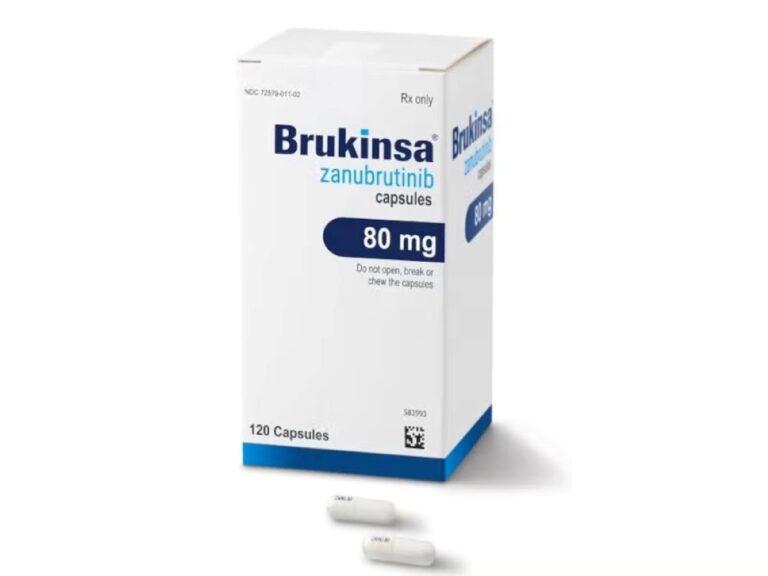
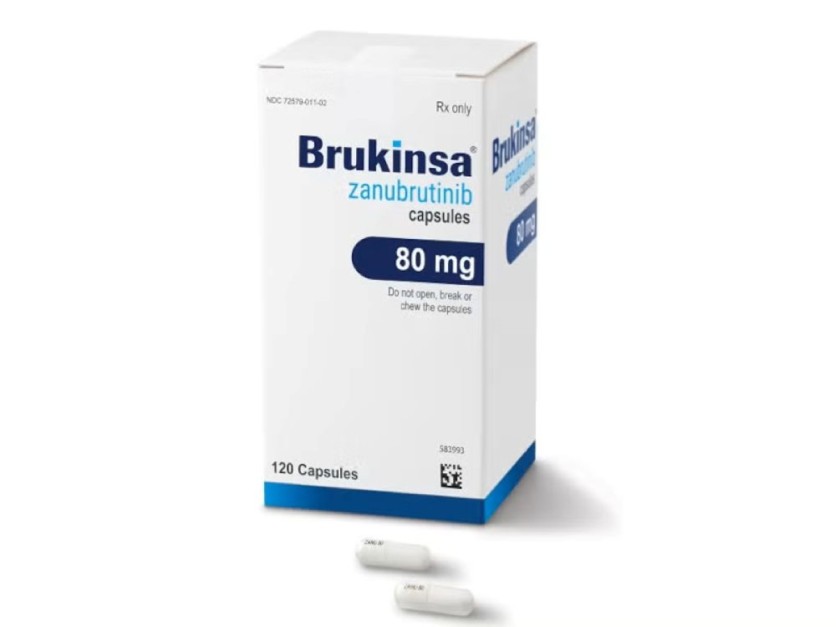
HomeAuto FDA Grants Brukinsa Priority Review After Chemo-Free Regimen Beats Standard Care in Mantle Cell Lymphoma
FDA Grants Brukinsa Priority Review After Chemo-Free Regimen Beats Standard Care in Mantle Cell Lymphoma
November 7, 2026:
Clinicaltrials.gov
The U.S. Food and Drug Administration has accepted a supplemental drug application for Brukinsa (zanubrutinib) as a first-line treatment for a rare, aggressive form of blood cancer called mantle cell lymphoma — and granted it Priority Review, a designation that shortens the agency’s standard 10-month clock to approximately six months. The move puts a potential approval on track for mid-2027.
The application rests on the results of the MANGROVE Phase 3 trial, which pitted zanubrutinib plus rituximab against bendamustine plus rituximab — the chemotherapy backbone that has served as the default for newly diagnosed, transplant-ineligible patients for more than a decade. The chemo-free regimen won decisively: a 43% reduction in the risk of disease progression or death, with a hazard ratio of 0.57 (95% confidence interval, 0.43–0.76; p
The disclosure came as part of BeOne Medicines’ third-quarter 2026 earnings release on November 5, 2026.
Why This Trial Changes the Treatment Equation
For the roughly 1,400 to 2,700 Americans newly diagnosed with mantle cell lymphoma each year — a disease that strikes predominantly men over 60 — the standard first-line playbook has long been to reach for chemotherapy. For younger, fit patients, that meant intensive drug regimens followed by stem cell transplant. For older patients or those with comorbidities that rule out transplant, it meant a less intense but still chemotherapy-based regimen: six cycles of intravenous bendamustine plus rituximab, followed by roughly two additional years of rituximab maintenance infusions.
MANGROVE, which enrolled 510 previously untreated, transplant-ineligible patients across 176 sites globally, asks whether that approach is still necessary. Its answer, delivered at the prespecified interim analysis, is that a chemotherapy-free combination — oral zanubrutinib twice daily plus six cycles of rituximab, then zanubrutinib alone until disease progression — outperforms the chemoimmunotherapy backbone that has anchored front-line care for years.
“For patients with newly diagnosed MCL, chemotherapy is currently the default,” said Amit Agarwal, MD, PhD, BeOne’s chief medical officer for hematology, in a statement following the trial results. “MANGROVE data show that our chemotherapy-free regimen can deliver unprecedented improvements in PFS. We believe it would be very meaningful for patients to be free from the burden of frequent infusions.”
Mantle cell lymphoma, as of 2023, is classified as incurable, with a five-year survival rate of roughly 50% for advanced-stage disease and no expert consensus on the optimal treatment approach. That classification predates MANGROVE’s confirmatory Phase 3 data. While the trial’s overall survival results are immature — the data show a trend favoring zanubrutinib-rituximab but no hazard ratio has been reported — the progression-free survival result alone is likely to reshape prescribing decisions before an FDA decision arrives.
“The question now is whether chemoimmunotherapy is needed in frontline MCL,” said Tycel Phillips at City of Hope, writing in The Hematologist — a question he framed against the backdrop of chemotherapy’s known long-term adverse effects and the growing clinical evidence supporting targeted-therapy sequences.
How Zanubrutinib Works — and Why the Second Generation Matters
Zanubrutinib belongs to a class of targeted drugs called BTK inhibitors, named for Bruton’s tyrosine kinase, an enzyme that sits near the top of a signaling cascade that cancer cells in mantle cell lymphoma — and other B-cell malignancies — depend on for survival. When a B cell’s surface receptor is activated, it triggers a chain reaction: BTK is phosphorylated, activates phospholipase C, which in turn releases intracellular signals that push the cell to proliferate. In healthy B cells, this is a tightly regulated process. In lymphoma cells, it runs unchecked.
Blocking BTK breaks the chain. Zanubrutinib does this by forming an irreversible covalent bond with a cysteine residue at position 481 in BTK’s active site — permanently disabling the enzyme for the life of the drug-protein complex. The cell is deprived of its survival signal and pushed toward apoptosis, or programmed cell death.
The first-generation BTK inhibitor, ibrutinib (Imbruvica), established this mechanism in clinical oncology when it received FDA approval in 2013. But ibrutinib’s chemical scaffold interacts with several kinases beyond BTK — including EGFR, HER2, and ITK — and those off-target interactions translate into well-documented side effects: elevated rates of atrial fibrillation, diarrhea, and bleeding events.
Zanubrutinib’s design addresses that selectivity gap. Its molecular structure binds Cys481 more selectively than ibrutinib, reducing off-target kinase activity at therapeutic concentrations. In the ALPINE head-to-head trial in chronic lymphocytic leukemia and small lymphocytic lymphoma, zanubrutinib delivered superior progression-free survival over ibrutinib and cut the rate of atrial fibrillation or flutter by more than half — 5.2% versus 13.3%.
The selectivity improvement has an important practical implication for MANGROVE’s design. When a patient begins front-line zanubrutinib treatment, the MCL cells have not yet been exposed to BTK inhibition and have not developed resistance. The most common resistance mechanism is a point mutation at precisely the cysteine that zanubrutinib targets — C481S, which substitutes serine for cysteine and prevents covalent binding. In treatment-naive patients, that resistance has not had time to emerge, optimizing the drug’s therapeutic window and explaining why the front-line setting is the most favorable context for a covalent BTK inhibitor.
The MANGROVE Trial: What the Data Shows
Trial design: Randomized, global, open-label Phase 3 study (NCT04002297). Enrolled patients 70 or older, or 60 or older with comorbidities precluding stem cell transplant. ECOG performance status 0–2.
Experimental arm: Oral zanubrutinib 160 mg twice daily plus intravenous rituximab on day 1 of cycles 1–6. After cycle 6, zanubrutinib continues as monotherapy until disease progression or intolerance.
Control arm: Six cycles of bendamustine plus rituximab, administered on a standard 28-day schedule.
The design deliberately omits rituximab maintenance — which standard practice after BR can extend infusion-based therapy by approximately two additional years. If approved, the zanubrutinib-rituximab regimen would eliminate that maintenance burden.
Primary endpoint result:
Hazard ratio: 0.57 (95% CI, 0.43–0.76; p
Risk reduction in progression or death: 43%
Secondary endpoints: Overall survival data are immature. A trend favoring zanubrutinib-rituximab was observed, but no hazard ratio has been reported. Investigator-assessed PFS, overall response rate, duration of response, and patient-reported outcomes are additional secondary endpoints; the full interim analysis is expected at the ASH 2026 Annual Meeting on December 12–15, 2026, in a Plenary Scientific Session — the highest-profile presentation slot at that conference.
Safety: The zanubrutinib pooled safety population (n=1,729 across studies) showed decreased neutrophil count in 51% of patients, decreased platelet count in 41%, upper respiratory tract infection in 38%, and hemorrhage events in 32%. Serious adverse events include hemorrhage, infections, second primary malignancies, cardiac arrhythmias, cytopenias, and hepatotoxicity. BeOne stated that the MANGROVE combination’s safety profile was consistent with the known profiles of both drugs, with no new safety signals identified.
Global Regulatory Coordination
The FDA Priority Review designation is the first regulatory milestone in a coordinated global filing strategy. BeOne completed submissions to the European Medicines Agency and Chinese regulatory authorities in the second half of 2026, with a Japanese submission planned for the fourth quarter of 2026. The company anticipates regulatory decisions across all major markets beginning in mid-2027, as the FDA PDUFA date is set for approximately June or July of that year.
The scale of the global regulatory push reflects how thoroughly MANGROVE has redefined Brukinsa’s commercial trajectory. When the FDA first approved zanubrutinib in 2019, it was under accelerated approval for previously treated MCL — a narrower indication for a patient population that had already received at least one prior therapy. MANGROVE is the confirmatory Phase 3 trial that fulfills the post-marketing commitment attached to that accelerated approval, while simultaneously seeking a substantially broader first-line indication. If the FDA approves the sNDA, Brukinsa’s MCL label would shift from a treatment of last resort to a treatment of first choice for the majority of newly diagnosed MCL patients.
About BeOne Medicines — and Its Corporate Transformation
BeOne Medicines is the renamed successor to BeiGene, the biotechnology company co-founded in Beijing in 2010 by John V. Oyler — a mechanical engineering graduate of MIT and Stanford MBA — and biochemist Xiaodong Wang. The company redomiciled from the Cayman Islands to Switzerland in May 2025, a governance change Oyler has described as better reflecting BeOne’s global footprint.
The company retains its listing on the Shanghai Stock Exchange alongside its primary Nasdaq listing and a Hong Kong exchange listing. BeOne has approximately 12,000 employees globally and is building an $800 million flagship US manufacturing campus — Princeton West Innovation Campus in Hopewell, New Jersey — as part of a voluntary agreement with the US government announced in September 2026 to expand American patient access and strengthen domestic manufacturing.
In the third quarter of 2026, BeOne reported total revenues of $1.9 billion — roughly 34% year-over-year growth — with US Brukinsa revenues reaching approximately $1.0 billion and global Brukinsa revenues of $1.4 billion. The company raised its full-year 2026 Brukinsa revenue guidance to $5.5–5.6 billion.
Oyler has also been active in advocating for artificial intelligence in oncology care. At BeOne’s AI Innovation Lab at the American Society of Hematology Annual Meeting in December 2025, Oyler said at ASH 2025 that AI tools need to improve but can “amplify human expertise” when grounded in trusted data, and outlined plans for AI-enabled tools targeting blood cancer education and care personalization.
What Comes Next
BeOne will present the full MANGROVE interim analysis at the ASH 2026 Annual Meeting in December 2026, in a Plenary Scientific Session. That presentation will include data the June 2026 topline readout did not publish: median progression-free survival values, overall response rates, duration of response, and potentially early overall survival observations. That data is likely to shape prescribing decisions among oncologists ahead of a formal FDA approval.
If the FDA approves the sNDA on its Priority Review timeline, the approval could arrive as early as mid-2027 — adding a first-line MCL indication to Brukinsa’s existing approvals across relapsed/refractory MCL, chronic lymphocytic leukemia, Waldenström’s macroglobulinemia, marginal zone lymphoma, and follicular lymphoma.
BeOne also received FDA approval in May 2026 for a second cancer drug, Beqalzi (sonrotoclax), a BCL-2 inhibitor approved for relapsed or refractory MCL. As both drugs target MCL — Brukinsa via BTK inhibition and Beqalzi via BCL-2 blockade — the company is studying the combination in earlier treatment lines, potentially creating a future where patients move through sequential or combined targeted therapies without ever requiring chemotherapy.
Frequently Asked Questions
What is mantle cell lymphoma, and who does it affect?
Mantle cell lymphoma is a rare, aggressive type of B-cell non-Hodgkin lymphoma that develops in cells of the lymph nodes’ mantle zone. It accounts for roughly 6–7% of non-Hodgkin lymphomas in the US, with an estimated 1,400 to 2,700 new American cases diagnosed each year. The disease predominantly affects men over the age of 60 — the male-to-female ratio is approximately 4:1 — and about 80% of patients are diagnosed at advanced stages. Standard treatment has historically involved chemotherapy, with or without stem cell transplant depending on age and fitness. As of 2023, the disease is classified as incurable, with five-year survival near 50% for advanced-stage cases, though patients may survive many years with treatment.
What does FDA Priority Review actually mean — and does it guarantee approval?
Priority Review is a designation the FDA grants to drug applications that, if approved, would offer a significant improvement in safety or effectiveness compared with available therapy for a serious condition. It shortens the standard 10-month review period to approximately six months, meaning the FDA must complete its review by the PDUFA (Prescription Drug User Fee Act) goal date — in Brukinsa’s case, estimated mid-2027. Priority Review does not guarantee approval; it only accelerates the FDA’s review timeline. The agency can still request additional data, issue a complete response letter, or approve with restrictions. The MANGROVE trial’s statistically significant PFS benefit (p
How does BTK inhibition work, and what makes zanubrutinib different from ibrutinib?
Both ibrutinib and zanubrutinib target Bruton’s tyrosine kinase (BTK), a signaling enzyme that lymphoma cells rely on to survive. Both drugs form a covalent, irreversible bond with cysteine 481 in BTK’s active site, permanently blocking the enzyme. The key difference is selectivity: zanubrutinib’s chemical structure reduces off-target kinase activity compared with ibrutinib — including interactions with EGFR and ITK — that are responsible for ibrutinib’s higher rates of atrial fibrillation, diarrhea, and bleeding. In the ALPINE head-to-head trial, zanubrutinib reduced atrial fibrillation rates by more than half compared with ibrutinib (5.2% vs. 13.3%) while also achieving superior progression-free survival.
When could Brukinsa be approved for first-line use in MCL?
If the FDA’s review proceeds on the Priority Review timeline without requests for additional data or advisory committee delays, a first-line MCL approval could arrive as early as mid-2027. BeOne has also submitted the application to European and Chinese regulators, with a Japanese submission planned for Q4 2026. The full MANGROVE interim analysis — including median PFS values, response rates, and early overall survival data — will be presented at ASH 2026 in December 2026, which may provide additional context for the FDA’s review. Patients seeking access ahead of a formal approval should speak with their oncologist about eligibility for clinical trials, compassionate use programs, or the existing Brukinsa indication for relapsed/refractory MCL if applicable to their situation.