HomeAuto FAA Targets New Compressor Wear Failure in Pratt & Whitney A220, E2 Engines
FAA Targets New Compressor Wear Failure in Pratt & Whitney A220, E2 Engines
September 18, 2026:
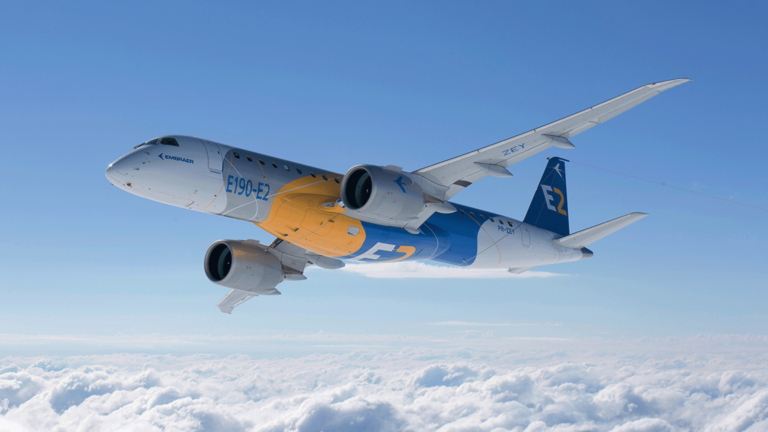
The Embraer E190-E2, which operates on the PW1900G, is one of the planes set to be inspected. Prattwhitney.com
The FAA published a proposed airworthiness directive on Wednesday that adds a newly identified compressor failure mode to the long list of regulatory actions against Pratt & Whitney’s geared turbofan engines — the exclusive powerplants for every Airbus A220 and Embraer E-Jet E2 in the world. The proposed rule arrives weeks after Guillaume Chevasson, CEO of Airbus Canada, declared that the AOG crisis is over for the A220 fleet — a claim the new directive does not yet contradict, but does complicate.
What the FAA Found
The proposed rule — Docket No. FAA-2026-8816, Federal Register document 2026-19094 — was triggered by six shop findings that Pratt & Whitney reported to the FAA: “clashing” damage on either the second-stage or third-stage high-pressure compressor rotors, caused by contact with the variable stator vanes that control airflow through the engine. The root cause is wear in the HPC variable stator vane bushing sets — small sleeve bearings and thrust-washer bearings that allow each variable vane to pivot precisely as the engine varies thrust. When those bearings wear down, the vane loses its constrained position and can rock forward axially, bringing its inner locating ring into contact with the rim surfaces of the HPC rotors behind it. That repeated contact grinds away at the rotor rear rim surfaces — the “clashing” damage the six shop teams discovered.
Left unchecked, the FAA found, this wear mechanism can produce failure of the HPC first-, second-, or third-stage rotors. Because these rotors spin at up to 24,470 RPM in the PW1500G, a rotor failure is not a contained event. The FAA’s filing states the unsafe condition could result in uncontained rotor release — the language the agency reserves for the most severe class of propulsion hazard — including damage to the engine and airframe, and loss of control of the airplane.
The underlying problem was documented in two Pratt & Whitney Alert Service Bulletins published on July 13, 2026 — one for PW1500G variants and one for PW1900G variants — which identified affected HPC module serial numbers and described inspection procedures. The proposed AD would mandate compliance with those bulletins for all operators who have not already acted.
How Geared Turbofan Variable Stator Vanes Work — and Why the Bushing Matters
To understand why a worn bearing causes a rotor hazard, it helps to understand the job the variable stator vane performs in the PW1500G/PW1900G.
The PW1500G and PW1900G are members of Pratt & Whitney’s PW1000G geared turbofan family, which uses a reduction gearbox to decouple the fan from the low-pressure compressor and turbine stages. That gearbox allows the fan to spin at roughly 3,461 RPM for ideal aerodynamic performance while the low-pressure spool runs at up to 10,600 RPM and the high-pressure spool runs at up to 24,470 RPM — each at the speed best suited to its function. The result, Pratt & Whitney claims, is 16% better fuel efficiency and 75% lower noise than prior-generation engines in the same thrust class.
The high-pressure compressor in these engines is an eight-stage axial unit in which rows of spinning rotor blades are interleaved with rows of variable stator vanes. The stator vanes are not fixed — they rotate on trunnions to adjust the angle at which incoming air enters each rotor stage, allowing the engine to manage airflow efficiently across a wide range of thrust settings. Each variable stator vane pivots in a set of sleeve bearings and thrust-washer bearings — the “HPC VSV bushing set” — that fits into the compressor casing and keeps the vane in precise axial position.
The six failure cases reported to the FAA shared a common mechanism: the bushing set wore down sufficiently that the vane lost its axial constraint, rocked forward, and allowed its inner locating ring to press against the rear rim surface of the HPC rotor stage immediately behind it. At the rotor’s operating speed, even modest contact creates circumferential wear and scratching that can propagate to rotor failure.
The FAA has defined the updated bushing components explicitly. The current worn parts (sleeve bearings P/Ns 30G1934, 30G1935, and 30G1936; thrust washers 30G1938, 30G1939, and 30G1940) are to be replaced with improved components (sleeve bearings 30G6496, 30G6497, and 30G6498; thrust washers 30G6499, 30G6500, and 30G6503).
What Airlines Must Do
The directive, if adopted as proposed, would affect 215 engines on US-registered aircraft. International compliance actions from counterpart regulators — the European Union Aviation Safety Agency (EASA) and Transport Canada — are expected to follow.
Required actions break into two tiers.
The first tier is borescope inspection. Operators must perform an initial inspection of the HPC first-, second-, and third-stage rotor rear rim surfaces for evidence of circumferential wear, scratching, or contact damage. The deadline is before the engine accumulates 8,000 flight hours, or within 1,000 flight hours of the AD’s effective date — whichever occurs later. Thereafter, repeat inspections are mandated at intervals not exceeding 1,000 flight hours. If damage is found, the affected rotor must be removed before the next flight and replaced.
The second tier is the permanent fix. Airlines must replace the worn HPC VSV bushing set with updated parts at the next opportunity when the HPC front case is opened during a scheduled shop visit. Completing the bushing replacement serves as terminating action, permanently ending the cycle of repetitive borescope inspections.
The FAA estimated total compliance costs for US operators at approximately $4.44 million — dominated by the $20,300 parts cost per engine for the VSV bushing set replacement, multiplied across the affected fleet. On-condition rotor replacements, should inspections reveal damage, would cost between roughly $259,000 and $316,000 per rotor depending on the stage.
Prior HPC Directives on the Same Engine Family
The September 17 directive is not the first time HPC components in the PW1500G and PW1900G have triggered regulatory intervention. A 2019 AD addressed HPC front hub corrosion that threatened to cause cracking before the component reached its published life limit. A 2021 airworthiness directive required removal of the HPC rotor shaft after reports of cracking that caused in-flight engine shutdowns and unscheduled removals. A subsequent 2021 directive addressed HPT first-stage hub life limits. The 2024-2025 regulatory cycle added requirements for angled ultrasonic rotor inspections of the HPC seventh-stage axial rotor after a related engine in the same PW1000G family experienced an integrally bladed rotor separation during an aborted takeoff.
Each of these directives addressed a different component failure mode — corrosion, shaft cracking, HPT life limits, IBR separation, and now VSV bushing wear. Together they form a map of durability issues concentrated in the compressor section of these engines as the fleet ages through its first decade of revenue service.
The FAA acknowledged in the current filing that this AD is considered an interim measure: Pratt & Whitney is developing additional mitigations beyond the bushing replacement, and the agency signaled that further rulemaking may follow once those solutions are finalized.
Context: Where the Broader GTF Recovery Stands
As recently as November 2025, approximately 17% of A220s were grounded due to GTF issues, with airlines including Air Baltic and Swiss International Air Lines absorbing significant financial and operational losses, with airlines including Air Baltic and Swiss International Air Lines absorbing significant financial and operational losses. That number has since fallen to just 2-3% by mid-2026, and Guillaume Chevasson, head of Airbus Canada’s A220 program, declared the “AOG crisis is over.”
The steeper crisis — the large-scale powder-metal contamination inspection program that peaked in early 2024 for the PW1100G engines on A320neo-family jets — had spillover effects on the A220 fleet, where the PW1500G shop visit time runs approximately 200 days. ITA Airways has separately pursued approximately €150 million (approximately $170 million USD) in damages from Pratt & Whitney over extended groundings of its aircraft in Naples.
Scott Kreamer, Pratt & Whitney’s vice president for the PW1500G engine program, told reporters at an Airbus briefing that all affected A220s return to service by the end of this year. The new HPC VSV bushing directive, while technically distinct from the powder-metal contamination issues, is a reminder that regulatory work on these engines is not finished.
It is worth noting the most serious known safety event in the PW1500G’s history: on December 23, 2024, a Swiss International Air Lines A220-300 suffered fatal engine failure at cruise altitude, leading to smoke in the cabin. One person died and 16 were injured. That incident underscores the stakes attached to each new compressor directive: the damage pathways the FAA regulates are not hypothetical.
Compliance Timeline
The proposed AD’s public comment window closes October 19, 2026. Once comments are reviewed, the FAA will issue a final rule, at which point affected US operators will have their compliance timelines activated. EASA and Transport Canada are expected to issue corresponding directives for European and Canadian operators of A220s and E2s.
Pratt & Whitney has not publicly commented on the proposed directive since its publication. The manufacturer’s service bulletins issued in July 2026 indicate it was already working with operators on voluntary compliance ahead of the regulatory mandate.
For travelers on A220s and Embraer E-Jet E2s, the borescope inspection regime and bushing replacement are both standard shop-level maintenance tasks. Airlines are not expected to ground aircraft on account of this directive unless inspections reveal active damage. The FAA’s framing of this as an interim measure, with further engineering mitigations in development, suggests the agency and manufacturer are aligned on a longer-term fix that may eventually supersede the inspection cycle entirely.
Currency conversions in this article are approximate and based on mid-market exchange rates at the time of publication.
Frequently Asked Questions
What is a variable stator vane, and why does its bushing matter for flight safety?
Variable stator vanes are adjustable airfoil-shaped vanes inside the high-pressure compressor that rotate to control airflow angle as the engine changes thrust settings. They are supported in the compressor casing by small sleeve and thrust-washer bearings — the bushing set. When those bearings wear down, the vane loses its precise axial position and can rock forward, pressing its inner locating ring against the surface of the spinning rotor stage behind it. At the 24,470 RPM the PW1500G’s HP rotor reaches, even moderate contact can grind away the rotor rim, eventually causing rotor fracture and the high-energy debris release the FAA describes as an uncontained failure.
Is this the same problem that caused hundreds of A220s to be grounded in 2023-2025?
No. The 2023-2025 groundings affecting the broader GTF family — including both the PW1100G on the A320neo and the PW1500G on the A220 — were driven primarily by a powder-metal contamination issue in certain engine parts manufactured between late 2015 and mid-2021. That contamination required lengthy shop inspections and rotor replacements and cost Pratt & Whitney and its partners an estimated $6-7 billion. The VSV bushing wear mechanism identified in the new directive is a distinct failure mode in a different part of the compressor assembly, triggered by normal wear rather than manufacturing contamination.
Is this accumulation of HPC compressor directives unusual for a relatively new engine?
It is notable. The PW1500G entered commercial service in July 2016 — roughly a decade ago. In those ten years, the HPC and related hot-section components have generated a series of separate airworthiness directives: a 2019 corrosion AD, a 2021 shaft-cracking AD, 2021 HPT hub life-limit reductions, a 2024-2025 rotor inspection program, and now this VSV bushing directive. Each addresses a different root cause, which suggests the FAA and Pratt & Whitney are finding problems as they accumulate operational data, rather than resolving a single design flaw. Pratt & Whitney has publicly described the GTF as being in a durability improvement cycle comparable to earlier-generation engines at the same service age.
What should passengers flying on an Airbus A220 or Embraer E190/195-E2 know?
Airlines are not grounding these aircraft because of this directive. The inspection regime requires borescope checks before each engine accumulates 8,000 flight hours, which happens during regular maintenance intervals, not between flights. If an inspection finds damage, the rotor is replaced before the aircraft returns to service — a conservative standard that protects passengers. The bushing replacement itself is performed during a scheduled shop visit and does not require taking an aircraft out of service on short notice. The meaningful risk is to future flights if an airline were to defer maintenance, which the directive is designed to prevent.