HomeAuto Europe’s First Commercial Lunar Rover Confirms 2029 Moon Flight on Blue Origin’s Blue Moon Lander
Europe’s First Commercial Lunar Rover Confirms 2029 Moon Flight on Blue Origin’s Blue Moon Lander
September 27, 2026:
INA FASSBENDER/AFP via Getty Images
Belgium’s Space Applications Services confirmed its LUVMI-M lunar rover will fly to the Moon’s south pole aboard Blue Origin’s Blue Moon Mark 1 lander in early 2029 — a milestone for European commercial space that also reveals how deeply the May 2026 New Glenn explosion has already reshuffled plans across the commercial lunar ecosystem. The company made the announcement on September 23, 2026, after its previous arrangement with Intuitive Machines was set aside in favor of the Blue Origin vehicle.
What Is the LUVMI-M Rover, and Why Does It Matter?
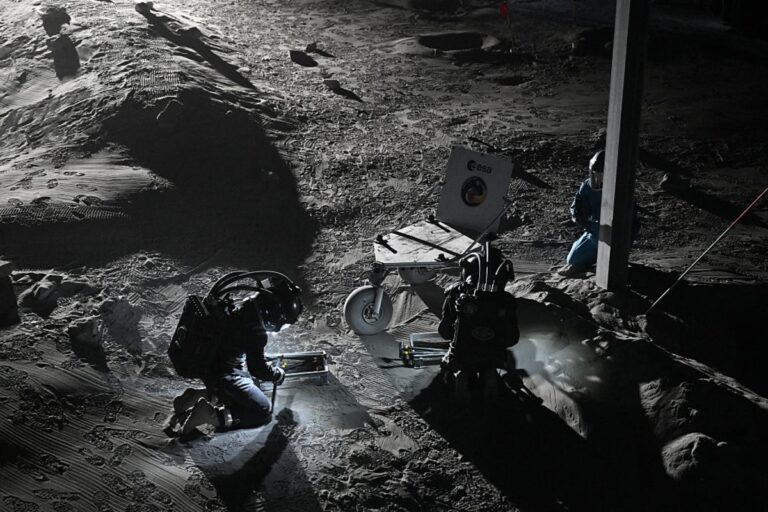
LUVMI-M — short for Lunar Volatiles Mobile Instrumentation-Medium — is a compact, purpose-built rover developed by Space Applications Services near Brussels, Belgium. It weighs between 20 and 30 kilograms (44 and 66 lbs) and is designed to host an equivalent mass in customer payloads: scientific instruments, technology demonstrators, and commercial experiments. That near-equal rover-to-payload mass ratio is a deliberate commercial design choice, making the platform among the most payload-efficient small rovers proposed for the south pole.
The baseline mission is designed to last between 10 and 14 Earth days, during which LUVMI-M will traverse the lunar surface near the south pole — an area of intense scientific and strategic interest because of evidence for water ice and other volatile compounds locked in permanently shadowed craters (PSRs). Temperatures inside those craters can reach -230°C (-382°F), and the ice trapped there represents both a potential resource for future human habitation and an archive of early solar system chemistry.
The rover is a four-wheel drive, holonomic platform — meaning all four wheels steer independently, giving it omnidirectional mobility without needing to reorient its chassis to change direction. An active suspension system adjusts the chassis height from ground contact to 30 centimeters (11.8 inches), allowing the rover to navigate cluttered polar terrain and clear obstacles. Its top speed is 5 cm/s, and it can traverse slopes of up to 15 degrees. Navigation relies on stereo cameras that map the surface in 3D, plus hazard-detection cameras; in areas where Earth-based operators cannot communicate quickly enough — the round-trip signal delay to the Moon runs approximately 2.5 seconds — the rover can switch to autonomous driving modes.
Once on the surface, LUVMI-M will be operated from Space Applications Services’ mission control facilities in Brussels, running on the company’s open-source Yamcs mission control framework. The company has accumulated more than seven years of experience operating payloads aboard the International Space Station, and regards that real-time, high-latency remote operations background as directly applicable to running a rover on a world a quarter-million miles (400,000 km) away.
Why This Announcement Reveals More Than a New Lander
The headline story is a confirmed mission agreement. But what the September 23 announcement implicitly reveals is a significant change of plans.
Until September 2025, Space Applications Services was publicly planning LUVMI-M’s first mission for the third quarter of 2028, targeting Shackleton Crater at the south pole. That announcement, made jointly with the company’s US counterpart Aerospace Applications North America, did not name a final launch vehicle, but the company had been in an ongoing collaboration with Intuitive Machines for lunar payload delivery services since at least early 2024.
That plan is now superseded. The new mission flies aboard Blue Origin’s Blue Moon Mark 1, with an early 2029 window. The company has not publicly explained when or why the lander substitution occurred, but the timing — announced four months after the New Glenn explosion disabled Blue Origin’s only launch pad — suggests the shift was related to a broader realignment of the commercial lunar manifest as Blue Origin sought customers and partners ahead of its launchpad recovery. Blue Origin is assembling seven Blue Moon landers (three Mark 1 cargo variants and four Mark 2 crewed variants), and securing payload commitments helps justify that manufacturing cadence.
For Space Applications Services, the switch carries both an upside and a risk. The upside: Blue Moon Mark 1 can carry up to 3,000 kilograms (6,614 lbs) of payload to the lunar surface — far more than Nova-C’s capacity — giving the mission more room to grow its customer manifest. The risk: the early 2029 window depends on Blue Origin successfully recovering LC-36A (its reconstructed launch pad) and executing a sequence of New Glenn flights before LUVMI-M reaches the front of the queue.
What the New Glenn Explosion Did to Blue Origin’s Schedule
On May 28, 2026, a New Glenn rocket exploded during a static fire test at Cape Canaveral’s Launch Complex 36, creating a massive fireball and collapsing a lightning tower. The blast destroyed the vehicle and heavily damaged the surrounding pad infrastructure. No one was injured.
The explosion occurred just weeks after Blue Origin had been awarded new NASA contracts to deliver cargo landers — including eventual lunar terrain vehicles — ahead of crewed Artemis missions. NASA Administrator Jared Isaacman pledged a “whole of government response” and said the agency would work with Blue Origin to assess near-term mission impacts.
Blue Origin CEO Dave Limp set an ambitious goal of returning to flight before the end of 2026, though experts noted that rebuilding from a launchpad explosion of this scale typically takes twelve to eighteen months. As a point of comparison, SpaceX’s 2016 Amos-6 explosion — which destroyed a Falcon 9 on its pad — took four months to determine root cause and more than a year to rebuild the pad, and SpaceX had a second active launchpad to fall back on. Blue Origin did not.
Blue Origin’s response has been a dual-pad strategy: rather than simply rebuilding LC-36A as it was, the company is modifying the launch system architecture to avoid replacing the most complex hydraulic components lost in the blast, with a target of returning LC-36A to flight status by late 2026. Simultaneously, the company is accelerating construction of a second, independent pad — LC-36B — which is scheduled to enter service by late 2027.
If Blue Origin meets both timelines, a first Blue Moon MK1 flight could plausibly occur in late 2026 or early 2027, and an early 2029 commercial payload mission becomes achievable — but only after multiple sequential successful flights demonstrate the vehicle’s reliability. For a customer like Space Applications Services, whose mission represents years of development and customer payload commitments, the early 2029 window is achievable but not without residual schedule risk.
How Does Blue Origin’s Blue Moon Mark 1 Work?
The Mark 1 is a single-stage, cargo-only robotic lander powered by a single BE-7 engine. The BE-7 runs on liquid hydrogen (LH2) and liquid oxygen (LOX) using a dual expander cycle: both propellants are used to cool the engine nozzle as they flow through it, converting from liquid to gas, and that gas pressure then drives the turbopumps that inject propellants into the combustion chamber. This architecture makes the engine restartable and deeply throttleable — both critical for soft, precise landings on uncertain terrain. A landing in the south polar region, where the sun angle is always low and shadows obscure terrain features, demands especially precise touchdown capability.
The lander stands 8.05 meters (26.4 feet) tall, measures 3.08 meters (10.1 feet) in diameter, and carries a fueled mass of roughly 21,350 kilograms (47,069 lbs). Its 3,000 kg (6,614 lb) payload capacity to the lunar surface is one of the largest available among commercial robotic landers. Blue Origin has also designed the MK1 to deploy Power Towers that can generate more than 10 kilowatts of electrical power from sunlight — useful for sustained operations on the peaks of near-eternal light near the pole’s rim, where the sun never quite sets.
What LUVMI-M Will Actually Do on the Moon
LUVMI-M’s customer manifest is designed around mobility — the ability to take scientific instruments and commercial payloads to specific surface locations, rather than operating them wherever a stationary lander happened to touch down. The mission will search for water ice and volatile compounds in the regolith, measure geological and geotechnical properties of the surface, record seismic activity, and investigate plasma physics and dust interactions. It will also host what the company calls “unconventional payloads” — cultural and symbolic objects from organizations and individuals who want to send something to the Moon.
One confirmed payload partner, announced in May 2026, is a Maltese organization collaborating to deliver a Lunar BioVault to the south pole — a symbolic repository of biological data and genetic information intended to represent Earth life at a location far from any conceivable terrestrial catastrophe.
The mission is positioned as the first in a series: the company intends to fly a LUVMI rover mission every two years, progressively increasing the level of rover autonomy and robotic capability, with the long-term goal of supporting a permanent lunar base.
Europe’s Role, and Why This Is a Meaningful First
European contributions to lunar missions have historically consisted of instruments flying aboard NASA or ESA-led spacecraft. A European-built, commercially operated rover traversing the lunar south pole under its own power — however compact — represents a qualitatively different level of operational autonomy for Europe’s space sector.
Space Applications Services is headquartered in Zaventem, Belgium, near Brussels, and the LUVMI-M mission draws on funding from the European Union, Belgium’s Science Policy Office (BELSPO), and the European Space Agency (ESA). The mission control center will operate from Belgium. Logan Ware, Commercial Director for Blue Origin International, called the agreement a reflection of “the increasingly international nature of lunar exploration, with European companies playing an active role in developing commercial capabilities for the Moon.”
The LUVMI-M announcement also comes during what has been a significant year for European commercial space more broadly: European NewSpace investment in September 2026 alone exceeded €1 billion (approximately $1.15 billion USD) according to European Spaceflight’s tracking, led by EnduroSat’s $205 million (approximately €178 million) funding round.
Where the LUVMI-M Mission Fits in the Broader 2029 Lunar Picture
The early 2029 launch window places LUVMI-M in a period when multiple parties are converging on the lunar south pole. NASA’s Artemis program is targeting crewed landings for the late 2020s, though specific dates have shifted repeatedly. Firefly Aerospace holds a $176.7 million NASA CLPS contract to deliver payloads to the south pole in 2029 using the Blue Ghost lander. NASA separately awarded Blue Origin a June 2026 contract to deliver the VIPER ice-prospecting rover to the south pole via a Blue Moon Mark 2 lander in 2028. China’s crewed lunar program is targeting a 2030 surface landing.
LUVMI-M’s early 2029 window would land it before the ESA flagship Lunar Prospecting and Scouting Rover (LPSR) — which Space Applications Services is also developing as ESA’s prime contractor — on a 2030 target. The smaller commercial rover thus has a chance to return real south polar surface data before the larger institutional mission arrives, potentially informing where that mission goes and what it prioritizes.
Richard Aked, CEO of Space Applications Services, framed the ambition directly in the September 23 announcement: “Commercial missions can make the Moon cost effectively accessible to companies, researchers, and others who wish to collect data or test technologies there.”
How Will LUVMI-M Get to the Moon?
The technical path from Earth to the lunar south pole involves multiple stages. New Glenn, once restored to flight, will lift Blue Moon Mark 1 from Launch Complex 36 at Cape Canaveral. The lander will perform a trans-lunar injection burn and a several-day cruise to the Moon, arriving in lunar orbit before executing a precision-guided powered descent to the south polar region. During final approach, the BE-7 engine’s deep-throttle capability allows the lander to slow from orbital velocity to a controlled, gentle touchdown on terrain that ground-based radar cannot fully resolve.
Once landed, LUVMI-M will deploy from the lander’s deck to the surface. From that point, mission control in Brussels will command the rover’s traverse using waypoint planning software, while stereo cameras generate 3D terrain maps in near-real time. Hazardous terrain detected by onboard cameras can trigger automatic stops pending operator review — a safeguard critical when the operator is 400,000 km (roughly 250,000 miles) away. In permanently shadowed crater approaches, the rover will switch to autonomous navigation modes where the communication delay makes real-time operator guidance impractical.
What Does “Early 2029” Actually Hinge On?
The early 2029 window is achievable — but it rests on a sequence of events, none of which are yet confirmed. Blue Origin must restore LC-36A to operational status (targeted: late 2026). The company must then execute multiple successful New Glenn flights before LUVMI-M’s MK1 lander reaches the front of the launch queue. The New Glenn explosion is not an isolated setback: it came after New Glenn’s April 2026 upper-stage failure placed a satellite in the wrong orbit, dooming the BlueBird 7 communications satellite. Two significant failures in six weeks, at two different stages of the vehicle, impose a non-trivial burden of demonstrated reliability before a high-value lunar payload is entrusted to the rocket.
For payload customers and agencies watching from the sidelines, the early 2029 window is a planning anchor — but with understood caveats. Wendy Whitman Cobb, a professor of Strategy and Security Studies at Air University who has analyzed the Artemis program’s commercial dependencies, wrote after the May 2026 explosion that she saw “significant consequences” coming from the failure, “not just for the company but for NASA’s lunar ambitions.”
Space Applications Services appears to have absorbed that risk and made a strategic bet: that Blue Origin’s recovery will proceed broadly on schedule, and that being positioned as an early customer on the commercial Blue Moon manifest — with a historically significant European mission — is worth the remaining uncertainty.
Frequently Asked Questions
What is LUVMI-M and how is it different from other lunar rovers?
LUVMI-M is a small commercial lunar rover, built by Belgium’s Space Applications Services, weighing 20–30 kilograms (44–66 lbs) and capable of hosting up to an equivalent mass in customer payloads. Most of that mass goes to scientific instruments, tech demonstrators, or commercial experiments. What distinguishes LUVMI-M is its near-equal rover-to-payload mass ratio and its holonomic four-wheel drive system, which lets it move in any direction without reorienting — useful in cramped polar terrain. It is not a NASA or ESA mission; it is a commercial service using European public funding for development but operated like a satellite rideshare company for the lunar surface.
Why did Space Applications Services switch from Intuitive Machines to Blue Origin’s Blue Moon?
As of September 2025, the company was publicly planning a Q3 2028 mission, targeting Shackleton Crater. That plan has been replaced by a Blue Moon Mark 1 slot with an early 2029 window. Space Applications Services has not offered a detailed explanation of the switch, but the timing aligns with significant upheaval in Blue Origin’s commercial lunar manifest following the May 2026 New Glenn explosion. Blue Moon Mark 1 can carry substantially more payload than the Nova-C class of landers, which may also have made it a more attractive platform for growing LUVMI-M’s customer manifest.
What does the New Glenn explosion mean for the early 2029 launch window?
The May 28, 2026 explosion destroyed Blue Origin’s only orbital rocket and severely damaged its single launch pad at Cape Canaveral. Blue Origin is targeting a return to flight before the end of 2026 and is building a second launch pad (LC-36B) for service by late 2027. If those timelines hold, an early 2029 commercial Blue Moon mission is achievable — but it requires multiple successful New Glenn flights first, and the vehicle’s reliability record entering 2026 already included an upper-stage orbit failure in April. Payload customers like Space Applications Services are essentially betting on Blue Origin’s recovery proceeding on schedule.
Is this really Europe’s first commercial lunar rover mission?
By the criteria Space Applications Services is using — “fully operational commercial lunar rover mission” — yes. Previous European contributions to lunar missions have been instruments aboard government-led spacecraft. If LUVMI-M launches and operates as planned, it will be the first European-built, commercially funded rover to traverse the lunar surface under its own power, operated from a mission control center in Belgium. ESA’s larger Lunar Prospecting and Scouting Rover (LPSR), also being developed by Space Applications Services, is a separate, institutional mission targeting 2030.