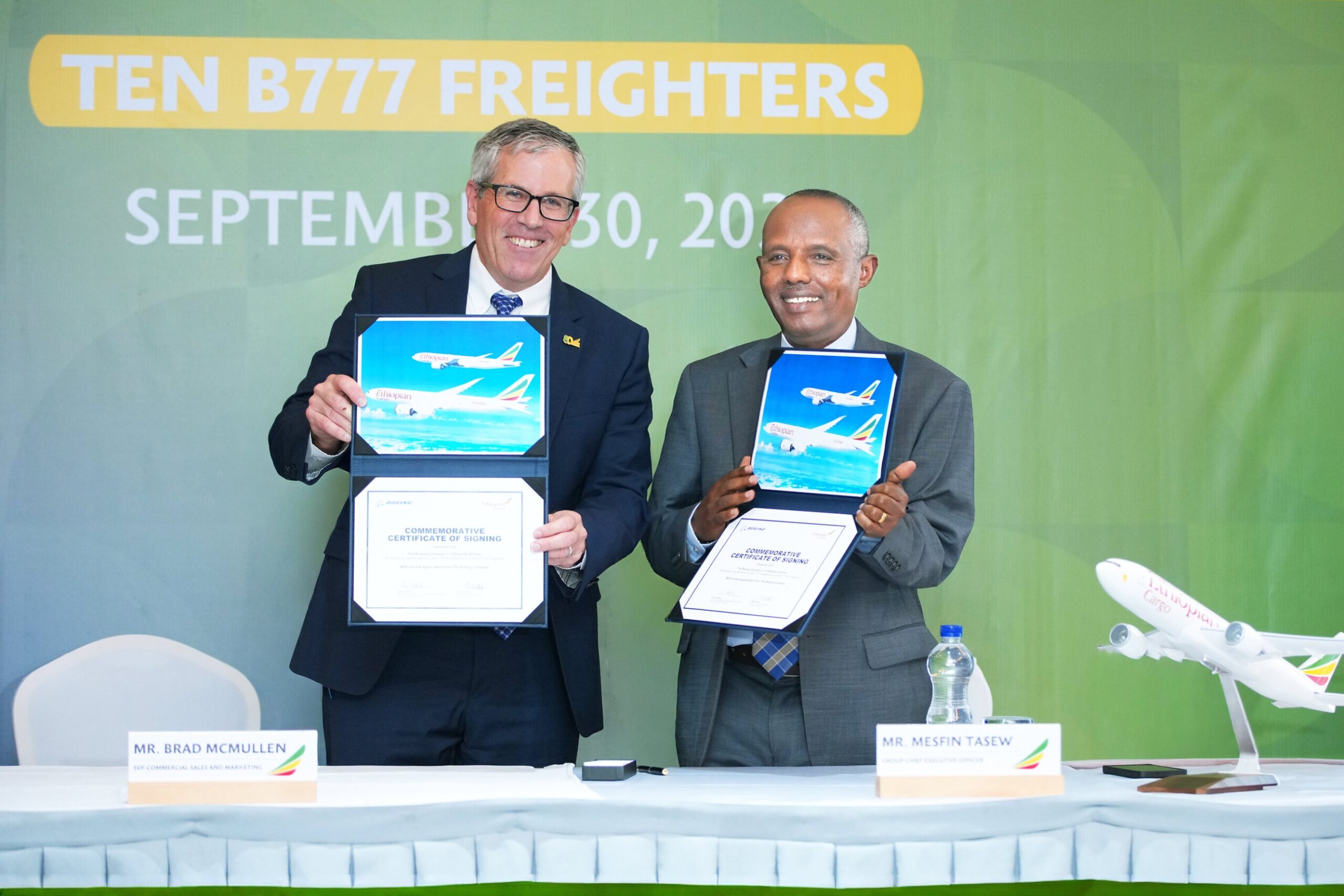
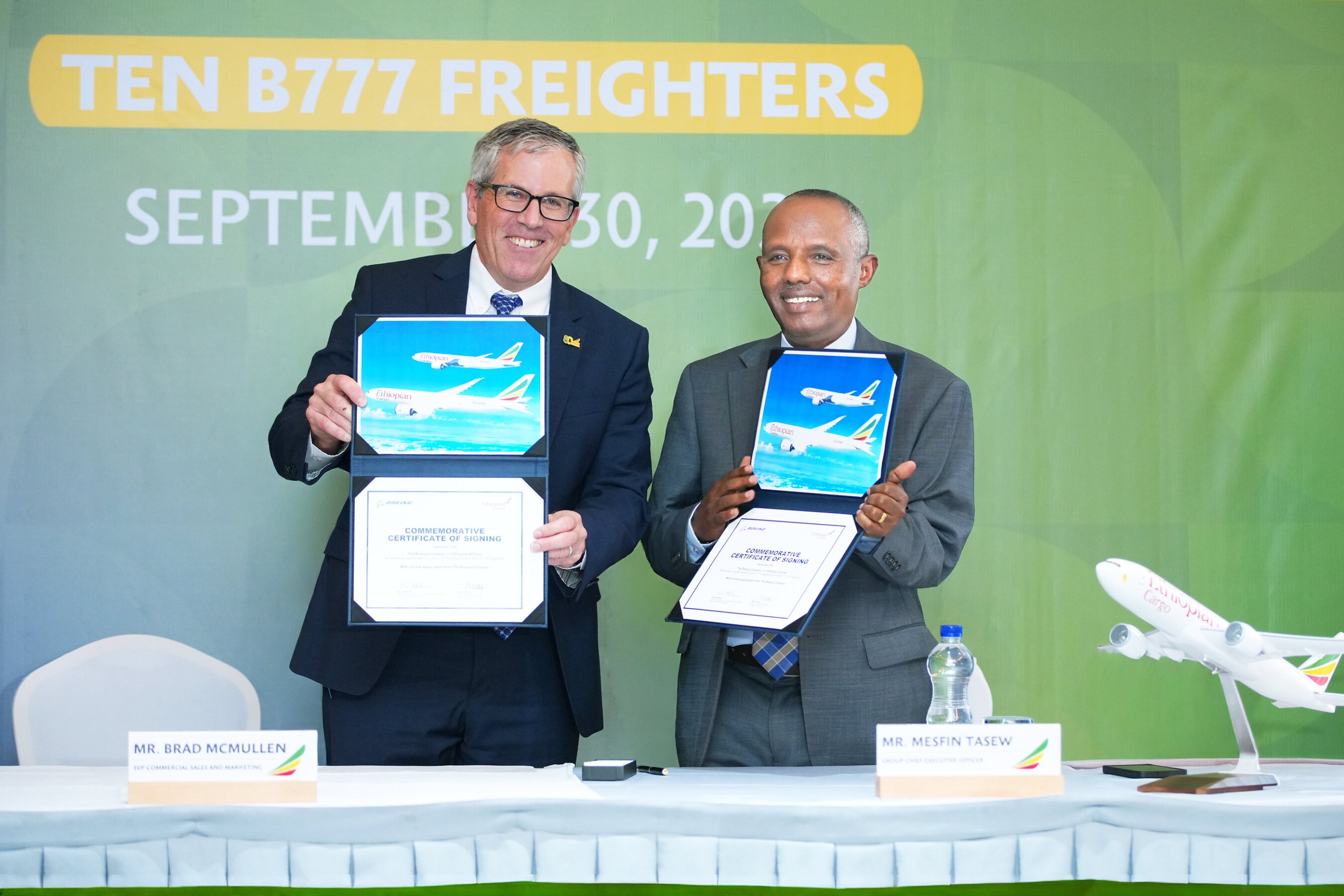
Ethiopian Airlines signed a ten-jet firm order on September 30 for ten Boeing 777 widebody freighters — two current-generation 777Fs and eight of the next-generation 777-8F variant — becoming the first carrier on the African continent to commit to Boeing’s most advanced cargo jet and placing a multi-billion-dollar wager on an aircraft that has yet to receive a single airworthiness certificate from the FAA. The deal was announced publicly on October 1 at a ceremony in Addis Ababa attended by U.S. Ambassador to Ethiopia Ervin Massinga, and carries an estimated list-price value of approximately $5 billion based on published Boeing pricing.
The order arrives two days after Ethiopian Airlines CEO Mesfin Tasew and Boeing Senior Vice President Brad McMullen signed it into existence. It also arrives at a precise inflection point in Boeing’s 777X program: the manufacturer cleared a critical FAA certification milestone in June, yet ETOPS authorization — required by most airlines before they will accept delivery — is still underway, with completion not expected until 2027 at the earliest.
What Africa Just Bought
The ten-aircraft order consists of two 777-200F freighters and eight 777-8F next-gen freighters. The former are deliverable on a well-established timeline; the latter are not. The two 777Fs bridge an operational gap created by a regulatory collision: under ICAO fuel-efficiency standards adopted in 2017 and ratified by the FAA in 2024, Boeing cannot certify new 777F aircraft after December 31, 2027. The FAA resolved this on September 16 when it granted Boeing a three-year 777F exemption permitting certification of up to 35 additional 777F aircraft beyond that deadline, enabling deliveries of the two current-generation aircraft to Ethiopian under terms that would otherwise have been legally impossible. A formal FAA exemption decision document was published September 16, 2026.
Ethiopian currently operates 12 Boeing 777-200F freighters, two 767-300Fs, and four 737-800SFs. It is Africa’s largest air cargo operator. In the most recent fiscal year, the carrier handled approximately 897,000 tonnes of cargo — a 16% increase year on year, per state media reporting sourced by Reuters.
Mesfin Tasew framed the deal in the language of milestone-making: “This agreement marks another significant milestone in strengthening Ethiopian Airlines’ cargo capabilities while supporting the continued expansion of our global network. The addition of the Boeing 777-8F Freighters and 777F Freighters will enhance our ability to serve customers around the world with greater payload capacity, operational flexibility, efficiency, and sustainability.” Boeing’s McMullen called Ethiopian “the first in Africa to order the new 777-8 Freighter,” a fact that matters considerably for the program’s commercial validation.
Why the 777-8F Is Worth Waiting For — and What It Actually Does
The 777-8 Freighter is the cargo variant of Boeing’s 777X family, a program launched in November 2013 that has accumulated $15 billion in development charges and roughly seven years of certification delays. What that sunk cost has produced is an aircraft with engineering specifications that exceed anything else in its class.
Where the outgoing 777F can carry 107 metric tonnes (235,900 lbs) of payload, the 777-8F is rated at 118 metric tonnes maximum payload (260,100 lbs) — roughly a 10% increase in outright lift. Its cargo volume comes in at 27,056 cubic feet (766 cubic meters) across 31 main-deck pallets and 13 lower-deck positions. Range is 4,410 nautical miles (8,170 km; 5,070 miles) with a full load.
Those performance gains are products of three engineering decisions that distinguish the 777-8F from the jet it replaces. First, the GE9X engine: Boeing selected GE Aerospace’s GE9X in March 2013 specifically for the 777X program. The GE9X features a 132-inch fan diameter — the world’s largest commercial turbofan fan — with a 10:1 bypass ratio and 60:1 overall pressure ratio. Those numbers translate to a claimed 10% fuel burn improvement over the GE90 engines that power the 777F. Unlike the 777-9’s -105B1A variant, the 777-8F variant uses a higher-thrust -110,000 lbf engine to handle the freighter’s higher maximum takeoff weight of 805,000 lbs (365,100 kg).
Second, the composite wing: the 777X family features carbon-fiber-reinforced polymer wings built in-house at Boeing’s $1 billion Composite Wing Center in Everett, Washington — the first time Boeing has manufactured composite wings domestically rather than outsourcing (the 787 Dreamliner’s wings are built by Mitsubishi). The wing area has increased 18% over the 777-300ER baseline, from 4,702 to 5,562 square feet (436.8 to 516.7 square meters), and usable fuel capacity rose accordingly.
Third, the folding wingtips: the 777X’s wingspan at full extension is 235 feet 5 inches (71.76 m), which would place it in ICAO airport code F — the same category as the 747-8 and A380, requiring special gate infrastructure. Boeing solved this with 11-foot (3.35 m) folding wingtips built by Liebherr Aerospace that complete their fold cycle in 20 seconds, bringing the operational wingspan within code E at 212 feet 9 inches (64.84 m). The 777-8F is thus the first commercial cargo aircraft with wingtip position controls in the flight deck cockpit — a distinction that required the FAA to issue ten special conditions governing load limits, crosswind handling, and malfunction procedures.
Where Boeing’s Certification Program Actually Stands
Boeing first flew the 777-9 on January 25, 2020, with a certification target of late 2020. The program’s certification target at that point was late 2020. It has since slipped repeatedly through a pressure vessel blowout, an uncommanded pitch event that prompted a formal FAA letter questioning “design maturity,” engine mount cracks that grounded the test fleet in August 2024, and a labor strike — accumulating charges that Boeing now estimates between $2.5 billion and $4 billion.
As of October 2026, the program stands here: in June, Boeing received FAA authorization to proceed with Type Inspection Authorization Phase 4B — the final phase with substantial remaining work, focused on avionics, stability and control, and human-factors testing. “4B is the last with what I’d say is a significant amount of work,” Boeing Commercial Airplanes President Stephanie Pope told aviation analysts in June. “We just got the approvals to go complete that work, which is a big milestone.” In May 2026, Boeing flew first production-standard 777-9 aircraft — Lufthansa’s airframe, with a fully outfitted passenger cabin rather than a test interior.
What Phase 4B authorization does not fully resolve is ETOPS. Extended-range Twin-engine Operational Performance Standards certification is the regulatory requirement for operations over oceans and remote areas beyond 60 minutes from a diversion airport. Most long-haul operators — and Ethiopian would use the 777-8F on precisely these routes — require ETOPS-180 or ETOPS-240 certification before accepting aircraft. Boeing began ETOPS flight testing in late July 2026, when a seventh 777-9 test aircraft joined the campaign specifically for ETOPS demonstrations. Boeing CEO Kelly Ortberg has acknowledged that ETOPS testing will extend into 2027, explicitly placing its completion beyond the core certification timeline. FAA Administrator Bryan Bedford indicated the full type certificate may not arrive until early 2027.
For the 777-8F, the timeline is structurally dependent on the 777-9’s completion: the freighter variant cannot receive its own type certificate until after the passenger aircraft is certified. Boeing itself expects first 777-8F deliveries approximately two years after the first 777-9 delivery. If the 777-9 certifies in early 2027, that places the freighter’s first delivery in late 2028 or, more conservatively, early 2029. Slippage in the 777-9 program propagates directly to every 777-8F delivery commitment — including Ethiopian’s eight aircraft, currently scheduled for delivery between approximately 2029 and 2035.
The 777-8F order book had 93 firm orders as of September 2026, with zero deliveries recorded. For context, the competing Airbus A350F had accumulated 115 firm orders by the same point, including 20 aircraft from Atlas Air that switched from the 777-8F in March 2026. The two programs are now in direct competition for the large freighter replacement market created by hundreds of aging Boeing 747-400F aircraft.
How Does a US Ambassador End Up at an Aircraft Signing in Addis Ababa?
The presence of U.S. Ambassador Ervin Massinga at the signing ceremony is not incidental. Ethiopian Airlines is a state-owned enterprise — the Ethiopian government holds ultimate control — and the purchase of Boeing aircraft, a U.S. manufacturer, carries diplomatic weight in the current geopolitical environment. The deal also falls under the FAA’s new 777F emissions exemption, which Boeing specifically justified in part by citing $440 million per aircraft in positive export balance for the U.S. at catalog prices, and arguing that without the exemption Boeing would lose more than $15 billion in export value. An ambassador’s attendance signals that the deal has been acknowledged at the level of the bilateral relationship between the U.S. and Ethiopia.
Africa’s Largest Cargo Bet — And Why It Depends on a Clock Boeing Doesn’t Control
The strategic rationale for the investment is inseparable from a ground-level construction project 45 km (28 miles) southeast of Addis Ababa. Ethiopia broke ground on Bishoftu International Airport on January 10, 2026, with Prime Minister Abiy Ahmed present. The airport project costs $12.5 billion for phase one alone, with Ethiopian Airlines contributing 30% of the funding and the remainder financed through lenders including the African Development Bank. When its first phase opens, around 2030, Bishoftu is designed to handle 60 million passengers annually. Full buildout envisions capacity for 110 million passengers and up to 3.7 million tonnes of cargo per year. That cargo figure alone is roughly four times Ethiopian’s current annual volumes, framing the infrastructure not as an expansion of current operations but as a platform for a qualitatively different scale of business. Main contractor selection for the project was originally scheduled for August 2026 but has been pushed to January 2027.
The airport’s physical position provides a structural operational benefit beyond passenger capacity. Bishoftu sits more than 400 meters (1,312 feet) lower in altitude than Addis Ababa Bole International Airport — and altitude matters enormously to aircraft performance. A freighter operating from a lower-elevation airport can carry more payload and extend range on the same amount of fuel, or achieve the same performance with less fuel. For a cargo operator competing with Gulf carriers based at sea-level hubs, that physics advantage is not trivial.
Ethiopian’s plan is coherent: build cargo traffic volume with the current 777F fleet while Bishoftu is under construction, then transition progressively to 777-8F operations as the new airport comes online. The 777-8F’s 4,410-nautical-mile (8,170 km; 5,070 mile) range is sufficient to connect Addis Ababa nonstop to major cargo destinations across Asia, the Middle East, and Europe. The 10% payload advantage over the 777F means that each aircraft can carry roughly 11 additional tonnes (24,200 lbs) per flight — at scale across a fleet of eight aircraft over a decade, that translates to hundreds of thousands of additional revenue-tonnes.
The strategy’s vulnerability is temporal. The Bishoftu timeline and the 777-8F delivery window are aimed at the same 2029–2032 horizon. If Boeing’s certification slips — if ETOPS extends further into 2027 or beyond, or if a fresh engineering finding requires remediation — the freighters arrive late for a hub that is itself being built to receive them. Ethiopian’s bet is not merely that the 777-8F is a better airplane than the 777F (it is). It is that Boeing’s long-delayed program will now, finally, deliver on its timeline.
What Does It Mean for Boeing?
For Boeing, the Ethiopian order adds to a 777-8F backlog that needed credible commercial momentum at a pivotal moment. The company has absorbed multi-billion-dollar charges on the 777X program for more than five years, deferring revenue that the airline manufacturer’s investors and customers need to see actually arrive. Each new firm order from a named operator — particularly one that is Africa’s largest cargo carrier and not a leasing company — strengthens the economic case that the program’s customer base will hold.
The order also comes against direct competitive pressure. Atlas Air’s 20-aircraft switch to A350F in March 2026, giving it 20 aircraft in the A350F order book, was a visible market signal that Boeing’s delivery uncertainty has costs. Ethiopian, by contrast, has remained committed to Boeing through a relationship that spans decades: its current fleet includes 29 787 Dreamliners, 12 777-200F freighters, and 15 737 MAX jets, along with the March 2024 order for eight 777-9 passenger aircraft. That institutional loyalty has commercial value.
For the African market broadly, the deal signals a different kind of ambition — not the regional connectivity that has long characterized African aviation investment, but a calculated play for a position in the global cargo hierarchy currently dominated by hubs at Dubai and Istanbul. Ethiopian has carried roughly 897,000 tonnes in its most recent fiscal year. Emirates SkyCargo, the world’s largest international air cargo carrier, moved significantly more. The gap is wide. But Ethiopian’s simultaneous investment in fleet and infrastructure — the two things a challenger hub actually needs — is a more credible structural challenge than anything the African market has produced in this domain before.
The delivery schedule currently runs from approximately 2027 for the two 777Fs to a spread across 2029–2035 for the eight 777-8Fs, contingent on Boeing achieving FAA type certification for the 777-9 on the timeline the company has publicly committed to, and ETOPS certification thereafter. Whether Boeing holds to that timeline is the single variable that could either validate or complicate the most ambitious aviation investment in Africa’s history.
Frequently Asked Questions
What is the Boeing 777-8F, and how is it different from the 777F currently flown by Ethiopian Airlines?
The 777-8 Freighter is the next-generation cargo variant of Boeing’s 777X family, designed to replace the 777F that has been in service since 2009. The key improvements are payload — the 777-8F carries up to 118 metric tonnes (260,100 lbs) of cargo compared to 107 metric tonnes (235,900 lbs) for the 777F, a roughly 10% increase — and fuel efficiency, primarily through its GE9X engines and new carbon-fiber composite wings. The 777-8F also features folding 11-foot wingtips that allow the aircraft to fit standard Code E airport gates despite a much larger wingspan. As of October 2026, the 777-8F has 93 firm orders and zero deliveries; the aircraft has not yet received FAA type certification.
When will Ethiopian Airlines actually receive its eight 777-8F freighters?
Boeing currently targets first 777-8F deliveries approximately two years after the first 777-9 passenger variant delivery, which is itself aimed at early 2027. That puts the earliest 777-8F deliveries in late 2028 or early 2029, though Boeing CEO Kelly Ortberg has noted that ETOPS certification — required for overwater routes — is still undergoing testing and won’t complete until 2027. Most airlines require ETOPS before accepting delivery. Ethiopian’s eight 777-8Fs are scheduled for delivery between approximately 2029 and 2035, subject to Boeing hitting its certification timeline.
Why does the Bishoftu airport matter to this order?
The new Bishoftu International Airport, under construction 45 km (28 miles) southeast of Addis Ababa at a cost of $12.5 billion, is designed to eventually handle up to 3.7 million tonnes of cargo annually — roughly four times Ethiopian’s current volumes. Its first phase is targeted to open around 2030. The airport also sits more than 400 meters (1,312 feet) lower in altitude than Bole, giving aircraft operating from it a meaningful payload and range advantage. Ethiopian’s strategy combines the new aircraft with the new airport: build traffic with the current 777F fleet while Bishoftu is built, then scale up using 777-8Fs when the new hub is operational.
How does the Airbus A350F competition affect this deal?
The A350F is the Boeing 777-8F’s primary competitor in the large freighter replacement market. As of September 2026, the A350F had accumulated 115 firm orders — more than the 777-8F’s 93 — partly because Airbus has been able to offer a more concrete delivery timeline. Atlas Air placed a 20-aircraft order for A350Fs in March 2026 after assessing Boeing’s certification uncertainty. Ethiopian’s choice of the 777-8F reflects its longstanding Boeing relationship and a judgment that the 777-8F’s higher payload (118 tonnes vs. A350F’s approximately 109 tonnes) is strategically worth the wait.