HomeAuto Ethan Hawke’s The Weight Opens September 18: FDR Made the Cargo Criminal First
Ethan Hawke’s The Weight Opens September 18: FDR Made the Cargo Criminal First
September 10, 2026:
Vert-ent.com
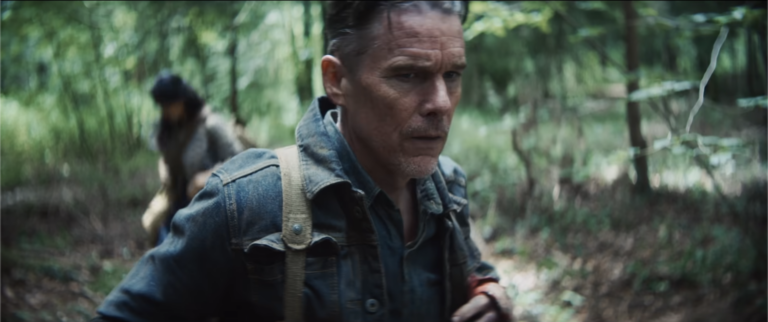
When Ethan Hawke’s Depression-era mechanic Samuel Murphy agrees to lead a ragtag crew of prisoners and guards across 100 miles of Oregon wilderness with four sacks of gold bars, he is committing a federal crime — not because he agreed to the mission, but because gold itself became contraband weeks before the journey begins. The Weight, director Padraic McKinley’s debut feature, opens in US theaters September 18, and its 95% Rotten Tomatoes score suggests critics have recognized what the film embeds inside its survival-thriller chassis: a remarkably accurate portrait of what FDR’s gold confiscation of 1933 actually meant, what gold’s physical properties actually demand, and what the American underclass of the Depression was actually being asked to carry for people who would never share its value.
The title operates on at least four levels simultaneously, and none of them is metaphorical in the way you might expect.
FDR Made the Cargo Illegal Before Murphy Could Pick It Up
On April 5, 1933 — roughly the same spring in which The Weight‘s story begins — President Franklin D. Roosevelt signed Executive Order 6102, forbidding the hoarding of gold coin, gold bullion, and gold certificates within the continental United States. Citizens had until May 1, 1933, to deliver their gold to the Federal Reserve at the mandated price of $20.67 (approximately $514 in 2025 purchasing power, per Federal Reserve inflation calculations) per troy ounce. The penalty for non-compliance: a fine of up to $10,000 (approximately $249,000 in 2025 dollars) or ten years in prison, or both.
The rationale was not simply economic moralizing. The Federal Reserve Act of 1913 required 40% gold backing for every Federal Reserve Note in circulation. By the late 1920s, bank runs accelerating through 1932 and into early 1933 had driven citizens and foreign investors to convert paper dollars into physical gold at an accelerating rate, depleting reserves toward that 40% floor. The executive order short-circuited this “gold drain” by criminalizing private gold ownership, forcing gold back into the Federal Reserve and freeing the government to expand the money supply without constraint. The Gold Reserve Act of 1934 then re-pegged the dollar at $35 per troy ounce — up from $20.67 — effectively devaluing the dollar by approximately 41% overnight and generating a windfall profit for the U.S. Treasury that seeded the Exchange Stabilization Fund.
Private gold ownership remained illegal in the United States until President Gerald Ford signed legislation that went into effect December 31, 1974 — 41 years after EO 6102.
The mine operators in The Weight are thus not merely trying to smuggle something valuable. They are trying to preserve assets in a form that the U.S. government declared, under criminal statute, they are not permitted to hold. Every bar in Murphy’s four sacks represents a direct challenge to the state’s monopoly on the physical embodiment of monetary value. Warden Clancy’s offer to Murphy — carry the gold and go free — is a transaction built entirely on contraband. Murphy is not a smuggler helping criminals. He is a coerced laborer helping property owners resist a government order that made property owners into criminals.
What “Half a Ton of Gold” Actually Means in Physical Terms
The film’s title earns its most literal meaning here. Gold (Au) carries a density of 19.32 grams per cubic centimeter — roughly 2.5 times denser than iron (7.87 g/cm³) and the third-densest element achievable without exotic chemistry, behind only osmium and iridium.
A standard “Good Delivery” gold bar, as specified by the London Bullion Market Association, measures approximately 25 by 7 by 4.5 centimeters (9.8 by 2.8 by 1.8 inches) and weighs between 350 and 430 troy ounces — or between 10.9 and 13.4 kilograms (24 to 29.5 pounds). If the film’s “approximately half a ton” of gold (roughly 450 kilograms, or 992 pounds) is divided among four sacks as shown, each sack weighs approximately 112 kilograms (247 pounds). The total volume of that gold would occupy roughly 23,300 cubic centimeters — a cube just under 29 centimeters (11.4 inches) per side. Visually unremarkable. Physically catastrophic to carry by hand.
For context, the U.S. Army’s recommended fighting load for sustained operations is approximately 22 kilograms (48 to 50 pounds). Studies of load-carriage biomechanics show that metabolic cost increases approximately linearly with carried load up to about 30% of body weight, then increases exponentially beyond that threshold. A 112-kilogram sack of gold represents four to five times the Army’s sustainable limit for a single person. Over 100 miles of forested terrain, at the pace the film’s six-day timeline implies, each person would need to cover roughly 16 miles per day while carrying a load that physiologists would classify as beyond sustained human capability without mechanical assistance — a sledge, a cart, pack animals.
This is why the film’s rope-bridge set piece described by multiple critics is not a thriller cliché but a genuine structural engineering problem. A wooden suspension bridge built for pack animals and foot traffic in 1930s Oregon wilderness might carry a rated load of 500 to 1,000 kilograms. Six men plus 450 kilograms of gold plus equipment, clothing, and weapons exceeds that threshold by design. Murphy’s mechanical expertise — the specific skill Warden Clancy prizes — is not incidental. A mechanic who understands load distribution, structural stress, and the load limits of improvised materials is the one person who can get the gold across a bridge that might not hold it.
At the 1933 exchange price of $20.67 per troy ounce, Murphy’s cargo was worth approximately $9,300 in 1933 dollars — roughly $214,000 in 2026 purchasing power, per the Minneapolis Fed CPI calculator. After FDR’s 1934 re-pegging at $35 per troy ounce, that same gold would be worth approximately $15,750 — around $362,000 in 2026 purchasing power. The crime of smuggling it is the difference between those two numbers, multiplied by the devaluation ratio, paid directly to the U.S. Treasury from the pockets of everyone who surrendered their gold at the lower price.
What Are Real Dangers of Oregon Wilderness in 1933?
Critics reviewing The Weight note that the Bavarian forests used as Oregon stand-ins lend “a dislocating eeriness” to the landscape, and that the environment reads as a coequal threat alongside the human antagonists, per the IndieWire review by Ryan Lattanzio. The historical record supports this framing more precisely than the film may have intended.
The Pacific Northwest old-growth forest of 1933 was among the most ecologically demanding environments in North America. Douglas fir and Sitka spruce canopy heights regularly exceeded 75 meters (246 feet), creating understory darkness that could disorient travelers without celestial navigation. River systems fed by Cascade snowmelt ran unpredictably in volume and speed. Cross-country travel at human scale — without roads, outside of Native trade routes and logging camp networks — routinely translated 100 linear miles into 150 or 180 hiking miles along ridgelines and drainages.
What the film’s 1933 Oregon setting adds that a generic wilderness-thriller setting does not: the first Tillamook Burn wildfire began on August 14, 1933 — in the logging operation above the North Fork of Gales Creek, 50 miles west of Portland, in the exact region Murphy’s crew must traverse. Temperatures reached 104 degrees Fahrenheit (40 degrees Celsius) with humidity at 20%. The fire burned for 11 days and destroyed approximately 240,000 to 267,000 acres of old-growth Oregon Coast Range forest (the variation in sources reflects different perimeter measurements). By 1951, four fires in the same region had burned a combined 355,000 acres (139,000 hectares), destroying an estimated 13 billion board feet of timber.
A crew crossing the northern Oregon Coast Range in August 1933 would not simply be navigating a dangerous wilderness. They would be navigating one that was simultaneously on fire, producing smoke columns visible from Portland and filling drainage corridors with superheated air. The “active antagonist” quality that critics identify in The Weight‘s environment has a specific historical basis that makes the forest threat more acute than the film’s Bavarian stand-in forests can fully convey.
What Anna’s Survival Knowledge Really Represents
The character of Anna, played by Julia Jones, is a Native woman who joins Murphy’s crew as a stowaway. She was raised, as the screenplay establishes, in a military boarding school designed to westernize Indigenous women. Reviews note that her wilderness navigation and survival skills prove essential to the crew’s progress, including a harrowing river crossing, according to the Hollywood Reporter review.
The boarding school detail is not atmospheric color. The Carlisle Indian Industrial School, founded in 1879 by Captain Richard Henry Pratt, established the template for federal assimilation policy under the motto that has come to define its legacy: “Kill the Indian, save the man.” Carlisle operated until 1918 and spawned 24 additional off-reservation schools. Students were forced to speak English, abandon traditional dress, and discard Indigenous cultural practices — including, critically, the ecological and navigational knowledge systems developed over generations of living in specific North American landscapes.
By 1933, the Indian boarding school system was under review — Commissioner John Collier’s Indian New Deal would begin reversing some of its policies with the Indian Reorganization Act of 1934 — but the damage to generations of Indigenous knowledge transmission was largely done. Thousands of Pacific Northwest Indigenous people had been processed through these institutions, stripped of the specific landscape knowledge that made safe cross-country travel through the Coast Range possible.
Anna’s position in the narrative is structurally precise: the person most capable of navigating the wilderness safely is precisely the person the U.S. government had spent 50 years trying to detach from that wilderness. Her survival knowledge is what the boarding school system classified as the thing to be destroyed — and what Murphy’s crew cannot complete its mission without. The same federal authority that criminalized gold ownership in April 1933 had been criminalizing Anna’s cultural inheritance since 1879. She and Murphy’s cargo both exist, in 1933, in legally vulnerable states because the U.S. government declared them so.
Singh’s Economics and Murphy’s Game Theory
The film’s ensemble serves as a Depression-era economic cross-section: Murphy (the wrongfully imprisoned mechanic), Singh (the immigrant with socialist sympathies), Rankin (the racist prisoner), Olson (the young Scandinavian), and the two armed guards. Multiple critics note Singh’s repeated articulations of collective action theory — that the men transporting the gold would be better off seizing it themselves than delivering it to those who will profit from their labor and the gold’s value, as the Variety film review analyzes.
This is not speechifying for its own sake. The multi-player social architecture of Murphy’s crew is a laboratory version of what game theorists call the iterated prisoner’s dilemma — a scenario originally designed in 1950 by Merrill Flood and Melvin Dresher at RAND Corporation and named by Albert Tucker, in which rational agents must choose between cooperation for mutual benefit or defection for individual gain. The prisoner’s dilemma’s core finding: defection is individually rational in a single-round game, but cooperation can emerge as a stable equilibrium in repeated interactions — when participants expect to meet again and punishment for betrayal remains credible.
Murphy’s crew violates several of the conditions that make cooperation stable. The authority enforcing cooperation (Clancy) is absent during the journey. The endpoint is finite and known. The players have heterogeneous motivations. These are precisely the conditions under which game theory predicts cooperation will collapse — under which betrayal becomes the dominant strategy for each individual, even when collective completion would benefit everyone. Singh’s socialist argument is, in formal terms, a collective action solution to the PD’s inefficiency: coordinate now, seize the cooperative surplus before Clancy can extract it. Rankin’s racism and Olson’s youth represent informational asymmetries that make the coordination Singh proposes unstable.
Murphy’s own equilibrium is unusual and, crucially, what makes him valuable to Clancy. Murphy has a specific, non-negotiable, fixed endpoint: reaching his daughter before she can be placed permanently in foster care. This functions as a credible commitment device — something game theorists identify as essential to stable cooperation. Unlike players motivated by abstract reward, Murphy cannot rationally defect, because defection means losing the thing cooperation is buying him. Clancy selected the right man not because Murphy is the strongest or the most skilled, but because he is the most predictably cooperative by structure.
The Weight is not an allegory in the loose sense of films that resemble real historical processes. It is a film in which the real historical processes — monetary coercion, assimilation policy, game-theoretic dynamics of forced labor, the literal physics of gold — are the architecture from which the narrative is built. McKinley, a longtime editor who worked on Hawke’s The Good Lord Bird before making this his debut feature, has constructed something that rewards the analytical attention a TechTimes reader brings to it.
Ford Flathead V8: Murphy’s Survival Tool
The Weight‘s car chase involving period-correct Ford Model 18s is not set-dressing but a meaningful historical object. The Ford Model 18, introduced in March 1932, carried the first flathead V8 engine offered at a price accessible to non-luxury buyers: a 221-cubic-inch (3.6-liter) cast-iron block producing 65 horsepower at 3,400 RPM and 130 pound-feet of torque, at a base price of approximately $465 (approximately $10,500 in 2026 purchasing power). Contemporary Chevrolet six-cylinder competitors produced around 50 horsepower, per Ford flathead V8 history.
The “flathead” designation describes the engine’s valve architecture: valves are located beside the pistons in the engine block (side-valve configuration) rather than in an overhead position in the cylinder head, simplifying manufacture and repair but creating a characteristic engineering vulnerability. The earliest flathead V8 cooling failures were well documented — porous castings, overheating under sustained load, and a reputation for burning oil after the first 1,000 miles of operation. Ford partially addressed these issues in the 1933 Model 40 by switching to aluminum cylinder heads, raising the horsepower rating to 75 and improving cooling.
For a mechanic with Murphy’s expertise, this engine architecture is a specific map of failure modes: two water pumps (one per cylinder head), both requiring monitoring; a gear-driven camshaft prone to specific stress patterns; an aluminum intake manifold that demanded precise carburetor mixture maintenance; and a cooling system that could not sustain the high continuous load of a hard pursuit without intervention. In a wilderness setting with no parts supply, this knowledge was not a professional credential. It was survival arithmetic.
What This Film Is About, Specifically
Samuel Murphy is a widowed Depression-era mechanic who, in the opening of the film, is evicted with his seven-year-old daughter Penny (Avy Berry) and gets into a violent altercation with undercover officers. He goes to prison; Penny goes to a group home facing permanent foster placement within 30 days. At the labor camp, Murphy earns Warden Clancy’s (Russell Crowe) attention — not through bravado but through what multiple critics describe as a quiet competence and natural leadership that makes him the one person Clancy can trust to actually complete the mission, as the Geek Vibes Nation review documents.
The mission: transport four sacks of government gold bars — contraband under federal law — across 100 miles of Oregon wilderness before FDR’s agents can confiscate them, in exchange for early release. The crew Clancy assembles includes Singh (Avi Nash), whose ongoing socialist commentary on the crew’s exploitation is the film’s explicit structural critique; Rankin (Austin Amelio), a racist whose provocations threaten the group’s cohesion; Olson (Lucas Lynggaard Tønnesen), younger and more emotionally vulnerable; and Anna (Julia Jones), the Indigenous runaway whose boarding-school past and wilderness knowledge make her simultaneously the crew’s most valuable member and its most politically charged presence.
IndieWire’s Ryan Lattanzio compared The Weight directly to William Friedkin’s Sorcerer (1977), which itself remade Henri-Georges Clouzot’s The Wages of Fear (1953) — the ur-text of cargo-transport survival cinema. The comparison is structurally apt: Friedkin’s film moved nitroglycerin through a South American jungle; McKinley moves criminalized gold through a Depression-era American wilderness. In both cases the cargo’s danger is not in what it does to people but in what carrying it reveals about who carries things in this world, and for whom.
Ethan Hawke, whom the Hollywood Reporter notes scored his fifth career Oscar nomination (his first for lead actor) this year for Blue Moon, delivers what multiple critics describe as one of his finest performances — economic, physically precise, and structured around withholding rather than display. Julia Jones as Anna is described by Loud and Clear Reviews as “a shining light alongside Hawke.” Russell Crowe, whose screen time is limited, nonetheless establishes Clancy as a man who speaks softly and enforces ruthlessly.
The film premiered at Sundance on January 26, 2026, and screened at the 76th Berlin International Film Festival on February 17, 2026. Vertical will release it to US theaters on September 18, 2026. The international wide release in approximately 28 countries follows shortly, on September 16, 2026, two days prior.
Frequently Asked Questions
What was Executive Order 6102, and why does it matter to the plot of The Weight?
Executive Order 6102, signed by President Franklin D. Roosevelt on April 5, 1933, criminalized private ownership of gold coin, gold bullion, and gold certificates in the United States. Citizens were required to deliver their gold to the Federal Reserve by May 1, 1933, at the government-mandated price of $20.67 per troy ounce (approximately $514 in 2025 purchasing power), under penalty of up to $10,000 in fines or ten years in prison. The order existed because the Federal Reserve Act of 1913 required 40% gold backing for paper currency — and accelerating bank runs had driven gold holdings toward that legal floor. By forcing gold into the Federal Reserve, the government freed itself to expand the money supply. In The Weight, which takes place months after EO 6102 was signed, the gold Murphy’s crew transports is not just valuable but federally illegal to possess — meaning Murphy is committing a federal crime before he takes a single step.
How physically realistic is the idea of six people carrying half a ton of gold across 100 miles of forest?
Extremely unrealistic as a sustained human effort, and the film knows it. Gold’s density (19.32 g/cm³) means that roughly 450 kilograms (992 pounds) of gold occupies a cube only about 29 centimeters (11.4 inches) per side — deceptively small, but distributed across four sacks, each weighing approximately 112 kilograms (247 pounds). The U.S. Army’s sustainable fighting load for prolonged operations is around 22 kilograms (48 pounds). Each sack represents roughly five times that limit. Over 100 miles in six days, through mountainous terrain with no mechanical assistance, the task pushes against the outer boundary of human physiological capability. This is why critics note the rope-bridge crossing as one of the film’s most genuinely suspenseful sequences — the structural load problem is real.
Is Anna’s character historically plausible, and what does she represent in the film’s larger argument?
Yes. The Carlisle Indian Industrial School (1879–1918) and the 24 additional off-reservation boarding schools it inspired systematically stripped Indigenous children of their languages, dress, and cultural practices — including the ecological and navigational knowledge systems specific to their home landscapes. By 1933, thousands of Pacific Northwest Indigenous people had been through these institutions. Anna’s character — a woman raised in a westernization school who retains wilderness survival knowledge despite the school’s effort to eliminate it — embodies the precise contradiction the boarding school system created: people whose government-mandated education was designed to make them unable to navigate the land their ancestors had inhabited for generations, but who sometimes retained or recovered that knowledge anyway. The Variety film critics’ review describes her story as giving The Weight “allegorical heft” as a film about “victims of an unjust system, thanklessly doing the heavy lifting for corrupt power-holders.”
What is the prisoner’s dilemma, and how does it apply to Murphy’s crew?
The prisoner’s dilemma game theory concept, developed by Merrill Flood and Melvin Dresher at RAND Corporation in 1950 and named by mathematician Albert Tucker, is a game theory scenario in which rational agents choosing between cooperation and betrayal tend toward betrayal even when cooperation would benefit everyone more. In an iterated version (where agents interact repeatedly), cooperation can become stable when future punishment for betrayal is credible. Murphy’s crew represents the dilemma’s worst-case conditions for cooperation: the enforcing authority (Clancy) is absent; the mission has a finite, known endpoint; and the players have conflicting private motivations. Singh’s socialist argument is a coherent collective action response — coordinate now, share the cooperative surplus. Murphy’s own cooperation is stable not because he is virtuous but because he has an irreplaceable commitment: reaching his daughter before she can be permanently adopted. That fixed endpoint is his credible commitment device, and Warden Clancy selected him precisely because it makes Murphy the one player in the group who cannot rationally defect.