HomeAuto ESA Hera Reaches Asteroid Didymos: First Close Image Shows Side DART Never Photographed
ESA Hera Reaches Asteroid Didymos: First Close Image Shows Side DART Never Photographed
November 6, 2026:
Esa.int
The first experiment in the history of planetary defense has two halves. Humanity completed the first on September 26, 2022, when NASA’s DART spacecraft drove itself into the moonlet Dimorphos at 6.6 kilometers per second (4.1 miles per second, approximately 14,750 mph) and shortened its orbit by 33 minutes. On Thursday, November 5, 2026, ESA’s Hera spacecraft began the second half — arriving at the Didymos binary asteroid system and returning the first close-range science image of a world humanity deliberately altered.
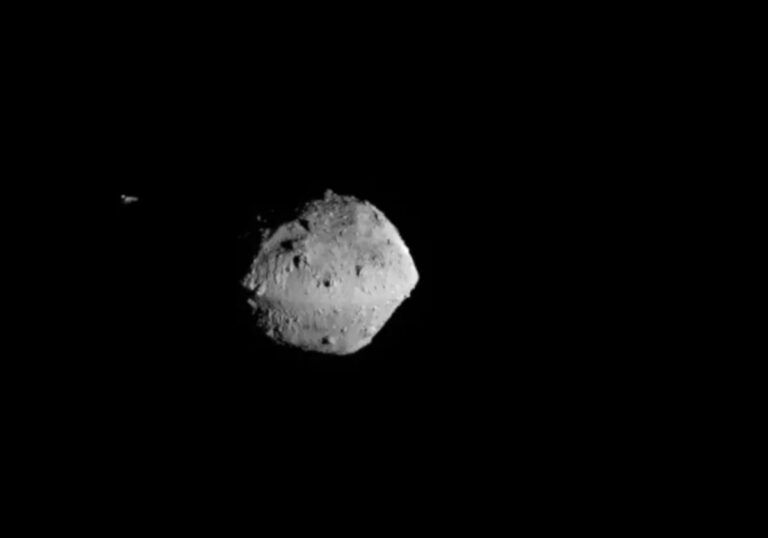
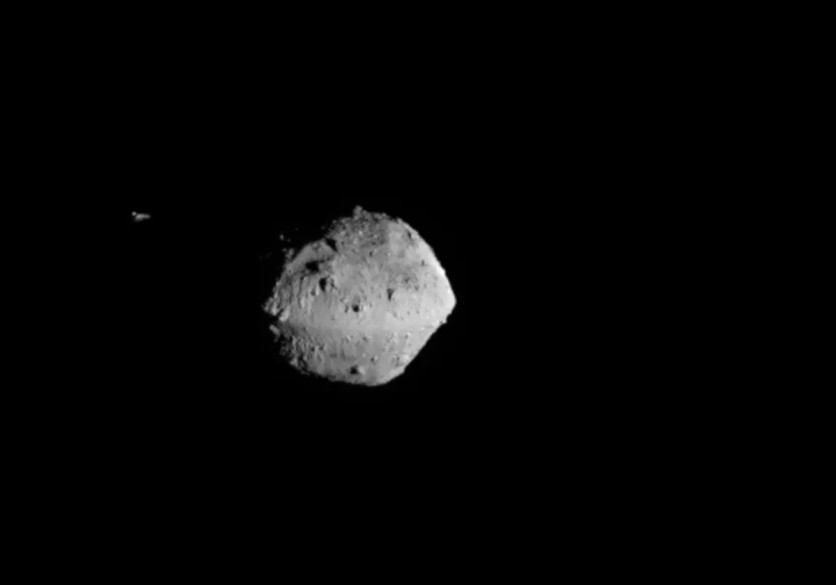
The image, taken from approximately 60 kilometers (37.3 miles) by Hera’s Asteroid Framing Camera, shows the face of the 780-meter-wide (2,559-foot-wide) Didymos that DART’s camera never saw — a rugged, boulder-strewn hemisphere that immediately raised questions about whether debris flung off Dimorphos during the 2022 impact may have reshaped its larger companion’s surface. It is the opening frame of what ESA has called, in its own mission documentation, a “crime scene investigation” — systematic, close-up science on a system that no longer looks the way it did before humanity touched it.
“This Feels Like Looking at a Whole New World”
The image, shared publicly Thursday, shows Didymos in sharp enough detail to resolve individual surface features across a hemisphere that DART never photographed. Dimorphos — the 151-meter-wide (495-foot-wide) moonlet that DART struck — appears at the lower left of the frame, partially obscured by shadow.
What immediately caught the science team’s attention was how different this face of Didymos looks from the hemisphere documented by DART’s DRACO camera in its final approach images in 2022.
“The first thing we said was wow!” said Hera Principal Investigator Patrick Michel, Director of Research at CNRS/Observatoire de la Côte d’Azur in Nice, France. “This is the other side of Didymos from the one that DART’s camera showed us shortly before impact, so this feels like looking at a whole new world. This side of Didymos has the same central ridge along its equator that we saw before, but otherwise appears very different, with multiple boulders and craters and what look like patterns of grooves or ridges.”
The equatorial ridge — a bulging band of material that girds Didymos’s midsection and is shared by other so-called “spinning top” asteroids such as Ryugu and Bennu, both of which were visited by sample-return missions in recent years — appears on both hemispheres, confirming the structure extends across the entire body. But the abundance of boulders visible on the newly imaged face was not anticipated at this density, and several members of the science team have already proposed a hypothesis for their origin.
Some or all of them may be impact ejecta that traveled the roughly 1 kilometer (0.6 miles) of space between Dimorphos and Didymos after DART’s collision and settled onto the larger body’s surface. The prediction is not speculative: a 2025 study published on arXiv (preprint 2503.08158) modeled the trajectory of DART-ejected boulders and found that the vast majority of ejecta re-impacts either Dimorphos itself or Didymos, with craters estimated at 0.2–2.9 meters (0.7–9.5 feet) in diameter from individual boulders. Hubble Space Telescope observations after the DART impact confirmed that at least 37 boulders ranging from 1 to 6.7 meters (3 to 22 feet) were ejected from Dimorphos’s surface.
“Since we expect a lot of impact-ejected material to have made it across the approximately 1 km (0.6 miles) of space from Dimorphos to Didymos, it may be that some of these characteristics originate from this transport of material,” said Hera Mission Scientist Michael Küppers, ESA’s project scientist for the mission. “We have exciting work ahead of us to sort it out. We look forward to seeing much more of both bodies and systematically mapping all the changes we identify.”
From a Single Dot to a World
The November 5 image is Hera’s first close-range science return, but the journey to this moment unfolded over several weeks. On October 18, Hera’s Asteroid Framing Camera first resolved Didymos and Dimorphos as two distinct objects — separated in the frame rather than appearing as the single point of light the system had been during the cruise phase. That image, taken from approximately 1,280 kilometers (795 miles), showed Dimorphos as barely a pixel in size but marked the beginning of Hera’s science observation campaign in earnest.
“With this image, the smaller Dimorphos asteroid becomes visible for the first time,” Küppers said at the time. “Before this acquisition, the spacecraft was still resolving the Didymos system as a single dot. But now, even though Dimorphos is made up of only around one pixel in this initial image, it is clearly well separated from its parent body.”
Over the following two and a half weeks, Hera closed the distance substantially, executing a series of braking maneuvers to match the speed of the Didymos system — ESA described this as the most challenging operational activity since the spacecraft’s launch. The binary system is currently located approximately 196.8 million kilometers (122.3 million miles) from Earth, requiring a one-way communication delay of roughly 11 minutes.
Ian Carnelli, Hera’s Mission Manager and ESA Head of the Systems Department, called Thursday’s image release a vindication of years of preparation. “Seeing this image is a hugely exciting moment for the whole Hera family,” he said. “It has taken years of hard work and dedication to reach this point — but we’re motivated to know that the adventure is only beginning!”
ESA has announced that the first detailed, full-resolution images of both Didymos and Dimorphos will be released publicly on November 25, 2026.
The DART Backstory: What Hera Is Finishing
Understanding what Hera is now seeing — and what it is designed to measure — requires going back to September 26, 2022, when NASA’s Double Asteroid Redirection Test spacecraft ended its mission exactly as planned: by driving into Dimorphos at roughly 6.6 kilometers per second (4.1 miles per second, approximately 14,750 mph). The collision was the first deliberate test of a kinetic impactor as a planetary defense technique — the idea that a spacecraft’s kinetic energy could nudge an asteroid onto a different trajectory if one were ever found on a collision course with Earth.
The result exceeded expectations. DART’s impact shortened Dimorphos’s orbital period around Didymos by approximately 33 minutes — reducing its along-track orbital velocity by 2.70 ± 0.10 mm/s — well above the 73-second minimum that would have constituted a mission success, and exceeding it by roughly 26 times. The impact also reshaped the moonlet’s overall structure and generated a 10,000-kilometer (6,214-mile) debris plume visible from ground-based telescopes around the world.
But DART’s own camera was destroyed in the impact. It captured imagery of Dimorphos’s surface at resolutions as good as a few centimeters per pixel during the final approach — but it ceased transmitting the moment it hit. What DART left behind was a physical record: a crater of uncertain size and depth, a reshaped surface, an altered orbit, and a debris field. What it did not leave behind was any way to characterize the physics of what it had done.
That is what Hera is here to measure.
The critical missing number is the momentum transfer efficiency — called the beta factor in impact physics. For a pure kinetic impact (no ejecta), beta equals 1: the impactor delivers its own momentum and nothing more. But when an impact blasts material off the surface in the anti-impact direction, that ejecta carries momentum of its own, amplifying the deflection beyond what the impactor alone could achieve. A beta of 3.61 — the value measured for DART’s impact, published by Cheng et al. in Nature in 2023 — means the total momentum transferred to Dimorphos was roughly 3.61 times the momentum DART carried. The ejecta alone contributed approximately 2.6 times as much momentum as the impactor itself.
That is a favorable number for planetary defense. It means a relatively small spacecraft, striking at the right angle, can deflect a much larger asteroid than its mass alone would suggest. But the beta value measured for DART/Dimorphos carries a large uncertainty: the full range is 2.2 to 4.9, depending on what Dimorphos actually weighs. And Dimorphos’s mass has never been directly measured. Ground-based estimates carry large uncertainties, because mass requires knowing both a body’s volume and its density — the latter is nearly impossible to infer reliably from Earth.
Hera will measure Dimorphos’s mass directly by tracking its own trajectory through the binary system’s gravity field with extraordinary precision. That radio science measurement will collapse the 2.2–4.9 beta range to a precise, reliable value — and in doing so, will convert the DART experiment from “a deflection that worked once” into “a technique that can be engineered to work again.”
What Hera Carries — and Why Every Instrument Matters
Hera arrived at Didymos carrying twelve scientific instruments distributed across the main spacecraft and two European CubeSats — Milani and Juventas — that will be deployed to operate autonomously in the vicinity of the asteroid system like aerial drones, taking risks the larger mothership cannot.
Milani and Juventas are the first ESA CubeSats to operate beyond Earth orbit — a technology demonstration embedded within the science mission. CubeSats (a class of standardized small satellites built from 10-centimeter, 4-inch cube units) have become increasingly common since their design was first proposed in 1999 by researchers at Cal Poly San Luis Obispo and Stanford, but deep-space deployment has remained challenging due to power, radiation, and communication constraints. Both CubeSats are planned to end their missions by touching down on Dimorphos’s surface.
The main spacecraft’s instrument suite:
AFC (Asteroid Framing Camera): The visible-light camera that captured Thursday’s science image, capable of resolving features as small as approximately 1 meter (3.3 feet) at close operational distances. Two redundant units are carried for reliability.
HyperScout-H: A hyperspectral imager covering the visible to near-infrared range (650–950 nm) in 25 wavelength bands. Maps surface composition by identifying mineral absorption signatures across both asteroids’ surfaces — revealing what DART excavated and what arrived as ejecta.
PALT (Planetary Altimeter): A micro-lidar laser altimeter with 0.5-meter (1.6-foot) vertical accuracy that will build a precise topographic map of Dimorphos’s surface and measure the depth and volume of DART’s impact crater. The crater geometry is essential: without knowing the excavated volume, it is impossible to calculate how much ejecta was produced and therefore how much of the beta value came from ejecta versus direct impact momentum.
TIRI (Thermal InfraRed Imager): Provided by JAXA, Japan’s space agency; covers 8–14 µm to measure surface temperatures. Temperature gradients reveal thermal properties and surface roughness, distinguishing solid rock from loose regolith.
Radio Science Experiment: Uses X-band Doppler tracking to measure masses and gravity fields of both asteroids directly — the measurement that determines Dimorphos’s mass and closes the beta calculation.
The CubeSat payloads:
Milani CubeSat carries the ASPECT spectral imager and VISTA dust and volatile sensor for close-up mineralogical characterization of the DART impact site and ejecta composition.
Juventas CubeSat carries two instruments of particular scientific importance: the GRASS gravimeter (for gravitational measurements of Dimorphos) and the JuRa radar — the first ground-penetrating radar ever flown to an asteroid. Operating at 50–70 MHz, JuRa is designed to probe up to approximately 100 meters (328 feet) below Dimorphos’s surface, revealing whether its interior is solid rock or the loose, porous “rubble pile” structure that researchers believe Dimorphos may represent. No other instrument in the history of asteroid exploration has attempted this measurement.
Milani is named in honor of the late Andrea Milani Comparetti, the Italian mathematician and astronomer who founded Europe’s asteroid risk monitoring infrastructure — specifically the NEODyS (Near Earth Objects Dynamic Site) service and AstDyS database, which track the orbital evolution of thousands of near-Earth asteroids and assess their impact probabilities — and whose work on orbital dynamics directly informed the scientific case for a kinetic deflection demonstration. A professor of mathematics at the University of Pisa, he died on November 28, 2018, before the mission he helped inspire reached the launch pad.
Five Phases, Six Months
Hera’s science operations at Didymos are structured in five sequential phases, each bringing the spacecraft and its CubeSats progressively closer to the surface and to more demanding science objectives.
Phase 1 — Early Characterization (6 weeks): Currently underway. Hera observes both asteroids from standoff distances of roughly 25 to 30 kilometers (15.5 to 18.6 miles), refining the shape models of both bodies, characterizing surface texture and boulder distribution at global scale, and confirming that all instruments are operating correctly in the asteroid system’s environment.
Phase 2 — Payload Deployment (2 weeks): Release of the Milani and Juventas CubeSats to begin autonomous operations in the Didymos system.
Phase 3 — Detailed Characterization (4 weeks): Hera moves to closer proximity for meter-scale surface mapping, composition surveys with HyperScout-H, thermal mapping with TIRI, and the first interior soundings from Juventas’s JuRa radar. This phase produces the global surface maps needed to understand how DART reshaped Dimorphos and how ejecta redistributed across both bodies.
Phase 4 — Close Observation (6 weeks): Hera’s laser altimeter enters its operational range, enabling precise crater depth measurements. This measurement — combined with the radio science mass determination — is what completes the beta calculation that DART began.
Phase 5 — Experimental (6 weeks): Juventas and Milani are pushed to extremely close distances before their controlled touchdowns on Dimorphos’s surface. ESA has planned for Hera’s formal mission at the Didymos system to extend at least through June 2027, with a possible extension. Hera’s own mission will ultimately conclude with a final descent toward Didymos.
The Closing of the Loop — and the Gap That Remains
Taken together, Hera’s data will accomplish something DART could not on its own: convert a successful but incompletely characterized deflection experiment into a fully understood event from which future mission planners can draw reliable parameters.
The momentum transfer efficiency — beta = 3.61 for DART/Dimorphos, range 2.2–4.9 — is favorable news. It means that ejecta amplified DART’s deflection by roughly 3.6 times, which implies that kinetic impactor missions can achieve meaningful deflections with relatively modest spacecraft masses. The planetary defense implication is significant: if beta reliably exceeds 2 across a range of asteroid types and sizes, a single planned spacecraft could deflect most sub-300-meter near-Earth asteroids given sufficient warning time, without requiring a nuclear option or multiple impactors.
“Hera’s discoveries will help turn the kinetic impact method of asteroid deflection from a one-off experiment to a well-understood and potentially repeatable technique if ever Earth comes under threat,” ESA has stated in its mission documentation.
But the deflection science now leads directly to the detection problem — and there, the picture is less reassuring.
Approximately 25,000 near-Earth asteroids wider than 140 meters (459 feet) exist, according to NASA estimates. Only about 40 percent have been catalogued. The remaining 60 percent — roughly 15,000 objects large enough to destroy a city or cause regional devastation — have never been observed. The NEO Surveyor telescope, a space-based infrared observatory specifically designed to detect dark asteroids that ground-based telescopes miss, was originally planned for a 2026 launch. Its cost estimate grew from approximately $1 billion to $1.6 billion, and its launch has been pushed to 2027–2028. As of this year, there is no spare planetary defense spacecraft ready to deploy against a newly discovered threat, according to Nancy Chabot, who coordinated the DART mission at Johns Hopkins Applied Physics Laboratory.
The implication is not cause for immediate alarm — but it is cause for clear-eyed accounting. DART proved deflection works. Hera will prove it works reliably. What neither mission resolves is the question of whether we would know in time to use that capability.
The Didymos system itself poses no hazard to Earth — it was selected precisely because its orbit brought it close enough for DART to reach efficiently, while keeping it safely away from any Earth-crossing risk. But the physics it embodies — the interaction between a high-speed impactor and a loosely bound rubble-pile asteroid — is exactly the physics that would govern a real planetary defense scenario if a threatening body of similar size were ever identified.
The image Hera returned Thursday from 60 kilometers (37.3 miles) above that system is the opening frame of the final chapter of that experiment — the moment when the investigation, years in the planning, finally begins.
The Didymos system has also become a laboratory for a phenomenon that planetary scientists had predicted but never directly observed: sesquinary ejecta — debris from an impact on one binary component that crosses the gap and settles onto the other. If Hera’s systematic mapping confirms that the boulders visible in Thursday’s image originated on Dimorphos and were transported to Didymos by DART’s collision, it will be the first direct observational confirmation of this process, with implications for how binary asteroid surfaces are reshaped over geological timescales.
What Comes Next
ESA will release detailed close-up imagery of both Didymos and Dimorphos on November 25, 2026. Those images, taken at substantially closer range and potentially with multiple instruments operating simultaneously, are expected to show DART’s impact site on Dimorphos for the first time since the 2022 collision — giving the science team its first direct view of whatever the impact left behind.
Hera launched on October 7, 2024, aboard a SpaceX Falcon 9 rocket from Cape Canaveral Space Force Station in Florida. The two-year transit included a Mars gravity assist flyby on March 12, 2025 — a close approach to within 5,000 kilometers (3,107 miles) of Mars, with a Deimos flyby at approximately 300 kilometers (186 miles) — which bent the spacecraft’s trajectory toward the Didymos system while providing an opportunity to test Hera’s instrument suite. That Deimos flyby produced its own scientific finding: a 2026 study in Nature Astronomy concluded that Deimos is likely a rubble pile reshaped by an oblique impact from a roughly 320-meter (1,050-foot) asteroid, forming a 10-kilometer (6.2-mile) basin near its south pole. The mission’s science return has already begun.
The total mission cost is €363 million (approximately $409 million USD at EUR/USD mid-market rate of approximately 1.1260 as of November 5, 2026; conversions are approximate), funded by the European Space Agency.
The mission is a collaboration between ESA and NASA, coordinated through the Asteroid Impact and Deflection Assessment (AIDA) framework established in 2013 — the first formal international bilateral collaboration in planetary defense science. Patrick Michel, whose advocacy has bridged the scientific and policy dimensions of planetary defense for more than two decades through his roles in UN COPUOS Action Team 14 and the International Asteroid Warning Network steering committee, leads the European science team. As his mission now delivers its first science images, the larger project he has spent his career on — establishing planetary defense as a mature, reliable discipline rather than a theoretical contingency — is measurably closer to completion.
What remains to be completed is the other half of readiness: the cataloguing of the thousands of city-killer asteroids still unknown, and the operational systems that would let humanity act on that knowledge in time. The deflection science, Hera is demonstrating, is in hand. The detection infrastructure still has work to do.
Currency conversions are approximate; €363 million was converted at EUR/USD mid-market rate of approximately 1.1260 as of November 5, 2026.
Frequently Asked Questions
What is the Didymos system?
Didymos is a binary asteroid system consisting of a 780-meter-wide (2,559-foot-wide) primary asteroid and a smaller moonlet called Dimorphos, approximately 151–160 meters (495–525 feet) wide. It is classified as an Apollo-type near-Earth asteroid and is considered a “potentially hazardous object” based on its orbit, though it poses no actual threat to Earth in the foreseeable future. It was selected for the DART/Hera planetary defense experiment precisely because its orbit made it accessible to both spacecraft while keeping it safely distant from any Earth-impact trajectory.
What did DART actually do?
NASA’s DART spacecraft struck Dimorphos on September 26, 2022, at approximately 6.6 km/s (4.1 miles/second, roughly 14,750 mph), shortening Dimorphos’s orbital period around Didymos by 33 minutes. The impact reduced Dimorphos’s along-track orbital velocity by 2.70 mm/s and generated a debris plume stretching 10,000 kilometers (6,214 miles) into space. The mission succeeded by roughly 26 times the minimum threshold set for mission success (73 seconds of orbital period change).
What is the beta factor and why does it matter?
The beta factor (also called the momentum enhancement factor) measures how much more momentum was transferred to Dimorphos than DART delivered by impact alone. For pure kinetic impact, beta = 1. For DART/Dimorphos, the measured beta was approximately 3.61 — meaning ejecta carried roughly 2.6 times as much additional momentum as DART itself. A higher beta value means smaller spacecraft can achieve larger deflections, making planetary defense more cost-effective. The uncertainty in beta (range 2.2–4.9) exists because Dimorphos’s mass has never been directly measured; Hera’s radio science experiment will resolve this.
What is Hera’s most important measurement?
Measuring the mass of Dimorphos directly, using the precise Doppler tracking of Hera’s radio signal as it orbits through the binary system’s gravity field. This mass measurement completes the beta calculation that DART began — converting the DART experiment from a one-off demonstration into a calibrated engineering dataset that future planetary defense missions can rely on.
Is Didymos dangerous?
No. The Didymos system was specifically selected for the DART/Hera experiment because its orbit keeps it at a safe distance from Earth while making it accessible to spacecraft launched from Earth. It poses no impact threat to Earth in any currently modeled scenario.
What are Milani and Juventas?
Milani and Juventas are the two CubeSat spacecraft aboard Hera — the first ESA CubeSats to operate beyond Earth orbit. Milani maps the surface composition of the Didymos system using spectral imaging. Juventas carries the JuRa radar instrument, which will attempt to probe up to 100 meters (328 feet) below Dimorphos’s surface — the first-ever radar sounding of an asteroid’s interior. Both CubeSats are planned to end their missions by landing on Dimorphos. Milani is named after Andrea Milani Comparetti (1948–2018), the Italian mathematician who founded the NEODyS asteroid risk monitoring service.
What is a rubble-pile asteroid?
An asteroid composed of loosely bound fragments held together by gravity rather than a single cohesive rocky body. Rubble piles have high internal porosity and low bulk density. Dimorphos is believed to be a rubble pile based on its density estimates and the dynamics of DART’s impact — but its interior structure has never been directly probed. Juventas’s JuRa radar will make the first direct measurement of Dimorphos’s subsurface, confirming or revising this interpretation.
What happens on November 25?
ESA has scheduled the public release of the first detailed, full-resolution images of both Didymos and Dimorphos for November 25, 2026. These images will be taken at closer range than Thursday’s science image and with multiple instruments, and are expected to show DART’s impact crater on Dimorphos for the first time since 2022.