Ear-Cuff Earphones at $31: HACRAY CuffAir Adds Luminous Silver; Roa Cites 10,000-Test Wire

November 15, 2026:

Ear-Cuff Earphones at $31: HACRAY CuffAir Adds Luminous Silver; Roa Cites 10,000-Test Wire
HACRAY CuffAir
Roa-international.com

Roa International announced Luminous Silver, a second color for its HACRAY CuffAir ear-cuff earphones, on Nov. 11, and pre-orders are open on the company’s official online store in Japan at ¥4,890 (approximately $31 USD). The price matches the original Metal Black, and the specifications Roa lists for silver match the figures in PHILE WEB’s April launch report.

For buyers deciding whether to wait for silver, the useful detail sits in the gap between Roa’s own pages. Roa’s store page lists early-December shipping, while retailer e-earphone lists late November with its own barcode and Bluetooth 6.0, and Roa’s announcement states neither a Bluetooth version nor a shipping date. Japanese outlet Real Sound Tech covered the news on Nov. 14 and described the silver as having a metallic finish.

Roa Store Says Early December; Retailer Lists Late November and Bluetooth 6.0

e-earphone’s product page lists Luminous Silver as scheduled for late November 2026, with its own barcode distinct from Metal Black’s. The same page gives the Bluetooth version as 6.0, a detail that neither Roa’s November announcement nor PHILE WEB’s April report states. Treat Bluetooth 6.0 as retailer-reported until Roa confirms it. The two shipping dates differ, and neither page explains why. Sound House’s English page lists only Metal Black, as a back-order item at ¥4,890 (approximately $31 USD), with no release date.

The original launch is well documented. PHILE WEB reported on April 28 that the CuffAir had gone on sale with shipping planned for early May. Sound House gives the Metal Black model number as HR-OE01MB, while e-earphone gives barcodes but no model number for the silver version.

How Does 0.6 mm (0.024 in) Shape-Memory Wire Keep Earphones on Your Ears?

Roa says the clip is a 0.6 mm (0.024 in) nickel-titanium wire in flexible TPU. Nickel-titanium, known as nitinol, is an alloy of roughly equal parts nickel and titanium. A clip that must spring back at body temperature would rely on superelasticity, which Wikipedia’s shape-memory alloy entry calls pseudoelasticity: a stress-driven effect in which the alloy takes a large deformation and recovers when released, rather than heat-triggered shape recovery. Wikipedia puts nitinol’s elastic range 10 to 30 times that of ordinary spring material. That is how a thin wire opens wide enough to pass over ear cartilage and still closes with grip.

Roa says the wire passed 10,000 expansion tests. If each wear opens the clip once, two to four clip-ons per day would take roughly 6.8 to 13.7 years to reach 10,000, by TechTimes arithmetic. Rivals cite higher numbers. Soundcore says its $169.99 AeroClip endures 20,000 bends, and EarFun cites more than 20,000 bends and stretches for the 0.55 mm nickel-titanium wire (0.022 in) in its Clip earbuds, encased in liquid silicone. Neither Roa’s announcement nor the PHILE WEB report describes how an expansion was measured, so 10,000 against 20,000 is not a like-for-like gap. The failure mode to watch is gradual: Wikipedia describes an alloy that loses superelastic behavior with cycling rather than breaking, which in a clip would show up as weaker grip rather than a sudden snap.

Because nitinol is roughly half nickel, skin contact deserves a question from anyone with a nickel allergy. Nickel is the most common contact allergy in industrialized countries, affecting roughly 8 to 19 percent of adults, and the risk depends on how much nickel a surface releases rather than on its nickel content. Nitinol’s oxide layer slows nickel release, though thicker layers can microcrack. Roa’s announcement describes TPU and a nickel-titanium wire but does not say whether the TPU fully covers the wire, while EarFun describes its wire as encased in liquid silicone. Buyers with a known nickel allergy should ask Roa before ordering.

Open-Ear Physics: Silicone Cover Cuts Leakage but Cannot Seal In Bass

Without an ear-canal seal, less bass reaches the eardrum, which is why open-ear designs lose low frequencies and, because the driver radiates outward, leak sound to bystanders. Shokz cautions that clip-on bass limits are tendencies, with tuning and fit also mattering. Roa’s answer is passive: an 11 mm (0.43 in) driver with a dedicated silicone cover over the speaker. The e-earphone product copy says the cover reduces leakage on trains and in cafés. JVC’s HA-NP1T2 takes a different route, adding anti-phase signal processing to cancel leakage. Neither Roa’s announcement nor PHILE WEB’s report describes digital leakage cancellation for the CuffAir or includes a leakage measurement.

AAC and SBC Only, IPX4 With No Dust Rating, and 60 ms Gaming Mode

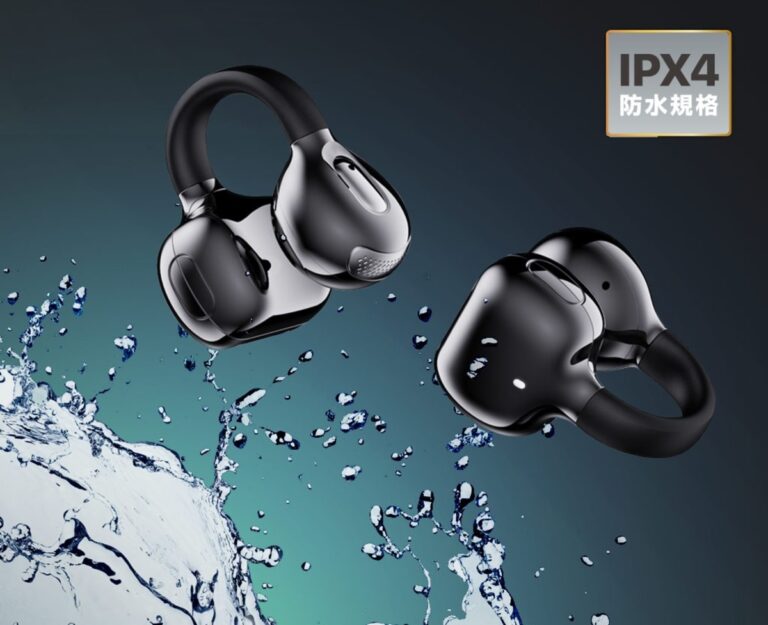
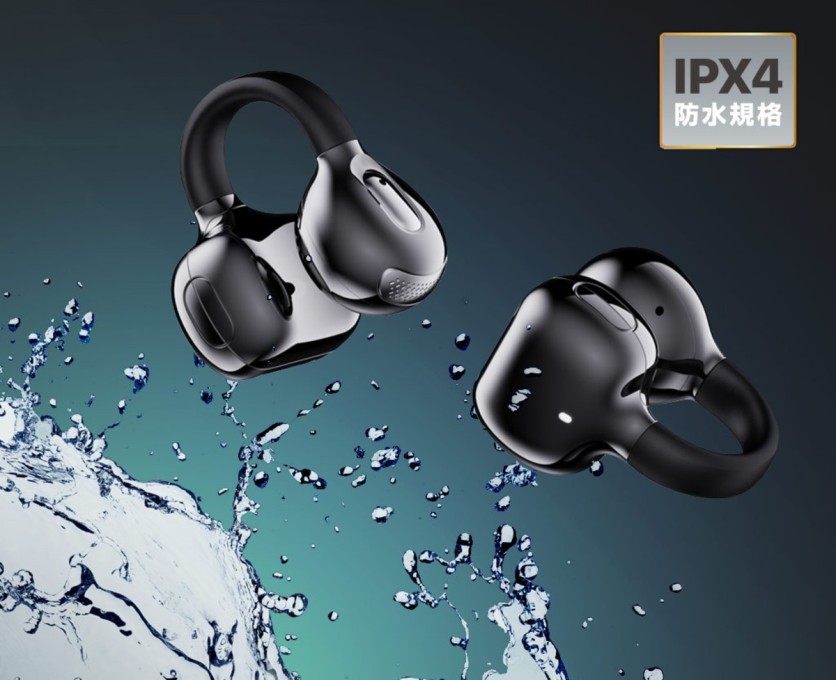
The CuffAir supports AAC and SBC. SBC is the baseline codec that Bluetooth’s A2DP audio profile requires of devices that support it, and AAC is a lossy standard that Apple adopted for iTunes and the iPod, with iPhone and iPad support. No higher-bitrate codec such as LDAC is listed, a feature TechTimes noted on CMF’s budget Clip Pro. The IPX4 rating covers splashing water from any direction, and the X means no dust rating is specified. IPX4 applies to the earbuds only, not the case.

Item Detail

Driver

11 mm (0.43 in)

Codecs

AAC, SBC

Bluetooth version

Not stated by Roa; e-earphone lists 6.0

Bluetooth range

About 10 m (33 ft)

Multipoint

Two devices at once

Gaming latency

60 ms

Controls

Physical click buttons, color-coded left and right

Water resistance

IPX4, earbuds only

Battery

About 7 hours per charge, up to about 24 hours with the case

Cells

40 mAh per bud, 320 mAh case

Charging

USB-C; about 2.5 hours for the buds, about 2 hours for the case

Shipping

Roa store: early December; e-earphone: late November

Weight and microphone

Not stated

Specifications come from Roa’s own announcement page and PHILE WEB’s April launch report.

How Does $31 CuffAir Compare With Other Ear-Cuff Earphones?

Price is the part of the story that holds up. Soundcore’s AeroClip, an open-ring clip-on model, lists at $169.99 in the US, about 5.5 times the CuffAir’s price, and lists Bluetooth 5.4 and multipoint. JVC’s HA-NP1T2 costs ¥19,800 in Japan (approximately $124 USD), about four times the CuffAir. Neither is a like-for-like match: the AeroClip states a Bluetooth version where Roa does not, and the JVC adds leakage processing that the CuffAir’s published specifications do not describe.

Can Buyers Outside Japan Order Luminous Silver?

Roa lists pre-orders on its official online store, mycaseshop.jp, and quotes the price in yen only. The store page says its warranty applies only within Japan. Sound House carries an English-language page for the Metal Black model. Roa International is a Tokyo company founded in July 2006 and based in Shinjuku. Roa’s announcement does not describe overseas shipping terms, so buyers outside Japan should confirm shipping, warranty and radio compliance with a seller before ordering.

Luminous Silver changes the finish, not the product. A reader who wants the CuffAir gets the same roughly $31 earphone in a second color, and should verify three things before paying: the Bluetooth version, the conflicting shipping dates (early December on Roa’s store, late November at e-earphone), and whether the nitinol wire touches skin. The 10,000-expansion figure is Roa’s own claim and cannot be compared directly with rivals’ 20,000-bend numbers until the test methods are published.

Exchange rate as of November 14, 2026; conversions are approximate.


Frequently Asked Questions

Is Luminous Silver a new CuffAir or only a new color?

Only a new color. Roa’s November announcement lists the same specifications as PHILE WEB’s April launch report, including driver, codecs, battery figures, IPX4 rating and 60 ms gaming latency, and the price is unchanged at ¥4,890 (approximately $31 USD).

Do open-ear earphones leak sound?

Yes, because the driver radiates sound without an enclosure. Shokz notes that leakage varies with volume and fit, along with speaker position and acoustic design. The CuffAir uses a passive silicone cover, and no leakage measurement appears in Roa’s announcement or PHILE WEB’s report.

How long will the shape-memory clip last?

Roa’s 10,000-expansion figure equals roughly 6.8 to 13.7 years at two to four clip-ons a day, if each wear counts as one expansion. Rivals cite 20,000 bends, but test methods are not published, so the numbers are not directly comparable. Wikipedia describes nitinol as an alloy that loses superelastic behavior with cycling, so weakening grip is the sign to watch for.

When will Luminous Silver ship?

Roa’s announcement states no shipping date, but its store page lists early-December shipping, while e-earphone lists late November 2026.

Source link