HomeAuto Dyson PencilVac Fluffycones Scores Near-Zero on Carpet After RTINGS Publishes Full Review
Dyson PencilVac Fluffycones Scores Near-Zero on Carpet After RTINGS Publishes Full Review
September 25, 2026:
Dyson.com
RTINGS.com — the independent testing lab that set the consumer standard for TV and headphone scoring — published its full hands-on verdict on the Dyson PencilVac Fluffycones on Wednesday. The review puts scores to what hands-on testers at multiple outlets had been describing qualitatively for months: this is the most precisely engineered cordless vacuum Dyson has ever made, it does one job better than almost anything else in the category, and it falls apart the moment that job changes.
The machine currently sells for $443 at Amazon — down from an original suggested retail around $599 — and what the lab data now makes concrete is exactly what you are and are not buying at that price point.
Inside the Tube: What Dyson Built to Hit 38mm
The defining engineering fact about the Dyson PencilVac Fluffycones is its diameter: 38mm (approximately 1.5 inches). That is roughly the width of a large hair dryer grip, and it is the dimension every other specification flows from — the bin size, the runtime, the suction numbers, and the machine’s hard-floor excellence are all consequences of the same root constraint as confirmed on Dyson’s product page.
To fit a functioning vacuum inside a 38mm tube, Dyson had to shrink its Hyperdymium motor to 28mm in diameter — a component that was already small by consumer appliance standards — while spinning it at 140,000 RPM to maintain meaningful suction. The motor, the battery pack, the two-stage linear dust separation system, and the sealed filtration assembly all live inside that handle. The machine weighs 1.8 kg (approximately 4 pounds). The bin holds 75ml — less than three fluid ounces — because there is physically no room for more, as Vacuum Wars independently confirmed.
That 75ml figure is not just small in absolute terms. Independent testing by Vacuum Wars placed the category average dustbin capacity at 746ml — making the PencilVac’s bin roughly one-tenth average size, and less than one-sixth the volume of the Dyson V12 Detect’s 440ml bin. An air-based dust compaction system compresses debris as you clean to stretch the usable capacity, but the bin still needs to be emptied frequently during any non-trivial cleaning session.
The same constraint explains the runtime. Dyson claims up to 30 minutes in Eco mode — a figure that is already shorter than the cordless category’s official average of approximately 45 minutes. On maximum power, Vacuum Wars measured approximately 9 minutes of actual runtime, against a category average of 13.5 minutes on max power. The combined airflow-and-runtime metric — a measure of how much usable cleaning power the machine delivers per minute — scored 12.65 points versus a category average of 15.85.
This is not Dyson cutting corners. It is the physics of the form factor. The 38mm constraint forces a smaller battery, which means shorter runtime. Fitting the suction path around that motor and battery inside the same tube means a narrower airflow channel, which means lower CFM. These are coupled consequences of one design decision, not separate tradeoffs independently made.
How the Fluffycones Head Actually Works
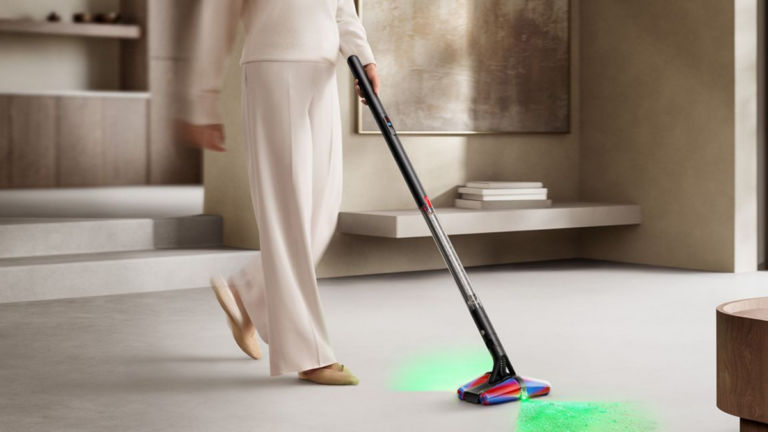
The other engineering achievement in the PencilVac is the Fluffycones cleaner head, which represents a genuine departure from how cordless vacuums have handled hair for the past decade. Dyson describes the Fluffycones head design as its most hair-specific cleaner head to date.
Conventional cordless stick vacuum heads use a cylindrical roller bar — either a hard nylon bristle roll or a soft Fluffy roller — which rotates against the floor surface to lift debris into the suction path. The mechanical problem with cylindrical rollers and long hair is geometric: hair encounters the roller tangentially, wraps around the circumference, and accumulates until a user manually removes it. Dyson’s own Motorbar and previous Fluffy heads addressed this with anti-tangle features, but the wrapping mechanism remained.
The Fluffycones head replaces the cylindrical roll with four conical brush bars arranged in two counter-rotating pairs. Because the brush bars taper from a wider base to a narrow tip, hair that gets picked up migrates toward the narrow end of the cone — pulled there by the tapering geometry and centrifugal force — rather than wrapping around a uniform diameter. At the tip, the hair is spiraled off into a “hairball” that can be picked up or ejected. Vacuum Wars confirmed tangling is genuinely prevented, not just reduced.
The mechanism works on shorter hair and pet hair consistently. In independent standardized testing, Vacuum Wars found that long hair — specifically hair around 14 inches (approximately 36 cm) in length — produced an unexpected result: rather than being tangled or jammed, it was processed by the cones and ejected to the side rather than collected into the bin. This was consistent across light and heavy passes. Households with very long hair may encounter this behavior; it is distinct from the tangling problem the Fluffycones is designed to solve, but it is also a real limitation in the hair pickup performance.
The head also enables the PencilVac’s distinctive multi-directional movement. Because the conical brush bars counter-rotate symmetrically, the head can be swept side-to-side and in arcs rather than requiring a conventional forward-and-back stroke. Combined with a 360-degree swivel joint, this makes the PencilVac meaningfully more nimble around chair legs, dining table bases, and narrow corridors than any traditional stick vacuum.
Green LED illumination, positioned on both the front and rear of the cleaner head, reveals fine dust under normal lighting conditions in both directions of travel. Testers who were initially skeptical of this as a marketing feature consistently reported it as one of the genuinely useful differentiators in real-world hard-floor use.
Hard Floor Performance: The Case For
On hard floors — hardwood, tile, LVP, and similar surfaces — the Vacuum Wars testing data makes the case for the PencilVac clearly.
The lab’s hard floor subcategory score placed the PencilVac at 3.15 out of 5, against a category average of 1.91. In other words, hard floor performance is one of the highest scores in the category. Fine dust pickup was described as nearly perfect. Medium-sized debris scored similarly, and larger debris was handled well. For a machine purpose-built for hard surfaces, this is precisely the profile you want — and it surpasses the hard-floor performance of most cordless vacuums that also clean carpet.
The filtration result is similarly impressive given the constraints. The two-stage sealed system captures 99.99% of particles as small as 0.3 microns — exceeding the 99.97% threshold that defines HEPA certification. Vacuum Wars validated this with an independent fog evaluation that the machine passed. For allergy sufferers or pet owners with hard floors, this is a meaningful spec — particularly given how small the machine is.
The PencilVac also lies nearly flat at 95mm (approximately 3.7 inches), allowing it to reach under most sofas and low-clearance furniture without attachment swaps.
What Lab Scores Confirm: The Case Against
The RTINGS lab scores, combined with corroborating data from Vacuum Wars and other independent outlets, are equally direct about where the machine fails the buyer.
Suction power is below average across the board. Vacuum Wars measured wand airflow at 29 CFM, against a category average of 42 CFM — a 31% deficit. Unsealed suction came in at 0.11 kPa versus the 0.58 kPa category average. For hard floors using soft conical rollers, this is not a practical problem — the machine does not need strong suction to lift debris off a flat surface. But it does mean the crevice tool underperforms, scoring 1 out of 5 in Vacuum Wars’ crevice pickup evaluation against a category average of 2.5.
Carpet performance is essentially zero. The Vacuum Wars carpet subcategory score for the PencilVac was 0.40 out of 5, against a category average of 3.7. The Fluffycones soft cones are not designed to agitate carpet fibers — on most carpet surfaces, the machine stalls. Testing by Choice in Australia confirmed blockages on flour-cleaning tasks, and the head stops reliably on medium and high-pile carpet. If your home has any meaningful carpet coverage, this machine cannot replace your primary vacuum.
The dustbin emptying process is an ergonomic shortcoming. Emptying requires removing the floorhead first, then using a sliding motion to release the bin. Vacuum Wars found dust and debris leaking out at multiple stages of the process — the opposite of hygienic in practice, despite Dyson’s “syringe-style” bin emptying marketing language. The air compaction system that squeezes debris deeper into the bin is useful, but it cannot compensate for the 75ml capacity ceiling.
Handheld use is limited. The machine ships with a single rotating combi-crevice tool. Using the full-length PencilVac as a handheld for above-floor tasks — furniture, car interiors, upholstery — is physically awkward given the machine’s length. It is not a meaningful two-in-one tool.
The overall score confirms the narrowness of the use case. Vacuum Wars overall score: 2.18 out of 5 against a category average of 2.53. The machine does not appear on the Vacuum Wars Top 10 Cordless Vacuums list, as noted in its full scored breakdown.
Who Should Buy It
The machine’s buyer profile has not changed since launch, and the lab data sharpens rather than revises it.
The Dyson PencilVac Fluffycones is the correct choice for a buyer who has a compact home with exclusively hard floors, wants the lightest and most agile daily-use vacuum available, has no carpet (or only very low-pile accent rugs that can be bypassed), and does not need a machine that doubles as a handheld or handles large cleaning sessions on a single charge. Vacuum Wars field testing of a 1,033-square-foot, five-room apartment found the machine could complete the entire space on Eco mode with roughly 30% battery remaining — results detailed in Vacuum Wars’ testing that confirm it is genuinely sufficient for smaller homes.
For a buyer in that profile, no other machine on the market combines the PencilVac’s weight (1.8 kg / 4 lbs), its agility around furniture, its dual-laser dust illumination, and its genuine HEPA-grade filtration in a single package.
For everyone else — particularly anyone with carpet, household members with very long hair, or homes larger than a compact apartment — a more versatile cordless at the same price point delivers more usable machine. Dyson’s own V15 Detect and V16 Piston Animal Submarine both offer superior carpet performance and runtime at comparable or lower price points, along with dramatically larger bins.
The RTINGS full scored review, with category comparisons and subcategory breakdowns, is available at RTINGS.com for members.
Frequently Asked Questions
Is the Dyson PencilVac Fluffycones good for carpet?
No. Independent lab testing gave the PencilVac a carpet subcategory score of 0.40 out of 5, against a category average of 3.7. The Fluffycones soft conical brush bars are designed for hard floors and do not agitate carpet fibers. On most medium- and high-pile carpet, the machine stalls entirely. It can function on very low-pile rugs but should not be purchased by anyone whose home includes meaningful carpet coverage.
How long does the Dyson PencilVac battery last in real-world use?
Dyson rates the battery at up to 30 minutes in Eco mode, against a cordless category average of approximately 45 minutes for official rated runtime. In independent maximum-power testing, actual runtime measured approximately 9 minutes, compared to a category average of 13.5 minutes on max power. The battery is removable with a single click, and Dyson sells a spare battery to extend runtime — a worthwhile purchase if you use the machine on max power for larger spaces.
Is the $443 price justified compared to other Dyson cordless vacuums?
At $443 (down from an original MSRP around $599), the PencilVac Fluffycones occupies the same price tier as Dyson’s V15 Detect and is within range of the V16 Piston Animal Submarine. Both of those machines offer carpet cleaning, significantly larger bins, longer runtimes, and comparable filtration. The PencilVac’s price is justified only for the buyer who specifically needs its ultra-slim form factor, its multi-directional cleaning head, and its hard-floor specialization — and who has no carpet. For mixed-floor homes, the value comparison does not favor the PencilVac. See the Dyson V16 Piston Animal Submarine review for a detailed comparison.
What makes the Dyson PencilVac engineering different from other cordless vacuums?
The PencilVac’s core engineering achievement is fitting a functional vacuum — a 28mm Hyperdymium motor spinning at 140,000 RPM, a sealed two-stage filtration system, a battery, and a conical brush head — inside a 38mm diameter handle. The conical brush bars solve the hair-tangling problem by using tapering geometry to migrate hair toward a narrow tip for ejection rather than allowing it to wrap around a cylindrical roller. Every performance limitation of the machine (small bin, short runtime, lower airflow) is a direct consequence of that 38mm constraint rather than a separate design choice.