September 7, 2026:


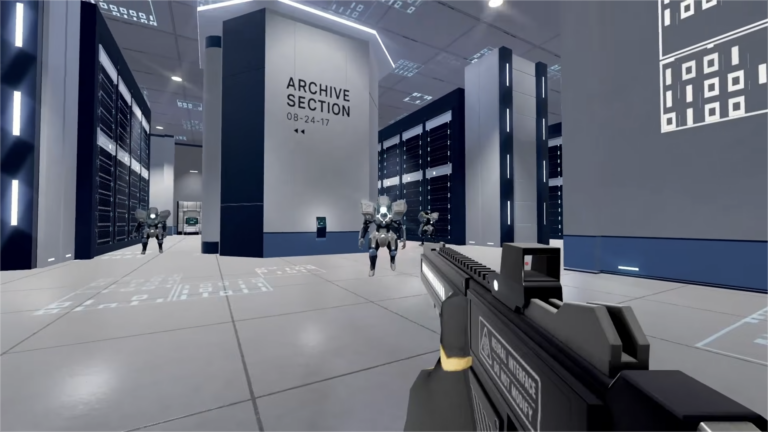
Happenstance Games released the official Dysector announcement trailer on September 4, introducing a first-person sci-fi shooter built around a premise that the genre has not tried before: the repair shop is not the setting — it is the premise of every combat encounter. Players manage a futuristic tech repair shop from the outside, but when a device turns up corrupted, they do not diagnose it from a workbench. They enter it, fight the corruption from the inside, and complete the job by winning.
The trailer confirms the core loop: accept a job at the shop counter, step inside the device, engage the corruption in first-person combat, return to the shop with the job done. No launch date has been announced. Dysector is coming to PC via Steam wishlist now.
The easiest shorthand for Dysector is that it blends a management simulation with a first-person shooter. That description is accurate but misses the specific problem the game is solving — and the specific mechanism it uses to solve it.
Management sims and FPS games have incompatible pacing registers by design. Management sims ask players to think in macro terms: allocate time, sequence jobs, grow the business. FPS games ask players to react in micro terms: read space, track enemies, fire accurately. These two demands are not merely different in kind; they actively interfere with each other if they compete for the player’s attention at the same time.
Dysector does not interleave the two loops. Instead, it separates them spatially. The shop exterior is where the management layer lives: accepting repair orders, maintaining the business, deciding what job to take. The device interior is where the FPS layer lives: first-person combat against whatever corruption has infected the hardware. The transition between them — the act of entering the device — is the game’s central mechanic. It is a mode-switch built into the world itself. The player is never doing both at once. That spatial and sequential separation is the architectural solution to a problem most management-FPS hybrids cannot escape.
The result is that each half of the game reinforces the other without undermining it. The management layer gives the combat meaning — this is a job, there is a client, and the stakes are professional as much as physical. The combat layer gives the management layer consequence — the jobs are not paperwork, they are missions.
The announcement trailer released September 4 establishes a visual identity built on contrast. Shop interiors and the city that surrounds the business carry one aesthetic register: functional, sci-fi urban, grounded. The interior world of the corrupted devices carries another: neon-lit corridors, darker and more industrial, with crackling energy and synthetic percussion on the soundtrack. Spatializing audio design makes the in-device environments feel distinct from the shop exterior even at the level of sensation.
The protagonist’s silhouette — resolve communicated before dialogue lands — appears in kinetic combat sequences that suggest an FPS built around precision and adaptation rather than overwhelming numbers. Environmental scale inside the devices implies a world designed with its own internal logic, a place that exists according to different rules than the repair counter outside.
What the trailer does not show: enemy types beyond the abstracted “corruption,” weapon variety, how many devices are in the game’s job catalog, or how the business management layer works in practice (pricing, customer relations, shop upgrades). These remain unannounced. What it does establish is the tonal register — deadpan workplace framing colliding with kinetic sci-fi combat — and confirms that Dysector is aiming for a specific hybrid experience, not a genre sampler.
Happenstance Games has not disclosed studio size, team background, or prior credits in any materials accompanying the announcement. Dysector appears to be the studio’s debut announced FPS title, and the production values visible in the announcement trailer — polished visual identity, considered sound design, deliberate pacing — suggest a team with a clear creative vision and the technical execution to support it.
The repair-shop subgenre has established genuine commercial credibility in 2026. ReStory: Chill Electronics Repairs, developed by Mandragora and published by tinyBuild, launched on Steam in August and earned a Metacritic score of 84 from critics and an Overwhelmingly Positive user rating — confirming that players will engage seriously with repair mechanics as a primary game loop. Dysector is entering a subgenre that has proven its audience. What it is testing is whether that audience will follow the repair loop into a combat register.
The specific concept — entering a device and fighting corruption — has roots in sci-fi fiction (the miniaturization premise of films like Fantastic Voyage and the body-exploration traditions of science fiction) but has not been the organizing mechanic of a shop-management game before. Viscera Cleanup Detail made the post-FPS cleanup loop its entire premise; Dysector inverts the premise in a different direction, making the FPS combat the mechanism of repair rather than the source of mess.
Two structural questions will determine whether Dysector delivers on its concept:
Does the shop layer have enough depth? If the management side of the game is thin — accepting jobs, hitting a button to enter the device, returning to accept the next job — then the “management sim” label overpromises. The compelling version of Dysector is one where shop decisions compound: which jobs to take, how to allocate time between jobs, whether the business grows in ways that change what devices appear. The trailer does not answer this. It is the largest unknown.
Does device variety sustain the FPS loop? The in-device combat loop needs enough variation — enemy types, device architectures, escalating challenge — to prevent the FPS layer from becoming repetitive. A repair shop that fixes phones, consoles, cameras, and industrial hardware implies device interiors that differ from each other. The trailer suggests visual variety, but whether that translates to mechanical variety is unconfirmed.
Both questions are answerable only by playing the game. The announcement is a concept pitch, and the concept is strong enough to earn attention. The execution is undemonstrated.
Dysector is confirmed for PC via Steam, with no release date, price point, or Early Access status announced. Interested players can add it to their Steam wishlist now to be notified at launch. Happenstance Games has not announced any additional platform support beyond PC, nor any demo or Steam Next Fest participation.
Dysector is a first-person sci-fi shooter with a built-in management layer. Players run a futuristic tech repair shop and accept jobs from clients. When a device arrives corrupted, the player enters the device in first-person — shrinking into its interior — and defeats the corruption through direct combat. Completing the combat encounter completes the repair job. The two game modes (shop management and FPS combat) are separated spatially and sequentially, not simultaneous: players are in one mode or the other at any given time, with device entry functioning as the mode-switch between them. Full details are on the official Dysector Steam page.
Dysector is developed by Happenstance Games, an independent studio whose prior credits and team size have not been publicly disclosed. The game is coming to PC via Steam with no release date or price point announced as of September 6, 2026.
ReStory: Chill Electronics Repairs is a cozy repair simulator in which players disassemble, diagnose, and reassemble period-accurate Y2K devices — satisfying in the way a puzzle is satisfying, with a strong tactile loop and no combat. The ReStory review on TechTimes covers its Metacritic 84 reception in detail. Dysector inverts the repair premise: the devices are corrupted, and fixing them means fighting through their interiors in first-person. Where ReStory is meditative, Dysector is action-oriented. Both treat the repair shop as a meaningful workplace, but they interpret what “repairing” requires in entirely different ways.
No demo has been announced. Players can wishlist Dysector on Steam to receive a notification when the game releases. No Early Access launch date, Steam Next Fest participation, or public beta has been confirmed.