HomeAuto Dragon’s Dogma 2 Rebuilds Pawn AI and Skill System Before Dark Arisen This Week
Dragon’s Dogma 2 Rebuilds Pawn AI and Skill System Before Dark Arisen This Week
August 31, 2026:
Capcom.com
Dragon’s Dogma 2’s biggest free update goes live on September 1 at 8:30 PM ET, and it directly addresses the two design criticisms that professional reviewers named most often when the game launched in March 2024: passive companions who felt reactive rather than engaged, and a four-skill loadout that forced players to sacrifice utility for damage at the exact moment the combat system rewarded creative expression. Those two problems are the structural center of Title Update 3.2 — not as partial fixes, but as fundamental redesigns.
The update, originally targeting late August, was delayed by a few days to give Capcom time to finalize additional fixes confirmed via the game’s official Twitter account on August 27. The full patch notes — which cover every one of the game’s ten vocations, the enemy behavior system, the save architecture, the Dragonsplague mechanic, and the graphics pipeline on both console and PC — are now live at dragonsdogma.com’s update page. For the 4 million players who purchased Dragon’s Dogma 2 since March 2024, and for anyone considering the game ahead of the Dark Arisen expansion on October 9, September 1 marks a version of the game that is, in several meaningful ways, not the one that launched.
Skill Slots Expand From Four to Six — What That Actually Changes
The number that sounds simplest carries the most structural weight. Expanding assignable weapon skills from four to six per vocation is not a cosmetic addition of two interface slots. In Dragon’s Dogma 2’s combat system, every vocation has a catalog of learnable skills — gap-closers, area-of-effect attacks, healing options, crowd-control abilities — but players could previously equip only four of them simultaneously. That constraint created a consistent tradeoff at high levels: carry the skills that deal damage or carry the skills that let you react to unexpected situations, but not both.
Adding two slots does not sound like much until you map what the constraint was actually costing players. A Mage using four slots for offensive spells had no room for crowd control. An Archer running maximum-damage skills had to drop repositioning tools like Front Kick. A Sorcerer who wanted both Seism and Prescient Flare had to cut survivability options. The six-slot skill expansion means those tradeoffs become choices rather than requirements — build hybrid loadouts that combine offensive and defensive options without sacrificing the game’s primary power fantasy. Across ten vocations, each with their own catalogs, the new ceiling changes the build-design conversation substantially.
Capcom’s Pawn AI Overhaul: From Reactive to Engaged
Dragon’s Dogma 2 launched to 86 on Metacritic, but the professional reviews and the 67% positive Steam reception pointed at the same weakness: the pawn companions, who are the game’s most distinctive design element, often felt like assistants waiting for direction rather than adventurers with tactical agency. IGN’s review cited finicky ally AI among the game’s primary criticisms. Title Update 3.2 is Capcom’s architectural response to that documented gap.
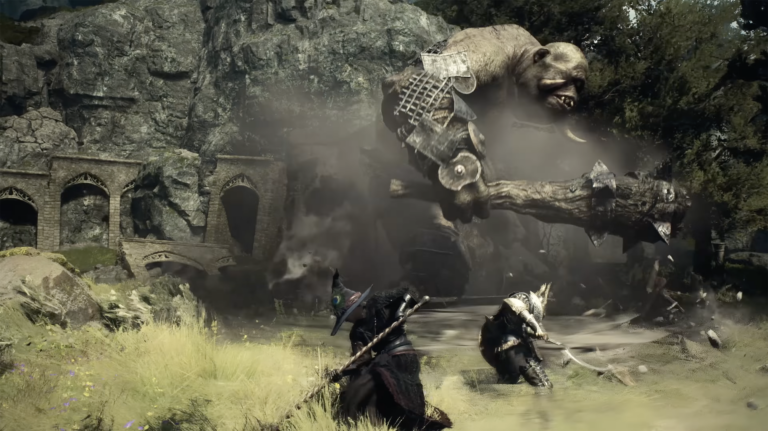
The behavioral changes are specific and numerous. Pawns can now grapple enemies and actively draw their attention, functioning as tanks rather than bystanders. When the Arisen is knocked down, pawns will now interfere with incoming attacks and protect the player while they cannot move. Pawns have gained environmental awareness: they can suggest and execute strategies like luring enemies toward large boulders or positioning them in exploitable terrain. They will now perform follow-up attacks on enemies the Arisen has knocked back — tactical coordination that the 2024 version of the game could not execute.
Two changes stand out for how they expand physical collaboration. While grappling a large enemy, a pawn can now pull the Arisen upward, extending jump height to reach points on towering enemies that would otherwise require more circuitous approaches. For players using ranged vocations like Archer or Magick Archer, pawns will now more reliably prioritize the enemies directly targeting the Arisen — a change that should make ranged builds feel like they have real tactical support rather than companions randomly engaging nearby threats.
On the quality-of-life front, pawns are now temporarily invincible when being revived by the Arisen — eliminating the frustrating sequence where a revival attempt was interrupted by another hit. Pawns will act more quickly overall, guard against attacks more effectively, and catch the Arisen after falls from significant heights during combat. Two new pawn commands round out the behavioral additions: holding the Go command activates Explore, and holding the “To Me!” command triggers a High Five — a small addition that lands well after two years of the community genuinely forming attachments to their companion characters.
The Save System Is Now a Modern RPG
The original save architecture — one save slot, three data types that could inadvertently overwrite each other — was the most frequently cited quality-of-life failure in the game’s first two years. Loading from Last Inn Rest could delete autosave data. Loading from autosave could eliminate careful manual checkpoints. The result was a system that actively discouraged experimentation and created anxiety around story decisions.
Title Update 3.2 rebuilds the save architecture from the foundation. Each player Arisen now has three separate save slots, each holding its own independent set of all three data types: Autosave, Interim Save, and Last Inn Rest Save. Loading from one no longer touches the others. The save screen now displays the date and time of each save — basic information that the original launch version did not provide. A new tutorial walks players through the updated system. The story skip option for replaying the opening sequence rounds out what is, taken together, a complete overhaul of the game’s relationship with player progress.
Dragonsplague Gets a Cure
Dragonsplague — the affliction pawns can contract by traveling between worlds and spread to the player’s party, eventually causing catastrophic, irreversible consequences if left unchecked — was one of the 2024 version’s most polarizing mechanics. Players who loved the tension it created had no way to intervene once infection set in; players who found the consequences punishing beyond their tolerance had no recourse.
The Dragonsbaulk Draught, added in 3.2, is that intervention. It functions as a cure item targeted at infected pawns, with new pawn dialogue indicating when the treatment is warranted. Infected pawns also receive mechanical improvements in 3.2: they can now stun large enemies by targeting their legs, attack smaller enemies without consuming stamina for a limited time, and accumulate the loss gauge — the internal counter driving toward Dragonsplague’s worst consequences — at a slower rate. The changes give players agency over a mechanic that was previously entirely outside their control once infection occurred.
Vocation Balance: All Ten Vocations Adjusted
Every vocation in Dragon’s Dogma 2 has received targeted tuning in 3.2, and two vocations receive entirely new core skills.
Mage and Sorcerer gain Magick Barrier, a new core skill activated via the Vocation Action button. Pressing it raises a magical barrier that blocks incoming attacks; stamina consumption varies by the weapon equipped. This directly addresses a gap between the game’s caster vocations and their melee counterparts’ survivability options.
Trickster gains Buoyant Brume, a new core skill that lets players press the jump button again mid-air to float for a period of time. Combined with the Trickster’s existing smokescreen kit, this expands the vocation’s spatial options substantially.
Elsewhere: the Fighter’s Blink Strike, Tusk Toss, and Riotous Fury have been made easier to land and chain together. Counter Slash now prioritizes the enemy that triggered the deflect. The Archer sees arrow-nocking speed increased on Exploding, Drenching, Tarring, and Blighting shots, Dire Arrow receives a damage buff, and the repositioning tools Front Kick and Leaping Punt have been adjusted for better backward movement. The Warrior’s Mighty Sweep and Stonesplitter gain increased forward reach, Chain of Blows input timing is made more consistent, and Savage Lash receives a damage increase. The Mystic Spearhand’s Mirour Vesture is reworked: it can now be charged to extend its barrier to party members, and gains a durability system so the barrier depletes on use rather than persisting indefinitely. The Magick Archer gets stickier auto-targeting when consecutively using offensive skills without manual aim.
The Thief receives an adjustment that cuts both ways: Formless Feint now costs more stamina, but pressing Vocation Action during the skill throws the attacker off balance — with a skill-tier timing reward that reduces stamina consumption for excellent execution.
System-Level Changes: Flinch, Stamina, and Enemy Behavior
Several changes affect moment-to-moment combat flow across all vocations. Players will now be less likely to flinch repeatedly in quick succession from the same attack sequence — the cascade flinch problem that made certain enemy encounters feel unfair at launch. Being struck while already downed now causes the Arisen to recover immediately rather than absorbing additional hits from the ground. Stamina recovery items used while exhausted now have instantaneous effects. Crawling is less likely to draw enemy attention. The invincibility window when revived with a Wakestone is extended.
Enemy behavior has also been adjusted across multiple creature types. Goblins, Saurians, and several serpent variants have reduced attack tracking, making their moves more avoidable. Drakes have had their low-health attack patterns revised to create more recovery windows. Skeleton and undead variants are now more vulnerable to holy damage. The flinch system updates apply reciprocally to enemies as well.
Performance Mode and Graphics: 60 FPS Arrives on Console
Producer Naoto Oyama stated in a Q&A published before the update that the team spent over six months on performance optimization work since the game’s launch in 2024. Title Update 3.2 delivers the headline result: PlayStation 5 and Xbox Series X can now target 60 frames per second in Performance Mode. Capcom’s stated target does not extend to Xbox Series S, and the update does not advertise a locked 60 FPS — the language is “tuned to target” rather than a hard guarantee.
PC players on Steam gain the most granular control: ten new graphics options including Volumetric Fog Resolution, Cloudscape Resolution, Foliage Density, Terrain Quality, Ray Tracing GI Quality and GI Shading Quality, Effect Reflections, CPU Saving Mode, NPC Culling, Swaying Grass Quality, and a live Graphics Memory readout in the options menu. Console players on PS5 and Xbox Series X|S receive one new option: Resource-Intense Effects Quality.
The update has no listed release date for a hard-locked 60 FPS or for Xbox Series S Performance Mode parity. Optimization work continues, per Capcom’s own language: “further optimisation updates through a combination of game engine updates and a wide range of incremental improvements” are still planned beyond 3.2.
What Is Not in This Update: Hard Mode
Director Kento Kinoshita confirmed in a Steam developer Q&A, published approximately a month before this update, that Hard Mode is in active development — specifically designed for players whose characters are approaching or have reached Dragon’s Dogma 2’s level cap. What the official Title Update 3.2 patch notes do not include, anywhere, is Hard Mode itself. It does not appear in the combat adjustments, the vocation section, the UI changes, or the optimization notes.
Hard Mode remains confirmed-in-development with no announced release window. It may arrive alongside the Dark Arisen expansion on October 9, or in a subsequent update. The 3.2 patch does bring harder combat indirectly — enemy behavior improvements, the flinch system rework, and Drake adjustments all raise the skill ceiling — but these are refinements, not a dedicated difficulty layer. Players who were waiting specifically for a Hard Mode toggle should not yet have what they are looking for.
Server Maintenance and Timing
Pawn server maintenance begins September 1 at 7:00 PM ET for approximately 90 minutes, during which lending and hiring pawns from other players will be unavailable. Title Update 3.2 goes live at 8:30 PM ET September 1 across all platforms — PlayStation 5, Xbox Series X|S, and PC via Steam. The Dark Arisen expansion, covering the new Norgan region, twelve Lost Rites dungeons, and over 25 hours of new content, launches October 9 on PlayStation 5, Xbox Series X|S, Nintendo Switch 2, and PC via Steam.
Frequently Asked Questions
Does Title Update 3.2 include Hard Mode?
No. Director Kento Kinoshita confirmed in a Steam developer Q&A that Hard Mode is in active development, aimed at players approaching or at Dragon’s Dogma 2’s level cap — but the official Title Update 3.2 patch notes published on dragonsdogma.com do not include Hard Mode anywhere. The update brings indirect difficulty improvements through enemy behavior tuning, the flinch system redesign, and Drake encounter adjustments, but these are not a dedicated difficulty setting. Hard Mode has no announced release window and may arrive alongside the Dark Arisen expansion on October 9 or in a later update.
What’s the biggest change for returning players who stopped playing because of the save system?
The save architecture is rebuilt entirely. Each Arisen now has three separate save slots, each holding an independent Autosave, Interim Save, and Last Inn Rest Save. Loading from any one type no longer deletes the others — the core frustration that caused many players to quit. Save screens now show the date and time of each save. If the single-save-slot design was the reason you put the game down, September 1 is a clean entry point.
Does Title Update 3.2’s pawn AI overhaul change how the pawn system feels in combat?
The changes are specific and numerous enough that the short answer is yes. Pawns now grapple enemies and draw their attention, interfere with attacks when the Arisen is down, suggest and execute environmental strategies, coordinate follow-up attacks on knocked-back enemies, and act more quickly across all conditions. They will also assist mounted combat by pulling the Arisen upward while grappling large enemies. The documented criticism from 2024 reviews was that pawns felt reactive rather than engaged — these changes are a direct architectural response to that specific gap.
Is September 1 a good time to start Dragon’s Dogma 2 for the first time before the October expansion?
The argument for starting now is concrete: six skill slots give new players more build flexibility from the outset, the save system won’t punish experimentation, and pawn companions will engage more actively from the first encounter. The game’s 86 Metacritic score reflects its strengths, and the 67% Steam rating reflected launch-specific frustrations that 3.2 directly addresses. Dark Arisen recommends approximately level 40 for its primary Forsaken Dominion content and level 20 for Lost Rites, so players who start on September 1 will have five weeks to build a character at the right range before October 9.