HomeAuto Double Fine Launches Action Labs: First Game Built in Six Weeks Slaps Bus Rulebreakers
Double Fine Launches Action Labs: First Game Built in Six Weeks Slaps Bus Rulebreakers
September 7, 2026:
Doublefine.com
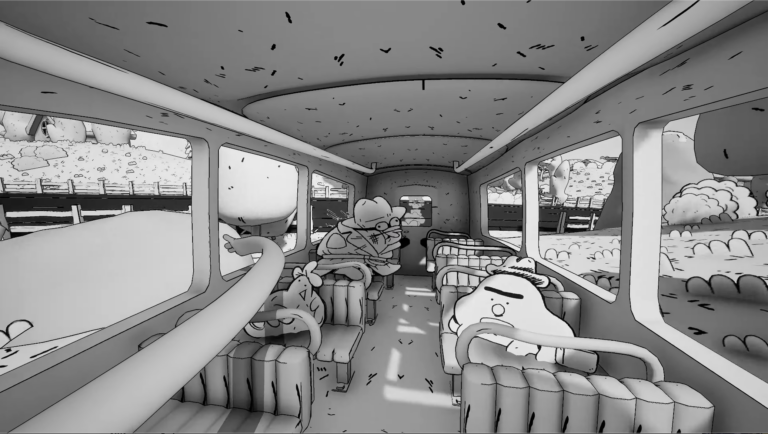
Two months after departing Xbox Game Studios with its intellectual properties intact, Double Fine Productions announced its first new game as a fully independent studio — and it is not the sequel anyone expected. Thank You Bus Driver, revealed September 4, 2026, puts players in the seat of a small-town bus driver who must enforce an ever-shifting rulebook, collect expressions of gratitude from satisfied passengers, and somehow keep the route on schedule while driving recklessly through cornfields. The announcement simultaneously introduced Double Fine Action Labs, a new label the studio is building specifically around small, fast, experimental games — and which Tim Schafer says may be the studio’s best chance at long-term survival on its own terms.
What Double Fine Action Labs Actually Is
The easiest way to misunderstand Double Fine Action Labs is to think of it as a side label for games the studio makes when it is between bigger projects. That framing misses what Schafer is describing. In a September 2, 2026, interview with GamesBeat, the studio founder was specific: “If you take more risks, you spend less money in general. That’s a bit of what Double Fine Action Labs is about. It’s about being able to take more risks and not blow the bankroll on them.” The label is not filler. It is a deliberate attempt to commercialize the methodology that has kept Double Fine viable through every crisis since 2007 — the Amnesia Fortnight process, in which small teams are temporarily freed from their main projects to prototype game ideas in a two-week sprint.
What makes Action Labs structurally different from prior Double Fine label experiments is the explicit intent to release the results commercially. Earlier Amnesia Fortnight cycles produced prototypes that sometimes became full games — Costume Quest, Iron Brigade, and Stacking all grew from those sprints — but the lab-to-market pipeline was slow and irregular. Double Fine Action Labs formalize it: small team, jam-speed development, low price point, self-published directly to Steam, GOG, Humble Store, and itch.io with no publisher intermediary. The result is what Thank You Bus Driver demonstrates — a complete, commercially releasable game built in approximately six weeks by a team led by designer Will Koehler.
Double Fine is not the only studio to make small games quickly. But it may be the first studio of its size — roughly 55 employees after the Xbox spinoff — to build a named, ongoing label around commercialized game jam methodology as a primary revenue strategy rather than as a side experiment. Schafer told GamesBeat the Kickstarter and the label together serve three functions: immediate revenue, proof of creative vitality to potential investors, and a distribution pipeline for team ideas that would otherwise die in a drawer. That framing matters. Action Labs is not nostalgia. It is economics.
How Thank You Bus Driver Works
You are a bus driver. Your town is small. Your passengers have opinions. Your employer has rules — many rules, and new ones arrive daily from the depot. The gap between those rules and actual human behavior is the game.
Each run of Thank You Bus Driver opens with a fresh set of regulations for that day. Hats prohibited. Aisle-standing forbidden. The specific prohibition changes with every session. Players are responsible for policing compliance: passengers who break rules get slapped; repeat offenders get ejected from the rear door. Meanwhile, the bus still needs to drive — on a route, under a time limit, through whatever the town throws at you. Shortcuts through cornfields are an option. Collisions with oncoming traffic and fences are, per the game’s own description, left to the player’s discretion.
The resource tying all of this together is gratitude. Every time a satisfied passenger says “thank you,” the player gains additional time to reach the next stop. Accumulating enough of those exchanges unlocks cosmetic rewards: bus decorations, town variants, and other content. The roguelite-adjacent structure — randomized daily rules, run-based sessions, persistent unlock progression — is the architectural choice that makes the game infinitely replayable without requiring a large content library. That matters enormously when development spans just six weeks, as Schafer confirmed in the GamesBeat interview.
The protagonist is not a hero. She is a person with a route to run and a reasonable expectation of basic courtesy from the people she serves. The central dramatic question is: can you complete the day — enforce the rules, stay on schedule, collect enough thank-yous — without everything falling apart? The tone is frenetic and slapstick, but the win condition is genuinely, unexpectedly sincere. You are trying to be appreciated. In a genre usually built around destruction or domination, that is a specific emotional register that only Double Fine would think to build a game around.
Why This Came From a Kickstarter, Not a Publisher
The context for Action Labs and Thank You Bus Driver is the Amnesia Fortnight 2026 campaign, which launched on Kickstarter on August 31, 2026. The campaign presented 26 game pitches from Double Fine’s development team and invited backers to vote on which four would enter prototype development — with one of those four to be selected as the winner and developed into a full, small-scale game published under the Action Labs label. The campaign hit $400,000 in 72 hours. As of this writing, the first round of backer voting closes today, September 6, with four finalists to be announced shortly after. Full prototype development begins September 9.
Thank You Bus Driver itself is not the Kickstarter winner — it is a separate game that was already completed before the Amnesia Fortnight campaign launched, described by Schafer as an example of what the Action Labs label can produce. The Kickstarter winner will be announced at the end of September after development concludes. Double Fine will demo Thank You Bus Driver alongside the Amnesia Fortnight campaign at PAX West through September 7.
Schafer was direct with GamesBeat about why he returned to Kickstarter after leaving Microsoft: “It’s not 100% guaranteed, but it’s a great sign if people really react to a pitch.” The crowdfunding model gives Double Fine immediate revenue, a direct line to its most committed fans, and — crucially — market signal about which game concepts resonate before the studio commits development resources. That is a very different production environment than shipping a game on Game Pass day one and waiting for Microsoft to decide whether the subscription engagement numbers justified the investment.
The 26-game pitch slate is itself a deliberate deployment of what Schafer calls the studio’s “number one resource”: the creativity of its team. Double Fine had approximately 55 employees as of the spinoff, roughly the same count as during the development of Brütal Legend more than a decade earlier — and Schafer says that is the right scale for the kind of work the studio does. The Action Labs label is designed to keep that team employed without requiring every project to be a commercial blockbuster.
What Double Fine Left Xbox With
Double Fine’s separation from Xbox Game Studios was completed on July 6, 2026, when the studio departed alongside Compulsion Games as part of the sweeping Xbox Reset restructuring. Unlike Ninja Theory, which was closed outright, Double Fine negotiated a spinoff that included the return of its intellectual property — Psychonauts, Keeper, Kiln, and the studio’s full back catalog. Schafer told GamesBeat: “It feels like at one point they were going to squish us like a bug, but instead we shot out like a watermelon seed.”
The spinoff required layoffs: approximately 23 employees left during the process, bringing Double Fine to its current team of roughly 55. The studio’s NLRB union petition, filed with the Communications Workers of America on May 7, 2026, remains pending as of this writing.
Keeper, the studio’s 2025 atmospheric puzzle adventure, arrived on PS5 on September 3, 2026, three days before this article, with a price drop from $30 to $20 across all platforms. Kiln, the online multiplayer pottery brawler released in April 2026, dropped from $20 to $8 for the base version. Schafer confirmed to GamesBeat that the studio continues to generate passive revenue from its back catalog — a condition he described as essential to the studio’s non-hit-dependent business model.
The Xbox-era constraint Schafer describes most vividly is not creative but structural: “We don’t have to go to a lot of meetings. We don’t have to use Teams anymore.” More substantively, Double Fine can now engage directly with any platform or publisher without routing through a single Microsoft liaison, price its own games without corporate approval, and structure its development calendar around what the team finds interesting rather than what fits a subscription service’s content slate.
What Schafer Thinks the Market Wants Right Now
Tim Schafer’s public positions on AI and game development technology are worth noting for a TechTimes audience, because they run counter to the prevailing conversation in the industry. Asked directly by GamesBeat whether AI would help game development, Schafer was skeptical: “I’ve never looked for technological solutions… I still think it’s creativity and imagination. Those are the things we’re always waiting for. Technology might be a tool that helps us do it, but I don’t think it’s going to save us.” Double Fine has no documented AI governance positions, no AI development tools publicly announced, and no technology policy advocacy on record — which is itself a notable stance for a studio that will need to articulate its competitive differentiation in an industry increasingly defined by AI-assisted production pipelines.
What Schafer does think the market wants right now: games that feel new, that cost less to acquire than a AAA title, and that can be played with friends without a 100-hour commitment. He specifically cited the current Steam environment — “janky, unpolished games that are a lot of fun” — as a market condition that Double Fine Action Labs is positioned to serve. The Amnesia Fortnight 2026 pitches were designed with that in mind: 26 ideas, quick to describe, quick to prototype, quick to evaluate.
Where to Wishlist and How to Back the Campaign
Thank You Bus Driver is available to wishlist now on Steam and GOG. No release date or price has been announced. The game is confirmed for PC (Windows). No console release has been announced.
The Amnesia Fortnight 2026 Kickstarter is live through September 30, 2026. Backers can still contribute and influence the final round of voting. The winning game from the campaign will be announced after development concludes September 23. All games produced under the label will be published as Double Fine Action Labs releases. The Kickstarter’s most absurd stretch goal: $100 million for Brütal Legend 2. Schafer told GamesBeat, “I think we could get it done for that.”
Frequently Asked Questions
What is Double Fine Action Labs, and how is it different from Double Fine Presents?
Double Fine Action Labs is a new label launched in September 2026 for small, fast, experimental games produced by Double Fine’s development team — typically built by small teams using a rapid-prototyping approach inspired by the studio’s Amnesia Fortnight game jam tradition. Unlike Double Fine Presents, which was a publishing label for other independent developers and was wound down after the Microsoft acquisition in 2019, Action Labs publishes games made internally by Double Fine staff. The distinction matters: Action Labs is a production model (fast, small-budget, self-published) as much as it is a brand.
How did Double Fine go from almost closing to announcing a new label so quickly?
When Xbox’s Reset restructuring put Double Fine at risk of closure in June 2026, the studio negotiated a spinoff rather than a shutdown. The deal — completed July 6, 2026 — returned Double Fine’s intellectual property to Tim Schafer and his team. Within weeks, Schafer launched the Amnesia Fortnight 2026 Kickstarter and introduced Action Labs as the distribution channel for its results. The speed reflects a pre-existing strategy: Double Fine had been doing internal game jams since 2007, and Schafer had already assembled a team capable of building commercial-quality prototypes quickly. The independence just gave the studio permission to sell them directly.
Why does Thank You Bus Driver only take a few weeks to build when most games take years?
The short build time is a feature of the methodology, not a shortcut. Amnesia Fortnight prototypes are built under intentional constraints — a small team (typically fewer than ten people), a fixed time window, a single designer’s core concept — that force creative decisions quickly rather than iterating toward a theoretically perfect design. The roguelite-adjacent structure of Thank You Bus Driver (randomized daily rules, run-based sessions) provides replayability without requiring months of additional content production. Schafer put it plainly: taking more risks and spending less money are not trade-offs in this model — they are the same decision.
What happens after the Amnesia Fortnight Kickstarter ends?
The campaign runs through September 30, 2026. After backer voting concludes, one of the four finalist prototypes (selected by backers in the first vote, with finalists announced after today’s closing) will be chosen as the winner of the second vote and developed further into a commercially released game under the Double Fine Action Labs label. The timeline for that release has not been announced. The other three finalists will be distributed to eligible backers as playable prototypes. The Kickstarter documentary, produced by 2 Player Productions, will cover the full development process.