HomeAuto DeepSeek’s 160,000-Chip Huawei Order Puts PRC Law Over Every API Query
DeepSeek’s 160,000-Chip Huawei Order Puts PRC Law Over Every API Query
September 6, 2026:
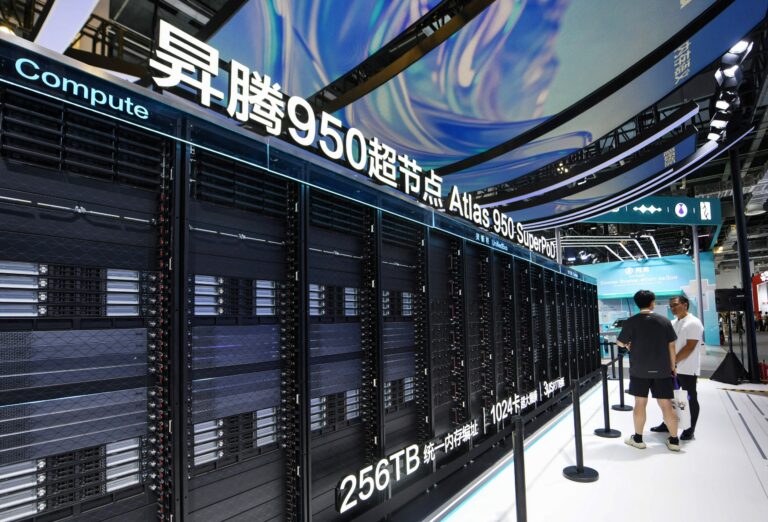
People visit the Huawei’s Atlas 950 SuperPoD during the World Artificial Intelligence Conference (WAIC) in Shanghai on July 17, 2026. / China OUT CN-STR/AFP via Getty Images
DeepSeek, the Hangzhou AI lab whose January 2025 model releases rattled global markets, has placed an order for 160,000 Ascend 950DT chips for a massive data center under construction in Ulanqab, Inner Mongolia — a procurement move that, if fulfilled, would create one of the largest clusters of domestically manufactured Chinese AI chips in history. The order, first reported by Bloomberg on September 4, carries a face value of approximately ¥17.76 billion (roughly $2.64 billion USD — exchange rate as of September 5, 2026; conversions are approximate) at ¥111,000 per chip price (approximately $16,500).
The strategic logic is straightforward. The Ascend 950DT is specifically engineered for the stage of AI computing that generates revenue — inference, the process by which a trained model generates responses to user queries. DeepSeek plans to deploy the chips to run its models in production at the Ulanqab facility; the company does not currently intend to use the 950DT for the computationally heavier task of training new models, according to people familiar with the matter cited by Bloomberg. Training — where DeepSeek’s most important technical work happens — continues to depend on Nvidia hardware, a dependency that has not yet closed.
That distinction matters enormously. It shapes what this order proves, what it does not prove, and what a developer or enterprise building on DeepSeek’s API should understand about where their queries are actually going.
Why Inference Chips Are Different From Training Chips
To understand why DeepSeek chose the 950DT specifically, it helps to understand what inference actually requires of hardware.
Training an AI model is a compute-intensive process: the system processes vast datasets over days or weeks, adjusting billions of internal weights through repeated gradient calculations. It demands sustained, parallel floating-point throughput — the kind of raw computational horsepower that Nvidia’s Hopper and Blackwell architectures excel at.
Inference is different. When a user sends DeepSeek a prompt, the model generates a response by producing one token at a time, and each token requires loading the relevant model weights from memory before any computation occurs. The bottleneck is not arithmetic throughput; it is how fast the chip can move data from memory to compute cores. At production scale, LLM inference is memory-bandwidth-limited at scale, not compute-limited.
This is precisely what the 950DT was designed to address. The chip integrates Huawei’s proprietary HiZQ 2.0 high-bandwidth memory (HBM), providing 144 GB at 4.0 TB/s of memory bandwidth. Its sibling chip, the 950PR, uses Huawei’s HiBL 1.0 memory and delivers 128 GB at 1.6 TB/s — optimized for the prefill phase of inference (processing the initial prompt) rather than the decode phase (generating each subsequent token). DeepSeek’s order for the 950DT, rather than the already-available 950PR, signals that the lab is optimizing specifically for high-throughput token generation at scale.
Huawei’s multi-die HBM architecture links two AI compute dies to four HiZQ 2.0 HBM die stacks through high-speed die-to-die interconnects, with an additional 2 TB/s of interconnect bandwidth for communication between chips in a cluster. The 8,192-chip Atlas 950 SuperPod system will eventually pack 8,192 of these chips together through Huawei’s proprietary UnifiedBus 2.0 interconnect fabric — the company’s equivalent of Nvidia’s NVLink — to deliver what Huawei claims is 8 exaflops of peak AI compute.
What Huawei’s Chip Cannot Yet Do
Before accepting Huawei’s performance claims, it is important to understand their provenance: every published specification for the Ascend 950DT comes from Huawei’s own announcements or from Chinese-language analyst interpretations. No independent benchmark published by a Western auditor has measured real-world performance figures for the 950DT.
The comparison data that does exist — using Huawei-announced specs — shows the 950DT trailing its Western contemporaries in memory bandwidth. The H200 and MI300X bandwidth specs confirm that Nvidia’s H200, which Nvidia cannot legally ship to China, delivers 4.89 TB/s across 141 GB of HBM3e; AMD’s Instinct MI300X delivers 6.55 TB/s across 128 GB of HBM3. DeepSeek’s own founder, Liang Wenfeng, offered the most candid assessment in a leaked investor call transcript circulated in July 2026: “All tasks the GB300 can do, the Huawei supernode can do, latency and all the same. The only cost: four Huawei GPUs equal one Nvidia GPU, and it’s two years behind.”
Huawei Connect 2025 chip roadmap presentations saw Huawei rotating chairman Eric Xu make a similar acknowledgment: individual Ascend chips trail Nvidia in raw performance, but assembling them into large-scale clusters can bridge much of that gap. The Ulanqab deployment — if it reaches its planned scale — will test that argument against real production workloads. Until it does, the 4:1 GPU equivalence ratio that Liang himself disclosed should be the working assumption.
Supply Constraints Cloud the Timeline
The 160,000-chip order faces a fundamental obstacle: Huawei cannot currently produce that many Ascend 950DT units in a short timeframe. The chip’s HiZQ 2.0 high-bandwidth memory is Huawei’s proprietary design, developed specifically to circumvent US HBM export restrictions 2024 on HBM2E and HBM3 memory. Advanced HBM stacks require precise through-silicon via (TSV) formation across multiple dies — a process with inherently challenging yield rates, particularly at early production volumes.
Shortages of high-end memory components are expected to supply limited to hundreds of thousands of 950DT units for the full year of 2026, according to Bloomberg’s sources, with Huawei also serving other customers and shipping small volumes internationally. DeepSeek reportedly asked Beijing to intervene and pressure Huawei to prioritize its allocation — a sign that the procurement dynamics have become as much a political question as a commercial one. Whether the Chinese government treats this as a national strategic priority will be one of the more significant signals in the coming months.
Even if fully delivered, the data center itself will not come online in full immediately. Bloomberg’s reporting indicated DeepSeek is targeting partial operation by late 2027 or early 2028 for at least part of the Ulanqab facility. The site, located in Inner Mongolia’s Ulanqab city approximately 350 kilometers (218 miles) northwest of Beijing, was chosen for its climate — an average annual temperature of approximately 4°C (39°F) reduces cooling requirements — and for its Ulanqab climate and power costs, which could run a 1-gigawatt facility well below what Chinese coastal cities charge.
DeepSeek’s Software Investment and the CANN Ecosystem
The hardware transition did not happen automatically. Running DeepSeek’s models on Huawei silicon required months of co-engineering work between the two companies, during which DeepSeek adapted its V4 model — the first major DeepSeek release specifically optimized for Ascend chips — to run on Huawei’s Compute Architecture for Neural Networks (CANN) software framework. SemiAnalysis confirmed that V4 model Ascend co-design was built from the ground up rather than adapted after separate development.
CANN is Huawei’s equivalent of Nvidia’s CUDA, and the difference matters practically. Nvidia’s CUDA ecosystem spans more than a decade of development, billions of dollars in tooling investment, and near-universal adoption in AI research frameworks, including PyTorch and TensorFlow. CANN is a younger ecosystem, thinner in tooling, and supported primarily by Chinese developers working on Chinese hardware. DeepSeek’s V4-Flash model achieves 10-millisecond latency and V4-Pro achieves 20-millisecond latency on V4 latency on Ascend clusters, according to Huawei — but those figures come from Huawei, not from independent measurement.
When DeepSeek attempted to train an earlier model on Huawei silicon, the effort stalled due to persistent technical difficulties with the Ascend chips’ training stack; training failed on Huawei silicon and the lab reverted to Nvidia hardware for that work, according to the Financial Times. The inference-only deployment of the 950DT reflects pragmatic recognition of where Chinese domestic silicon is genuinely competitive today, and where it is not.
Nvidia’s China Chapter: The Numbers
The market context framing DeepSeek’s chip order is stark. Bernstein Research China market share forecasts Huawei capturing roughly 50% of China’s AI chip market by the end of 2026, with Nvidia’s share falling from approximately 40% in 2025 to approximately 8%. Nvidia sold approximately one million H20 chips to China in 2024, a pipeline that has since closed following further export restrictions. On its most recent earnings call, Nvidia CFO Colette Kress zero H20 China shipments confirmed in the company’s outlook.
Jensen Huang China market comments to CNBC in May 2026 put the loss in direct terms: “We have largely conceded the China market to Huawei.” He called China a “$50 billion opportunity this year alone” and noted that nearly half of the world’s AI researchers are based there. Huawei chip revenue projection 2026 shows the company’s AI chip revenue climbing from $7.5 billion in 2025 to approximately $12 billion in 2026, powered in large part by the surge in Ascend 950 demand that followed DeepSeek’s V4 release in April 2026. The company has already announced the next two steps in its roadmap: the Ascend 960, targeting launch in Q4 2027, and the Ascend 970 in Q4 2028.
Did Export Controls Produce the Opposite of Their Intended Effect?
Washington began restricting AI chip exports to China in October 2022, tightening the rules in 2023, 2024, and through subsequent policy revisions, with the stated goal of limiting China’s ability to accumulate frontier AI compute. The strategy rested on a premise: that denying American silicon would keep Chinese AI labs hardware-dependent and slow their progress.
DeepSeek’s 160,000-chip Huawei order is a data point on the other side of that debate. Independent export controls 1-to-3-year delay estimate by the Center for Strategic and International Studies and Longterm Wiki finds that US export controls have produced a meaningful but bounded setback while simultaneously accelerating China’s push toward domestic chip self-sufficiency. The enforcement gaps are significant: approximately 140,000 GPUs were reportedly smuggled to China through third-country intermediaries in 2024 alone, according to that same analysis, with only one Bureau of Industry and Security (BIS) officer assigned to monitor all of Southeast Asia.
The result, as it stands in September 2026, is a bifurcated global AI hardware ecosystem: Nvidia’s architecture dominates Western AI infrastructure, while Huawei’s Ascend stack is becoming the default for Chinese AI deployments. Two separate chip supply chains, two separate software ecosystems, two separate energy infrastructure buildouts — proceeding in parallel and increasingly unable to run each other’s code without significant porting effort.
What You Need to Know Before Using DeepSeek’s API
The Ulanqab data center is not just a hardware story. When the facility eventually comes online, every inference query routed through it — every prompt from a developer calling DeepSeek’s API, every enterprise workflow processing customer data through DeepSeek’s models — will be handled by infrastructure operating under Chinese jurisdiction.
China’s National Intelligence Law text (2017), Article 7, requires that “all organizations and citizens shall support, assist, and cooperate with national intelligence efforts in accordance with law.” This obligation applies to every company incorporated in China, regardless of where its servers are physically located, what its stated privacy policy says, or whether it has a Western subsidiary. The Data Security Law (2021) and Cybersecurity Law (2017) add requirements for data localization and government-access provisions that operate alongside the intelligence law.
DeepSeek’s own privacy policy acknowledges storing user data on servers in China. The House Select Committee DeepSeek report (2025) found that DeepSeek collects detailed user data — including keystroke patterns, IP addresses, and uploaded files — and transmits it via backend infrastructure connected to China Mobile. The Feroot Security China Mobile finding identified code in DeepSeek’s application capable of transmitting user data to China Mobile’s registry; this was independently confirmed by researchers at the University of Calgary and UC Berkeley. US state government DeepSeek bans have been enacted in Texas, New York, and Virginia for government devices; Congress has advanced bipartisan legislation to extend that ban federally. The same compilation confirms Italy imposed an emergency GDPR ban in January 2025; the Czech Republic banned DeepSeek from public administration in July 2025.
The Ulanqab chips will be running inference, not training. That is the commercially active layer — the one that processes your actual queries. For individual developers, the practical risk is what you put in your prompts. For enterprises running sensitive customer data through DeepSeek’s API, the legal framework governing that data includes China’s National Intelligence Law and cannot be negotiated away by contract.
Is the Training Gap Closing?
The critical remaining question is whether DeepSeek — or any Chinese frontier AI lab — will eventually train its next-generation models on domestic silicon. That would represent true decoupling. As of this reporting, it has not happened. DeepSeek’s Ulanqab cluster is being built for inference only; training continues on Nvidia hardware that the lab accumulated before export restrictions tightened further.
DeepSeek has been developing its own proprietary AI inference chip, according to Reuters DeepSeek inference chip report in July 2026, citing three people familiar with the effort. That chip, if successfully developed and manufactured, could eventually reduce DeepSeek’s dependence on both Nvidia and Huawei. But chip development at this scale typically takes three to five years from design to volume production, and DeepSeek would face the same supply chain constraints that have limited Huawei’s output.
The Ulanqab data center, expected to reach at least partial operation by late 2027 or early 2028, is where the practical answer to that question will eventually be written. A 160,000-chip inference cluster is not a training cluster. It is, however, evidence that China’s AI infrastructure is being built for the long term — in petaflops and in policy choices that a growing number of governments have concluded they need to account for before touching the API.
Frequently Asked Questions
What is the Huawei Ascend 950DT, and why did DeepSeek choose it over Nvidia chips?
The Ascend 950DT is Huawei’s latest AI accelerator, launched on Huawei Cloud in August 2026 and scheduled for full commercial availability in Q4 2026. It is designed specifically for AI inference — the stage of AI computing where a trained model generates responses in production — with 144 GB HBM at 4.0 TB/s of Huawei’s proprietary HiZQ 2.0 high-bandwidth memory. DeepSeek chose it because inference is memory-bandwidth-limited: generating each token of a response requires loading model weights from memory, making bandwidth the primary constraint. Nvidia’s superior chips are legally barred from export to China under US export controls, leaving the 950DT as the most capable domestically available alternative for inference workloads.
Can the Huawei Ascend 950DT actually match Nvidia’s AI chips in performance?
Not yet, by the admission of the people closest to the hardware. According to a Liang Wenfeng investor call statement circulated in July 2026, DeepSeek’s founder said four Huawei GPUs are equivalent to one Nvidia GPU in effective compute and that Huawei is approximately two years behind. The Eric Xu cluster strategy remarks at Huawei Connect 2025 argued that assembling chips into large clusters can compensate for individual chip performance gaps. Critically, all published benchmark figures for the Ascend 950DT come from Huawei’s own announcements; no independent Western auditor has measured real-world performance on the chip. The H200 and MI300X bandwidth comparison shows the 950DT’s 4.0 TB/s memory bandwidth trails the Nvidia H200 (4.89 TB/s) and AMD MI300X (6.55 TB/s) based on vendor-reported specs.
Is DeepSeek safe to use? What happens to my data?
DeepSeek is incorporated in China and stores user data on servers in China. China’s National Intelligence Law (2017) carries an Article 7 obligation to cooperate with national intelligence work on demand, regardless of stated privacy policies. DeepSeek’s privacy policy acknowledges collecting keystroke patterns, IP addresses, and uploaded files. A Congressional DeepSeek data privacy report found DeepSeek transmits data via infrastructure connected to China Mobile, a state-owned telecommunications company. With the Ulanqab inference cluster planned to process API queries, the data processed there will be subject to this legal framework. US government devices in multiple states and federally are banned from using DeepSeek; Italy and the Czech Republic have also imposed restrictions. For developers and enterprises, the practical question is: do the contents of your prompts or your users’ data warrant exposure to a legal regime that requires cooperation with Chinese intelligence services on demand? There is no technical mitigation that fully addresses this structural legal risk.
Does DeepSeek still need Nvidia chips if it is ordering from Huawei?
Yes. The 160,000 Ascend 950DT chips are earmarked for inference — running models in production. DeepSeek continues to use Nvidia hardware for training, the process of building the models in the first place. When DeepSeek attempted to train an earlier model on Huawei silicon, DeepSeek training reversion to Nvidia followed persistent technical difficulties, according to the Financial Times. Training on domestic silicon remains an unsolved problem. The inference/training split means DeepSeek’s commercial monetization layer is moving to sovereign hardware, but its core R&D capability — model development — still depends on American chips, subject to US export policy.