Dead Star’s Radio Clockwork Found Orbiting a Sun-Like Star: The First Proof Long-Period Transients Aren’t Exclusive to Red Dwarf Pairs

November 13, 2026:

Dead Star’s Radio Clockwork Found Orbiting a Sun-Like Star: The First Proof Long-Period Transients Aren’t Exclusive to Red Dwarf Pairs
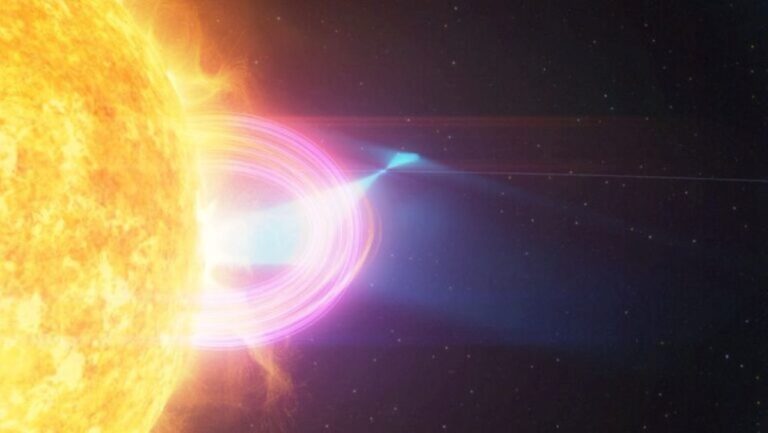
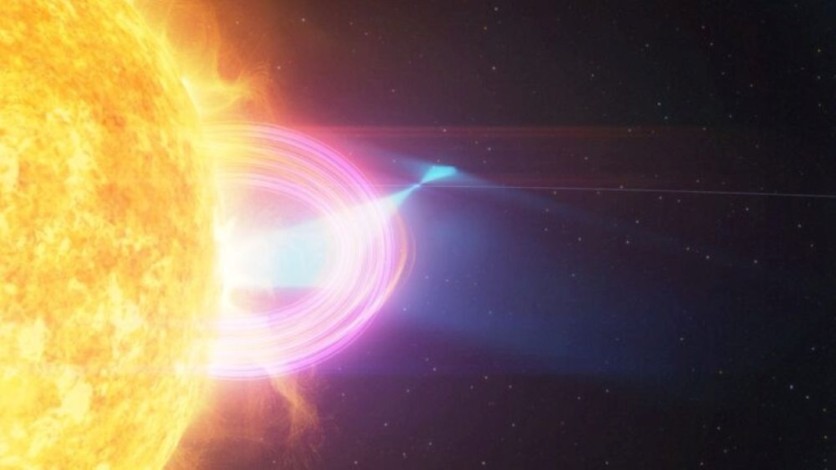
beams white dwarf pass other star’s atmosphere
The beams from the white dwarf pass through the other star’s atmosphere, revealing clues about its behaviour.
N Hurley-Walker/Icrar.org

Astronomers have detected clockwork radio pulses coming from a white dwarf — the dense, Earth-sized remnant of a dead star — orbiting a star virtually identical to our Sun. The discovery, published today in Nature Astronomy by lead author Sam McSweeney and colleagues at ICRAR’s Curtin University node and the SKA Observatory, fundamentally reshapes what scientists thought they knew about one of astronomy’s newest and most puzzling phenomena: long-period transients.

The newly described star system GPM J071507−114153 sits more than 5,000 light-years from Earth. Every eight minutes, it emits a burst of coherent radio waves detectable across interstellar space. Then it goes quiet. It stays quiet for 26 hours before the cycle begins again. For about six hours out of every 32, the pulses are on. For the remaining 26, the universe offers no hint the system exists.

That behavior alone would have made the system remarkable. But what makes it historic is the companion star: a G-type, or Sun-like, star — the first time a long-period transient has ever been seen orbiting anything remotely resembling our own star.

“This is the first time the pulses are clear enough to see the white dwarf moving in its orbit around its companion,” said McSweeney, who is now a commissioning scientist at the SKA Observatory.

What Are Long-Period Transients?

Long-period transients, or LPTs, are a class of radio sources that pulse on timescales of minutes to hours — far too slow to be conventional pulsars (which pulse in milliseconds) and far too regular to be random radio flares. The first was discovered in 2022 by a team at ICRAR’s Curtin University node, led by Associate Professor Natasha Hurley-Walker, using the Murchison Widefield Array (MWA), a radio telescope at Inyarrimanha Ilgari Bundara in Western Australia.

Since then, roughly a dozen LPTs have been found. For most of that brief history, the leading explanation involved white dwarfs paired with cool, dim red-dwarf stars — M-type companions much smaller and less massive than the Sun. The pairing of a hot, dense white dwarf with a cool companion seemed like a prerequisite for the emission mechanism to function.

GPM J071507 breaks that assumption cleanly. Its companion is a G-type star: 0.89 to 1.07 times the mass of the Sun, surface temperatures between 5,380 and 5,930 degrees Celsius (9,716 and 10,706 degrees Fahrenheit), and a lifespan measured in billions of years. The Sun itself is a G2V star. For the first time, a long-period transient has been found orbiting a star our own solar system’s star could be a stand-in for.

The Jupiter-Io Connection: How the Pulses Work

The mechanism behind LPT pulses isn’t random. It’s a process called electron cyclotron maser emission (ECME) — and the most accessible way to understand it is through the solar system’s own backyard.

Jupiter and its moon Io are connected by one of the most powerful electric circuits in the solar system. As Io orbits Jupiter, it passes through Jupiter’s immense magnetic field. That relative motion induces a voltage — essentially, the same principle as a dynamo or generator — which drives electric currents along magnetic field lines between Io and Jupiter. Those currents accelerate electrons to near-light speeds. When those relativistic electrons spiral tightly around the magnetic field lines near Jupiter’s poles, they emit intense, coherent radio waves. This is what gives Jupiter its distinctive decametric radio emission, detectable from Earth with the right equipment.

A white dwarf binary system works the same way, at much greater scales.

The white dwarf carries a magnetic field potentially billions of times stronger than Earth’s — in highly magnetic white dwarfs, fields can reach 10⁹ gauss. As it orbits its companion star, the white dwarf’s rotating magnetic field lines couple to the companion, driving a continuous electric current between the two stars. This is the unipolar inductor model: the binary system acts as a natural electromagnetic generator with the white dwarf as the magnet and the companion’s surface as one terminal of the circuit.

Electrons accelerated by this circuit stream toward the white dwarf’s magnetic poles. There, in a narrow geometric window called the loss-cone, the conditions trigger maser amplification — a natural, stimulated emission process analogous to a laser, but operating at radio frequencies rather than light frequencies. The result is a beam of coherent radio waves, narrowly focused, sweeping through space with each rotation of the white dwarf.

Earth happens to lie in the path of that beam for about six hours out of every 32. The other 26 hours, the beam points elsewhere.

Reading a Distant Star’s Weather Through Its Pulses

Detecting the pulses is only the beginning. Because they travel through the companion star’s outer atmosphere and magnetic envelope before reaching Earth, the pulses carry information about conditions on the companion star itself.

“It’s amazing that by using radio wavelengths we can detect the storms on a star over 5,000 light-years away,” said Hurley-Walker, whose team identified the LPT class and co-authored the new paper.

Variations in the pulse timing and shape encode two distinct phenomena: stellar flares — magnetic reconnection events on the companion star that temporarily boost the current driving the emission — and stellar prominences, loops of plasma extending above the companion’s surface that can partially occlude or scatter the beam. When the astronomers observed the white dwarf briefly disappearing behind a strong magnetic region of its companion, they were watching the stellar equivalent of a cloud passing in front of a lighthouse.

The clarity of the signal also allowed, for the first time, a direct measurement of the white dwarf’s orbital velocity. As it moves toward and away from Earth during its orbit, the Doppler shift of its radio pulses traces the arc of its path. That measurement required the Pawsey Supercomputing Research Centre to process more than 100 hours of raw radio data from the MWA, with the MeerKAT radio telescope in South Africa pinpointing the precise sky location, and W. M. Keck Observatory in Hawai’i confirming the companion’s G-type classification through optical observations.

Why a Sun-Like Companion Changes Everything

The significance of a G-type companion isn’t sentimental. It’s mechanistic.

Previous LPTs with confirmed binary companions involved M-dwarf stars: smaller, dimmer, cooler, less magnetically active, and less massive than the Sun. M-dwarfs were thought to offer something the ECME mechanism required. This discovery shows they don’t.

G-type stars are more massive, produce stronger stellar winds, and have hotter, more magnetically active coronae and chromospheres than M-dwarfs. They offer more material for the stellar-wind interaction and can sustain the current-driving mechanism at greater orbital separations. The fact that the LPT mechanism works robustly around a G-type companion means it isn’t sensitive to the companion’s spectral type — it’s governed by the white dwarf’s magnetic field strength and the binary orbital geometry.

The implication is significant: the total population of long-period transients in the Milky Way is likely far larger than any estimate based solely on white dwarf/M-dwarf pairings could predict. If the companion’s type doesn’t matter, then any white dwarf with a sufficient magnetic field, orbiting any main-sequence star at the right separation, is a candidate LPT. The Sun itself will become a white dwarf in roughly five billion years. Depending on what companions remain in orbit, its remnant could power exactly this kind of beacon.

What the SKA Will Find Next

The dozen or so LPTs discovered to date all came from precursor telescopes — the MWA and instruments like it — operating at the limits of their sensitivity. The Square Kilometre Array (SKA), currently under construction in both Australia and South Africa, is expected to be roughly 50 times more sensitive than any existing radio instrument and capable of surveying the sky about 10,000 times faster.

McSweeney, who now works on SKA commissioning, is among those expecting the population to explode once the instrument is fully operational, currently projected for around 2030. The handful of known LPTs discovered with precursor telescopes may represent only the brightest members of a much larger class — one that may ultimately redefine how astronomers catalog the endpoints of stellar evolution.

For now, every pulse from GPM J071507 arrives as an eight-minute reminder that the universe’s most extreme physics doesn’t always require the universe’s most exotic ingredients. Sometimes a dead star and a star like our Sun are enough.

The paper “A long-period transient with a Sun-like companion” by McSweeney et al. appears in the Nature Astronomy journal, published November 12, 2026.

Source link