HomeAuto D-Robotics Raises $400M for Humanoid Chips as US Bans Chinese Robot Imports
D-Robotics Raises $400M for Humanoid Chips as US Bans Chinese Robot Imports
September 19, 2026:
D-robotics.cc
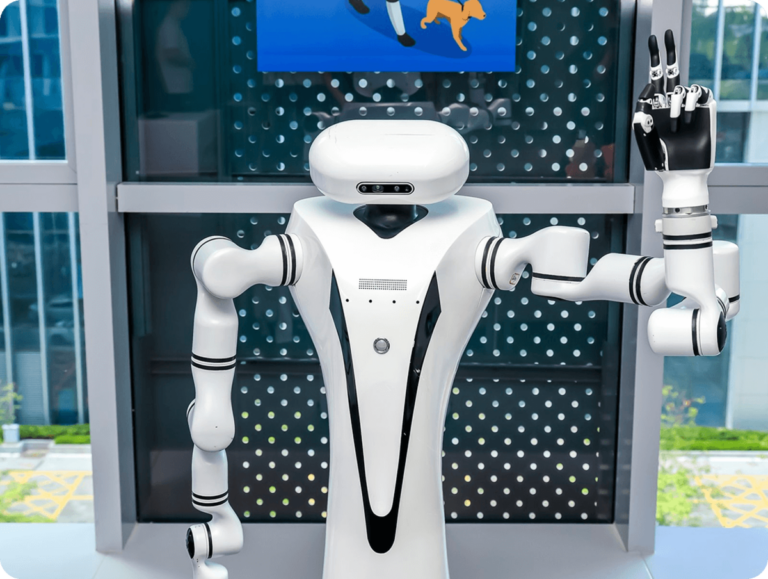
D-Robotics, the Chinese startup that designs the computing silicon running inside today’s wave of AI-powered humanoid and industrial robots, announced a $400 million close on September 17, 2026 — one of the largest single financing events ever recorded for a dedicated robotics semiconductor company — in the same week the US Federal Communications Commission’s July ban on new Chinese humanoid robot imports was still reverberating through the industry. The round, led by South Korean financial conglomerate Mirae Asset, arrives with a sharp irony: the Sunrise chips D-Robotics makes are designed to power precisely the class of robots placed on the FCC’s Covered List in July 2026.
That regulatory headwind does not diminish what D-Robotics has built. But it does define the stakes of the bet Mirae Asset and its co-investors just made.
D-Robotics was spun out from Horizon Robotics — a Hong Kong-listed designer of automotive driver-assistance chips — in early 2024, with a single mandate: to apply Horizon’s edge-inference silicon expertise to a new class of machines. The strategic wager was that physically embodied AI — systems capable of perceiving, reasoning, and acting in the real world — would require fundamentally different silicon than the cloud GPUs or general-purpose processors that power AI in data centers and smartphones.
From Automotive Silicon to Robot Brains: What D-Robotics Actually Makes
The company’s Sunrise chip family spans a computing range from 5 to 560 TOPS (Tera Operations Per Second, measured at INT8 precision), covering everything from lightweight home-cleaning robots to the demanding neural processing requirements of full-scale humanoids. Understanding why that range matters requires understanding what “embodied AI” actually demands from silicon.
A humanoid robot navigating a factory floor cannot route its perception-to-action decisions through a distant cloud server. The round-trip latency — even on a fast cellular connection — is incompatible with the millisecond-level motor control loops that keep a bipedal robot upright and responsive. The silicon inside the robot must do the inference locally, in real time, on a power budget measured in tens of watts rather than kilowatts. That is the fundamental engineering problem D-Robotics is building chips to solve.
The company’s top-end Sunrise S600, launched in November 2025, addresses this with a proprietary “Brain-Cerebellum” dual architecture that D-Robotics describes as its defining design philosophy. The “Brain” consists of an 18-core ARM Cortex-A78AE CPU cluster running large language models, vision-language models, and vision-language-action (VLA) models — the multimodal AI systems that translate sensor inputs into semantic understanding and action plans. The “Cerebellum” is the company’s proprietary Nash-architecture Brain Processing Unit, a dedicated neural accelerator optimized for the high-frequency, low-latency locomotion control and perception-fusion tasks that keep a robot’s body stable and reactive. The design is intentional: by separating the general reasoning engine from the real-time motor controller, D-Robotics avoids the bottleneck that occurs when a single processor must handle both a language model inference call and a 500 Hz joint-torque command in the same compute pipeline.
The S600 delivers 560 TOPS of peak INT8 compute (effective with 1/2 sparsity; total processing performance is below 4,800, per D-Robotics’ own footnote). It natively supports VLA models, large language models, and locomotion controllers — the three model classes that define the current generation of embodied AI systems.
How It Compares to NVIDIA’s Challenge
The dominant Western competitor in this specific segment is NVIDIA’s Jetson AGX Thor, which targets the same humanoid robot compute market. Jetson Thor delivers 2,070 FP4 TFLOPS on Blackwell GPU — floating-point at quarter precision, suited for larger transformer models — with a 14-core Arm Neoverse-V3AE CPU and 128 GB of LPDDR5x memory, within a 130-watt power envelope. Adopted customers include Agility Robotics and Boston Dynamics.
Those figures are not directly comparable to D-Robotics’ 560 INT8 TOPS because the two chips optimize for different points in the inference pipeline. Jetson Thor’s floating-point compute advantage enables larger unquantized models to run without precision loss; D-Robotics’ INT8 architecture prioritizes efficient deployment of quantized networks, typically achieving lower power draw per inference operation on production-optimized model weights. In practice, robot makers selecting between them are choosing between two different architectural philosophies: NVIDIA’s GPU-heritage approach (broader model compatibility, higher raw compute ceiling) versus D-Robotics’ purpose-built BPU approach (tighter latency budgets, more efficient quantized inference, lower bill-of-materials cost at scale).
D-Robotics’ strategy leans heavily on that cost-and-ecosystem dimension. Its Sunrise portfolio spans 5 to 560 TOPS — a range that lets one developer relationship serve everything from a floor-cleaning robot (minimal compute, low power) to a full humanoid (maximum compute, tight latency). NVIDIA’s Jetson lineup covers similar ground but at price points calibrated for a Western enterprise customer base.
What the $400M Will Buy
The Series C was led by Mirae Asset, the South Korean financial conglomerate that has been systematically building positions in Asian deep-tech semiconductors — its portfolio includes Korean chip designers Rebellions and SEMIFIVE — while its Global X ETF brand has launched China robotics and humanoid-focused exchange-traded funds. Co-investors include Meituan Strategic Investment, government-backed platforms Hefei State-owned Investment and Nanshan Strategic Emerging Industry Investment, and institutions Cathay Capital and GF Xinde, per 36Kr’s investor breakdown. Existing shareholders GL Ventures, 5Y Capital, Linear Capital, and Vertex Growth — the latter an investment arm of Singapore’s Temasek — also increased their stakes.
The raise brings D-Robotics’ total disclosed funding to approximately $770 million across four rounds completed in roughly 26 months: a $100 million Series A in mid-2025, a $120 million Series B1 in March 2026, and a $150 million Series B2 reported by Yicai in April, bringing the Series B total to $270 million, followed now by this $400 million close.
D-Robotics says the capital will be directed at two priorities: broadening the Sunrise chip portfolio across additional computing tiers to serve robot categories with different power and latency budgets, and building out a software platform that spans the full robot development chain — from model training and deployment to real-time joint control.
Commercially, the company reports revenue growing “several times” year-over-year in the first half of 2026 compared to the same period in 2025 — an unquantified multiplier that nonetheless signals the transition from pre-revenue chip startup to functioning commercial business. Cumulative Sunrise chip shipments exceeded 8 million units by the time of the Series C close. The S600 was adopted by more than 20 leading embodied AI customers within its first six months on the market, including UBTECH, FOURIER, Booster Robotics, Astribot, TARS, Spirit AI, and X Square Robot. The majority of those customers were already in mass production as of the announcement date.
The Market Behind the Money: Why $305B by 2045
Morgan Stanley’s research projects the humanoid robot semiconductor market will reach $305 billion by 2045, representing roughly half of the entire global chip market in today’s dollars. The bank’s analysis projects the bill of materials for a humanoid robot will collapse from roughly $131,000 today to approximately $23,000 by 2045 as manufacturing scales — but within that cheaper robot, semiconductor content will grow from 4 to 6 percent of total BOM cost today to 24 percent by then. AI processors alone, which enable a robot’s decision-making and autonomy, are forecast to grow from representing approximately 67 percent of total semiconductor costs inside humanoids today to roughly 93 percent by 2045. The computational intensity is what drives value; the body becomes a commodity while the brain becomes the primary economic asset.
TrendForce has separately projected the humanoid chip market will surpass $48 million by 2028, with NVIDIA’s Jetson Thor adoption by Agility Robotics, Boston Dynamics, and Amazon among the near-term volume drivers.
In the near term, China dominates the global market for humanoid robot deployment, with an estimated market share of roughly 85 percent as of mid-2026. Chinese manufacturers — including Unitree, Zhiyuan, and the customers running D-Robotics’ Sunrise chips — have been scaling output faster than Western rivals, according to Kangyuxiao Li, an analyst at Morningstar. That scale creates a self-reinforcing dynamic: volume justifies chip investment, which drives down per-unit silicon cost, which expands the addressable robot market.
Why the FCC Ruling Changes D-Robotics’ Global Story
On July 28, 2026, the FCC added humanoid and quadruped robots to its Covered List under the Secure and Trusted Communications Networks Act, effectively banning new imports of these product categories from foreign — primarily Chinese — manufacturers. The FCC stated that advanced robotic devices collect data that could be “leveraged by malign actors to surveil Americans, enhance the capabilities of foreign intelligence services, or to remotely commandeer the robots.”
This is not a peripheral development for D-Robotics. Every one of the S600’s named customers — UBTECH, FOURIER, Booster Robotics, Astribot, and the others — is a Chinese manufacturer. The Sunrise chip does not itself collect or transmit data; it is a processor. But the robots it powers are now banned from the US market if they are new Chinese-made models. An American company that wants to build a humanoid robot using a Sunrise S600 is building with a Chinese-supplied chip into a market that US regulators are actively de-risking from Chinese technology.
The FCC action followed a bipartisan legislative push. In June 2026, Chairman John Moolenaar, Representative Jay Obernolte, and Representative Jennifer McClellan introduced the GUARD Act, which would require security agencies to conduct risk assessments of Chinese robotics communications equipment and empower the FCC to ban those deemed threats. A March 2026 House Homeland Security hearing specifically examined national security risks of Chinese artificial intelligence, robotics, and autonomous technologies.
In July 2026, Representative Tim Walberg sent a letter to Secretary Lutnick citing China’s National Intelligence Law Article 7 — which requires all Chinese organizations and citizens to support, assist, and cooperate with national intelligence work on demand — as a structural risk for any US company partnering with Chinese robot component makers.
That legal framework — China’s National Intelligence Law (2017), Data Security Law (2021), and Cybersecurity Law (2017) — applies to D-Robotics regardless of its Hong Kong incorporation address, the location of any particular server, or the company’s stated privacy practices. These are fixed statutory obligations under Chinese law, not negotiable corporate positions.
Mirae Asset’s Position and What It Signals
For Mirae Asset, the D-Robotics investment extends a deliberate pattern. Mirae Asset Venture Investment has been building positions in AI semiconductor companies, and the broader group’s Global X brand has launched China robotics and humanoid-focused ETFs. In August 2026, the Korean firm projected it would form new funds totaling 929 billion won (approximately $654 million at exchange rates current at time of publication) by year-end, backed by Korea’s national AI semiconductor push, with semiconductors named as an explicit priority sector.
Leading a $400 million China-based robotics chip round represents a step change in both scale and geographic scope for the firm. It reflects a thesis held by multiple Asian institutional investors — Temasek (via Vertex Growth), Singapore’s 5Y Capital, and Cathay Capital — that the physical AI supply chain, not just the software model layer, is the defining capital-formation opportunity of the current hardware cycle. The bet is that whoever owns the chip layer beneath the robot body owns the value.
That bet is plausible. It is also being placed in an environment where the US government has made clear it views Chinese robot hardware as a national security risk, and where the regulatory pressure on Chinese-origin components in American supply chains is likely to intensify regardless of the outcome of any bilateral summit.
What Does the Brain-Cerebellum Architecture Mean for Robot Buyers?
The “Brain-Cerebellum” design is D-Robotics’ attempt to solve a specific engineering problem that general-purpose processors handle poorly. A humanoid robot running a VLA model — the class of AI system that connects visual perception, language understanding, and motor action — must maintain two very different compute rhythms simultaneously. The language-model inference layer runs at a relatively low frequency; it is computationally expensive but not time-critical at the millisecond level. The locomotion controller runs at very high frequency (typically hundreds of times per second) and is safety-critical: a delay or error here means the robot falls.
On a GPU designed for training large models, these two tasks compete for memory bandwidth and compute resources. The Nash-architecture BPU on the S600 separates them at the silicon level, giving each its own optimized pipeline. This is the same architectural insight that led to separate GPU and NPU cores in modern smartphone chips — except applied to the specific latency and throughput requirements of physical robots.
For a robot maker choosing a compute platform, this architectural choice has downstream consequences for which models can be run efficiently, how much power the compute subsystem draws, and how much flexibility exists to update the robot’s intelligence in the field without a hardware replacement. D-Robotics’ RDK developer platform is designed to make those software updates as frictionless as possible — a standard developer kit, a common toolchain, and a community of more than 100,000 developers across more than 20 countries who have built on the platform.
Whether that ecosystem depth can offset the regulatory headwind in the US market is a question that no amount of chip performance resolves.
Is D-Robotics’ Global Expansion Story Actually Global?
The company’s stated developer community spans 500-plus universities and 100,000-plus developers across 20-plus countries, and its IFA 2026 presence in Berlin demonstrated genuine European market penetration: TCL’s “hey AiMe” home companion robot, Vbot’s SuperDog quadruped, and xLean’s TR1 floor-cleaning robot all ran Sunrise chips at the show. Partners include Bosch Sensortec, Midea, Mammotion, and Fourier Intelligence.
That European and Asian presence is real. The US market is where the regulatory picture is most unfavorable. The FCC ban on new Chinese humanoid robot imports does not prohibit D-Robotics from selling chips to a US startup that builds a US-assembled robot. It prohibits new Chinese humanoid robot products from receiving FCC authorizations — the approvals needed for any radio-frequency-capable device to be sold in the United States. Since virtually every humanoid robot contains wireless communication hardware, the Covered List designation is, in practice, a ban on new Chinese humanoid robots entering the US consumer and commercial market.
A US robot maker that wanted to build a NVIDIA-free, D-Robotics-powered humanoid for American customers would need to demonstrate that its product is not “foreign-made” in the FCC’s sense — which likely means US assembly, US-sourced integrations, and a supply-chain audit trail that could survive regulatory scrutiny. None of those requirements make D-Robotics’ chips technically unsuitable. They do make a D-Robotics-based US robot product significantly more complicated to bring to market than a NVIDIA Jetson Thor-based alternative.
Currency conversions are approximate and based on exchange rates at the time of publication.
Frequently Asked Questions
What is D-Robotics and why is a Horizon Robotics spinout raising $400 million?
D-Robotics was spun off from Horizon Robotics — a Chinese autonomous-driving chip company that trades on the Hong Kong exchange — in early 2024, with a mandate to design computing silicon specifically for AI-powered robots. It is not building robots; it is building the processors that go inside robots. The $400 million Series C, led by South Korean conglomerate Mirae Asset, reflects investor conviction that the chip layer beneath humanoid robots will be among the most valuable positions in the coming decade, with Morgan Stanley projecting the humanoid robot semiconductor market alone could reach $305 billion by 2045.
How does the Sunrise S600 chip differ technically from NVIDIA’s Jetson Thor?
Both chips are designed to run vision-language-action (VLA) models and large language models inside humanoid robots at the edge rather than in the cloud. The core architectural difference is in how they divide compute resources. NVIDIA’s Jetson Thor uses a Blackwell GPU delivering 2,070 FP4 TFLOPS — floating-point performance optimized for running large unquantized models with high precision. D-Robotics’ Sunrise S600 uses a dual-compute “Brain-Cerebellum” design pairing an 18-core ARM CPU with its proprietary Nash-architecture Brain Processing Unit (BPU), delivering 560 TOPS at INT8 — integer-quantized inference optimized for efficient deployment of production-ready models. These are genuinely different architectural strategies for the same underlying problem, not a straightforward comparison. Jetson Thor targets higher raw compute with broader model compatibility; S600 targets tighter latency budgets and lower power draw on optimized models.
Is D-Robotics subject to China’s national security laws, and what does that mean for customers?
Yes. D-Robotics is a Chinese company, and China’s National Intelligence Law (2017) requires all Chinese organizations and citizens to support, assist, and cooperate with national intelligence work on demand. The Data Security Law (2021) and Cybersecurity Law (2017) add data-localization and government-access obligations. These are fixed statutory requirements under Chinese law that apply regardless of where D-Robotics incorporates, where its servers are physically located, or what its stated privacy policy says. For a US robot maker evaluating Sunrise chips, this legal framework means the chip supplier is legally obligated to comply with Chinese government intelligence requests — which is the same concern that led the FCC to ban new Chinese humanoid robot imports in July 2026 and prompted bipartisan legislation (the GUARD Act) to restrict Chinese robotics communications equipment more broadly.
Will the FCC’s ban on Chinese humanoid robot imports stop D-Robotics from selling chips in the US?
The FCC’s July 2026 ruling bans new import authorizations for foreign-made humanoid robots, quadrupeds, and connected power inverters — it does not directly ban the chips inside them. A US company could theoretically build an American-assembled humanoid robot using D-Robotics’ Sunrise chips and sell it in the US market. The complication is supply-chain scrutiny: US lawmakers have specifically cited China’s National Intelligence Law as a structural risk for American companies partnering with Chinese robot component makers, and the regulatory environment around Chinese-origin components in American technology supply chains is tightening, not loosening. US robot makers evaluating NVIDIA Jetson Thor versus D-Robotics’ Sunrise chips will need to factor in not just technical performance and cost but the downstream regulatory exposure that comes with Chinese-sourced silicon.