November 22, 2026:


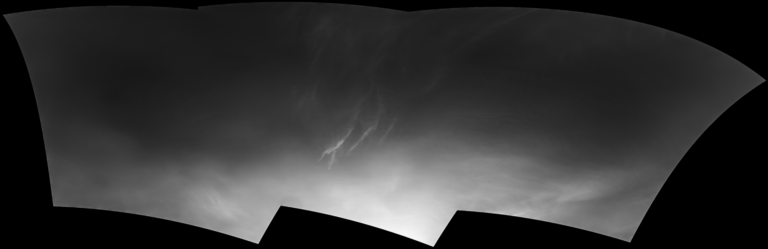
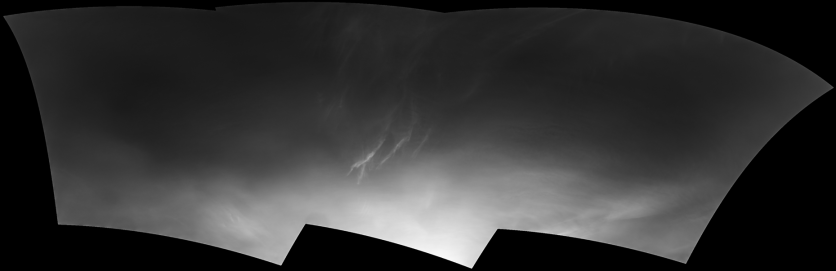
NASA’s Curiosity rover photographed thin, glowing clouds drifting across the Martian sky after sunset on October 31, 2026, and NASA posted the black-and-white panorama on November 20 at 5:27 p.m. ET. The clouds return every autumn at Gale Crater, and Curiosity’s team can predict when to look.
NASA cataloged the image as PIA26805 and took it on the mission’s 5,061st Martian day, or sol, with Curiosity’s Navigation Cameras, known as Navcams. NASA’s caption says the clouds appear for a short time each fall over Gale Crater, a site Curiosity has explored for more than 14 years. The image entry does not state the clouds’ composition or altitude.
Alex Innanen, an atmospheric scientist at York University, wrote in a NASA mission blog posted October 19 that Mars Year 39 began in late September, at the northern spring equinox. Mars scientists track the seasons by solar longitude, which starts at 0 degrees at that equinox; each season spans 90 degrees of the planet’s 360-degree orbit. Gale Crater sits just south of the equator, so the new Mars year means autumn there.
The blog says autumn brings back high-altitude twilight clouds, which the low Sun lights at sunset. Most clouds at Gale are too thin to see, but twilight clouds are bright enough to show up in raw Navcam images. A zenith movie from Wednesday, October 7 (sol 5,037) showed high, wispy clouds, and that day’s late-afternoon cloud movies caught the first high-altitude clouds of the season. The October 31 frames came 24 sols later.
Mark Lemmon, an atmospheric scientist at the Space Science Institute in Boulder, Colorado, said the clouds have become predictable enough that the team can plan observations ahead of time, because they appear at about the same time each year. NASA’s February 2025 release counted Curiosity’s January 2025 recording as the fourth Mars year of observations; the phenomenon occurs in early southern fall. Pathfinder saw twilight clouds on Mars in 1997, and Curiosity first spotted them in 2019.
A paper Lemmon led in Geophysical Research Letters in December 2024 described a previously unreported cloud season in early southern autumn at Gale. It found that ice begins to form near sunset in a narrow range of particle sizes, then grows and falls out.
Twilight clouds sit high enough to stay in sunlight after dark at the surface, so researchers can estimate their height from the timing of when sunlight leaves them. The Lemmon-led paper used the timing of Mars’s shadow crossing the clouds and placed them 50 to 80 km (31 to 50 miles) up, judging them probably carbon dioxide ice.
Heights differ by cloud type. NASA’s January 2025 Mastcam images put carbon dioxide ice clouds at roughly 60 to 80 km (37 to 50 miles), with water-ice clouds near 50 km (31 miles) moving in the opposite direction. A May 2019 Navcam image, taken on sol 2,400, showed clouds NASA put at about 19 miles (31 km) up and described as likely water ice.
Curiosity’s Navcams are black-and-white navigation cameras. NASA said in 2021 that Navcam images show the fine, rippling structures of twilight clouds, while color images from the Mastcam show their shine.
That division matters for the new image. Iridescence is a color effect that arises from similar particle sizes, and Lemmon’s team uses it as a probe of how cloud particles grow. A black-and-white mosaic cannot show it, and NASA’s image entry does not say whether the October 31 clouds are water ice or carbon dioxide ice.
“Noctilucent” is Latin for “night shining.” On Earth, noctilucent clouds form about 50 miles (80 km) up, higher than any other clouds, and they are made of water vapor that freezes around meteor dust. From the ground, they show up only when the viewer is in darkness and the Sun is low enough to light the clouds from below.
Mars is different because its atmosphere is more than 95% carbon dioxide, and NASA says its highest, coldest clouds can be made of carbon dioxide ice rather than water ice. Mars Express has detected carbon dioxide clouds 80 to 100 km up (50 to 62 miles), the highest clouds ever observed above any planetary surface.
Perseverance, which works in Jezero Crater in the northern hemisphere, has not seen carbon dioxide ice twilight clouds since landing in 2021, and NASA says one big mystery is why they have not been spotted in other places on Mars. Pathfinder, which landed north of the equator at Ares Vallis, saw twilight clouds in 1997.
Lemmon suggests atmospheric gravity waves could be responsible, because they can cool the atmosphere, but he says Martian gravity waves are not fully understood.
The Curiosity blog says twilight cloud activity should increase as autumn goes on. The October 31 mosaic is a black-and-white record of a season that returns on a schedule, NASA’s image entry gives no composition or altitude for it, and why the clouds have not been seen elsewhere on Mars remains unexplained.
Yes. NASA says Martian clouds are made of water ice or, at higher altitudes and lower temperatures, carbon dioxide ice, and most clouds at Gale Crater are too thin to be seen by human eyes or Curiosity’s cameras.
Yes, with its Mastcam. On January 17, 2025, Curiosity’s Mastcam recorded red-and-green-tinted twilight clouds over 16 minutes.
NASA says plumes of falling carbon dioxide ice descend as low as about 50 km (31 miles) above the surface before evaporating.
Scientists commonly number Mars years from the northern spring equinox of April 11, 1955, which began Mars Year 1. By that count, Mars Year 39 began in late September 2026.