HomeAuto Competing Bid Forces onsemi to Rewrite Synaptics Deal: $1.3B Less, All Cash
Competing Bid Forces onsemi to Rewrite Synaptics Deal: $1.3B Less, All Cash
October 3, 2026:
ETIENNE LAURENT/AFP via Getty Images
An unsolicited offer from an unnamed rival was serious enough to upend a signed, board-approved merger agreement — and to prove, in the process, just how badly the semiconductor industry wants the edge AI silicon that Synaptics has been quietly building for three years.
onsemi (NASDAQ: ON) and Synaptics Incorporated (NASDAQ: SYNA) disclosed an amended merger agreement on October 1, 2026, filed an October 1 8-K with the Securities and Exchange Commission, replacing their original June 25 all-stock deal with a fixed all-cash offer of $123 per share. The revised terms value Synaptics at approximately $5.7 billion in aggregate — roughly $1.3 billion less than the approximately $7 billion headline valuation attached to the original June 25 press release, which was the largest acquisition in onsemi’s history. The amendment, both companies confirmed, followed receipt of an unsolicited, non-binding proposal from a third-party strategic buyer — identified only as “Party A” in Synaptics SEC regulatory filings — submitted on September 2, 2026.
Unnamed Rival Triggered the Rewrite
The mechanics of how a competing bidder can reshape an already-signed deal are straightforward in theory and brutal in practice. Once Synaptics received the September 2 proposal, its board was obligated to evaluate it in good faith — and if the proposal constituted a “Superior Proposal” under the merger agreement’s terms, onsemi was required to receive notice and a right to match.
According to Synaptics DEFA14A SEC filing, the Synaptics Special Committee and full board determined, in consultation with legal and financial advisors, that “in light of the proposed terms of the A&R Merger Agreement, the proposal from the strategic party, as revised by the strategic party since its initial September 2 unsolicited proposal, no longer constituted a Superior Proposal.” That phrasing is deliberate: the rival’s offer was revised during negotiations — meaning it was meaningful enough to stay in play for nearly a month — before onsemi’s improved terms ultimately prevailed.
The rival’s identity has not been disclosed and is not expected to be until Synaptics’ proxy statement is filed with the SEC. But its existence is itself the story. Whoever Party A is, they were willing to bid against a signed agreement for a company whose last 12 months of public revenue totaled approximately $1.2 billion according to the Synaptics FY2026 annual report. That willingness reflects something broader than an interest in one company — it reflects an industry-wide scramble for edge AI compute platforms that the incumbents did not build.
Why Synaptics Attracted a Competing Bid: The Astra Platform
To understand why Party A was willing to disturb a signed $7 billion deal, it helps to understand what Synaptics has been building and why it is hard to replicate quickly.
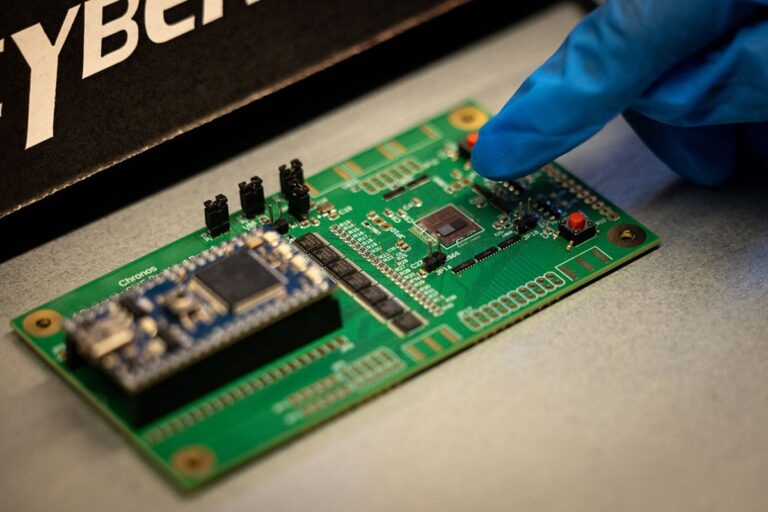
Synaptics’ Astra platform is an AI-native edge computing architecture that combines heterogeneous processing, wireless connectivity, and a rich human-machine interface library on a common silicon foundation, as described in CNX Software Astra SRW1500 specs. At its core, Astra uses a heterogeneous compute architecture: Arm Cortex-M and Cortex-A CPU cores are paired with the proprietary Synaptics Torq AI platform — co-developed with Google Research — and Google’s open-source RISC-V-based Coral neural processing unit (NPU), detailed in Synaptics Astra platform investor page. Synaptics was the first company to embed Google’s RISC-V Coral NPU in commercial silicon.
The open AI software stack supports TensorFlow, PyTorch, and ONNX frameworks, and operates on FreeRTOS and Zephyr RTOS — two of the most widely deployed real-time operating systems in embedded devices worldwide.
The SRW1500 series, among the first single-chip edge AI MCU platforms with integrated Wi-Fi 7 connectivity when it launched in early 2026, packs an Arm Cortex-M52 core, an Arm Ethos-U55 NPU running at 200 MHz for up to 50 GOPS of AI inference performance, tri-band Wi-Fi 7 (802.11be) covering 2.4 GHz, 5 GHz, and 6 GHz, Bluetooth 6.0 LE with long-range support, and 802.15.4 radio for Zigbee, Thread, and Matter — all in one package, as confirmed in AudioXpress SRW1500 launch coverage. The practical significance: OEMs building smart home devices, industrial IoT nodes, or robotics systems can source a single Synaptics chip instead of integrating separate compute, wireless, and AI-acceleration components from multiple vendors.
That system-level simplification is the source of Synaptics’ moat and the reason its Synaptics FY2026 10-K revenue grew 11.4% year over year to approximately $1.2 billion, driven primarily by Core IoT product applications.
What onsemi Is Getting: Four Pillars, No Gaps
onsemi’s strategic logic for acquiring Synaptics is built around a concept both companies call the “four pillars of physical AI” — Power, Sense, Connected Compute, and Control, as defined in the original merger press release June. Physical AI refers to intelligence embedded in real-world devices and machines — factory robots, autonomous vehicles, AR/VR headsets, industrial automation equipment — that must sense their environment, process data locally, and act in real time without the latency or connectivity dependence of cloud-based AI, as analyzed by SiliconANGLE physical AI analysis.
Before this deal, onsemi could plausibly claim leadership in only two of those four pillars. The company is the second-largest power semiconductor manufacturer in the world and the largest supplier of automotive image sensors, with a portfolio spanning silicon carbide (SiC) EliteSiC devices for EV drivetrains and AI data center power delivery, gallium nitride (GaN) for high-efficiency switching, and its Hyperlux CMOS image sensor family for automotive ADAS and machine vision. It had nothing for Connected Compute and virtually nothing for Control beyond its imaging systems.
Synaptics fills both gaps with direct, production-ready IP. Connected Compute comes from the Astra platform described above. Control comes from Synaptics’ decade-plus legacy in human-machine interface technologies: touch controllers deployed in virtually every major PC and laptop touchpad, display drivers, fingerprint biometrics, audio processing, and video codecs — the interfaces through which humans interact with the intelligent machines physical AI is meant to animate.
“The addition of Synaptics helps position onsemi at the intersection of these four pillars, enabling us to capture a significantly larger AI opportunity that extends beyond AI data center and into edge applications,” onsemi President and CEO Hassane El-Khoury said when the original merger press release June was released. With the revised terms disclosed on October 1, El-Khoury restated the logic: “Synaptics is accretive to our long-term model, with a strong growth outlook and attractive gross margin profile that will help accelerate onsemi’s evolution,” according to the revised merger press release October.
The two companies expect the combined platform to expand onsemi’s total addressable market by $30 billion, pushing it to $243 billion by 2030.
onsemi Frames a Lower Price as a Shareholder Win
The switch from stock to cash — and the corresponding reduction from $7 billion to $5.7 billion — might look like a concession. onsemi is presenting it as the opposite.
Under the original all-stock structure, onsemi would have issued new shares to Synaptics holders, diluting existing onsemi shareholders and providing no immediate EPS benefit. The revised merger press release October confirmed the all-cash deal, funded through cash on hand and committed debt financing from Morgan Stanley, eliminates that dilution entirely. The amended agreement also removes any closing condition tied to onsemi securing its financing, reducing deal-break risk for Synaptics shareholders.
“The all-cash transaction delivers higher value to our shareholders through lower total cost consideration, and we now expect the transaction to be immediately accretive to non-GAAP EPS upon closing,” El-Khoury said in the revised merger press release October. In the original deal, onsemi had forecast accretion within 18 months — not immediately. The $1.3 billion reduction in purchase price moved the deal from “eventually accretive” to “immediately accretive” in onsemi’s financial model.
El-Khoury also disclosed incremental value creation opportunities beyond the previously announced $200 million in annual run-rate synergies: additional revenue synergies from combining the two platforms, and the potential to insource a portion of Synaptics’ production into onsemi’s manufacturing network — benefits the company expects to materialize after the initial 18 months post-close.
Synaptics Shareholders: Cash Certainty Over Stock Risk
For Synaptics shareholders, the original all-stock deal had become increasingly uncomfortable. After the agreement was announced on June 25, onsemi shares fell nearly 10% in extended trading as Reuters June 25 stock report described investors digesting the acquisition premium — meaning the effective value of the deal declined in tandem before the ink was dry.
The competing bid in September arrived while that uncertainty persisted. By the time the Synaptics Special Committee finished its evaluation, the board had extracted from onsemi a fixed cash price that eliminated the share-price exposure entirely.
“Our Board has been singularly focused on delivering the best outcome for our shareholders, and today’s amended agreement reflects that commitment,” said Rahul Patel, Synaptics President and CEO, in the revised merger press release October. “By transitioning to an all-cash structure, we are providing value certainty at a meaningful premium as compared to current value.” The Synaptics board voted unanimously to recommend the amended agreement.
The deal still requires approval from Synaptics shareholders at a special meeting, whose date has not yet been announced.
Part of a Larger Semiconductor Land Grab
The mystery rival’s September 2 bid is best understood not as an opportunistic move against a single deal, but as a symptom of an industry-wide collision.
The same strategic logic that drove onsemi to bid $7 billion for Synaptics in June is driving competitors to make analogous moves. Analog Devices Alif acquisition announcement confirmed ADI agreed to acquire Alif Semiconductor for $1.35 billion in cash in September 2026 — combining Alif’s AI-native MCUs and NPUs with ADI’s analog sensing and power management in a nearly identical strategic frame. “AI is moving out of the data center and into the physical world, where latency, power, and trust cannot be compromised,” said ADI CEO Vincent Roche — a statement that could have come from El-Khoury’s script.
AI2 Work edge AI analysis documented that NXP Semiconductors launched a bid for Ambarella at approximately $3 billion and completed its acquisition of edge AI chipmaker Kinara for $307 million, with Qualcomm, TDK, and Renesas also completing deals targeting edge AI capability in the same period. The analysis found “the past month has brought an unusually dense run of semiconductor acquisitions.”
The pattern is identical in each case: a large, incumbent analog or power semiconductor company — which owns the power, sensing, and signal-processing stack — acquires a smaller specialist that owns the edge AI compute and connectivity stack, because neither side can build the other’s capability from scratch in time to meet the physical AI design cycle already underway at automotive, robotics, and industrial OEM customers.
Party A, whoever they are, was running that same playbook. The September 2 bid was not irrational — it was the industry’s consensus thesis, expressed as a competing offer.
Regulatory Picture and Path to Close
The U.S. Federal Trade Commission cleared the transaction, the most significant jurisdictional hurdle for a domestic semiconductor deal, as confirmed in the revised merger press release October. HSR filings were submitted on July 17, 2026, and the 30-day waiting period expired on August 17 without a second request — indicating the agencies saw no serious competitive overlap. Both companies operate in largely complementary product markets with minimal overlap, which has generally insulated the deal from antitrust scrutiny.
Regulatory reviews remain ongoing in unspecified international jurisdictions. The transaction is expected to close by mid-2027, subject to the completion of those reviews and approval from Synaptics shareholders.
Frequently Asked Questions
Why did onsemi lower the Synaptics acquisition price by $1.3 billion?
The price reduction was not a sign of weakening commitment — it was the financial result of restructuring the deal from all-stock to all-cash. An unnamed rival bidder submitted an unsolicited offer for Synaptics on September 2, 2026, forcing onsemi to negotiate improved terms. onsemi raised the certainty of value by committing to a fixed $123-per-share cash price, while simultaneously reducing the total consideration from approximately $7 billion to $5.7 billion. The lower price, combined with the elimination of share dilution, made the deal immediately accretive to onsemi’s non-GAAP earnings per share — an improvement over the original structure, which was forecast to become accretive only within 18 months.
What is Synaptics’ Astra platform, and why do rival chipmakers want it?
Astra is Synaptics’ family of edge AI processors and microcontrollers designed to run AI inference locally on devices — inside smart home gadgets, factory robots, autonomous vehicles, and other physical systems — without depending on cloud connectivity. Architecturally, Astra chips combine Arm CPU cores with Synaptics’ Torq NPU (co-developed with Google Research), Google’s open-source RISC-V Coral NPU, and integrated Wi-Fi 7, Bluetooth 6.0, and Zigbee/Thread/Matter wireless radios on a single piece of silicon. No major power semiconductor company — onsemi, Analog Devices, NXP — has built comparable edge compute plus connectivity IP internally. That gap is why every incumbent in the sector is simultaneously bidding for the companies that have it.
Who was the mystery bidder for Synaptics?
The competing party is identified only as “Party A” in regulatory filings and has not been publicly disclosed. The filings confirm the proposal arrived as an unsolicited, non-binding offer on September 2, 2026, and was revised at least once during negotiations before Synaptics’ board concluded onsemi’s amended terms were superior. The identity of Party A is expected to be disclosed in Synaptics’ forthcoming proxy statement filed with the SEC in connection with the shareholder vote.
When will the Synaptics shareholder vote take place, and what happens if shareholders reject the deal?
Synaptics has not yet announced the date of the special meeting at which shareholders will vote on the amended agreement. If shareholders reject the deal — or if the remaining international regulatory reviews produce a blocking condition — the transaction would not close. Under those circumstances, Synaptics would remain an independent company. Synaptics’ proxy statement, once filed, will contain a full description of the terms, the financial advisor fairness opinion, and the board’s recommendation.