China’s Einstein Probe Catches Red Dwarf Flare; Robotic Telescopes Confirm in 20 Minutes

November 8, 2026:

China’s Einstein Probe Catches Red Dwarf Flare; Robotic Telescopes Confirm in 20 Minutes
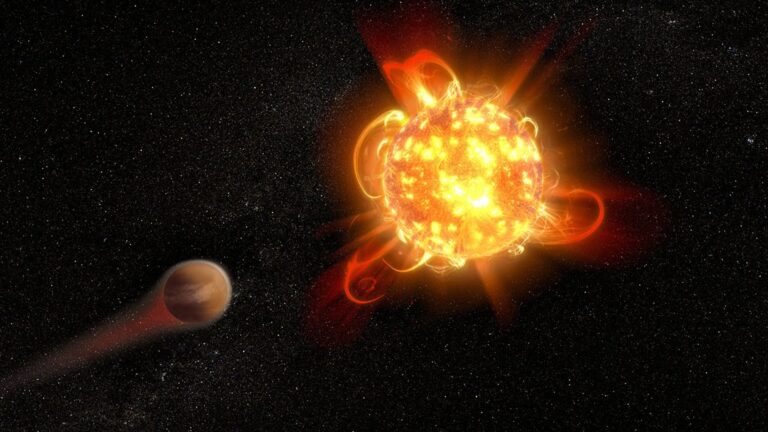
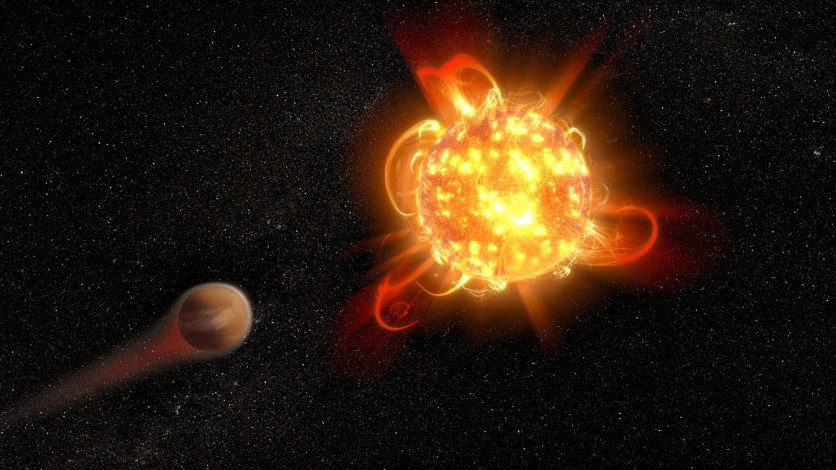
Artist's Illustration of a Young Red Dwarf Stripping Away a Planet's Atmosphere
Violent outbursts of seething gas from young red dwarf stars may make conditions uninhabitable on fledgling planets. In this artist’s rendering, an active, young, red dwarf (right) is stripping the atmosphere from an orbiting planet . Scientists found that flares from the youngest red dwarfs they surveyed — approximately 40 million years old — are 100 to 1,000 times more energetic than when the stars are older. They also detected one of the most intense stellar flares ever observed in ultraviolet light — more energetic than the most powerful flare ever recorded from our Sun.
nasa.gov

In the early hours of Friday, three separate facilities spanning two continents converged on a single point in the constellation Perseus to characterize an energetic X-ray flare from a nearby red dwarf star — the latest demonstration of the operational maturity of modern time-domain astronomy’s alert infrastructure.

At 21:28:37 UTC on Thursday, November 6, the Wide-field X-ray Telescope (WXT) aboard China’s Einstein Probe satellite triggered on an X-ray brightening designated EP-WXT trigger 01709322274. Within minutes, astronomers at the Ondrejov Observatory in the Czech Republic had the flaring star in their sights. Twenty minutes after the trigger, the robotic GOTO telescope network — operating from the Canary Islands — confirmed the source was significantly brighter than its baseline level. By early Friday morning, the Einstein Probe team issued a formal classification via NASA’s General Coordinates Network (GCN): the trigger was almost certainly a stellar flare on a high-proper-motion M dwarf catalogued as Gaia DR3 111731654357442816, not the kind of extragalactic transient the satellite’s alert system is also designed to catch.

A Star That Moves Fast — and Flares Hard

The source, Gaia DR3 111731654357442816, is identified in the GCN circulars as a high-proper-motion M dwarf — the kind of designation that immediately signals a relatively nearby star. Stars with large proper motions tend to lie within a few hundred light-years of the Sun; their motion across the sky, accumulated over decades of observations by missions like ESA’s Gaia astrometric satellite, betrays their proximity.

M dwarfs (also called red dwarfs) are the most common stars in the Milky Way, accounting for the large majority of stellar objects in the galaxy. Despite their diminutive size and cool surface temperatures — typically below 3,900 degrees Kelvin — they are magnetically turbulent, and their flares can release enormous amounts of energy in X-rays and extreme ultraviolet radiation, sometimes exceeding the most powerful eruptions the Sun produces.

A. Li of Beijing Normal University and colleagues, writing for the Einstein Probe team, report that the WXT measured an estimated soft X-ray flux of approximately 6 × 10⁻¹¹ erg/s/cm² in the 0.5–4.0 keV energy band. Translated to an intrinsic luminosity, that corresponds to roughly 3.6 × 10²⁹ erg/s — a moderate event by M-dwarf standards. Published flare statistics from eROSITA-Chandra surveys show that M-dwarf X-ray flare energies span roughly four orders of magnitude, from about 10²⁹ to 10³³ erg per event, placing Thursday’s outburst near the lower end of the observed distribution.

Ondrejov: Catching the Flare Mid-Fade

The first optical confirmation came from the D50 telescope at the Astronomical Institute of the Czech Academy of Sciences in Ondrejov, roughly 35 kilometers (21.7 miles) southeast of Prague. The D50 is a 0.5-meter (19.7-inch) autonomous robotic facility originally designed to respond rapidly to gamma-ray burst alerts — a heritage that makes it equally well-suited to chasing alerts from space X-ray observatories like Einstein Probe.

According to GCN Circular 46177, submitted by F. Novotný, J. Strobl, M. Jelínek, and R. Hudec of Ondrejov, the team began observing the WXT error box just 15 minutes after the trigger. They obtained ten stacked image sequences between 21:43:37 and 22:02:13 UTC, covering a window from T₀+15 min to T₀+34 min.

Their images caught the star in the act of fading: its brightness declined steadily from 13.15 to 13.27 mag in R-band over the sequence, a dimming rate of 0.44 ± 0.04 magnitudes per hour. Field stars of comparable brightness remained constant to within 0.01–0.02 mag — ruling out instrumental systematics. The team located the flaring object at RA = 03:07:47.32, Dec = +24:57:51.9, just 1.5 arcminutes from the WXT position, comfortably within the 3.1-arcminute X-ray error radius. No other M-dwarf-colored variable was present in the field.

GOTO: Brighter Than Its Quiescent State

The second optical confirmation came from the Gravitational-wave Optical Transient Observer (GOTO), a robotic telescope network run by an international consortium including the University of Warwick, University of Birmingham, University of Sheffield, University of Leicester, Armagh Observatory, Instituto de Astrofísica de Canarias, and several other institutions. GOTO operates from two sites — the Roque de los Muchachos Observatory on La Palma, Spain, and Siding Spring Observatory in New South Wales, Australia — with each site deploying arrays of eight 40-centimeter (15.7-inch) unit telescopes on a single robotic mount, yielding approximately 40 square degrees of instantaneous sky coverage per system.

GOTO began imaging the WXT localization region at 21:48:37 UTC — just 20 minutes post-trigger — achieving a 5-sigma limiting depth of L GCN Circular 46178 by D. O’Neill, B. P. Gompertz, R. Starling, and more than a dozen GOTO collaboration members, the network detected the flaring star at L = 14.24 ± 0.002 AB mag, roughly 0.5 magnitudes brighter than its quiescent level of approximately 14.75 AB mag. No additional transient candidates credibly associated with the trigger were found anywhere in the field.

The GOTO pipeline processed images immediately after acquisition, applying difference imaging against deeper template observations and running candidates through a machine-learning “real-bogus” classifier before human vetting.

Why Einstein Probe Must Rule Out the Extragalactic

The Einstein Probe satellite, launched on January 9, 2024 by the Chinese Academy of Sciences (CAS) in collaboration with ESA and the Max Planck Institute for Extraterrestrial Physics (MPE), was designed with a dual purpose: hunting exotic extragalactic transients — including X-ray counterparts to gravitational-wave events, tidal disruption events, and distant gamma-ray bursts — while simultaneously conducting a systematic, unbiased survey of stellar X-ray variability across the entire soft X-ray sky.

WXT, the wide-angle instrument that issued the November 6 alert, exploits lobster-eye micro-pore optics to achieve an instantaneous field of view of approximately 3,600 square degrees — roughly one-eleventh of the entire sky. The design borrows its name from the reflecting geometry of a lobster’s compound eye: millions of tiny square pores are arranged so their walls are orthogonal to each other, allowing X-ray photons to reflect toward a focal plane even though the optics have no single optical axis. The result is a field of view that conventional X-ray telescopes built on single-axis Wolter mirrors — such as NASA’s Chandra or ESA’s XMM-Newton — simply cannot match. WXT scans the hemisphere opposite the Sun roughly every five hours, flagging new bright transients for rapid follow-up. The detector is a CMOS array sensitive to photons in the 0.5–4 keV range.

Because a bright soft X-ray flare from a nearby M dwarf can mimic the early-time emission of a more exotic object, the EP team must assess each trigger carefully before declaring a classification. The simultaneous optical brightening captured by both Ondrejov and GOTO — consistent with a stellar flare declining on timescales of tens of minutes, and localized to a known high-proper-motion red dwarf within the error circle — provided the corroborating evidence needed to close the case.

Why M-Dwarf Flares Matter Beyond Stellar Physics

The event carries significance beyond the immediate science of one star’s outburst. M dwarfs are among the primary hosts of known rocky exoplanets, including several that orbit within or near stellar habitable zones. Because these stars are much cooler and dimmer than the Sun, habitable-zone orbits are far closer in — close enough that X-ray and extreme ultraviolet radiation from flares can interact with any planetary atmosphere present.

Research has established that high-energy radiation at flare intensities can ionize and heat planetary upper atmospheres. During the extended high-activity phase of an M dwarf’s early life — which can persist for hundreds of millions to more than a billion years — a planet in the habitable zone may endure elevated radiation bombardment. However, the picture is more nuanced than early research suggested: a 2025 study found flares have limited atmospheric impact using detailed photoionization models, finding that M-dwarf flares alter cumulative atmospheric mass loss by “less than a factor of two” for Earth-sized planets in the habitable zone, suggesting that flare activity alone may not be sufficient to strip a planet of its atmosphere over geological time.

What is clear is that well-characterized flare events like Thursday’s outburst — observed simultaneously in soft X-ray and optical — provide the statistical sample needed to build accurate models of M-dwarf radiation environments. The flare’s flux, luminosity, and optical decay rate all feed into population-level studies of flare energetics and recurrence rates: data that ultimately informs assessments of habitability around the most common stars in the galaxy.

A Template for Time-Domain Coordination

Perhaps as notable as the science itself is the speed and seamlessness of the response. From the moment Einstein Probe’s onboard triggering system issued an alert, robotic telescopes on the ground — in the Czech Republic and across a network spanning Europe and Australia — were acquiring images within a quarter of an hour. By the time the EP team formally circulated their classification, the nature of the event was no longer in doubt.

This model — a space X-ray sentinel broadcasting alerts to a global fleet of automated optical follow-up facilities — has become the operational backbone of modern transient astronomy. Einstein Probe has issued hundreds of such alerts since its commissioning phase completed in 2024, and the growing list of rapid, multiwavelength responses demonstrates that the infrastructure is working as intended. GOTO alone has identified roughly 5,859 transients since the network reached its current operational configuration.

The three GCN Circulars covering this event (nos. GCN Circular 46177, GCN Circular 46178, and GCN Circular 46179) are publicly available through NASA’s General Coordinates Network.

Source link