HomeAuto China Exit Ban Decree: Engineers Barred Indefinitely, No Notice Required
China Exit Ban Decree: Engineers Barred Indefinitely, No Notice Required
September 17, 2026:
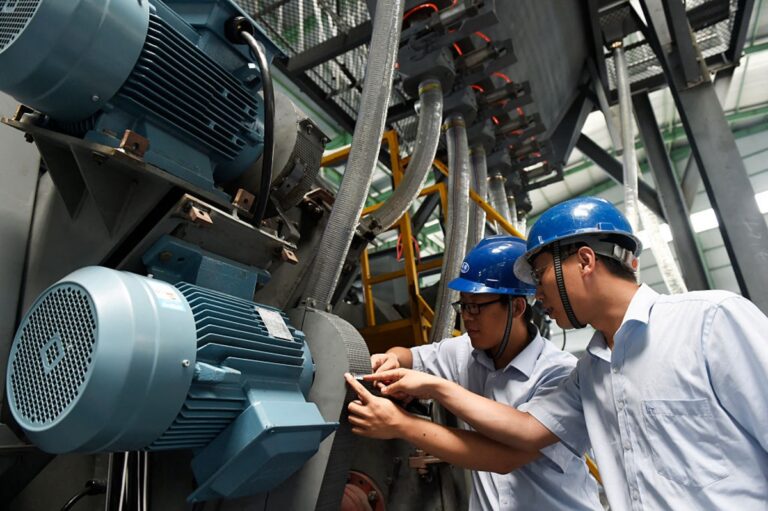
This photo taken on June 30, 2015 shows engineers checking a machine they designed in a factory in Zouping, eastern China’s Shandong province. CN-STR/AFP via Getty Images
China’s decade-long push to control its strategic technology through export licensing just extended to the engineers who carry that technology in their heads: as of yesterday, a new regulation formally ties Chinese citizens’ freedom to leave the country to the same export-control regime that Beijing has been deploying as an economic weapon against the United States, Japan, and the European Union. For the multinationals that have been recruiting Chinese engineers to build mirror factories for rare earths, EV batteries, and advanced solar cells outside China, that pathway is now formally closed.
State Council Decree No. 841 — the Regulations on Exit and Entry Administration — was signed by Premier Li Qiang on July 22, 2026 and took effect on September 15, 2026. Its 19 articles cover the verification of exit and entry applications, new restrictions on citizens and foreign nationals, and a registration regime for immigration consulting firms. The provision that has drawn the most attention from international employers and export-control practitioners is Article 4, paragraph 3, which states that where a Chinese citizen has violated export control, technology import-and-export administration, or related regulations, and that violation “may endanger national industrial or technological security,” the Ministry of Commerce (MOFCOM) and other relevant State Council departments may bar that person from leaving China.
The new law does not enumerate specific industries, but Cheng Xiezhong, a professor at the China University of Political Science and Law, said in remarks at a government press briefing that unauthorized exports of dual-use items or transfers of key industrial technology abroad would fall under the provision. Engineers with specialized knowledge in rare earth separation chemistry, N-type solar cell manufacturing, and EV battery electrolyte formulas are, by the analysis of multiple legal commentators, the primary population the rule targets.
No Time Limit — and No Notice Required
Two features of Decree No. 841 distinguish it from China’s prior exit-ban framework, both with direct consequences for anyone working in or alongside China’s strategic technology industries.
First, the exit ban for export-control violations carries no fixed time limit. Unlike the regulation’s other categories — fraudulent document use and overseas criminal conduct, both of which carry bans of six months to three years — the Article 4(3) export-control ban is open-ended, to be determined by MOFCOM. A Jamestown Foundation analysis by Christopher Nye and Charles Sun, published August 7, 2026, was explicit on this point: the export-control exit ban is indefinite. A license can be held indefinitely; so now can a person.
Second, Article 6 of the decree requires authorities to inform an individual in writing of the facts, grounds, and available appeals — but explicitly excuses that notice where doing so “may affect national security, the investigation of criminal cases, or other similar circumstances.” Because export-control cases and national security cases are precisely those most likely to trigger an Article 4(3) ban, the categories most likely to result in a ban are exactly those in which notice may be withheld. An engineer who arrives at an airport, is turned back at the border, and receives no written explanation is a foreseeable outcome under the text of the regulation.
What the Mechanism Actually Does: Engineers as the Controlled Item
The structural novelty of Article 4(3) comes into focus when it is placed alongside the US “deemed export” rule — a concept that exists in American export-control law but has no direct equivalent in prior Chinese regulation.
Under the US Export Administration Regulations, releasing controlled technology or source code to a foreign national inside the United States is “deemed” to be an export to that person’s home country, even though nothing crosses a border. The logic, explained on the BIS deemed export rule page, is that a foreign person who learns how to do something controlled has effectively taken the knowledge out of the country, even if they never leave. The transfer of knowledge is the controlled event.
Decree No. 841 inverts this logic in a direction with significantly greater personal-liberty consequences. Rather than treating a foreign person’s knowledge acquisition inside the US as a constructive export, China is now treating a Chinese engineer’s departure from China — or the realistic prospect of it — as a prospective export threat. The engineer is the vessel for controlled knowledge; the engineer leaving would constitute the export. The remedy is not a license denial before the transfer, but detention within the country after the violation has been identified or merely anticipated. A detailed TIMEWELL export control analysis by Ryuta Hamamoto, published August 9, 2026, laid out this structural inversion against both the US and Japanese deemed-export frameworks.
This structure also explains why the “may endanger” standard in Article 4(3) requires no completed violation. The US deemed-export rule similarly does not wait for a completed transfer to require a license — the obligation attaches before the knowledge moves. China’s formulation operates the same way, with MOFCOM empowered to act on anticipated risk rather than proven harm.
Enforcement Was Already Underway
Decree No. 841 formalizes an enforcement posture Beijing had already begun deploying in practice before the regulation existed on paper.
In May 2026, two Japanese nationals employed by Fuji Electric — the Japanese heavy electrical manufacturer — were detained in Dalian on suspicion of violating China’s laws against smuggling goods prohibited from export, reportedly involving rare-earth-related items. Japan’s Chief Cabinet Secretary Minoru Kihara confirmed both detentions, and Japanese diplomatic officials conducted consular visits. Both were subsequently formally arrested. The company said at the time it had “no comment.” A Morgan Lewis LawFlash from July 1, 2026, analyzing the pattern, called the detentions part of “an increasingly active enforcement posture” toward rare earths and strategic mineral export control violations.
In a separate track covering AI rather than physical materials, Bloomberg reported on May 26, 2026 that Chinese government agencies had begun requiring senior AI researchers and executives at private firms including Alibaba and DeepSeek to obtain pre-approval before overseas travel. Some DeepSeek staff had already been required to surrender their passports. These informal controls preceded Decree 841’s formal legal framework; the decree now provides the statutory foundation for what had been administrative guidance.
Earlier, in July 2025, Wells Fargo Managing Director Chenyue Mao — born in Shanghai and based in Atlanta — was subject to an exit ban while visiting China, leading Wells Fargo to suspend all China travel. The US-China Business Council described the incident as having “everyone jittery again.” The specific legal basis for Mao’s ban was never publicly disclosed by Chinese authorities.
The Talent-Transfer Pathway Is Now Formally Closed
The geopolitical consequence of Decree No. 841 is most direct in the rare-earth and battery sectors, where Western supply-chain builders have been attempting to recreate Chinese industrial capabilities in new geographies.
Since Beijing imposed export controls on rare earth separation equipment, purification technology, and dual-use minerals beginning in April 2025 — initially against the United States, then against Japan in January 2026 — Western governments and companies have turned to a supplementary strategy: recruiting experienced Chinese engineers to work on projects in Australia, Brazil, Texas, and elsewhere, on the theory that moving the people who know how to achieve rare-earth-grade purity circumvents the controls on the equipment and materials themselves. An Asia Times rare earth analysis by Jeff Pao from August 4, 2026, documented how this engineer-recruitment strategy had been gaining traction across Western rare-earth projects.
A Shandong-based analyst writing under the pen name “Xinghe Duke” described the enforcement problem this decree addresses in blunt terms: “In the past, foreign companies dodged China’s export controls by poaching Chinese engineers, offering them higher pay, green cards and equity to help build identical factories in Vietnam, India or Mexico. That path is now closed under the new regulation.”
The Wall Street Journal reported in June 2025 that China’s Ministry of Commerce had already asked certain rare-earth companies to submit lists of technical personnel with details on their expertise and research experience. Some technical staff were already required to surrender their passports to employers or local authorities. In April 2026, the Ministry of State Security disclosed the details of a 2023 conviction in which a rare-earth company manager — identified by the surname Cheng — was jailed for 11.5 years for leaking state secrets to an employee of a foreign nonferrous metals firm, including receiving approximately $510,000 to cover overseas living costs for his wife and daughter.
China’s Ministry of Commerce had also, by June 2025, piloted additional control measures inside strategic industries that went well beyond the new formal regulation: embedding digital watermarks in documents distributed via company networks to trigger alerts if found overseas; requiring employees in key positions to report their children’s plans to study abroad to internal Communist Party organizations in advance; and requiring family members of senior technical personnel to file advance applications before international travel.
The Regulatory Architecture: Decree No. 841 Is Not Alone
Decree No. 841 operates inside a broader countersanctions framework that China has been assembling since 2020, and which has substantially accelerated since April 2025.
The regulation’s most direct companion is State Council Decree No. 837 — the Regulations on Overseas Investment, which took effect July 1, 2026 — which bars Chinese investors and companies from moving export-controlled goods, technology, services, or data abroad by dispatching technical personnel, facilitating overseas work assignments, providing remote technical guidance, or running cross-border training programs. A Jamestown outbound investment analysis from July 11, 2026 noted that together, Decree 837 (which controls the act of transferring the knowledge) and Decree 841 (which controls the person carrying it) close the two remaining gaps in Beijing’s export control architecture.
Also in force since April 2026: Decree No. 834, the Regulations on Industrial and Supply Chain Security, and Decree No. 835, the Regulations on Countering Improper Extraterritorial Jurisdiction by Foreign States. A Jones Day compliance catch-22 analysis from May 2026 noted that these two decrees together make it legally impossible for multinationals to simultaneously satisfy Chinese law and US or EU supply-chain due-diligence requirements — a single corporate decision, such as terminating a Chinese supplier to comply with the US Uyghur Forced Labor Prevention Act, can now simultaneously trigger supply-chain investigations under Decree 834 and potential personal criminal liability under Decree 835.
Article 5 of Decree 841 adds a dimension relevant to foreign nationals specifically: if a foreign national’s employer or the foreign national themselves is listed on China’s Unreliable Entity List, Malicious Entity List, or Countermeasures List — or is otherwise subject to Chinese countermeasures — immigration and visa authorities may deny entry into China or refuse to issue entry and exit documents, with bans of one to five years. A CMS Law China sanctions update from August 26, 2026 illustrates how the pool of Article 5 targets continues to expand, noting that the August 5, 2026 addition of seven US entities to China’s Countermeasures List means more employers now expose their staff to this risk.
What Multinationals Need to Do Now
Legal advisories published following Decree 841’s announcement converge on a set of immediate practical steps for employers with operations in China.
A Hanku Law Order 841 analysis published in August 2026 confirmed one important limitation in the regulation’s scope: a person “may not be restricted from leaving China solely by reason of his or her occupation or employer.” The ban requires both an identified violation and a formal decision by the relevant State Council department. This means blanket pre-emptive bans on all engineers in a given company are not authorized by the text of the decree — but a ban on a specific engineer who has already been identified as having violated export-control rules remains unlimited in duration and can be imposed without prior notice in national security cases.
The CMS Law advisory from August 2026 recommends that companies with employees in semiconductor fabrication, battery manufacturing, solar panel production, or rare-earth supply chains audit the export-control compliance status of staff who move between China and overseas facilities. Employers who sponsor visa applications or facilitate employee mobility should also review internal procedures for supporting documentation — under Article 5’s new entry-ban provisions for foreign nationals, false or inaccurate information in visa applications now carries the risk of a one-to-five year ban from entering China at all.
The Jamestown Foundation’s analysts Christopher Nye and Charles Sun framed the regulation’s broader significance plainly: “Preventing people from leaving the PRC is a precondition for controlling the flow of other factors, such as capital, technology, and data.”
How Does the “May Endanger” Standard Actually Work?
Decree No. 841 does not define what evidence or process triggers an exit ban under Article 4(3). The phrase “may endanger national industrial or technological security” is the operative standard, and it is deliberately broad. Cheng Xiezhong, the China University of Political Science and Law professor, offered the official interpretation at the government’s post-announcement briefing: the phrase allows precautionary action before harm is complete. “It means the authorities won’t wait until harm is done, but they will take precautionary measures,” said the Shandong-based Xinghe Duke in published commentary. “The wording of ‘Decided by the commerce authority and other departments’ means there is a lawful process. ‘Barred from leaving’ does not mean arrest; it just means the targeted person cannot leave the country.”
The Human Rights Dimension
Human rights and export-control analysts have identified the same language as the regulation’s most consequential open question. The Jamestown Foundation analysis noted that Article 6’s notice requirement — which already excuses notification in national security and criminal investigation cases — means that a person banned under the export-control provision may have “nothing to appeal against and no record that the state ever acted.” Safeguard Defenders’ exit ban report, the Madrid-based human rights organization’s analysis that has tracked China’s exit-ban framework since 2023, described the new regulation as expanding “the PRC’s transnational repression efforts” and called the new language “further codification of some of the worst aspects of the PRC’s use of exit bans.”
What the Rules Do Not Cover
Analysts and legal advisors have been careful to note where Decree 841 does not extend. The Article 4(3) exit ban applies to Chinese citizens — not to foreign nationals. A US engineer or Japanese technician traveling to China on business is not subject to the exit-ban provision. A detailed TIMEWELL business travel guidance piece by Ryuta Hamamoto, published August 9, 2026, confirmed this after cross-checking the regulation text against multiple official PRC versions. Chinese and foreign officials alike at the September 15 government press conference on the regulation’s effective date emphasized that ordinary tourists with valid passports and genuine travel plans “can depart freely,” and noted that China logged more than 697 million exit-and-entry trips in 2025, a record high.
The risk for foreign nationals under Decree 841 runs instead through Article 5, and through the parallel framework of Decrees 834 and 835: being listed on a Chinese countermeasures or entity list, being employed by a listed company, or making inaccurate statements on a visa application or at entry. The Fuji Electric detentions in Dalian, which occurred under prior law rather than Decree 841 itself, involved foreign nationals detained on suspicion of physically carrying controlled goods — not on the basis of the personal knowledge they possessed. The new regulation formalizes, for Chinese citizens, the knowledge-as-export framework; for foreign nationals, the most significant new risk is the enhanced visa accuracy and entity-list provisions of Article 5.
What Can You Do Now?
Employers with operations in China who sponsor Chinese employees for overseas assignments, secondments, or training should immediately audit the export-control compliance status of those employees. Any employee who has had involvement with export-controlled goods, technologies, or processes — rare earths, battery electrolytes, dual-use manufacturing equipment, advanced AI systems — should be reviewed for potential Article 4(3) exposure before any planned overseas travel is facilitated.
Foreign nationals applying for Chinese visas should verify that all application materials — employment information, stated travel purpose, and any invitation letter documentation — are complete and accurate. Under Article 5’s new entry-ban provisions, inaccurate information now carries the risk of a one-to-five year bar from entering China at all. The TIMEWELL analysis of Decree 841 notes that visa applications are often delegated to travel agencies or local fixers and that the new precision requirements are materially higher than what companies have treated as acceptable practice.
Companies should also consult legal counsel on whether their export-control compliance activities — supply-chain audits, due-diligence questionnaires sent to Chinese suppliers, or termination of Chinese vendor relationships in response to US or EU requirements — expose their China-based employees or operations to liability under Decrees 834 or 835, which create a potential compliance catch-22 between Chinese law and Western regulatory obligations.
Frequently Asked Questions
Can a Chinese engineer be barred from leaving China simply because they work in the rare earth or battery sector?
Not solely on the basis of their occupation. The Hanku Law firm’s analysis of Decree No. 841 confirms that the Article 4(3) exit ban requires both an identified violation of export-control or technology-transfer rules and a formal decision by MOFCOM or another relevant State Council department. A person cannot be banned simply because their employer operates in a controlled sector. The risk is most acute for individuals who have been involved in unauthorized technology transfers, who work with materials or processes already covered by China’s export-control catalogue, or who are identified through an investigation.
How long can an export-control exit ban last under Decree No. 841?
There is no time limit. The regulation sets a fixed duration of six months to three years for bans imposed for fraudulent travel documentation or overseas criminal conduct, but Article 4(3) — the export-control provision — carries no stated maximum duration. MOFCOM determines when, if ever, the ban is lifted. The Jamestown Foundation indefinite ban finding from August 7, 2026 was explicit on this point: the export-control exit ban is indefinite.
Does Decree No. 841 give China new tools against foreign engineers or executives visiting China?
The Article 4(3) exit-ban provision applies only to Chinese citizens, not to foreign nationals. However, Article 5 of the same decree provides that foreign nationals who appear on China’s Unreliable Entity List, Malicious Entity List, or Countermeasures List, or who are otherwise subject to Chinese countermeasures, may be denied entry into China or refused entry and exit documents for one to five years. Additionally, Article 5 establishes a one-to-five year entry ban for foreign nationals who make false statements or submit inaccurate materials in visa applications. According to the CMS Law China sanctions update from August 2026, MOFCOM had by then added seven US entities to the Countermeasures List, and the pool of affected employers continues to grow.
What happens to a Chinese engineer who holds a US green card and is exit-banned under Decree No. 841?
The Jamestown Foundation green card analysis flagged this as the regulation’s most dangerous edge case. US permanent residence requires continuous residence to maintain naturalization eligibility, and a green card itself becomes invalid as a travel document after an absence of one year or more. An engineer subject to an open-ended exit ban under Article 4(3) who is physically detained in China faces the loss of both their current legal status in the US and their path to naturalization, with no stated mechanism in Decree 841 for time-limited review. The regulation does not recognize dual nationality — China does not — and naturalized US citizens of Chinese descent face the same exposure as Chinese nationals. The USCIS green card travel rules confirm that an absence of one year or more renders a green card invalid for re-entry purposes, with the Returning Resident (SB-1) visa as a limited remedy that requires evidence the absence was beyond the holder’s control.