HomeAuto Chaos Theory Reveals Beyond Spider-Verse’s Canon Events Are Patterns, Not Laws
Chaos Theory Reveals Beyond Spider-Verse’s Canon Events Are Patterns, Not Laws
September 9, 2026:
Sonypicturesanimation.com
The most important scientific claim embedded in Spider-Man: Beyond the Spider-Verse — the Sony Pictures Animation film scheduled to arrive in theaters June 18, 2027 — is not about superpowers. It is about whether a convergent pattern can be mistaken for a law by someone who has only ever observed the pattern from inside it.
That question is not invented for the superhero context. It is an open problem in nonlinear dynamics, and the leaked four-minute opening footage circulating since August 14, 2026 — condemned by co-writer Christopher Miller as “not a fan of leaks of unfinished, not fully rendered footage” — suggests the film is building toward it deliberately. Variety’s trailer leak report and Hollywood Reporter’s leak coverage both confirmed the August 14, 2026 leak and Miller’s statement.
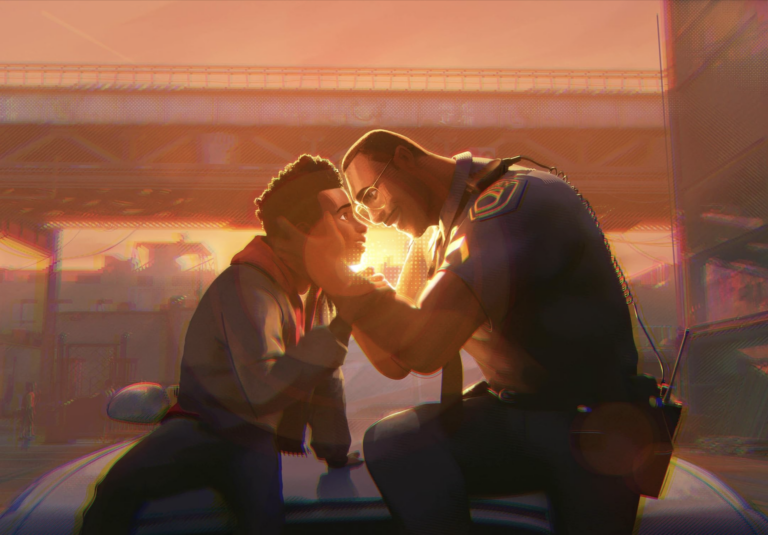
The footage picks up directly from Across the Spider-Verse‘s Across the Spider-Verse cliffhanger, with Miles Morales trapped on Earth-42 — the universe that produced the radioactive spider that gave him his powers, and that therefore has no Spider-Man of its own. What the film will argue, piece by piece, is whether Miles can save his father Jefferson Davis’s life without collapsing the multiverse. Miguel O’Hara — Spider-Man 2099, voiced by Oscar Isaac — says no. Chaos theory suggests O’Hara might be wrong, and the film’s science is specific enough to say exactly why.
Canon Events Are Attractor States, Not Physical Laws
Miguel O’Hara’s case against Miles rests on a specific claim: that Canon Events — the recurring structural moments every Spider-Person must experience across every universe, including the loss of a mentor and the death of a police captain — are not coincidences. They are load-bearing nodes in the Web of Life and Destiny. Disturb enough of them and the multiverse loses structural coherence. The Canon Events fandom wiki entry details the framework O’Hara constructed.
This is recognizable as a version of something real. In the mathematical field of dynamical systems, an attractor is a set of states toward which a system tends to evolve for a wide variety of starting conditions. As Wikipedia’s dynamical systems attractor article explains, system values that get close enough to the attractor remain close even if slightly disturbed. The Lorenz attractor — first described by MIT meteorologist Edward Lorenz in his 1963 atmospheric convection equations — is the most famous example: a system that is chaotic in its fine-grained trajectory but constrained to an unmistakably bounded region of phase space. History in every Spider-Verse branch is free to vary in fine detail. Canon Events function as that bounded region — the attractor within which each universe’s narrative must remain.
This is genuinely different from the Many-Worlds Interpretation of quantum mechanics, which Across the Spider-Verse gestures toward as its multiverse substrate. Hugh Everett III Wikipedia — who proposed in his 1957 Princeton dissertation that every quantum event with multiple possible outcomes produces a branch of reality — built a framework where all outcomes occur simultaneously, each in its own newly diverged universe. In strict Everettian branching, the branches are causally sealed from one another after divergence: an observer in branch A cannot acquire evidence of events in branch B, and there is no cross-branch structural coupling. There are no load-bearing nodes. There are just branches.
The Spider-Verse departs from Everett at exactly the point that makes it more scientifically interesting than it first appears. By imagining that Canon Events must fire in each branch — that they constitute a form of cross-branch structural coupling through the Web of Life and Destiny — the films are positing something closer to attractor states in a shared phase space than to autonomous Everettian branches. And that distinction matters, because attractor states behave very differently from laws.
A law is a constraint. You cannot violate it. An attractor is a tendency. It pulls. It can, under the right conditions, be escaped.
The specific condition that determines whether an escape is possible is bifurcation. In dynamical systems theory, a bifurcation occurs when a small change in a parameter causes a qualitative change in the system’s behavior — a fixed point splits into two, a limit cycle emerges from a stable state, chaos erupts from order. The bifurcation theory Wikipedia entry covers this mechanism in depth. The question the film is building toward is whether Jefferson Davis’s death is a Canon Event that functions as a fixed-point attractor — one where Miles pushing back simply returns to the same state — or whether it is near a bifurcation point, where the right intervention could produce a qualitatively different basin entirely.
The term “strange attractor” was coined by David Ruelle and Floris Takens in their Ruelle and Takens 1971 paper “On the nature of turbulence,” published in Communications in Mathematical Physics. A strange attractor — the Lorenz butterfly diagram being the canonical image — is locally unstable but globally bounded. Two trajectories starting arbitrarily close to each other diverge exponentially, yet both remain within the attractor’s bounded region. Canon Events, in the film’s logic, exhibit exactly this property: universes are free to vary wildly in the details of each Spider-Person’s life, but they converge reliably on the same structural moments.
What Miguel O’Hara cannot know from inside the system is whether that convergence reflects an underlying law or an extremely robust basin of attraction. These look identical from the inside.
Miguel O’Hara Is Not a Neutral Explainer
The film’s scientific argument only works if Miguel O’Hara is not presented as a reliable narrator of his own framework — and the setup is careful about this in ways that the attractor-state reading makes explicit.
O’Hara built the Spider-Society in the wake of his own multiversal catastrophe: an attempt to bring a version of his family from an alternate universe into his own, which destabilized that universe and killed everyone in it. The Canon Events framework emerged from his grief. He observed that certain structural moments appeared reliably across the universes his Spider-Society monitored, he watched what happened when Miles disrupted one of them, and he concluded that the pattern was a law.
But this is precisely the inference error that attractor dynamics make plausible. A system exhibiting strong attractor convergence will resist many perturbations — small interventions will return to the same state, appearing to confirm that the state is “necessary.” An observer who has only witnessed small-perturbation attempts, and who has never encountered a perturbation sufficient to push the system past a bifurcation point, will rationally but incorrectly conclude that no such perturbation is possible. O’Hara is an empiricist working from a dataset that is systematically biased toward confirming his prior — because the Spider-Society intervenes to prevent the very outcomes that would disconfirm it.
Whether the film renders this epistemological trap explicitly — or whether Miles simply succeeds, leaving viewers to draw their own inference — is the central unanswered question that Variety CinemaCon 2026 coverage confirmed the film is building toward, per director Bob Persichetti and writer-producers Phil Lord and Christopher Miller.
What Does Miles’s Origin Actually Mean in Evolutionary Terms?
Miles Morales was never supposed to be a Spider-Man. The radioactive spider that bit him came from Earth-42 — the universe being introduced in Beyond the Spider-Verse as his prison — which means Earth-42 produced the mechanism for creating a Spider-Man but has no Spider-Man to show for it. Miles is what evolutionary biologists, following Gould and Vrba’s exaptation concept from their 1982 paper in Paleobiology, call an exaptation: a feature deployed for a function it was not shaped by natural selection to perform.
Gould and Vrba introduced the term specifically to replace “pre-adaptation,” which carried misleading teleological implications — as if evolution were planning ahead. The canonical example is feathers: they appear in the fossil record on flightless dinosaur ancestors, evolved most likely for thermoregulation, and were later co-opted for flight. Feathers were not designed to enable flight. Flight is what happened when the right context arrived.
Miles is the Spider-Verse equivalent. The cross-universal spider bite was not designed to produce a Spider-Man in his universe. What the film is arguing — if the attractor-state reading holds — is that his anomalous origin places him outside the basin of attraction that governs every other Spider-Person. His Canon Events are not predetermined, because his Canon Events were never fixed by the system that produced him. He is the feather that learned to fly.
The evolutionary biology question this raises is whether exaptations stabilize or destabilize their host organisms — in this case, Miles’s host universe. Flight destabilized the ecosystem in ways that produced enormous evolutionary novelty, including the eventual dominance of flowering plants co-dependent on flying pollinators. A Miles Morales whose Canon Events remain open may be less a threat to the multiverse than its first genuine evolutionary pressure point — an organism whose anomalous origin generates a new fitness landscape rather than simply inheriting the old one.
How Does the Venom Blast Work, and Is It Actually Possible?
The opening sequence confirmed by leaked footage shows Miles using a Venom Blast — his signature bioelectric discharge — to break free from his Earth-42 captors. This power, examined in detail in TechTimes’s Venom Strike biology coverage of the 2026 comics relaunch, is grounded in a real biological mechanism: bioelectrogenesis.
The electric eel (Electrophorus electricus) produces up to 860 volts by stacking thousands of electrocytes — modified muscle cells that have been evolutionarily repurposed as biological capacitors — in series along its body, exactly like cells of a voltaic pile. Volta’s voltaic pile invention, published in 1800, drew on the voltage-stacking principle shared with electrogenic fish like the electric ray (Torpedo).
Miles’s Venom Blast compresses the same mechanism into a human-sized frame — a fictional extrapolation of real bioelectronic engineering. The mechanism (voltage-gated ion cascades, stacked potential differences, directed discharge through the hands) exists in nature. The energy density is where the science fiction lives. That the film opens with this power being used to escape captivity positions it as what it is biologically: a defense mechanism under sympathetic nervous system arousal, controlled by the same fear-and-resolve signaling that governs adrenaline-mediated electrocyte discharge in real electrogenic species. Miles’s Venom Blast is stronger when he is afraid. In a fish, that would be normal neurology.
Is The Spot Actually a Topology Problem?
The Spot — primary villain of the trilogy, voiced by Jason Schwartzman — is the most mathematically specific threat in mainstream superhero cinema. His body consists of portals: holes in spacetime distributed across his skin, through which objects, energy, and apparently entire universes can travel. As he absorbs more power across the trilogy’s arc, he grows more dangerous. The film’s logic explains why, though it does not use the mathematical vocabulary: he is not stronger in the way a more muscular villain is stronger. He is more complex in the way a manifold of higher genus is more complex. The The Spot Marvel Comics character article details his origin and portal-based powers.
In mathematics, topology is the study of properties preserved under continuous deformations — stretching and bending but not tearing or gluing. The surface genus Wikipedia mathematics article defines genus as a surface’s hole count: a sphere has genus zero, a torus (a donut shape) has genus one, a surface with a hundred holes has genus one hundred.
The Spot is a living manifold of increasing genus. Each new portal he generates adds a handle to his surface, and each handle increases his structural complexity. In the language of general relativity, a black hole’s singularity represents a point at which the smooth structure of spacetime breaks down — the manifold’s coordinate description fails. A fully powered Spot may constitute the same kind of breakdown within the multiverse’s Web of Life and Destiny: a singularity in the manifold, a point at which the smooth structure of the interconnected Spider-universes can no longer be described without encountering the irreducible discontinuity he represents.
This gives the trilogy’s climax a mathematical coherence most superhero films do not attempt. Miles is not fighting a villain who has a lot of energy. He is fighting the progressive topological dissolution of the multiverse itself.
Why Does Watching the Spider-Verse Feel Like Experiencing Universe Collision?
The five concept areas above are all things the film argues with plot and dialogue. The sixth is something it argues with the viewer’s own visual cortex — and it requires no explanation from the characters to work.
Every universe in Spider-Verse receives its own visual grammar. Miles’s Earth-TRN700 uses a 2.5D hybrid style — CGI geometry rendered with hand-drawn outlines, halftone Ben-Day dots (the printing technique that defined Silver Age Marvel Comics), and intentional color misregistration, animated on-twos (updated every other frame) rather than every frame. The Into the Spider-Verse animation Wikipedia article documents how each universe received its own distinct visual style. Gwen Stacy’s Earth-65 runs in watercolor washes and pastel desaturation. Spider-Punk’s frames move his jacket on different timing from his body — the physical dissonance of punk collage aesthetics made literal.
In information theory, a signal’s redundancy is the degree to which its encoding contains more information than strictly necessary. The Spider-Verse films use visual style as a redundancy layer: a viewer knows which universe a character belongs to from the visual grammar of every frame they occupy, not only from dialogue or context. When characters from different universes share a scene, the competing grammars produce interference patterns at every frame boundary — the “glitching” composite aesthetic that became the franchise’s visual signature.
This is not merely an art choice. In cognitive neuroscience, the brain’s ventral visual stream — the pathway running from primary visual cortex through areas V4 and the lateral occipital complex — is extraordinarily sensitive to material and surface-property consistency within a scene. The predictive coding Wikipedia neuroscience entry explains how the brain continuously generates top-down predictions about what visual input should look like, and registers mismatches between prediction and input as prediction error signals. A halftone face in an otherwise smooth-rendered scene generates strong prediction error. A character whose jacket moves on different timing from their body generates strong prediction error. The viewer does not merely see that the universes are different. They feel the difference, at the level of sensory processing, before they have time to form a conscious interpretation.
The Spider-Verse filmmakers discovered, empirically, a technique that cognitive neuroscience has theoretical grounding for. Universe collision is not described in the films. It is induced.
What Is the Real Scientific Question Beyond the Spider-Verse Is Asking?
Taken together, the five scientific concepts embedded in the trilogy converge on a single question that is genuinely unresolved in theoretical physics and complexity science:
Can a local actor meaningfully resist convergent attractor dynamics — and if so, under what conditions?
In chaos theory, the answer depends on the system’s bifurcation structure. In evolutionary biology, it depends on whether the host organism can restructure around the exaptation. In topology, it depends on whether the manifold can absorb or accommodate the singularity. Beyond the Spider-Verse is positioned to argue that the answer, at least in Miles Morales’s case, is yes — not because the laws of the multiverse have changed, but because the laws were never laws to begin with. They were patterns. And Miles, born from a mechanism designed for another universe, may be the only Spider-Person who has never been fully inside the basin of attraction.
The film is scheduled for theaters June 18, 2027. The leaked unfinished footage from D23 confirms the opening sequence. The official first public trailer has not yet been released. What Sony’s CinemaCon 2026 presentation confirmed is that Phil Lord called the film “the most spectacular” in the franchise, and Chris Miller called it “the most emotional Spider-Verse film we have ever made.” Whether the film’s resolution is as intellectually rigorous as its setup is the question the science cannot answer in advance. The bifurcation is still ahead.
Frequently Asked Questions
What is a Canon Event, and why does chaos theory suggest Miles could escape one?
A Canon Event, in Spider-Verse lore, is a structurally recurring moment every Spider-Person must experience — the loss of a mentor, the death of a police captain — described by Miguel O’Hara as a load-bearing node whose disruption risks collapsing the multiverse. Chaos theory’s attractor-state framework offers a more precise model: these events function as attractors in a dynamical system, not fixed laws. An attractor pulls a system toward a particular state across a wide variety of starting conditions, and small perturbations return to it — which is why O’Hara’s data appears to confirm necessity. But attractor systems can also exhibit bifurcations: points at which a sufficiently large perturbation produces a qualitatively different basin of attraction entirely. Miles’s ability to save his father depends on whether the Canon Event governing Jefferson Davis’s fate is near a bifurcation point. Chaos theory says that is possible. It does not say it is guaranteed.
Is the Many-Worlds Interpretation actually the multiverse model the Spider-Verse films use?
Partially. The films invoke eternal inflation and Everettian branching as the conceptual substrate for an infinite set of parallel universes. But the Spider-Verse departs from strict Many-Worlds physics at a key point: in Hugh Everett III Wikipedia’s 1957 formulation, branches are causally sealed from each other after divergence — no cross-branch structural coupling is possible. The Spider-Verse’s Canon Events require exactly that coupling: a structural pattern that must fire across all branches, enforced by the Web of Life and Destiny as a shared sub-dimensional manifold. This is closer to the attractor-state model of dynamical systems — a phase space in which separate trajectories (universes) tend to converge on the same fixed points — than to pure Everettian branching. The departure is what makes the fiction scientifically coherent rather than merely invoking physics vocabulary.
What makes Miles Morales scientifically different from every other Spider-Person?
Miles’s origin is what evolutionary biologists call an exaptation: a trait deployed for a function it was not shaped by natural selection — or in this case, cross-universal spider biology — to perform. The radioactive spider that bit Miles came from Earth-42, meaning Earth-42’s spider produced a Spider-Man for a universe that was never part of Earth-42’s Canon Event structure. Every other Spider-Person was produced by their own universe’s biological mechanism and therefore inherits that universe’s attractor dynamics. Miles was not. He entered his universe’s attractor basin from outside it, which means his Canon Events may not be governed by the same fixed-point dynamics as every Spider-Person the Spider-Society has ever monitored. Stephen Jay Gould and Elisabeth Vrba, who coined exaptation coined by Gould Vrba in 1982, described the process as co-opting a trait for a radically new context — and argued that exaptations, far from being threats to host organisms, often generate the conditions for evolutionary novelty.
Why does watching different universes collide in the Spider-Verse feel viscerally different from just seeing them described?
Because the films encode universe-identity information in the visual grammar of every frame — and the brain’s visual processing system registers competing visual grammars as prediction error before conscious interpretation occurs. The predictive coding Wikipedia neuroscience framework proposes that the ventral visual stream continuously generates predictions about expected sensory input, and that mismatches between prediction and input produce prediction error signals that propagate upward through the visual hierarchy. A halftone character in a smooth-rendered scene, or a jacket that moves on different timing from the body it belongs to, produces exactly this kind of mismatch. The Spider-Verse filmmakers discovered a technique that makes universe collision a perceptual event, not just a narrative one — which is a genuinely novel use of animation as a cognitive tool rather than a stylistic choice.