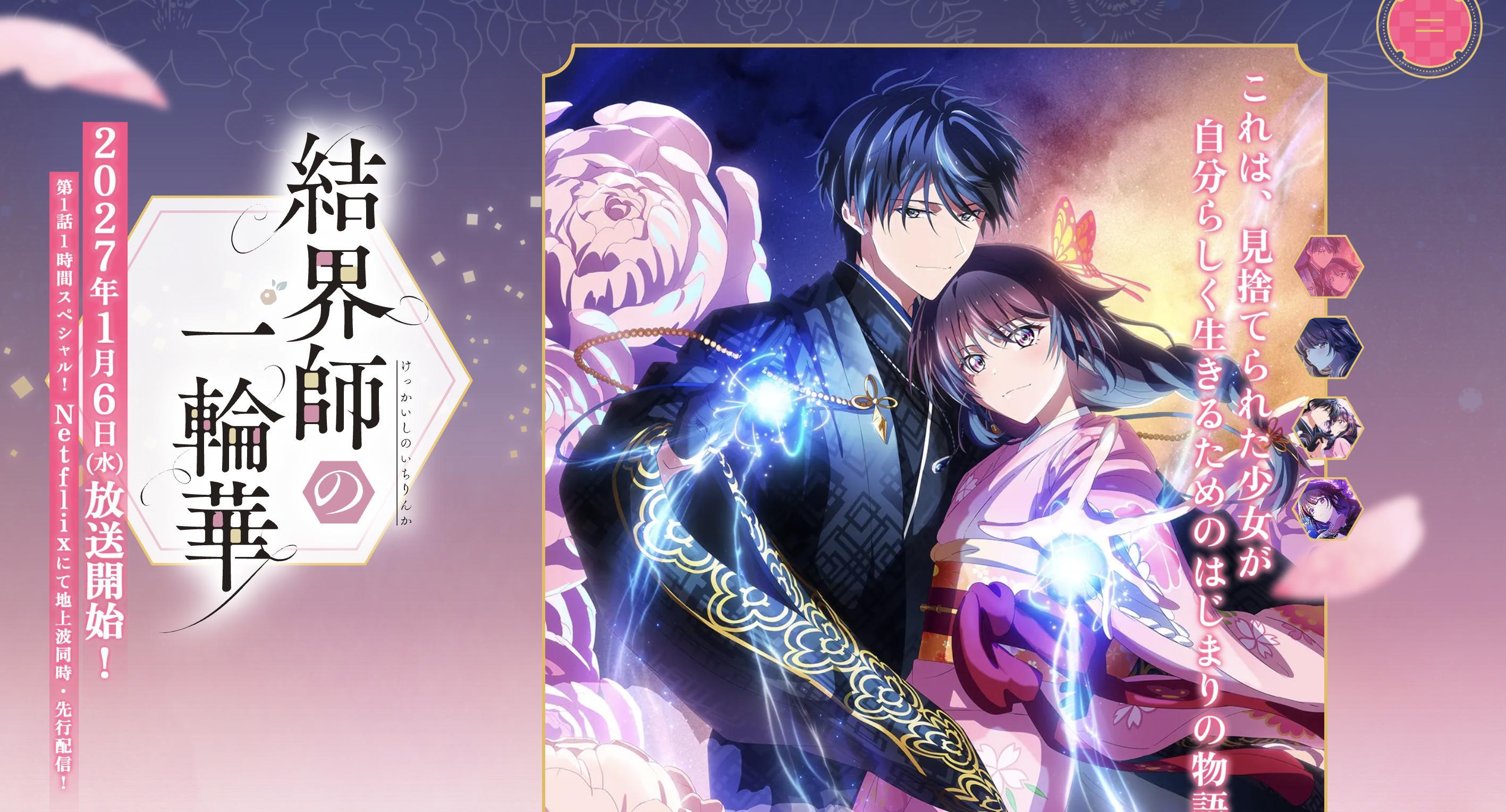
November 23, 2026:

Bride of the Barrier Master (Kekkaishi no Ichirinka) premieres Wednesday, Jan. 6, 2027, with a one-hour first episode, and Netflix will stream the series weekly. Anime News Network reported that the first episode airs at 11 p.m. JST on TOKYO MX, which is 9 a.m. ET. Netflix’s own release says streaming times may vary, so international viewers should check their regional listing closer to the date.
Naniwa Danshi performs the opening theme, “Ichirinka.” Studio TROYCA is adapting Kureha’s light novels into a romantic fantasy about a young woman who hides her own power while commanding spirit servants called shikigami. The folklore behind those servants gives viewers a way to read the series before it starts.
Japan’s tradition is more complicated than the idea of a loyal magical helper. A scholarly study of shikigami finds tales in which the servants acted on their own, which makes the series’ devoted shikigami a useful thing to watch.
The production committee announced the date on Nov. 22, a release timed to Good Spouses Day in Japan, along with a main visual and main promotional video. Chiaki Kobayashi joins the cast as Yanagi Ichise and Takuya Eguchi as Yukizasa Sankoro.
Toru Kitahata directs at TROYCA, Minami Murayama designs the characters, and Yuko Kakihara handles series composition. Akari Kito voices Hana Ichise, and Kikunosuke Toya voices Saku Ichinomiya. The light novels have more than 2.5 million copies in print.
This is a different work from the 2006 manga and anime Kekkaishi, a separate series. The titles share the Japanese word for “barrier master,” and the new series has no stated link to it.
According to the official synopsis, Japan is protected by five pillars that clan practitioners guard. The English light novel description calls them five clans wielding barrier-weaving magic. Eighteen-year-old Hana was born into a branch family and lives in the shadow of her twin sister, Hazuki.
When a strong power awakens in Hana, she chooses to hide it to keep living quietly. Saku Ichinomiya becomes head of the Ichinomiya clan and sets out to find a bride strong enough to stand beside him, and Hana has to weigh whether a marriage contract that promises a peaceful future is worth the exposure. The official tagline calls the series the story of a neglected girl beginning to live as her true self.
The anime’s cast list introduces three of Hana’s shikigami: Azuha, a butterfly shikigami; Aoi, a samurai; and Miyabi, a celestial maiden.
In Japanese folklore, a shikigami is a conjured being, and Shinto scholar Inoue Nobutaka describes it as a kind of kami represented by a small ghost. The belief comes from onmyōdō, and onmyōji were said to command shikigami as a mark of their power. Carolyn Pang, writing in the Japanese Journal of Religious Studies in 2013, found no written explanation of what shikigami are inside onmyōdō itself. She groups scholars’ views into five ideas, from a metaphor for a divination tool to a human-made curse to a spirit servant.
Pang also found that the obedient servant is not the whole record. In a Heian-era tale Pang examines, two shikigami called out the name of the passing courtier Minamoto no Takaakira. He met misfortune soon after and was banished from the capital. Pang reads those shikigami as acting without instructions from any onmyōji, in contrast to most tales, where shikigami are commanded to set curses. A summary of the folklore adds that a careless invoker may lose control of a shikigami, which can develop its own will.
Nothing in the announcements reviewed says the series will show a shikigami slipping out of control. Viewers should treat that as a question to watch for, not a prediction.
In the Konjaku monogatari shū tales Pang examines, commanding more than one shikigami indicated an onmyōji’s magical power, and control depended on specific knowledge rather than inheritance. In one tale, the court onmyōji Abe no Seimei concealed the two shikigami that the monk Chitoku had brought as a test, and Chitoku later returned, apologized and asked for them back. Pang notes that shikigami were not hereditary, so descendants in Seimei’s house could hear them but could not control them.
That record gives viewers a yardstick for Hana, who commands several shikigami and hides a power of her own. The comparison is an analogy and not something the series has confirmed.
The Japanese word for barrier, kekkai, began as a Buddhist term for boundary, translating the Sanskrit sīmābandha, and fiction commonly uses it to mean a force field. Such boundaries have also been real: a tradition described as 1,300 years old has barred women from part of Mt. Ōmine in Nara, and it has been called a nyonin kekkai.
Onmyōdō also had its own clan structure. The Taihō Code of 701 established onmyōji posts at court, and the Abe and Kamo families came to dominate the art. Pang, citing scholar Masuo Shin’ichirō, notes that provincial practitioners such as Chitoku lacked knowledge that those court lineages kept under their control. That parallels a series in which clan families guard the protective pillars, though the series has not explained how the pillars work.
Economist Thomas Schelling argued, in a 1956 essay and in The Strategy of Conflict (1960), that the power to constrain another party can depend on the power to bind oneself. A commitment device restricts future options to make a promise credible.
Read that way, a contract marriage between a clan head and a branch-family sorcerer binds both sides, and the question for the story is whether Hana’s hidden power leaves them negotiating on equal information. This is a reading of the synopsis, and the series may take it in another direction.
Kureha also wrote The Ogre’s Bride, another series with an anime adaptation, and the two works shared a collaboration visual announced Sept. 11.
Episode 1 airs at 11 p.m. JST on Jan. 6, which is 9 a.m. ET, and viewers can read the Yen Press light novels first. Three things are worth watching: whether the series explains how the pillars work, how Hana’s shikigami are made, and whether the shikigami stay as loyal as the promotional materials suggest.
Read through Pang’s findings, a shikigami story is a story about control: in the tales she examines, who commands the servant measures the master’s skill.
The anime starts Wednesday, Jan. 6, 2027, at 11 p.m. JST on TOKYO MX, which is 9 a.m. ET, with a one-hour first episode. Netflix will stream it weekly, and Netflix says streaming times may vary.
Naniwa Danshi performs “Ichirinka” as the opening theme.
A shikigami is a conjured spirit servant from onmyōdō tradition. Scholar Carolyn Pang found that tales also describe shikigami acting without a master’s instructions, so obedience was not guaranteed.
No link has been stated. Kekkaishi is a 2006 anime and manga, and the shared word means barrier master.