HomeAuto Boyajian’s Star Dimmings Follow 782-Day Orbital Clock, New Bayesian Study Finds
Boyajian’s Star Dimmings Follow 782-Day Orbital Clock, New Bayesian Study Finds
September 4, 2026:
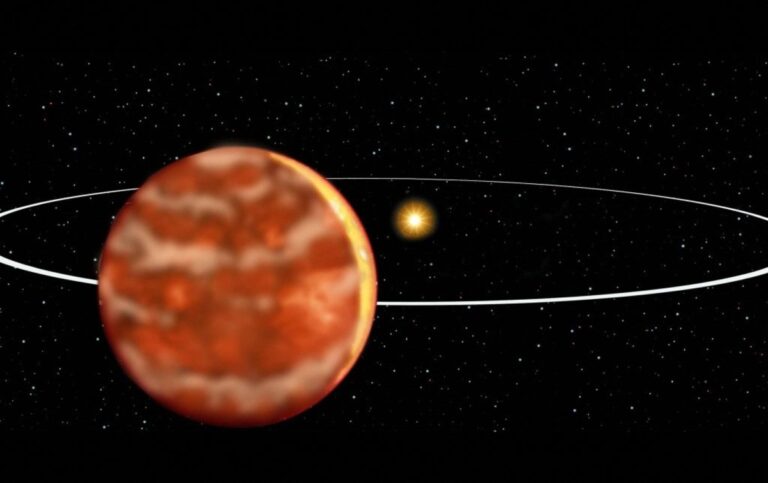
HO/GEMINI OBSERVATORY/AFP via Getty Images
Boyajian’s Star — the peculiar F-type dwarf that baffled astronomers for more than a decade with its chaotic, record-breaking brightness drops — may be following an orbital clock after all. A preprint posted to arXiv on September 3, 2026 by IAC astrophysicist Hector Socas-Navarro presents the strongest quantitative case yet that the star’s dip families recur on a roughly 782-day cycle driven by an orbiting debris swarm, and the model generates a specific, testable prediction: if the period is real, the next cluster of dips will arrive on schedule — and TESS or ground-based telescopes will be watching.
A Decade of Chaos, One Ordinary Star
Located roughly 1,470 light-years from Earth in the constellation Cygnus, KIC 8462852 is, by every stellar classification measure, unremarkable. It is an F3 main-sequence dwarf, slightly hotter than the Sun and about 50 percent larger, with no unusual spectral lines, no detectable infrared excess from a dust disk, and no sign of the youth or accretion activity that might explain wild photometric behavior. Yet when citizen scientists working the Planet Hunters project combed through data from NASA’s Kepler mission in 2015, they flagged its light curve as unprecedented in the entire Kepler catalog.
The star had dimmed by as much as 22 percent in asymmetric, multi-day plunges — depths that a transiting planet could not produce even if it were nearly half the star’s diameter. The discovery paper, led by Louisiana State University astronomer Tabetha Boyajian and titled “Where’s the Flux?” (giving the star its ironic nickname the WTF Star), described events that defied every template in the standard toolkit. Within months, a popular science culture had built up around KIC 8462852, including a Kickstarter campaign that raised more than $100,000 from over 1,700 donors to fund dedicated ground-based monitoring. Penn State astronomer Jason Wright formalized the most dramatic hypothesis in a 2016 paper: could the dips be the signature of an alien megastructure — a Dyson sphere or swarm built by an advanced civilization?
Follow-up observations from 2016 through 2017, including a real-time dipping event caught in May 2017, delivered the key empirical answer. Multiwavelength photometry showed that blue light was blocked more than red: the fingerprint of fine circumstellar dust, not a solid opaque structure. A team of more than 200 researchers, including Boyajian and Wright, published those results in The Astrophysical Journal Letters in January 2018, ruling out alien megastructures and pointing firmly toward sub-micron dust grains — particles far smaller than a grain of sand, roughly one one-hundredth the width of a human hair — as the proximate cause. The 2021 confirmation that the star has a binary companion — a faint red dwarf at approximately 880 AU projected separation — added a plausible gravitational mechanism for destabilizing the orbits of comets or planetesimals and sending them inward.
What no one had successfully established was why the dust appeared when it did, and whether any underlying pattern governed the timing.
Previous Periodicity Searches — and Why They Fell Short
The temptation to find a hidden clock in the Kepler data was irresistible from the start. The two major dip complexes observed during Kepler’s four-year primary mission — a major event in 2011 and another in 2013 — were separated by roughly 750 days. In 2018, Gary Sacco and two co-authors, writing in the Journal of the American Association of Variable Star Observers, reported that observations appeared consistent with a 1,574-day recurrence period, integrating Kepler data with subsequent Las Cumbres Observatory monitoring. A separate proposal by Bruce Gary identified a potential 1,601-day repeat.
Neither of those periods survived as a robust, statistically grounded result. The fundamental obstacle was a mismatch between the hypothesis and the data: if dips were truly periodic, they should repeat at predictable times, but the observed dip events within each “family” were chaotic, asymmetric, and wildly variable in depth. A strict periodogram — the standard tool for finding regular signals — found nothing convincing.
Socas-Navarro’s new paper takes a different conceptual path. Instead of looking for a rigid repeating clock, it asks whether the dip families arrive on a dispersed schedule — one that progressively smears out from orbit to orbit — and uses Bayesian model comparison to test whether that smeared pattern fits the data significantly better than pure randomness.
What Makes This Analysis Different: Bayesian Comparison and Orbital Phase Dispersion
The key innovation is physical rather than statistical. When a comet or large planetesimal breaks apart near a star, its fragments are placed in slightly different orbits — each fragment acquires a slightly different orbital period depending on where it ends up in the debris field. On the first return, the fragments arrive in a compact cluster, producing a coherent dipping episode. On the second return, they are a little more spread out. On the third return, more spread still. After many revolutions, what began as a tight swarm becomes a diffuse ring, and the distinct dipping families blur into continuous background variability.
This is not a hypothetical mechanism invented for this paper. It is precisely how terrestrial meteor showers work. The Leonid storms of 1833, 1866, and 1966 — in which hundreds of thousands of meteors per hour rained down on Earth — occurred when our planet crossed the dense, recently ejected trail from a single perihelion passage of Comet 55P/Tempel-Tuttle, which orbits the Sun every 33 years. The annual Leonid shower that most people see today is the same trail, dispersed over centuries. The Perseid shower follows the same logic for Comet Swift-Tuttle. Each perihelion passage deposits a new, compact filament; gravitational perturbations from Jupiter and other planets spread earlier filaments progressively wider. A distant observer watching a star at the center of that debris system would see not a clockwork transit but a smeared, increasingly irregular burst of dimmings — which is, of course, exactly what Boyajian’s Star shows.
Socas-Navarro formalizes this “progressive orbital phase dispersion” model with two free parameters: a recurrence period P and a dispersion width σ_P representing how much the dip-family arrival times can scatter around the expected window. He then computes the Bayesian evidence for this model compared to a null model in which each dip family occurs at a completely random, independent time — no orbital structure at all.
What the Statistics Show
The Bayes factor measures how much more probable the observed data are under the recurrence model than under the null. A Bayes factor of 1 means neither model is favored. On the Jeffreys scale — the standard interpretive framework for Bayesian model comparison developed by statistician Harold Jeffreys in 1939 and widely used in cosmology and astrophysics — a Bayes factor above 10 is considered “very strong” evidence for the preferred model, and a value in the 30–100 range crosses into the “very strong” to “decisive” territory depending on which variant of the scale is applied.
Socas-Navarro’s analysis returns a Bayes factor of 44.9 in favor of the orbital recurrence model. The maximum-likelihood solution places the recurrence period at P_ML = 781.6 days, with a dispersion of σ_P = 80 days — meaning each successive dip family is expected to arrive within a roughly 160-day window centered on multiples of 781.6 days from a reference event.
Two independent cross-checks support the fit. First, if the major “D800” Kepler dip complex and the 2019 TESS transit event are separated by exactly four orbital revolutions under the model, the implied period is 776.1 days — within rounding of 781.6. Second, at a period of approximately 782 days, the orbital distance from this star is roughly 1.6 AU, and the expected transit duration for a body orbiting there works out to approximately 20.5 hours. The 2019 TESS observation recorded a shallow, symmetric transit lasting about 21 hours — a match that, as the paper notes, is “independently of the timing fit.”
How a Bayesian Approach Differs From a Standard Periodogram
Because the paper’s statistical methodology is central to its claim, it is worth explaining what Bayesian model comparison does that a standard Lomb-Scargle periodogram cannot. A periodogram searches for strict repeating signals at fixed frequencies. If the signal jitters — if the same phenomenon arrives at slightly different times on each occurrence — the periodogram dilutes its power across adjacent frequencies and typically returns nothing convincing. That is exactly why prior periodicity searches in Boyajian’s Star’s light curve came up empty despite the suggestive clustering of events.
Bayesian model comparison takes a different approach: rather than asking “is there a strict frequency,” it asks “does the data fit model A or model B better, after averaging over all possible parameter values?” By treating the dispersion σ_P as a free parameter, the analysis allows the period to smear on each cycle — which is exactly what physical orbital phase dispersion predicts. The result is a method that can detect the kind of soft, progressively blurring repetition that a comet debris stream would produce, where a standard periodogram would find nothing.
A Bayes factor of 44.9 is meaningful but not, by itself, conclusive proof. The paper explicitly acknowledges this. The result is conditional on the model structure, the prior distributions assumed for P and σ_P, how the individual dips are assigned to “families,” and the observing selection function imposed by the gaps between Kepler, ground-based campaigns, and TESS coverage. “The family timings strongly favor this specific recurrent-fragment model over independent occurrence,” the paper states, but adds that this “does not prove orbital recurrence” in a model-independent sense.
What it does provide — which no prior analysis had — is a quantitative, physically motivated framework with a specific numerical prediction that can be tested.
What a ~782-Day Orbit Would Mean
An orbital period of roughly 782 days places the hypothesized debris source at approximately 1.6 AU from the star — near the outer edge of, or just beyond, the habitable zone for a star somewhat hotter than the Sun. The analysis does not directly constrain the size or composition of the disrupted body, only the orbital geometry inferred from the timing of the dip families.
The most parsimonious physical interpretation, and the one Socas-Navarro explicitly favors, is catastrophic tidal disruption of a large comet or planetesimal — possibly comparable in scale to a small dwarf planet — whose fragments were scattered across slightly different orbital energies. This is consistent with the earlier dust-confirmation result (sub-micron grain sizes point to cometary or asteroid debris rather than solid rock) and with the star’s newly confirmed binary companion, which could gravitationally perturb a Kuiper-belt-like reservoir of icy bodies and send them on plunging orbits toward the primary star.
The ~782-day period is notably different from the 1,574-day figure proposed by Sacco et al. in 2018. It is approximately half of that value. Whether the relationship is coincidental, or whether the two proposals are describing different harmonics or different subsets of dip events, is a question the paper does not resolve. It simply notes that the D800-to-TESS-transit interval is most consistent with four cycles at approximately 781 days.
Where Does This Leave the SETI Hypothesis?
Hector Socas-Navarro is not only a solar physicist at the IAC — he is also an active researcher and public advocate in the search for extraterrestrial intelligence, hosting the widely followed Spanish-language science communication podcast Coffee Break: Señal y Ruido since 2015 and serving as director of the Foundation of the European Solar Telescope. His IAC research biography confirms his dual role as a solar-physics specialist and SETI-adjacent communicator. His engagement with Boyajian’s Star is therefore both scientifically and personally motivated.
The paper’s treatment of the SETI question is careful and unsentimental. The primary framing is entirely naturalistic — a disrupted debris stream, an orbital clock, a predictable mechanism. The analysis does not invoke extraterrestrial intelligence and does not claim to have tested it. But its implications for the megastructure hypothesis are real. A quasi-periodic signal is, in principle, more suggestive of artificial structure than pure randomness would be — any engineered, orbiting megastructure would produce some kind of recurring transit signal. The paper’s contribution to the SETI discussion is not to rule in artificial structure but to show that a naturalistic model now provides a quantitative, specific, and independently corroborated account of the timing — one that makes the megastructure interpretation substantially harder to defend as the simpler hypothesis.
The SETI community watching Boyajian’s Star has always required as a minimum standard that every plausible natural explanation be rigorously excluded before any artificial one can be entertained. Socas-Navarro’s analysis has not closed that natural-explanation door, but it has made it substantially more rigorous and specific, which is exactly what that standard demands.
Caveats the Paper Makes Explicit
Socas-Navarro identifies four limitations in his own analysis that any reader of headlines should understand.
First, the Bayes factor of 44.9 is sensitive to the choice of null model. The null tested here is that dip-family times are statistically independent — no orbital structure at all. A more sophisticated null (for instance, a model that allows clustering due to stellar intrinsic activity rather than orbital mechanics) might change the Bayes factor significantly in either direction. The paper tests one specific alternative and finds it strongly disfavored; it does not exhaustively compare all alternatives.
Second, assigning individual dip events to “families” requires judgment calls. Different grouping schemes produce different family-center times, and a different grouping could shift the best-fit period meaningfully. The paper acknowledges this sensitivity without fully exploring it.
Third, the observing window is far from uniform: Kepler provided dense, 30-minute-cadence coverage for four years, then went silent; ground-based campaigns provided sparser, multiband coverage; TESS provided high-cadence data in three separated windows. These gaps introduce complex selection effects that the analysis accounts for statistically but cannot eliminate.
Fourth, Yang and Satarla, in a 2026 Research Notes of the AAS paper, reported no deep dimming events (above 0.5 percent) in any of the three TESS observing windows covering Boyajian’s Star between 2019 and 2022. This quiescence during a period when the 782-day model might have predicted some enhanced activity is not obviously inconsistent — the model’s dispersion width (σ_P = 80 days) and the sparseness of TESS sector coverage both allow for a quiet window — but it is a constraint that future modeling will need to address.
The Falsifiable Prediction That Will Test Everything
The most important forward-looking element of Socas-Navarro’s analysis is a specific, verifiable prediction that does not require decades of waiting. Under the 782-day period, future dip windows can be projected from known reference events. If the model is correct, enhanced dipping activity should appear within a predictable window in the coming two years or so. TESS continues to operate and periodically observes KIC 8462852’s region of the sky. Ground-based networks, including the AAVSO monitoring campaign that has been continuously active since 2015, are in place to catch any such events in real time.
A fresh cluster of dips arriving within the predicted window would represent powerful confirmation that something genuinely orbital — not random stellar physics — is driving the variability. A prolonged quiet period during a predicted active window, by contrast, would require substantial revision of the model or its assumed period. Either outcome advances the field considerably more than a decade of inconclusive monitoring has managed to do, because Socas-Navarro’s model, for the first time, provides a specific epoch to look at and a specific null result to falsify.
Broader Implications for Time-Domain Astronomy
Boyajian’s Star catalyzed the systematic search for “dipper stars” — main-sequence objects showing irregular, deep flux drops attributed to transiting dust. Several dozen have been found since 2016, mostly in young stellar populations where remnant protoplanetary disks naturally produce such behavior. Boyajian’s Star remains unusual precisely because it shows no youth indicators: no infrared excess from a disk, no signs of accretion, no spectroscopic anomalies. A 2018 ultraviolet study using GALEX data reinforced this picture, finding no coherent near-UV variability and confirming the star’s consistent adult spectral character. It is an ordinary adult star doing extraordinary things.
If the orbital recurrence model holds, the implication for stellar astrophysics is noteworthy: late-stage disruption of large planetesimals — events presumed to be common in younger systems and largely over in mature ones — can produce dramatic, sustained photometric variability even in stars that have long since dispersed their protoplanetary disk material. This would suggest that the population of “extreme dipper” events observable by current and future wide-field time-domain surveys — TESS, and eventually the Vera C. Rubin Observatory’s Legacy Survey of Space and Time — might include a class of mature-star phenomena currently underrepresented in models. The LSST Science overview identifies time-domain astronomy as one of the four core science themes for the next generation of sky surveys, and an orbital recurrence like the one proposed here would be exactly the kind of testable, repeating phenomenon that makes a star a high-value target for long-baseline monitoring.
For the SETI community, the Socas-Navarro result adds one more data point in the ongoing effort to construct a rigorous baseline for what unusual stellar variability looks like when it is entirely natural. Every well-characterized natural mechanism narrows the range of anomalies that remain genuinely unexplained — and therefore genuinely interesting from a technosignature perspective.
Frequently Asked Questions
Has the mystery of Boyajian’s Star finally been solved?
Not definitively, but the new Bayesian analysis marks the most concrete progress in over a decade. The study finds strong statistical evidence (Bayes factor of 44.9) that the star’s dipping episodes follow an approximately 782-day orbital recurrence — consistent with a spreading debris swarm from a disrupted comet or planetesimal. The paper explicitly states that this “does not prove orbital recurrence” in a model-independent sense, and it acknowledges several limitations in the analysis, including sensitivity to how dip events are grouped and to the choice of statistical null model. What it provides for the first time is a specific, testable prediction: if the 782-day period is real, future dip windows are calculable, and forthcoming TESS observations or ground-based monitoring will either confirm or falsify it within a couple of years. The Socas-Navarro preprint paper details the methodology, caveats, and forward predictions.
Is Boyajian’s Star still a candidate for an alien megastructure?
Technically it has never been ruled out as a logical possibility, but the scientific case for a natural explanation has grown substantially stronger with this new study. The 2018 dust-confirmation result established that the dimming is chromatic — blue light is blocked more than red — which rules out solid opaque objects such as a megastructure. The new orbital model now provides a quantitatively grounded, physically motivated explanation for the timing of the dimmings, which the megastructure hypothesis has never specifically addressed. The SETI community’s standard requires exhausting natural explanations before invoking artificial ones, and naturalistic models are becoming increasingly specific and testable.
What is a Bayes factor, and why does it matter here?
A Bayes factor measures how much more probable the observed data are under one hypothesis than under a competing one. The Jeffreys evidence rating scale — widely used in astronomy and statistics — classifies a Bayes factor above 10 as “very strong” evidence; the value of 44.9 found in this paper sits comfortably within that range and approaches the “decisive” zone on some implementations of the scale. What makes Bayesian model comparison particularly suited to Boyajian’s Star is that it can test a hypothesis (orbital recurrence with some permitted fuzziness) that a standard periodogram would miss entirely, because a standard periodogram requires signals to repeat at a rigid, precise frequency. The orbital phase dispersion model explicitly allows the recurrence to smear out over successive cycles — exactly as cometary debris streams do in our own solar system.
What happens next, and how will astronomers know if the model is right?
The 782-day period generates a specific prediction: dip families should recur within calculable time windows. Astronomers can now point TESS or ground-based networks at the star during those windows and look for enhanced photometric activity. If a fresh cluster of dips appears within the predicted window — with the multi-day, asymmetric, chromatic structure characteristic of previous Boyajian’s Star events — the orbital model will gain powerful independent support. If the star remains anomalously quiet during a predicted active period, the period will need revision or abandonment. The AAVSO monitoring campaign that has tracked the star continuously since 2015 is already well positioned to catch any future events in near-real time.