HomeAuto Bouchra Hits VOD: Morocco’s First International Animated Feature Built in Free Software
Bouchra Hits VOD: Morocco’s First International Animated Feature Built in Free Software
September 7, 2026:
Filmmovement.com
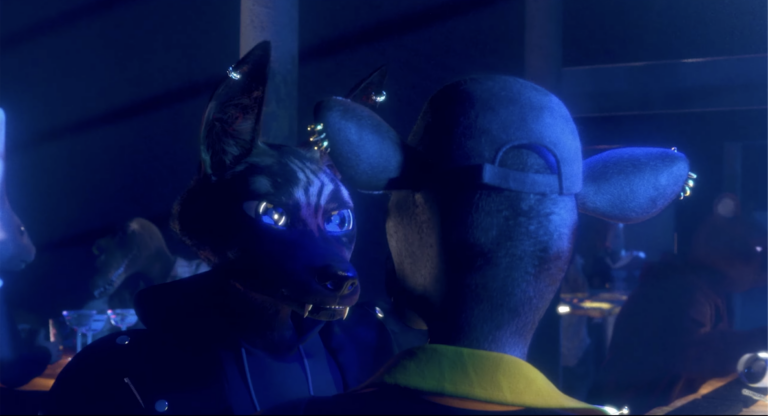
Bouchra, the animated film, follows a 35-year-old Moroccan coyote living in Brooklyn who struggles to write a script while placing long-overdue calls to her mother in Casablanca. The coyote’s name is also Bouchra, her mother is a jackal named Aicha, their conversations were actually recorded by the film’s director Meriem Bennani, and the streets of Casablanca in which those conversations take place are photogrammetric reconstructions — real-city geometry derived from photographs, fed through open-source Blender software, and inhabited by characters who could not exist in the world they are walking through.
That production infrastructure is the story beneath the story. Following the 2025 Academy Award win by the Latvian animated film Flow — which was also built entirely in Blender on a budget of approximately €3.5 million — Bouchra becomes the second data point in 18 months confirming that the capital barrier separating non-Western animation from international festival competition has collapsed. The film made its TIFF Platform section debut in September 2025, where it became the first animated work ever nominated for the Platform Prize, and has since earned the Gold Q-Hugo at Chicago’s LGBTQ+-focused OutLook program, the 2026 Ingmar Bergman Debut Award at Gothenburg, and a 4-out-of-5-star review from The Guardian. As of September 2026, Bouchra holds an 86% “Fresh” rating on Rotten Tomatoes from 21 critics, and is available to US audiences on Amazon Video, Apple TV, and Fandango At Home following its August 21, 2026 digital launch.
Blender Built the Barrier’s Exit: How a Free Tool Changed Who Gets to Make Feature Animation
The technical spine of Bouchra’s production is Blender, the free and open-source 3D creation suite maintained by the Netherlands-based Blender Foundation. Blender covers the full 3D pipeline — modeling, rigging, animation, simulation, rendering, compositing — and costs nothing to license. Before it reached professional viability, the animation industry’s standard toolchain required expensive proprietary licenses for software from Autodesk and SideFX, placing studio-grade feature animation firmly in the hands of studios that could pay for it.
Bouchra’s crew of nearly 20, working out of New York City under a deadline of one and a half years, built the film’s anthropomorphic characters in Blender while using a separate technique — real-time photogrammetry — to reconstruct its outdoor environments. The “low-lit metropolitan” skylines of Casablanca and Brooklyn were shot in live action, then processed in Blender’s pipeline to produce 3D-scanned backgrounds; the film’s interior sets were fully computer-animated. The result is a film in which characters who cannot exist in the real world walk through scans of a real city — a visual condition that reviewers consistently described as characters rendered with “grounded, textural realism that gives the world an authentic presence.”
Character animation combined Blender rig animation with motion capture: producer Jason Coombs and Bennani performed movements in motion capture suits, generating raw data that was then refined as character animation. This hybrid approach — photogrammetry for environment, motion capture for movement, hand-rigged animation for refinement — is the same general architecture that professional VFX studios use, deployed on a budget that Fondazione Prada funded, not a major animation studio.
Blender’s decisive role in Bouchra follows directly from Flow director Gints Zilbalodis’s 2025 Oscar acceptance, in which he praised Blender for enabling filmmakers who “might not have had a chance” to make films before, and called the software “not in any way a compromise.” Zilbalodis built Flow over five and a half years using Blender’s EEVEE real-time render engine, which allows fast iteration by rendering in real time rather than waiting for time-intensive path-traced renders. Bennani and Barki used the same approach. The “PS2-quality textures” and imperfect mesh seams that some critics noted in Bouchra — and that others called its defining aesthetic identity — are not evidence of limitation but of deliberate choice: the filmmakers left photogrammetric seams and rendering imperfections in place as what Cineuropa’s David Katz called proof that “PlayStation 2 graphics and autofiction actually do belong together.”
What Photogrammetry Actually Does: Why the Film Could Not Have Been Made Any Other Way
Photogrammetry — specifically the Structure-from-Motion (SfM) technique — derives 3D geometry from overlapping 2D photographs taken from multiple camera positions. Software tools (open-source COLMAP and commercial Agisoft Metashape being the most widely used) analyze matched features across images to compute a point cloud, then a polygon mesh, then a textured surface. A filmmaker with a mirrorless camera and enough overlapping photographs of a city block can reconstruct that block as a navigable 3D environment.
The creative implication is significant: Casablanca as a physical location was never a film set, was never built, and never had a production designer. It was photographed, computed, and inhabited. The resulting background has a quality that hand-built sets cannot reproduce — the ambient texture of a city that actually is Casablanca, processed through an SfM pipeline that preserves its light, proportion, and material specificity. This is the visual property that makes Bouchra’s animal characters simultaneously impossible and plausible: they walk through a world whose geometry is provably real even as they are provably not.
In our own universe, this technique is used not only in filmmaking but in autonomous vehicle mapping (where LiDAR and camera systems reconstruct road environments for navigation systems), in architecture and heritage preservation (where structural surveys now rely on photogrammetric point clouds rather than manual measurement), and in medical imaging (where volumetric reconstruction from 2D scan slices follows the same mathematical logic as SfM). What Bennani and Barki did was apply tools developed for spatial surveying to the problem of world-building — and discover that the resulting world was richer than anything they could have designed from scratch.
The film’s interior sets, by contrast, are fully computer-animated in Blender — no photogrammetric data, pure 3D modeling. The shift between exterior (photogrammetric/real) and interior (hand-built/designed) is one of Bouchra’s subtler formal choices: the outside world is real-world data; the inside world is constructed. Given that the film is about a character who lives between two cities and two selves, this is not incidental.
How Does Bouchra Tell Its Story: Coyotes, Phone Calls, and Nine Years of Silence
Bouchra — the character — is a 35-year-old queer Moroccan filmmaker living in Brooklyn, unable to write the script for her autobiographical debut feature. She is rendered as a coyote, her mother Aicha as a jackal (or coyote, depending on the version — the species designation was revised between the film’s 2024 Milan premiere and its 2025 festival run). Her friends and romantic interests are bears, cows, lizards, frogs, and elephants. No one in the film’s world finds this remarkable.
The character designs do not draw from Disney’s anthropomorphic tradition of expressive animal faces calibrated for maximum emotional legibility. Bouchra and her circle look more like an art student’s first rigged character — textured with apparent care but not idealized — which is precisely the point. As Next Best Picture’s J Don Birnam wrote, the coyote form becomes a metaphor for self-representation, a way to reconcile queerness, diaspora, and creative expression in ways live action alone could not.
The film’s central dramatic question is one Bouchra the filmmaker cannot answer at the film’s start: can she call her mother, who has spent nine years not discussing the coming-out letter her daughter sent her, and have the conversation that would allow her to make her film? As she begins to sketch storyboards, those storyboards bleed into the film the viewer is watching. Whether any given scene is Bouchra’s memories, her projections, or the film-within-a-film she is making is deliberately unresolved — a choice that ArtReview’s Cici Peng described as the film creating deliberate uncertainty about “whether the storyboards reveal Bouchra’s memories, or if they expand into episodes of a film Bouchra has already made.”
The emotional register is what critics called “contained, well-behaved” on the surface — a polished young professional in New York — while the coyote form holds the energy of “a wild animal, with potential to get angry,” as Barki put it at TIFF. The film operates in a minor key of accumulated restraint: the word “gay” is not spoken aloud until the closing dinner scene, when Bouchra finally explains to her family what her film is about. It has been nine years since the letter.
Why Animal Characters Engage Us As Deeply As Human Ones: The Cognitive Science
The film’s all-animal cast is not a stylistic flourish but a cognitive instrument, and evolutionary psychology explains why it works as well as it does.
Cognitive scientist Justin Barrett’s hyperactive agency detection device (HADD) hypothesis proposes that human brains evolved a strong bias toward attributing intention, emotion, and social structure to non-human entities — because the cost of a false negative (assuming a predator-shaped shadow is not a predator) historically exceeded the cost of a false positive (assuming a wind-blown bush has intent). This over-attribution reflex means our social cognition machinery fires readily when presented with animal characters that exhibit human-like movement. The fusiform face area, the brain region specialized for face processing, responds to schematic animal faces; mirror neuron systems activate in response to observed non-human movement patterns.
What Bouchra specifically exploits — and what Bennani has called the reason animation was the only way to tell this story — is the protective distance the animal form provides. The actual voice recordings of Bennani’s real conversations with her real mother are embedded in the film, but they emerge from coyote and jackal mouths rather than from recognizable human faces. The cognitive experience is one of full emotional engagement (HADD ensures this) combined with protective un-specificity (the faces are not her mother’s face). In clinical language, this resembles affect regulation through avatar — a technique with some parallel in EMDR trauma therapy, where distancing mechanisms allow patients to process difficult material without being overwhelmed by it.
The film that resulted was described by Variety as deploying “animation as a protective veil” and by the Chicago International Film Festival jury as a work in which “anthropomorphic characters lend their voices to make sense of a mother’s struggle to accept her child’s sexuality, while showing the beauty of chosen family filling in the gaps.”
Three Languages, One Map of Displacement: The Linguistics of the Diaspora
Bouchra speaks three languages: Darija (Moroccan Arabic), French, and English. The film’s dialogue moves between them not randomly but diagnostically — each language marks a different layer of the protagonist’s identity and relational context.
In sociolinguistics, code-switching between languages — the practice of alternating between languages within a conversation — is understood to serve multiple functions simultaneously: it signals in-group membership, marks topic or emotional shifts, calibrates intimacy and power dynamics, and indexes which dimension of the speaker’s identity is currently active. John Gumperz’s foundational work in the 1960s and 1970s established code-switching as evidence of sophisticated bilingual competence rather than linguistic confusion.
Morocco’s linguistic landscape is itself a product of colonial history: Darija (the everyday spoken mother tongue) is distinct from both Classical Arabic (formal/religious register) and French, which was imposed by the French Protectorate (1912–1956) and has since become the language of professional life, higher education, and upper-class urban culture. When Bouchra speaks Darija with her mother, she is operating in the register of family, home, and childhood. When she speaks French, she is navigating shared cultural inheritance with ambivalence. When she speaks English, she is fully in the New York identity she built for herself.
The film’s subtitles — in English, with the original Darija and French preserved for those who understand them — function as what critics have called “a map of displacement”: language shift is identity shift, made visible. Half of the film’s dialogue is in English; the remainder is in French and Darija.
One line, identified by Variety, encodes the entire psycholinguistic structure: Bouchra tells someone she has “never been with someone who spoke my own language.” Her sexuality has been built, almost entirely, in English — the language furthest from Darija, furthest from the register in which her mother knows her.
What Confabulation Tells Us About the Film’s Structure
The film-within-a-film does not depict what actually happened. Aicha, Bennani’s real mother, is a cardiologist; the Aicha in Bouchra’s fictional film is a painter and sculptor. Bouchra’s name comes from Bennani’s real aunt; in the film, a character named Yamna substitutes. The storyboards Bouchra draws may be memories, may be plans, may be fabrications. Program notes for the Melbourne International Film Festival 2026 used the clinical term “confabulation” to describe what the film is doing.
In neuroscience, confabulation refers to the brain’s production of plausible-seeming memories that cannot be verified or are factually incorrect, without the subject’s intent to deceive — the brain filling narrative gaps with coherent-feeling content. Elizabeth Loftus’s decades of research on memory malleability established that all autobiographical memory is reconstructive, not reproductive: every “recall” is partly re-authorship. Michael Gazzaniga’s “interpreter” hypothesis goes further, proposing that the left brain hemisphere generates confabulated narratives to make sense of actions generated elsewhere — the storytelling impulse as the brain’s default mode of self-understanding.
What Bennani and Barki have done is build this neuroscience into the film’s architecture rather than stating it. The layers of fiction — the film the viewer watches, the film Bouchra is making, the conversations that may or may not have happened as depicted — are not stylistic indulgence but a formal claim: that memory does not work the way conventional autobiography pretends, and that a film structure which dramatizes its own unreliability is more truthful than one that hides it. As Jace Clayton wrote in 4Columns of the original Milan cut, “For all the mixed-media wizardry and zoomorphic verve, For Aicha is a tender story of familial reconciliation.”
Is Bouchra a Coming-Out Film? Only in the Same Way a Storm Is About Rain
The film is, on one level, about a daughter coming out to her mother. But Bennani was explicit at TIFF about what the film is not: “Rather than have [the story] focus on a specific rhyme or reason for which characters are which, I imagine this stylistic choice was made to create a remove from reality.” The coming-out is not the film’s dramatic engine; it is the absence around which the film is organized. The letter was sent nine years before the film begins. The silence following it — from both sides — is what the film inhabits.
Morocco’s Article 489 of the Penal Code criminalizes same-sex relations, which means that Bouchra’s migration from Casablanca to New York is not a lifestyle choice but a structural condition: New York is a place where she can exist as she is; Casablanca, under current law, is a place where that existence carries legal risk. The film never explains this. It doesn’t need to: the city scenes do it implicitly. In Casablanca, Bouchra is rain-soaked and constrained. In New York, she is lit and alive.
In Review Online’s Lawrence Garcia drew the comparison that best captures the film’s register: Richard Linklater’s conversational realism, transplanted into the body of an animated art film, set in a diaspora geography that American viewers rarely encounter except as stereotype.
Where to Watch and What the Film Is Part Of
Bouchra is currently available to rent or buy in the United States on Amazon Video, Apple TV, and Fandango At Home. The US theatrical run opened June 26, 2026 at New York’s Metrograph. The UK theatrical run launched August 7, 2026 via distributor T A P E, with screenings at venues including the National Science and Media Museum in Bradford, where it screened August 18–20, 2026.
The film is not rated (US) and carries a 15 certificate in the UK. It runs 83 minutes in its festival and theatrical cut.
It is simultaneously the first animated feature produced in Morocco to receive international distribution, the first animated film nominated for TIFF’s Platform Prize, and a proof case for what open-source production infrastructure enables when directed by filmmakers who know what they want to make. The next film it will inevitably be compared to — Flow — cost €3.5 million and won an Oscar. The film whose comparison it will eventually escape is every studio animated feature that a Moroccan director couldn’t have made because the tools cost too much.
Frequently Asked Questions
What is Bouchra about?
Bouchra follows a 35-year-old queer Moroccan coyote — an alter ego of director Meriem Bennani — who lives in Brooklyn and is trying to write the script for her first film. Unable to get started, she begins placing phone calls to her mother in Casablanca, who has not spoken with her daughter about her sexuality since a coming-out letter nine years earlier. The film is structured as an autofiction: it contains what appear to be Bennani’s real recorded conversations with her real mother, performed by anthropomorphic animal characters in photogrammetry-reconstructed versions of real New York and Casablanca streets. As Bouchra the filmmaker begins sketching storyboards for her film-within-a-film, it becomes unclear whether what the viewer is watching is her memory, her projection, or her art — which, the directors suggest, is the correct confusion.
How was Bouchra animated, and why does it look the way it does?
The film was animated entirely in Blender, the free and open-source 3D software that also powered Flow, the 2025 Oscar winner for Best Animated Feature. Outdoor backgrounds in both Casablanca and Brooklyn are photogrammetric reconstructions — real-city geometry derived from photographs using Structure-from-Motion (SfM) algorithms, processed in Blender’s CGI pipeline. Interior sets are fully hand-built in Blender. Character animation combines Blender rig animation with motion capture data: the film’s producer Jason Coombs and Bennani performed movements in motion capture suits. The resulting aesthetic — “PS2-quality textures,” imperfect mesh seams, animal faces that don’t push toward Disney expressiveness — was a deliberate choice. The filmmakers describe it as “intentional jank”: roughness as authenticity signal, the formal equivalent of a phone call’s compressed audio being emotionally truer than a studio recording.
Is Bouchra based on a true story?
Yes and no, in ways the film treats as structurally important. The phone conversations depicted are based on Bennani’s actual recordings of conversations with her real mother, from which Bennani is performing as voice actor in the film. Bennani’s real mother gave permission for the recordings to be used. But the film’s version of Aicha (Bouchra’s mother) is a painter and sculptor; Bennani’s real mother is a cardiologist. The film’s title character shares a name with Bennani’s real aunt, not with Bennani herself. The storyboards Bouchra draws throughout may depict memories, wishes, or the film she hasn’t yet made. The directors describe this layering not as artistic license but as an accurate representation of how autobiographical memory actually works — reconstructive, not reproductive, partly confabulated in the clinical sense.
Why does everyone in the film look like an animal?
The filmmakers cite two reasons. First, practical: asking real friends and family members to appear as recognizable human characters would have changed the emotional register of their performances. Animal avatars create distance that protects the participants while retaining the emotional reality of the voices. Second, cognitive: evolutionary psychology research on hyperactive agency detection (HADD) suggests that human brains attribute emotion and social intention to non-human characters almost as readily as to human ones — which means the animal form sacrifices almost no emotional engagement while providing significant representational freedom. As Barki put it: “feeling like it’s like achieving humanity by moving away from it.” The animal world in the film is also not explained or justified within the film’s logic — jackals make films in Casablanca; coyotes live in Brooklyn. This normalizes the form in a way that renders it invisible, leaving the voices and the relationships as the primary emotional data.