BMW M350 xDrive Delivers M3-Exclusive Drift Mode to All Owners as Free OTA Update

September 8, 2026:

BMW M350 xDrive Delivers M3-Exclusive Drift Mode to All Owners as Free OTA Update
BMW M350 xDrive
Bmw.com

BMW confirmed the specifications of its next-generation M350 xDrive on September 7–8, 2026, revealing that the M340i successor will arrive with a full software-selectable rear-wheel-drive mode — a capability previously reserved for the $75,000-plus M3 — delivered to every owner as a free over-the-air update in 2027. The company calls the feature Drift Moment, and it will ship to cars already sitting in customer driveways at no cost, no dealership visit required. That is the single most consequential detail: the feature does not exist yet, but BMW is selling you the hardware today and the experience next year, pushed wirelessly to your garage.

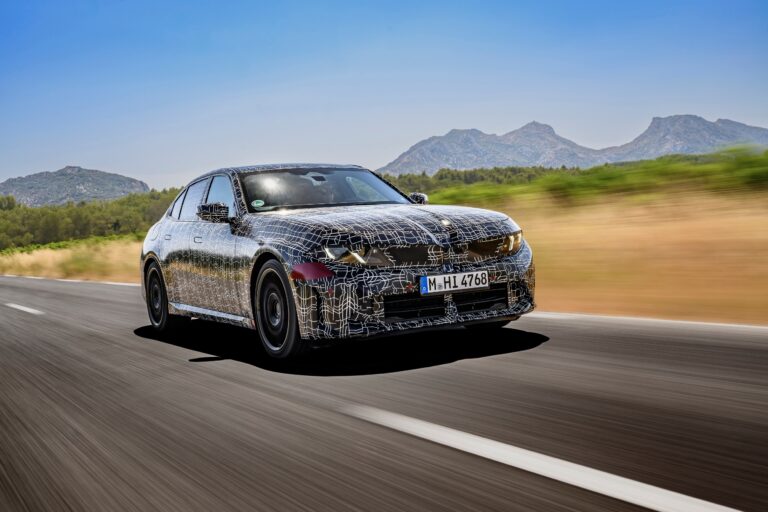
The announcement came after a controlled prototype press drive at BMW’s proving grounds in Miramas, southern France, first reported by Auto Bild on September 7 and confirmed the following day by Jalopnik, Carscoops, Motor1, and BMWBLOG, which conducted a full first drive of the camouflaged prototype.

What Is Drift Moment, and How Does It Work?

Activating Drift Moment through the M350’s central display instructs the car’s electronically controlled xDrive multi-disc clutch to close entirely on the front-axle side, routing all engine output to the rear wheels only. Combined with Dynamic Stability Control switched off, the system effectively converts the standard all-wheel-drive M350 into a rear-drive machine on demand. The feature was previously available only on the full-fat M3, which costs roughly $15,000 more than the expected M350 price range — making this a meaningful democratization of a capability that once required a significantly more expensive vehicle.

There is an engineering tradeoff embedded in how the system works that buyers should understand. In DSC-off mode specifically, BMW deliberately introduces a small amount of extra clearance between the clutch plates to reduce drag losses while the car operates in rear-biased configuration. The cost of that extra clearance is roughly 20 milliseconds of additional front-axle response time if the driver suddenly needs front-axle torque back — a fractionally slower recovery than the standard xDrive configuration provides. BMW is making a deliberate tradeoff: a more authentic rear-drive feel in exchange for a marginally slower front-axle intervention in an emergency. Whether that tradeoff makes sense depends entirely on whether the driver stays aware of the car’s reduced safety margin in DSC-off mode.

Drift Moment is not available at the M350’s launch, which is expected in the second half of 2026. BMW’s own press release confirmed at three separate points that the feature will “be made available during the course of 2027” — and that already-delivered cars will receive it through a Remote Software Upgrade, BMW’s term for its over-the-air update mechanism.

How the Software Does What a Second Driveshaft Cannot

The mechanism behind Drift Moment — and what makes it possible without new hardware — is BMW’s electronically controlled xDrive multi-disc clutch, which already exists on the standard car. Standard xDrive uses this clutch to actively distribute torque between the front and rear axles in real time. Drift Moment simply re-parameterizes that same clutch: it routes 100 percent of drive rearward and simultaneously opens a small amount of additional clearance in the clutch plates to minimize mechanical drag while operating rear-biased. No new components are added. The entire feature is a software configuration of hardware BMW already had to build.

BMW’s central controller manages a suite of fast actuators — brakes, the xDrive clutch, and the rear mechanical differential lock — using data from a six-axis motion sensor that tracks lateral, vertical, and longitudinal acceleration alongside roll, pitch, and yaw simultaneously. The system sequences these actuators deliberately: brake intervention fires first because it is the fastest, while the mechanical rear differential lock engages only after that initial correction has stabilized, since activating the lock prematurely would counteract the brakes rather than assist them. The result is a coordinated response the driver experiences as seamless.

What this makes the M350 xDrive is, technically, a Level 4 software-defined vehicle under the taxonomy established by VDA and PwC — the first level at which new functions can be installed post-sale in a vehicle already delivered, without hardware modification. That distinction has usually been associated with electric vehicles, which are easier to build around centralized software architectures. BMW is demonstrating that combustion-engine cars can reach the same level. The combustion driving stack BMW describes internally as the “Heart of Joy” system was adapted directly from the software architecture developed for the all-electric iX3, and the benchmark it was measured against was not a sports car or a race lap — it was the response speed of BMW’s own electric motors, which can shuffle torque front to rear faster than any mechanical AWD system.

Hardware Underneath: Not Just a Software Story

Drift Moment draws attention, but the M350 xDrive makes a substantive case on its mechanical merits as well. Under the hood sits the B58 turbocharged 3.0-liter inline-six with 48-volt mild-hybrid assistance, producing 437 hp (443 PS European metric) and 428 lb-ft (580 Nm) of torque. That is roughly 55 more horsepower and 44 more lb-ft than the outgoing M340i sold in North America, where the predecessor produced 382 hp and 369 lb-ft. The 48-volt mild-hybrid system adds 40 Nm at low RPM directly to the gearbox to bridge the gap before the turbocharger has fully spooled — addressing the low-rpm hesitation that occasionally blunted the character of the outgoing car.

BMW claims the M350 can hit 62 mph in 4.1 seconds provisional before reaching an electronically limited 155 mph (250 km/h), though those figures remain subject to change while development continues.

The chassis has been comprehensively reworked. The M350 xDrive receives model-specific chassis tuning, improved torsional and vertical rigidity, adaptive M suspension, an M Sport rear differential, and variable sport steering as standard equipment. Tire sizes grow to 245/35 fronts and 275/30 rears on 20-inch wheels — the widest rubber BMW has fitted to an M Performance 3 Series. The wider rear tires are also what makes the physics of Drift Moment possible when it eventually ships.

The platform is an evolution of the CLAR architecture rather than the fully new Neue Klasse platform underpinning the electric i3. Coded G50, the new 3 Series rides on CLAR II, which provides the longer hood, shorter overhangs, and traditional rear-drive proportions that distinguish the combustion car from its electric sibling. Production is scheduled to begin in the second half of 2026 at BMW’s Dingolfing plant in Bavaria.

Three Drive Modes — and the Gap That Matters

BMW replaced the M350’s familiar Sport and Sport Plus mode names with Personal, M Sport, and M Sport Plus, adding a dedicated M Mode button on the steering wheel that lets drivers jump directly to their preferred setup rather than cycling through sequentially. Journalists who drove the prototype at Miramas reported that the mode gap feels meaningfully wider than in the M340i, where the distinction between Sport and Sport Plus was sometimes difficult to detect, where the distinction was sometimes difficult to detect. The progression across modes changes the car’s character in substantive ways rather than adjusting a few damper rates.

On the wet handling sections at Miramas — where surface water is applied irregularly to force the stability systems to manage shifting friction levels — prototype drivers noted that Personal mode kept the car stable and composed even as tires lost and regained grip, while DTC mode (traction control only, no full stability intervention) allowed sustained controlled slides via throttle management. That is the closest approximation currently available of what Drift Moment will eventually feel like with the front axle electronically removed from the equation.

Interior and Design: Neue Klasse Language, Combustion Proportions

The M350 remains in heavy camouflage in official photography, but the visible design confirms the direction. The front end borrows the Neue Klasse-influenced LED signature from the electric i3, while the longer hood required to package a combustion inline-six actually benefits the proportions — longer hood, shorter overhangs, a silhouette closer to the traditional 3 Series than the EV’s more compact profile.

Inside, the cabin is clearly related to the electric i3. BMW’s Panoramic iDrive system is present with the latest iDrive X interface on the central display. The iDrive rotary controller that longtime BMW owners have relied on is absent, consistent with BMW’s broader interface transition. Quad exhaust tips confirmed — two per side — for the M Performance variant.

Does Buying Early Make Sense?

The M350 xDrive will enter production in the second half of 2026 without Drift Moment. Buyers who take delivery immediately will own a 437-hp all-wheel-drive performance sedan for months before the feature that most differentiates the car from its predecessor arrives wirelessly. For buyers who want Drift Moment on day one, the correct purchase decision is to wait — likely until sometime in 2027.

For buyers who are comfortable purchasing a car on a software roadmap rather than a fixed spec sheet, the M350 delivers a compelling case independent of Drift Moment: more power, wider tires, a fully reworked chassis, and Neue Klasse styling at what is expected to be a meaningfully lower price than the full M3 G84, which will not arrive until July 2028 at the earliest. Until then, the M350 is the only performance 3 Series available on the new G50 platform.

The broader point is what BMW is demonstrating about the automotive industry’s direction: the M350 xDrive arrives with hardware already in place for an experience that does not yet exist in software. The car you take delivery of in late 2026 and the car you drive in 2027 are the same physical object but different products. That is not a metaphor — it is an engineering fact made possible by the same decoupled software architecture BMW developed for its electric lineup, now applied to a gasoline-powered performance sedan.


Frequently Asked Questions

What exactly is BMW’s Drift Moment feature and when can I get it?

Drift Moment is a software mode that instructs the M350’s electronically controlled all-wheel-drive clutch to route all engine power exclusively to the rear wheels, effectively converting the AWD car into a rear-wheel-drive machine at the press of a button on the central display. BMW says the feature will not be available at the car’s launch in late 2026, but will be delivered during 2027 through an over-the-air Remote Software Upgrade — including to cars that have already been delivered. There is no additional charge.

Is the BMW M350 xDrive the same as a software-defined vehicle?

Yes, in the technical sense of the term. Under the VDA and PwC classification of software-defined vehicle readiness levels, the M350 qualifies as an SDV Level 4 vehicle — the first level at which new driving functions can be installed post-sale in an already-delivered car, without any hardware modification. What makes this noteworthy is that SDV Level 4 has typically been associated with electric vehicles; BMW is demonstrating that combustion-engine cars can reach the same level of software/hardware decoupling.

How does the M350 xDrive compare to the M340i it replaces?

The M350 xDrive replaces the M340i with approximately 55 more horsepower (437 hp vs. 382 hp in North America), wider 275/30 rear tires on 20-inch wheels (up from 19-inch maximum on the M340i), a more heavily reworked chassis with improved torsional rigidity, and the new iDrive X interface. It also drops the “i” suffix from its badge, part of BMW’s decision to reserve that designation exclusively for electric vehicles going forward. The manual transmission is gone from G50 entirely — the M350 will be automatic-only, as confirmed when the model was quietly listed on BMW’s own website earlier in 2026.

What is the engineering tradeoff built into Drift Moment?

When BMW activates Drift Moment in DSC-off mode, the system introduces a small amount of additional clearance between the xDrive multi-disc clutch plates to reduce mechanical drag while operating in rear-drive configuration. That extra clearance costs approximately 20 milliseconds of response time if the driver suddenly needs front-axle torque back. It is a deliberate engineering choice: BMW is prioritizing authentic rear-drive feel over the fastest possible recovery if the driver needs to revert to AWD traction. Drivers using Drift Moment on public roads should treat it the same way they would treat any stability-system-off mode — as a track or spirited driving performance feature that removes safety systems they would want in an emergency situation.

Source link