November 23, 2026:


Blue Origin’s New Shepard carried six people past 100 km (62 miles) on Nov. 22, 2024, and it has not flown anyone since January. The last flight was NS-38 on Jan. 22, 2026. The company paused the program on Jan. 30 for no less than two years, which puts the earliest restart in early 2028. That window opens within a month of Jan. 1, 2028, the date the FAA is set to gain the ability to propose safety rules for people aboard commercial spacecraft.
Customers on Blue Origin’s multi-year customer backlog are now waiting on a pause with no announced restart date. The main suborbital rival, Virgin Galactic, has moved the first commercial flight of its new spaceship into 2027.
Blue Origin’s attention is elsewhere. On Nov. 19, Google and Blue Origin announced a launch services agreement for Project Suncatcher, Google’s research effort to run AI chips on solar-powered satellites, with the launch targeted for the first quarter of 2029 aboard New Glenn.
The Suncatcher mission is Google’s first dedicated heavy-lift launch for the project, and the satellites are planned to carry roughly a data center rack’s worth of computing built around Google’s tensor processing unit (TPU) chips. The companies did not say how many satellites will fly.
New Glenn has been grounded since an explosion during a test in May damaged Blue Origin’s Florida launch pad. In early November, CEO Dave Limp told employees in a memo that return to flight slipped to January 2027.
The pause on New Shepard was framed the same way. In a Jan. 30 email to employees, Limp, a former Amazon executive, said the company would redirect people and resources toward its human lunar capabilities, including New Glenn, and wrote that New Shepard “will forever be our first step.” Reuters described the move as effectively canceling the vehicle, a characterization Blue Origin’s own announcement does not use.
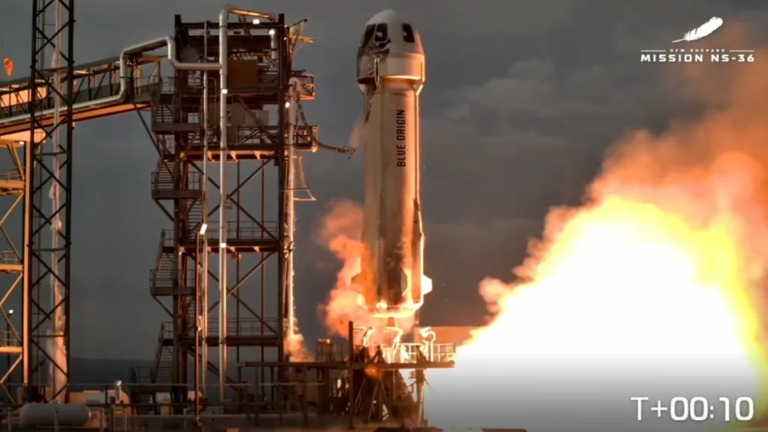
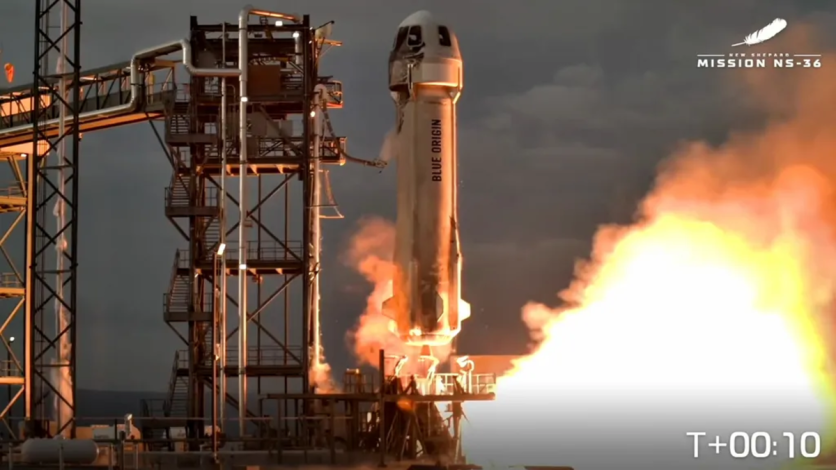
NS-28 lifted off from Launch Site One in West Texas at 10:30 a.m. ET on Nov. 22, 2024, right on schedule. The booster’s single BE-3PM engine burns liquid hydrogen and liquid oxygen, producing 490 kilonewtons of thrust (110,000 pounds-force) at liftoff for a powered climb of roughly 110 seconds.
The capsule peaked at 107 km (66 miles) by Blue Origin’s figure as relayed by SpaceNews, and at 347,661 feet (about 106 km, or 66 miles) in Space.com’s report. Both clear the 100 km line, and the crew spent about four minutes in space during a flight of about 10 minutes.
Reuse is where the design gets distinctive. The booster descends, relights its engine, deploys four landing legs and touches down on a pad about 3.24 km (2.01 miles) from the launch site. On NS-28 the booster landed about 7.5 minutes after liftoff, roughly 2.5 minutes before the capsule came down.
The capsule descends under three parachutes and can land safely on just one, then a 14 cm (5.5 in) crushable ring absorbs the final impact. Six reclined seats face six windows in a cabin of 15 cubic meters (530 cubic feet).
The design also has a hard ceiling. Reaching 100 km straight up takes about 1.4 km/s (0.87 miles per second) of velocity change, while low Earth orbit takes about 9.2 km/s (5.7 miles per second). That gap is why New Shepard cannot become a satellite launcher.
The vehicle’s launch escape system, built to pull the capsule away at any point in the climb, has been used once for real. On Sept. 12, 2022, the NS-23 engine failed about a minute after liftoff, the capsule landed safely and the booster was lost. Blue Origin attributed the cause to a thermal-structure failure of the engine nozzle, and flights resumed in December 2023, about 15 months later.
Emily Calandrelli, an MIT-trained engineer and author who hosts Netflix’s Emily’s Wonder Lab, flew with Marc and Sharon Hagle, who first flew on NS-20 on March 31, 2022. The other three passengers were Austin Litteral, a financial-services risk manager who won his seat in a Whatnot giveaway; J.D. Russell, a technology entrepreneur and former federal game warden; and Hank Wolfond, chairman and CEO of Bayshore Capital and a licensed pilot.
Both Calandrelli and Sharon Hagle work in STEM outreach. Calandrelli works to inspire young people, especially girls, in STEM, and Sharon Hagle founded the nonprofit SpaceKids Global in 2015 to promote space and science education for elementary students.
The Hagles are among six people who have flown New Shepard twice, according to Wikipedia’s flight table. Russell is another, and so is Florida investor Evan Dick, who had already flown twice before NS-28.
After reaching weightlessness, Calandrelli said she turned upside down to look at Earth and saw “so much blackness.”
Calandrelli said in a social media post that she would become the 100th woman to go to space. SpaceNews noted that the count includes nine women who flew on Virgin Galactic flights that passed the 80.5 km (50 miles) altitude U.S. agencies use for astronaut wings but fell short of 100 km, and that Blue Origin’s webcast did not mention the milestone.
Space.com tallied her place differently depending on the standard: the 10th woman above the Kármán line on a suborbital flight, the 21st woman on a suborbital flight when Virgin Galactic’s flights above 50 miles are included, and the 714th space traveler by the Association of Space Explorers’ count.
The line itself is a convention. The international aeronautics federation FAI places it at 100 km, the U.S. military awards astronaut wings above 50 miles (80 km), and NASA used the 100 km figure until 2005. Theodore von Kármán’s own calculation put the limit of aerodynamic flight near 83.8 km (52 miles), and the line has no distinct physical meaning because the atmosphere thins gradually.
Under federal law, the FAA can regulate public safety around commercial launches but is limited in proposing safety rules specific to people on board until Jan. 1, 2028, with narrow exceptions such as after a serious accident. Congress has extended that “learning period” several times, most recently to Jan. 1, 2028, by Public Law 118-159, and can extend it again or let it lapse.
The question has followed New Shepard before. In 2021, 21 current and former Blue Origin employees published an essay alleging that schedule and cost pressure took priority over safety, and the FAA said it was reviewing the claims. Blue Origin said it stands behind its record. The FAA later closed the review, saying it found no specific safety issues.
New Shepard flew 38 times with one in-flight failure, NS-23, which its escape system handled. A vehicle that returns in early 2028 would fly into a regulatory window that did not exist for those flights.
Virgin Galactic retired its VSS Unity spaceplane in June 2024 after seven commercial flights. It has since slid the first commercial flight of its Delta-class ship, Apeiron, from the fourth quarter of 2026 into 2027, as installation work ran longer than estimated, the company said.
Virgin Galactic’s flights have crossed 80.5 km (50 miles) but not 100 km, so no suborbital vehicle is flying paying passengers past the Kármán line today.
New Shepard flew 38 times and carried 98 passengers, about 92 of them different individuals, before Blue Origin stopped it. A reader holding a ticket, or weighing one, should plan around a restart no earlier than January 2028 that Blue Origin has not yet scheduled, a Virgin Galactic spaceship that is not yet flying commercially, and a federal safety-rule freeze that Congress could extend or let expire. The open questions are whether Blue Origin names a restart date, how it handles its customer backlog during the pause, and whether its lunar and New Glenn work gets the resources the pause was meant to free up.
No. Blue Origin paused New Shepard flights on Jan. 30 for no less than two years, and the last flight, NS-38, carried six people in January.
Blue Origin has not announced a restart date. A pause of no less than two years from Jan. 30, 2026 puts the earliest return in early 2028.
By the 100 km (62 miles) Kármán line that Blue Origin uses, yes: NS-28 peaked near 107 km (66 miles). U.S. agencies award astronaut wings above 80.5 km (50 miles), a lower line that Virgin Galactic’s flights cross.
Not automatically. Starting Jan. 1, 2028, the FAA may propose rules for the safety of people aboard commercial spacecraft, but Congress can extend the freeze again, and any rules would take time to write.