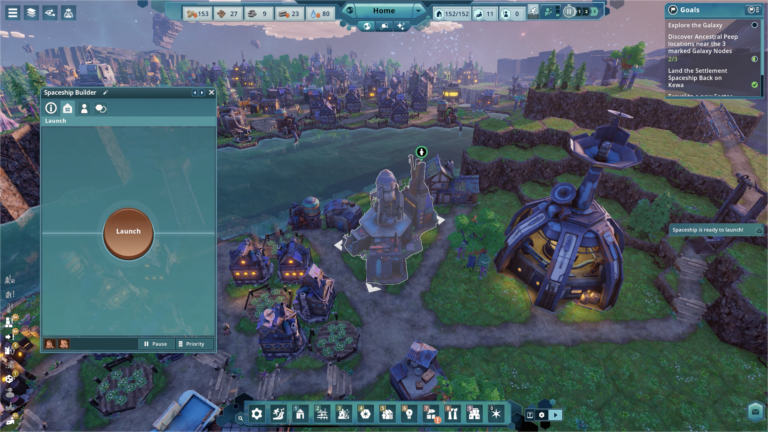
August 22, 2026:


Hooded Horse and Balancing Monkey Games announced the October 15 release date today for Beyond These Stars — a city-building and colony management game where players construct an entire civilization on the back of a sentient Space Whale — confirming it will launch across Steam, GOG, Epic Games Store, and the Microsoft Store, with day-one availability on PC Game Pass at no additional cost to subscribers. The announcement confirms that the studio is skipping Early Access entirely, going straight to a full 1.0 release. A free playable demo is currently available on the Beyond These Stars Steam page.
The decision to go directly to 1.0 is notable for a small indie studio. In a March 2026 Steam blog post, the team wrote that “many of our systems were complete enough to meet our requirements for a 1.0 release,” and that players would experience the game “in a fully realized form, rather than just a chapter of it.” That fully realized form includes the complete galaxy to explore, multiple alien species to encounter, planets that can be permanently settled, and the game’s full narrative — none of which would have been present in the originally planned Early Access build.
Beyond These Stars is a sequel to Before We Leave, the 2020 city builder from the same New Zealand-based studio. Where that game eventually had the Peeps — the player’s small civilization — launch themselves into space and confront massive Space Whales, the new game begins with the Peeps stranded atop one.
The player guides the Peeps as they board Kewa, a lone Space Whale traveling the cosmos, and attempt to build a home there: constructing supply chains, managing population needs, terraforming the whale’s back to expand usable land, and maintaining a delicate ecological balance — all while their “ground” is a living creature with its own wants, moods, and memories.
The studio received development support from New Zealand’s Centre of Digital Excellence (CODE), a government initiative supporting game development in Aotearoa.
The most distinctive design decision in Beyond These Stars is that Kewa — the Space Whale — is not passive terrain. Kewa is a fully written, deeply characterized companion with emotions, memories, and agency. Kewa’s happiness is tracked as an active game variable and shapes every system around it.
When Kewa is healthy, the whale travels the galaxy faster, moving players toward new star systems and resources more efficiently. When Kewa is thriving, the whale spontaneously spawns Kewa Fruit Trees across the playable area, granting Peep happiness bonuses. When Kewa is neglected — over-exploited, polluted, or ignored — Thorny Stems appear instead, suppressing Peep productivity. The habitat itself, the total usable land on Kewa’s back, will shrink if the ecosystem is abused. Conversely, planting forests (which expand the atmosphere) and digging canals can grow it.
This is not a metaphor. It is the entire design philosophy of the game: ecological mutualism encoded as a feedback loop. Parasitic relationships — extracting without maintaining — are mechanically inferior. Symbiotic relationships are mechanically rewarded. Players who treat Kewa as a resource to exploit will find themselves with shrinking cities and an increasingly hostile companion. Players who build sustainability alongside productivity will find Kewa an active partner in their journey.
The designer of Kewa’s character, narrative designer Emily, has publicly noted that Kewa’s demeanor was directly influenced by Treebeard from J.R.R. Tolkien’s Lord of the Rings — old, slow, and full of memories both beautiful and painful that surface only as the whale’s health improves. The dev blog on writing Kewa details this influence and the creative process behind the character. As Kewa’s health crosses certain thresholds, the whale initiates conversations with the Peeps, sharing fragments of a long history in what the game’s creative director Sam Barham requested be poetic, metaphor-laden speech. Kewa’s relationship with the player grows over the course of the game — which means it can also deteriorate.
Beyond These Stars runs on a hex-tile base inherited from Before We Leave, but the production system is meaningfully more complex. Players who found Before We Leave‘s supply chains satisfying should note that byproducts are now tracked across the production pipeline: wood processing generates wood dust, which must be burned in dedicated burners; burners produce soot, which itself requires management. Steam community members who played the demo have flagged this as the steepest part of the learning curve — but also as the most satisfying once it clicks, according to demo feedback discussions from players.
Managing resources on Kewa’s finite back is only part of the challenge. When Kewa’s stamina runs low during galaxy travel, the whale detours through debris fields to feed — and the resulting debris can rain down on the city, damaging buildings and interrupting production chains. Keeping Kewa well-fed and content is, mechanically speaking, both a survival strategy and an infrastructure decision.
Once players unlock interstellar travel, a procedurally generated Galaxy Map opens up. Star systems contain a range of discoveries: trade stations, alien species, barren planets, space junk, anomalies — and, crucially, planets that support Peep life. These can be settled with permanent outposts to supplement resources that Kewa’s back cannot produce in sufficient quantity.
The studio has teased one planet rich in fertile land, ocean water, berries, wheat, shells, and — most importantly for food production — cows and chickens, which unlock Pasture buildings and an entirely new tier of agricultural output. How long the Peeps can work a given outpost depends on Kewa’s cooperation. A healthy, happy Kewa will linger at a system long enough for meaningful extraction. A neglected Kewa may decide to leave early, cutting off a resource operation mid-chain.
Not every star is productive. Barren rocks, junk fields, and strange objects populate the map — part of the appeal for players who value exploration-driven city builders alongside the management loop.
Critics who played preview builds have been consistently enthusiastic. PCGamesN praised the game for fulfilling the fantasy of living “atop a giant space whale” in a way that feels mechanically grounded. Rock Paper Shotgun drew a comparison to the creature AI in Black & White, the 2001 Peter Molyneux god game: they described Kewa as having the same quality of feeling “quietly autonomous — as if it was quietly rebelling or warming up to me by itself,” which they found striking. GamesRadar called Beyond These Stars “a galaxy-wide supply chain simulator” and a “traditional city management game” simultaneously, and said the game’s strangeness is its strongest selling point: compelling “from the first moments.”
Twenty-one Steam curators have reviewed the game based on demo access as of the time of writing, according to the Beyond These Stars curator page.
The two games share a premise — build a settlement on the back of a giant living creature — but come from different studios with different design approaches. The Wandering Village, developed by Stray Fawn Studio and released to version 1.0 in July 2025, is set on the back of Onbu, a ground-walking megasaur in a post-apocalyptic landscape, and has earned very positive reviews across nearly 4,000 Steam ratings. Beyond These Stars is set in space, uses a procedurally generated galaxy, and features Kewa as a fully voiced, narrative-driven character with a written personality and backstory — a more ambitious character integration than Onbu’s simpler stat-driven behavior.
The other meaningful difference is scope. Beyond These Stars launches as a complete 1.0 with the full story and the full galaxy, rather than the chapter-by-chapter delivery of a typical Early Access release.
Beyond These Stars launches on October 15, 2026. The game will be available on Steam, GOG, Epic Games Store, and the Microsoft Store. PC Game Pass subscribers can play it from day one at no additional cost. The game supports Family Sharing and Steam Cloud. English ships with full voice audio; fourteen additional languages are supported with interface and subtitles, per the Steam store language table. System requirements are modest — a Windows 10 (64-bit) PC with an Intel Core i3-6300 or AMD FX-9370, 8 GB RAM, and an NVIDIA GTX 750 or AMD Radeon R9 380 is the minimum specification. The free demo, updated from its June 2024 Next Fest debut, is live on Steam now.
No. At launch, Beyond These Stars is a PC-only title. It will be available on Steam, GOG, Epic Games Store, and the Microsoft Store on October 15, 2026. PC Game Pass subscribers on Windows can play it from day one. No console version has been announced.
Both games put players in charge of a settlement built on the back of a giant living creature, but they diverge significantly. The Wandering Village features Onbu, a ground-walking creature in a post-apocalyptic landscape, with relatively simple creature-response mechanics. Beyond These Stars takes place in space, includes a procedurally generated galaxy with multiple explorable star systems, and builds Kewa — the Space Whale — as a fully written character with dialogue, a personal history, and emotional responses to player decisions that meaningfully shift gameplay. Beyond These Stars also launches directly as a full 1.0 release, whereas The Wandering Village spent years in Early Access before its 1.0 debut.
Neglecting Kewa’s ecosystem and happiness has escalating mechanical consequences. An unhappy Kewa spawns Thorny Stems across the playable area, reducing Peep productivity. A severely neglected Kewa may unilaterally bolt to a cooler region of the galaxy if it overheats, triggering a debris shower that damages city buildings mid-session. The habitat itself — the total buildable space on Kewa’s back — will shrink as ecosystem health deteriorates. The game’s design philosophy is explicit: the mutualistic approach, caring for Kewa while building efficiently, is mechanically superior to extraction-first strategies, as detailed in the Kewa happiness developer blog.
Yes. The full narrative, including Kewa’s personal history and the origins of the Space Whales in this universe, is included in the 1.0 launch. The studio confirmed that the skip of Early Access was partly motivated by their ability to include the complete story: the Early Access build would have shipped without the full galaxy, alien species encounters, settled planets, and the narrative conclusion, per the official plans announcement.