November 10, 2026:


Czech Railways (České dráhy) and Škoda Group signed a CZK 4.1 billion (approximately €165 million) contract on Monday for 10 new RegioPanter battery-electric multiple units — pushing the country’s most ambitious regional fleet decarbonization push into a new phase and deepening a partnership that has already reshaped how millions of passengers travel on partially electrified lines.
Only about one-third of the Czech rail network carries overhead wires — roughly 3,000 of the country’s approximately 9,500 kilometers of main lines — leaving thousands of kilometers of regional routes still reliant on diesel-powered rolling stock the country is now racing to retire.
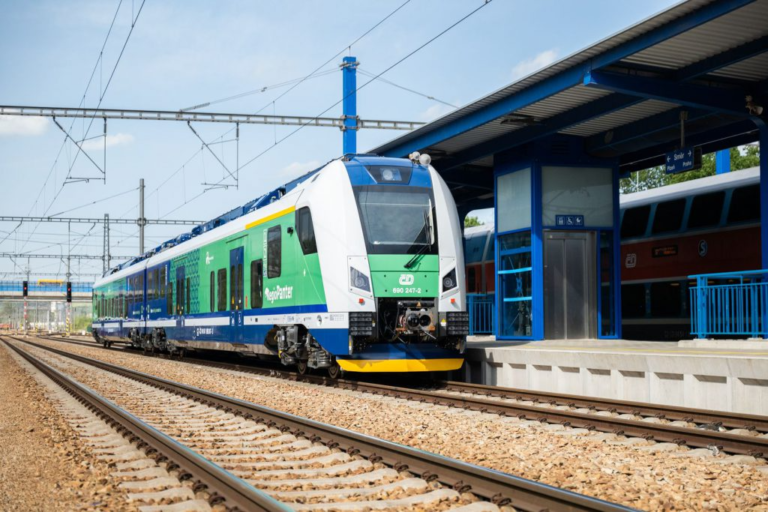
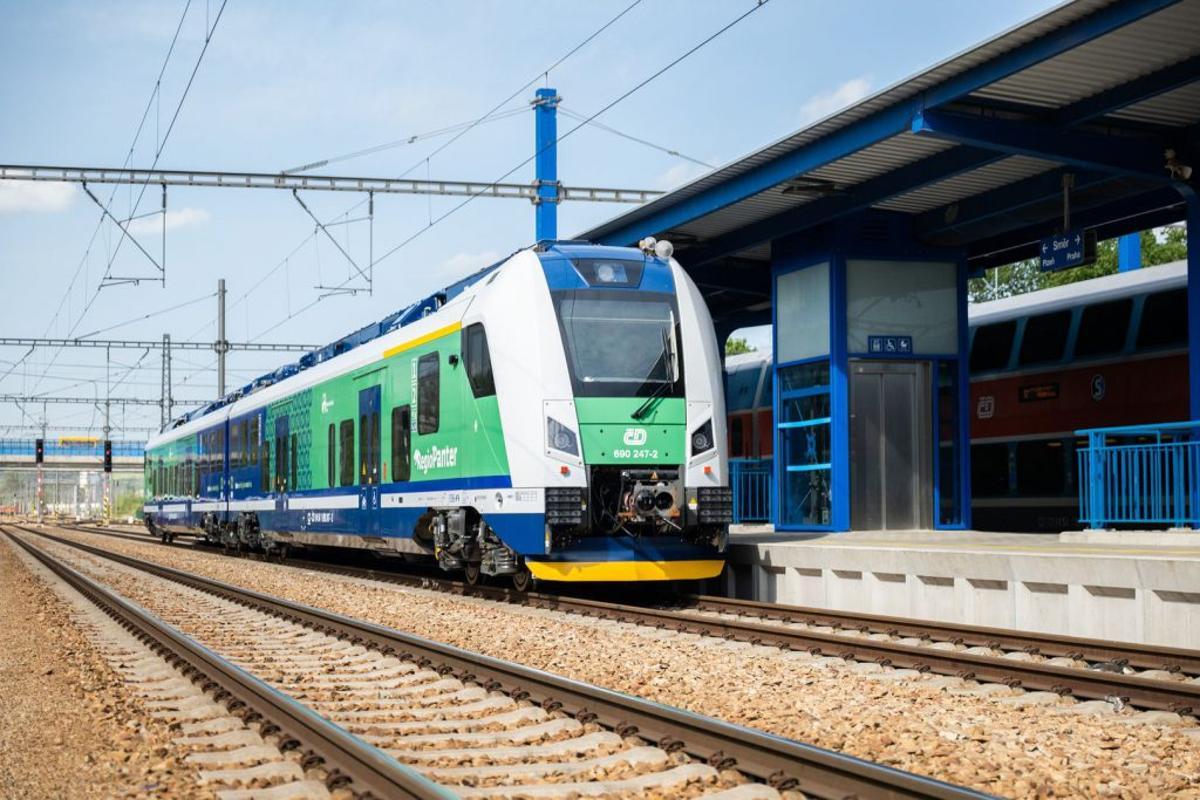
Czech Railways came to this contract with two years of on-the-ground results behind it. The operator launched its first four RegioPanter battery-electric units on December 15, 2024, on the S8 line between Veřovice and Ostrava via Studénka and Štramberk in the Moravian-Silesian region, in a ceremony attended by the minister of transport, the regional governor, and the chief executives of both ČD and Škoda Group.
Those four pioneer trains delivered what the technology promised: an 80-kilometer range on battery power, a top speed of 160 km/h under catenary and 120 km/h on battery alone, and regenerative braking that returns stored energy to the system even on non-electrified stretches. Early projections from that initial deployment pointed to an annual saving of at least 200,000 liters of diesel and 500 tonnes of CO₂ per unit batch — figures that made the case for scaling up nearly impossible to argue against.
A second batch of 15 next-generation RegioPanter BEMUs, contracted in June 2024 for CZK 3.5 billion (approximately €141.6 million), is currently completing final testing at the VUZ Velim proving ground. Delivery slipped from a late-2026 target to March 2027 due to aluminum profile supply constraints, but the trains remain on course for Moravian-Silesian service. The 10-unit order confirmed today effectively launches the next procurement wave, with deliveries starting in 2029.
The RegioPanter BEMU platform, built at Škoda Group’s Plzeň manufacturing facilities and fitted with ABB’s Pro Series lithium-titanate oxide battery packs, is engineered for dual-system operation. Under electrified catenary — either 3 kV DC or 25 kV 50 Hz AC — the trains draw power from the overhead wire while simultaneously recharging their battery packs. When the wire ends, the train continues on stored energy, cutting out the forced passenger interchange that previously made diesel-hauled branch connections a fixed feature of regional travel.
In the Moravian-Silesian region, that capability already delivers new direct connections: Ostrava now links to towns including Krnov, Nový Jičín, and Budišov nad Budišovou without any additional infrastructure spending by the regional government.
The Czech contract is part of a broader pattern of BEMU orders accumulating around Škoda Group. In December 2025, the manufacturer — in consortium with ŽOS Trnava — signed a framework agreement with Slovak operator ZSSK for up to 36 battery-powered trains worth nearly €332 million, representing the company’s first battery train export order. Latvia’s transport authority contracted Škoda for up to 16 BEMUs that same month for regional services.
Škoda unveiled the second-generation RegioPanter platform — the technical basis for these newer contracts — at Rail Business Days 2026 in Ostrava in June, where it demonstrated improvements in passenger capacity, reduced energy consumption, and refined performance on mixed-infrastructure routes. The updated design maintains a minimum 80-kilometer battery range, the 160/120 km/h speed profile of its predecessor, and the dual-voltage compatibility that regional operators require.
The 10-unit order fits inside a larger procurement architecture designed by Czech Railways CEO Michal Krapinec. Two parallel public tenders launched in January 2026 seek up to 120 battery-electric multiple units across two framework agreements — the BEMU130 (minimum 121 seats) and BEMU135 (minimum 140 seats) — with an initial firm call-off covering 13 units and additional orders to follow as regional transport authorities confirm their service plans.
“We have seen a high level of interest in these connections, and the number of passengers using modern, barrier-free trains with direct connections is growing,” Krapinec said when the mega-tender launched. The near-term 10-unit deal locks in production continuity with Škoda Group while the larger pipeline matures.
With EU-level pressure accelerating diesel retirement timelines, and the cost of extending overhead wire across lower-traffic branch lines proving economically unviable in market after market, the Czech Republic’s battery-first regional strategy is drawing increasing attention from operators across the continent watching closely to see how the economics hold at full scale.