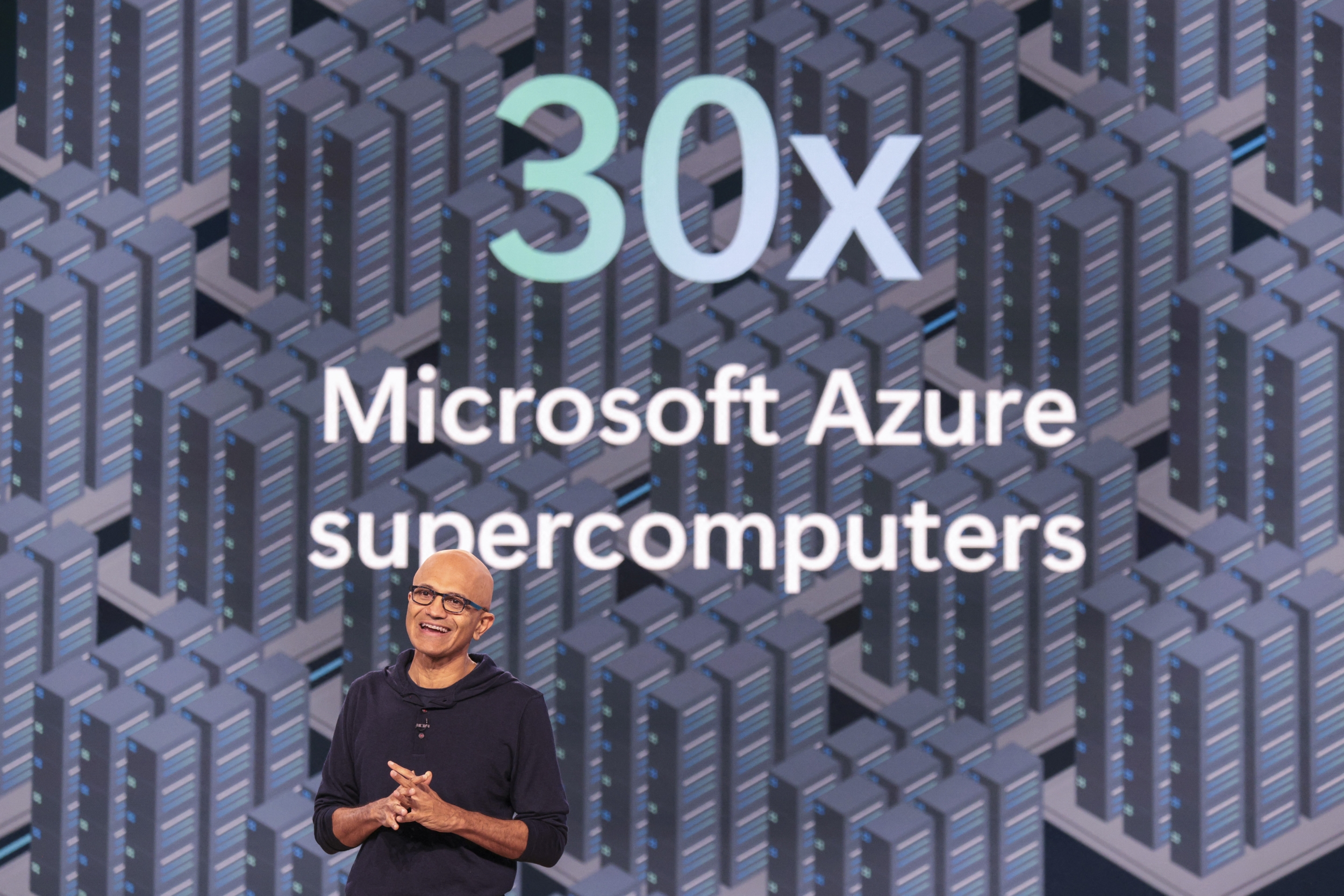
Microsoft reported 48% Azure revenue growth for the quarter ended September 30, 2026 — the fastest rate in at least two years — in the first earnings cycle under a new corporate structure that publicly declares AI agents the company’s primary revenue driver. The result, reported on October 28, marked an inflection point: faster Azure growth on less capital than the market had feared, undermining the prevailing concern that Microsoft’s infrastructure spending surge would crush free cash flow indefinitely. CFO Amy Hood guided Azure growth of 49% to 50% in constant currency for Q2 FY2027 — a further acceleration — on an annualized revenue trajectory approaching $140 billion for the platform.
Beat Across the Board
Microsoft’s Q1 FY2027 results beat analyst consensus across every major metric.
Total revenue reached $92.3 billion, a 19% increase year-over-year (22% in constant currency), above analyst consensus of approximately $91 billion. Operating income grew 21% to $45.9 billion. GAAP net income climbed 32% to $36.6 billion, with diluted earnings per share of $4.92. Non-GAAP EPS came in at $4.89, above the $4.72 analyst consensus. Microsoft Cloud — the combined measure of Azure, Microsoft 365 commercial cloud, and related services — grew 30% to $63.9 billion.
“We are delivering greater capability, choice, control, and cost efficiency for customers across our entire stack,” said Satya Nadella in the press release, Microsoft’s chairman and chief executive. “By helping organizations build and own their own intelligence, and earning trust through agent safety and security, we are translating our innovation into growing adoption and real-world impact across every industry.”
“We delivered a strong start to the fiscal year with Microsoft Cloud revenue of $63.9 billion, with growth accelerating to 30% year-over-year,” said CFO Hood in the same earnings press release. “Results exceeded expectations across revenue, operating income, and earnings per share.”
Shares rose 4% after-hours on October 28.
How Does Azure’s 48% Compare to Its Own Recent Track Record?
Azure revenue in Q1 FY2027 was $33.2 billion (exact: $33,165 million), up 48% year-over-year from $22.4 billion in Q1 FY2026 — a gain of $10.8 billion in a single quarter. That makes Azure Microsoft’s single largest product line by revenue, overtaking even Microsoft 365 commercial cloud, which generated $27.8 billion that quarter.
What makes the 48% rate significant is where it sits relative to Microsoft’s own recent history. Azure’s growth ranged between 39% and 43% throughout all four quarters of fiscal year 2026, per prior quarterly disclosures and Q1 FY2027 press release confirmation. This quarter’s 48% is not a continuation of that range — it is a break above it, the highest single-quarter rate in at least two years and five points above the top of the FY2026 range. Microsoft’s 10-Q for the quarter cited broad workload growth across the platform as the driver — language pointing to broad-based enterprise uptake rather than a few large individual contracts.
This quarter was also Azure’s first absolute dollar disclosure: Microsoft reported revenue in dollar terms rather than as a percentage growth figure alone. That structural reporting change, combined with the 48% rate and Q2 guidance of 49%–50%, gives investors and enterprise technology buyers a considerably sharper view of Azure’s scale and trajectory than was available even three months ago.
What Naming a Segment “Agents” Signals About the Physics of Cloud Growth
Q1 FY2027 was the first quarter Microsoft reported under a new segment structure announced September 2026. The company replaced its old three-segment framework — Productivity and Business Processes, Intelligent Cloud, and More Personal Computing — with two broader units: Agents and Infra and Devices and Consumer.
The Agents and Infra segment — which houses Azure, Microsoft 365 commercial cloud, productivity and server licensing, industry solutions, and Frontier/support services — generated $76.8 billion in Q1, up 25% year-over-year, with operating income of $40.6 billion. Devices and Consumer — containing Xbox ($5.4 billion), Windows OEM and devices ($3.6 billion, down 22%), and Search and Advertising ($6.6 billion) — brought in $15.5 billion, down 3%.
The name itself is a declaration. Naming a revenue segment “Agents” — rather than “Cloud,” “AI,” or any of a dozen alternatives — reflects a specific claim about the underlying consumption physics that will drive that segment’s growth.
Traditional cloud use involves a person issuing a command and a server responding once. AI chatbots involve a similar one-query-one-response pattern. AI agents are different in a structural sense: an autonomous agent completing a business task — researching a supplier, drafting a proposal, updating records, executing a sequence of software actions — may trigger 20 to 100 sequential large language model API calls per task. Each of those calls consumes GPU compute on Azure. The per-user infrastructure consumption of an organization deploying agents is therefore not additive compared to chatbot adoption — it is multiplicative. Microsoft’s decision to rename its primary revenue segment reflects a bet that this consumption fan-out is where the next several years of Azure growth will be sourced.
Nadella has said publicly that the AI agent market will ultimately surpass the cloud computing market in total economic value. The segment name anchors that thesis in the company’s formal financial reporting.
$39.4 Billion in Capex Came in $6 Billion Below Estimates — and That’s the Point
Capital expenditure totaled $39.4 billion in Q1 FY2027 (PP&E additions: $39,367 million) — more than double the $19.4 billion spent in Q1 FY2026, a 103% year-over-year increase. The spending funds the global data center construction and server hardware procurement that Microsoft’s press release described as “substantial investments in cloud and AI strategy.”
The headline capex figure, however, masked the number investors were actually watching: whether it came in below the estimates analysts had modeled. It did — by roughly $6 billion, per InvestingLive’s consensus comparison.
The significance of that gap is not the dollar amount but what it implies about the investment cycle. The concern throughout calendar 2026 was that Microsoft was committing to ever-larger incremental outlays to sustain Azure’s growth — a pattern that would permanently suppress free cash flow. The $39.4 billion figure, arriving below estimates while Azure’s growth rate rose to 48%, is consistent with a different and more favorable interpretation: that infrastructure installed during the buildout phase is now generating billable workloads, meaning each additional dollar of Azure revenue requires less incremental capital than during the initial deployment surge. The cloud infrastructure capex cycle has historically followed a buildout-then-harvest pattern, most prominently during AWS’s 2014–2018 period; Microsoft’s Q1 FY2027 print is the first concrete data point suggesting a similar dynamic may be beginning for Azure.
The cost of that buildout is still visible in free cash flow. With operating cash flow of $58.0 billion partially offset by $39.4 billion in capex, free cash flow came to approximately $18.6 billion — sharply below approximately $25.7 billion in the year-earlier period. Microsoft returned $10.2 billion to shareholders through dividends and buybacks in the same quarter, signaling financial confidence even as FCF remained compressed.
The $677 Billion Contracted Backlog Puts Future Revenue in Sight
Microsoft’s commercial remaining performance obligation — contracted future revenue from enterprise customers that has not yet been recognized under GAAP revenue recognition rules — jumped 73% to $677 billion in Q1 FY2027. That compares to $678 billion in the Q4 FY2026 report, indicating the backlog is holding steady near record levels even as revenue converts.
At Microsoft’s current revenue conversion rate, $677 billion in contracted obligations represents roughly two to two-and-a-half years of committed future revenue. That backlog figure does more editorial work than any single quarter’s growth rate: it signals that enterprise AI adoption is not a short-term burst that corporations might pull back from, but a multi-year capital commitment that customers have contractually locked in through long-term agreements with Microsoft’s cloud.
The concentration risk embedded in the backlog is worth noting. A substantial portion of the $677 billion is attributable to Microsoft’s partnership with OpenAI, estimated at approximately 30–35% of the total in prior period analyses. Excluding OpenAI, the Q4 FY2026 figure grew 25% year-over-year — still solid but meaningfully different from the 73% headline figure, underscoring that the pace of backlog growth is partly a function of one very large contractual relationship.
Microsoft in the Hyperscaler Field: Capex and Cloud Growth in Context
How Does Azure Growth Compare to AWS and Google Cloud This Quarter?
Microsoft’s $39.4 billion single-quarter infrastructure outlay places it in the vanguard of what analysts at Moody’s hyperscaler capex forecast projects as close to $785 billion in aggregate hyperscaler capex for full-year 2026, approaching $1 trillion in 2027 according to revised industry projections.
Google Cloud reported 63% revenue growth in its most recent quarter, powered by $35.67 billion in quarterly capex. AWS has been expanding at 28%, with Amazon guiding toward approximately $200 billion in total 2026 capital investment. Microsoft, with calendar-year 2026 capex guidance of approximately $175 billion, sits between the two on spending scale while achieving a cloud-platform growth rate that exceeded both rivals in this period.
What distinguishes Microsoft’s competitive position is the depth of its enterprise relationships — anchored by Microsoft 365’s widespread corporate seat presence — and its integration of OpenAI’s models across Azure AI services and Copilot products. As of Q3 FY2026, Microsoft disclosed that its AI business had surpassed an annualized revenue run rate of $37 billion, up 123% year-over-year; the company did not update that metric in the Q1 FY2027 release, but the 48% Azure growth rate implies continued momentum.
Q2 FY2027 Guidance: Azure Growth Expected to Accelerate Further
Hood’s Q2 FY2027 guidance implies the acceleration is not yet finished. Azure is expected to grow 49% to 50% in Q2 in constant currency in the December 2026 quarter — one to two points above the 48% just reported. That guidance would put Azure’s annualized revenue run rate at approximately $138 billion to $140 billion by the end of calendar 2026, a scale that would have appeared implausible during the post-pandemic cloud normalization period of 2023, when Azure’s growth had decelerated into the mid-twenties.
The key risk Microsoft’s own filings identify is the durability of demand relative to capital deployed. The company’s Q1 FY2027 10-Q lists risk factors including customer demand, technological developments, competitive dynamics, and regulatory conditions. Against that caveat, the $677 billion contracted backlog — growing 73% year-over-year — is the clearest available evidence that the demand signal is real and multi-year, not quarter-by-quarter.
Key Metrics at a Glance
| Metric |
Q1 FY2027 |
Q1 FY2026 |
Change |
| Total Revenue |
$92.3B |
$77.7B |
+19% |
| Operating Income |
$45.9B |
$38.0B |
+21% |
| Net Income (GAAP) |
$36.6B |
$27.7B |
+32% |
| Diluted EPS (GAAP) |
$4.92 |
$3.72 |
+32% |
| Diluted EPS (Non-GAAP) |
$4.89 |
$4.13 |
+18% |
| Azure Revenue |
$33.2B |
$22.4B |
+48% |
| Microsoft Cloud Revenue |
$63.9B |
~$48.7B |
+30% |
| Capex (PP&E Additions) |
$39.4B |
$19.4B |
+103% |
| Commercial RPO (Backlog) |
$677B |
~$391B |
+73% |
| Free Cash Flow (approx.) |
~$18.6B |
~$25.7B |
~–27% |
All figures from the Q1 FY2027 earnings press release, October 28, 2026. Free cash flow is derived (operating cash flow $58.0B minus PP&E additions $39.4B). Prior-year FCF is approximate.
Frequently Asked Questions
What is Microsoft’s “Agents and Infra” segment, and why does the name matter?
Agents and Infra is the larger of Microsoft’s two new corporate reporting segments, introduced with the Q1 FY2027 earnings cycle. It houses Azure, Microsoft 365 commercial cloud, productivity and server licensing, industry solutions, and Frontier/support services — $76.8 billion in Q1 FY2027 revenue. The name matters because it encodes a specific claim about what will drive that revenue: AI agents, unlike chatbots or simple AI assistants, execute multi-step autonomous tasks that each require multiple sequential API calls to the underlying language models hosted on Azure. Each agent action is a billable compute event. An enterprise deploying agents for operations, code generation, or data analysis consumes Azure infrastructure at a rate that scales faster than seat count — creating a structural consumption multiplier that Microsoft is publicly betting will be the dominant force in cloud revenue growth over the next several years.
Why did Azure’s 48% growth rate get described as a re-acceleration?
Azure grew between 39% and 43% in each of the four quarters of fiscal year 2026, and 48% confirms renewed acceleration above that entire prior-year range. The Q1 FY2027 rate of 48% sits five points above the top of that range — a meaningful statistical break from a trend that had been either stable or narrowly accelerating. When Microsoft’s Q2 FY2027 guidance calls for 49%–50%, that constitutes two consecutive quarters of acceleration above the FY2026 range, which is the basis for calling Q1 a re-acceleration rather than a continuation.
What happened to Microsoft’s free cash flow, and should investors be concerned?
Free cash flow fell to $18.6 billion in Q1 FY2027 from approximately $25.7 billion in Q1 FY2026, a decline of roughly 27%, driven entirely by the doubling of capital expenditure. This is the near-term cost of building the infrastructure that Azure’s growth depends on. Whether it is a concern depends on whether the “harvest phase” thesis holds: if already-installed capacity continues to generate accelerating Azure revenue while incremental capex moderates (as the Q1 FY2027 capex beat relative to analyst estimates suggests may be happening), FCF should recover as the buildout-to-revenue conversion ratio improves. If capex must continue doubling to sustain growth, the FCF pressure persists.
Will Azure keep growing faster than it did throughout fiscal year 2026?
Microsoft’s Q2 FY2027 guidance of 49%–50% implies a further acceleration above Q1’s 48%. The $677 billion commercial RPO backlog, growing 73% year-over-year, provides contractual visibility that supports the guidance range for at least the near term. The principal uncertainties are whether enterprise AI agent workloads convert from pilot deployments to full production at the rate reflected in contracted commitments, and whether competitive dynamics — particularly from AWS and Google Cloud, both growing their AI infrastructure positions aggressively — alter customer allocation of workloads across cloud providers.