HomeAuto Autumn Headphone Festival 2026: R2R Ladder-DAC Hits $74 USB Dongle; $3,799 Kiso Cypress Flagship Makes Japan Debut
Autumn Headphone Festival 2026: R2R Ladder-DAC Hits $74 USB Dongle; $3,799 Kiso Cypress Flagship Makes Japan Debut
November 9, 2026:
Audio-technica.com
Tokyo’s Sapia Tower hosted the Autumn Headphone Festival 2026 (秋のヘッドフォン祭 2026) today — the most concentrated single-day product reveal in Japan’s personal-audio calendar — where three converging technological shifts took center stage: magnetic fluid driver technology graduating from earbuds to flagship over-ears, a $3,799 closed-back headphone carved from 300-year-old Kiso cypress, and R2R ladder-DAC architecture spreading from $529 transportable units down to a $74 USB dongle.
Organized by specialist retailer Fujiya Avic and held on the 5th and 6th floors of Station Conference Tokyo — directly connected to Tokyo Station’s Yaesu North Exit — the 42nd edition of the Headphone Festival series ran from 11:00 to 18:00 JST with free admission and no advance registration. More than 70 booths hosting upward of 170 brands covered everything from $25 gaming accessories to a $25,239 reference stack, with product launches, Japan debuts, and prototype demonstrations filling every aisle.
Headline Debuts
Technics EAH-A1000 — Magnetic Fluid Physics Comes to Over-Ears
The most anticipated preview of the day came from the Panasonic/Technics booth: the EAH-A1000, the brand’s new flagship wireless over-ear and the successor to the EAH-A800 that debuted at CES 2022. Technics announced the headphone globally on September 29, 2026 at $449.99 US (£399/approximately $529; €449/approximately $500); in Japan, Panasonic confirmed a November 19, 2026 street date with an expected price of ¥59,400–¥66,000 (approximately $375–$416) including tax and a planned monthly production run of roughly 2,000 units.
How the magnetic fluid driver works: The engineering headline is a newly developed 40 mm Magnetic Fluid Driver — the first time Technics has applied this technology to an over-ear headphone. Ferrofluid (a colloidal suspension of magnetite nanoparticles in a carrier fluid) is placed between the voice coil and pole piece magnet in the driver’s magnetic gap. The ferrofluid adheres magnetically, creating a fluid bearing that provides two functions: it centers the voice coil during large excursions, preventing the tilt and rub that cause distortion artifacts, and it creates a second suspension point alongside the mechanical surround. This two-point support allows the diaphragm to maintain more precise pistonic motion, reducing second- and third-harmonic distortion that scales with driver diameter — which is why the technique, long used in loudspeaker design, becomes especially valuable at 40mm scales.
Technics previously used ferrofluid-based driver designs in its EAH-TZ700 premium IEMs and the EAH-AZ100 true-wireless earbuds; scaling the approach to a 40mm over-ear driver presented different engineering challenges. The diaphragm itself is a cone-shaped carbon-fiber construction; the surround uses Technics’ SST (Symmetrical Surround Technology) Edge, adapted from the brand’s flagship loudspeakers, ensuring the surround’s forward and backward movement is equally compliant to reduce harmonic distortion. A flat baffle structure minimizes reflections around the driver, and an Acoustic Control Chamber behind it manages airflow to balance low and midrange frequencies.
The EAH-A1000 also upgrades connectivity significantly over the A800. It supports LE Audio with Auracast broadcast capability — enabling the headphone to receive audio streamed simultaneously to any number of compatible devices in a space without pairing — alongside LDAC and lossless USB Audio. Multipoint connectivity now spans three simultaneous devices rather than two, and Dolby Atmos with head-tracking is included. Active noise cancellation uses eight microphones in total (three feed-forward plus one feedback per side), adapting to both ambient noise levels and each wearer’s physical fit. Battery life is rated at up to 45 hours with ANC on and up to 90 hours with ANC off, per Technics. The headphone ships in Black and the new Platinum Greige colorway; the “Flow Arm” headband structure transitions from a square cross-section at the slider to a triangular one at the hanger and folds flat for travel.
Attending press were able to audition the EAH-A1000 at the event ahead of its November 19 street date.
Audio-Technica ATH-AWX7000 — 300-Year-Old Cypress Meets Modern Acoustic Engineering
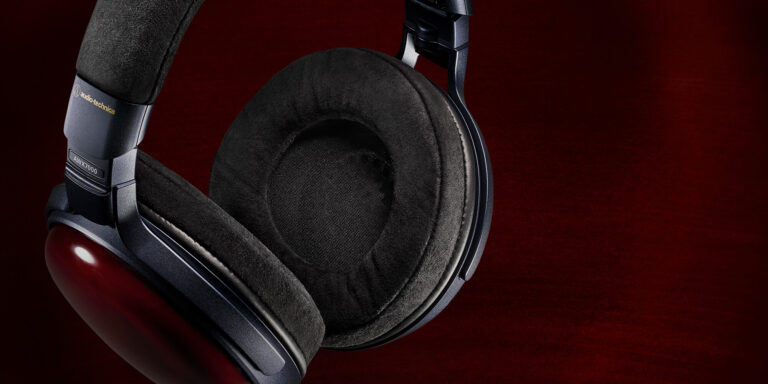
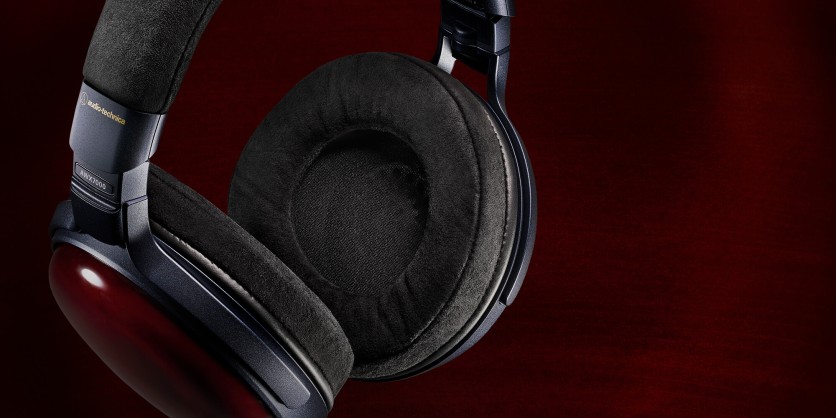
Audio-Technica’s booth was another focal point: the ATH-AWX7000 closed-back headphones, the company’s new flagship closed-back headphone, had gone on sale just the day before — November 6, 2026 — and today marked its first appearance at a Japanese listening event. Priced at $3,799 US (£3,299/approximately $4,378; €3,799/approximately $4,232), it had debuted publicly at the Paris Audio Video Show on October 23, 2026.
The ATH-AWX7000 sits alongside the open-back ATH-ADX7000 ($3,499) at the summit of Audio-Technica’s headphone lineup and represents the company’s first deployment of its True Closed-back Acoustic (TCbA) design philosophy. Where conventional closed-back headphone engineering treats the sealed air volume behind the diaphragm as an acoustic impedance load — a spring the driver must work against, often resulting in a “darker” or “boomier” quality — TCbA turns that physics around, designing the internal acoustic geometry to harness the air pressure as a controlled resonance element rather than fighting it.
The craft: Each earcup housing is carved from Kiso cypress (Hinoki — 木曽檜), a slow-growing Japanese conifer from strictly managed state-owned forests in Nagano Prefecture. The timber can take up to 300 years to reach the size required for headphone housings, and Audio-Technica secured a special government allocation. Each housing then receives a hand-applied Echizen lacquer finish — a technique with origins more than 1,500 years old that brings out the natural grain and color of the wood, ensuring no two pairs are identical.
The engineering: The driver is a specially developed 58 mm dynamic unit featuring Audio-Technica’s Hybrid Matrix Diaphragm (HMD), which bonds a polymer film to a metal dome rather than relying on a single material — the two layers interact to manage stiffness distribution, promising cleaner bass, better dynamics, and a wider soundstage than a single-material diaphragm of the same size. The HXDT (High-Concentricity X Dynamic Transducer) die-forming technique used in manufacturing cuts diaphragm concentricity tolerances to one-tenth of conventional levels, ensuring more uniform movement and improved transient response. Sensitivity is 97 dB/mW at 48 Ω impedance; the headphone weighs 353 g (12.4 oz).
The earpads and headband are upholstered in Japanese deerskin; the magnesium frame is finished in deep navy kachi-iro, a color historically associated with samurai armor. Audio-Technica provided a generous selection of partnering hardware for audition, including the iFi audio iDSD Phantom, Topping D900/A900/DX9 Discrete, TEAC UD-507/HA-507, Esoteric N-05XE and Masu Works Model465.
The ATH-AWX7000 ships with two detachable eight-braid cables using A2DC connectors: a 2.5 m (8.2 ft) balanced cable terminated in four-pin XLR, and a 3 m (9.8 ft) unbalanced cable with a 6.3 mm stereo plug, plus a hard carrying case. All design, engineering, and manufacturing takes place at Audio-Technica’s Naruse Factory in Japan.
Booth-by-Booth Highlights
MUSIN — iBasso D18 Crotalus Japan Debut
The MUSIN booth housed one of the day’s most-discussed pieces of portable electronics: the iBasso D18 Crotalus, making its Japan debut ahead of a December domestic release at an expected ¥90,000 (approximately $568); international price: $529.
The D18 is a transportable portable DAC/amp built around iBasso’s proprietary R2R Ultra architecture — a next-generation ladder-DAC design. In an R2R (resistor-to-resistor) ladder DAC, only two resistor values (R and 2R) are needed; each binary bit controls its own switch in the ladder network, and the resulting weighted currents sum at an output node followed by an analog filter. The key trade-off vs. the dominant delta-sigma DAC topology: R2R requires precisely matched resistors (iBasso uses laser-trimmed networks to below 0.001% tolerance) to avoid differential non-linearity distortion at bit-transition points, but it eliminates the digital oversampling chain that delta-sigma architectures require — avoiding oversampling artifacts that some listeners find audible as a brightness or edge in high-pitched sounds.
On battery power the D18 delivers up to 1,530 mW at 32 Ω; switch to DC 12V mode via the included power supply and that climbs to 1,750 mW at 32 Ω, bridging the gap between portable and desktop performance. The SNR is a specified 128 dB (AES17, A-weighted) on the 4.4 mm balanced output, with channel separation of 142 dB and a noise floor of just 1.5 µV RMS. It decodes PCM up to 768 kHz and DSD512 natively over USB, with PCM 768 kHz/DoP256 via coaxial. Battery life is rated at nine hours; total weight is 271 g (9.6 oz).
MUSIN is also taking on distribution of the Chinese OASEAR brand, with five models on display. Flagship MIZER (1DD + 4BA + 4EST, reference) and near-flagship ALIOTH (1DD + 4BA + 4 micro planar, four-way crossover, ~¥180,000/approximately $1,136, November) join the entry-level HEXE (9.2 mm beryllium-coated DD + custom BA, ~¥18,000/approximately $114, November) — the latter available in both a USB-C microphone version and a 4.4 mm balanced-cable version.
final — DTAS DAC mini and the PORTA
The final booth’s showpiece was the DTAS DAC mini, an upcoming sub-¥6,000 (approximately $38) USB DAC dongle that extends the company’s DTAS personal-optimization technology from its TONARITE wireless headphone to wired IEMs. DTAS works by using a smartphone camera with a specialized headband accessory to scan the shape of the user’s head, ears, and shoulders, generating a bespoke audio profile. The DAC mini stores that profile locally, so a device running DTAS on one phone carries the personalization automatically when plugged into a laptop or a second phone. final has simplified the scan process for the DAC mini — where the TONARITE required the user to pause at left and right positions, the new app accepts a continuous slow head rotation, similar to Face ID enrollment. Compatible earphones at launch: the E500 and VR3000; the profile optimization focuses on ASMR and spatial reproduction rather than the pure audiophile tuning of the TONARITE profile. Release is planned before year-end at ¥5,000–¥6,000 (approximately $32–$38).
Final’s PORTA, an approximately 40 g on-ear wireless headphone already on sale, received its first audio-event display. Its defining feature is an “Air Wire” headband structure that minimizes contact area with the top of the head, with two independent wireless earpiece modules connected by a thin wire — each carrying its own USB-C charging port.
The booth also offered walk-in audition of the flagship DX10000CL IEM (normally by appointment) and crowdfunding previews of the ZE3000 ASMR for TINGLE TWS and the VR3000 PRO for Gaming (which uses a USB cradle for latency-free PC gaming).
Under the DITA brand (distributed by final), the curious on-ear KA1 (retro-futuristic industrial design, USB-C input, MMCX/2-pin dual connector, ~¥45,000/approximately $284, TBD) and the mid-range IEM Destin (single DD in a simplified VENTURE housing, titanium diaphragm rather than the VENTURE’s gold-plated titanium-ceramic composite, targeting below ¥400,000/approximately $2,524, year-end) both received their Japan debuts.
Emilai — FiiO, iFi audio, em
The Emilai booth packed the event’s highest density of new SKUs, spread across the FiiO, iFi audio, and house brand em labels.
FiiO headlined with the DT11, the company’s first portable digital transport — a signal-routing device with no DAC or headphone output of its own, intended to feed external DAC/amps. It outputs optical (×1), transformer-isolated coaxial (×2), and USB-C (up to 9W charging-pass-through); it carries the same FPGA plus dual femtosecond crystal oscillators as FiiO’s flagship DAP, the M27. A magnetic attachment on the rear simplifies stacking. Release is planned for winter 2026.
The BTR19 portable Bluetooth amplifier — the new flagship of FiiO’s BTR line, succeeding the BTR17 — arrives in December at around ¥59,400 (approximately $375). It deploys dual ESS ES9027PRO DAC chips and ten Texas Instruments op-amps in array, reaching a peak output of 1,500 mW. A circular touch display and magnetic attachment make it equally suited to desktop stacking and pocket use. The smaller BTR25 (also December, ~¥21,560/approximately $136) complements it at a lower price point.
Additional FiiO launches on the floor: the updated portable CD player DM15 (November, ~¥47,300/approximately $298; DAC chip changed from R2R); tri-hybrid IEM FX25 (November, ~¥148,500/approximately $937); open-ear hook IEM FF17 (TBD); planar open-back headphone FT15 (~¥88,000/approximately $555, winter); tube amp TS13 (TBD); CD transport/player DP11 (~¥33,000/approximately $208, winter); gaming sound card MAGE (~¥3,960/approximately $25, winter); audio interface/headphone amp KG13 (~$125, winter); and a range of gaming accessories including wireless headset FG5 and the add-on boom-mic cable LL-3.5A.
A note for buyers of Chinese-brand wireless audio products: FiiO, iBasso, HiBy, SOUNDPEATS, Moondrop, and other Chinese manufacturers are subject to China’s National Intelligence Law (2017, Article 7), which requires all Chinese organizations to support and cooperate with state intelligence activities on demand. While standalone DAC/amp hardware presents minimal data-collection risk, buyers using companion apps for FiiO or SOUNDPEATS products should review manufacturer privacy policies accordingly.
iFi audio brought the iCAN Phantom 1.5, an incremental evolution of its flagship 15,000 mW balanced analog headphone amplifier — adding a VU-meter display and expanded gain/iEMatch controls to the existing semiconductor/GE5670 tube switching. Release timing and price are TBD. The iDSD GR2 MT (winter, ~¥132,000/approximately $833) is a “Master Tuned” revision of the iDSD GR2, with a bespoke digital filter designed by Grammy-winning producer Steve Levine and upgraded circuit-board materials, DAC I/V resistors, and amplifier capacitors. Also displayed: the DAC-integrated USB-C earphone cable GO Cable (December, ~¥14,300/approximately $90); and two USB-C Bluetooth transmitter dongles, the UP Play (December, ~¥10,780/approximately $68) and UP Play Max (December, ~¥16,500/approximately $104).
The in-house em brand’s NEXIEM Linear — a USB-C IEM built around xMEMS’ Montara Plus full-range MEMS driver — was shown in its latest prototype form. MEMS (micro-electromechanical systems) drivers use silicon-fabricated piezoelectric structures to produce sound: unlike a conventional dynamic driver (a wound voice coil moving a membrane inside a magnetic gap), a MEMS driver is etched from a silicon wafer, enabling dramatically tighter unit-to-unit consistency. The cable houses a dedicated Aptos2 bias amplifier and a CX31993 384 kHz/32-bit DAC chip. The booth ran A/B listening comparisons to gather feedback for final production tuning.
Aiuto — Noble Audio FoKus Astrid, Sendy Audio
Noble Audio‘s next true-wireless IEM, the FoKus Astrid, received its world premiere at the Aiuto booth. Expected this winter at around ¥99,000 (approximately $625), the FoKus Astrid is a three-driver hybrid TWS: an 8.3 mm dynamic driver, a 6 mm planar magnetic driver, and a balanced-armature unit work in combination, all inside a Bluetooth chassis supporting both LDAC and aptX Adaptive — a codec pairing rarely seen together. Active noise cancellation and ambient pass-through are included. Battery life is rated at eight hours from the earbuds alone and 40 hours with the wireless-charging case.
Sendy Audio contributed two new headphones. The Peacock PRO (open-back planar, ~¥300,000/approximately $1,893, winter) updates the original Peacock with a new 88 mm driver using a PET + carbon-fiber composite diaphragm for tighter bass, warmer midrange, and more extended highs, housed in a wood enclosure. The Sendy Pro TG-X1 (~¥60,000/approximately $379, winter), the first closed-back model in the Sendy Pro professional line, uses a 50 mm dynamic driver with a dual-layer PET + titanium diaphragm. The booth also displayed the Astell&Kern PD5 DAP alongside AZLA TRINITY RED budget wired earphones.
MixWave — HiBy Music, HiBy Digital, Kotori Audio
HiBy Music revealed the RS2 II compact R2R DAP (~¥79,200/approximately $499, late November) and its 500-unit worldwide limited edition sibling, the RS2 II Gold Limited Edition (~¥105,300/approximately $664), in solid brass. Both carry the same “Darwin III” R2R architecture from HiBy’s flagship RS8 II into a compact chassis, with a new FPGA, precision-matched resistors, high-accuracy clock, and up to 630 mW output, plus dual microSD slots for up to 4 TB of local storage. The standard model weighs 156 g (5.5 oz); the brass Gold edition weighs 240 g (8.5 oz) and develops a patina over time.
HiBy Digital presented the BD100 desktop DAC/amp (~¥26,000/approximately $164, year-end), a rare desktop-class device incorporating a 3.5 mm microphone input for gaming and voice chat alongside its audiophile-grade dual CS43198 DAC chips (PCM 768 kHz/DSD512, up to 1,087 mW output) and Bluetooth 5.4 with LDAC and aptX Lossless.
Singapore brand Kotori Audio made its Japanese appearance via MixWave with the Project 787 (~¥300,000/approximately $1,893, year-end): a 6BA + 2EST IEM with 3D-printed acoustic chambers, a titanium and stainless-steel shell, and a DITA Awesome Plug V2 universal cable.
Media Integration / beyerdynamic
beyerdynamic‘s lifestyle over-ear, the AVENTHO Y, was available for audition in four color options. It uses full-size DT-series earcups and accepts optional accessories for a low-latency wireless gaming dongle and a detachable boom microphone, covering both commuter and gaming use from a single pair of headphones. Both the AVENTHO Y and the gaming-focused MMX 100 wireless (DT-velour earpads, 2.4 GHz dongle + BT + USB + analog) feature tool-free removable earpads and user-replaceable batteries — a serviceability pitch beyerdynamic staff emphasized explicitly to press.
Skullcandy at Greenfunding
Skullcandy’s latest two products are running crowdfunding campaigns in Japan through the Greenfunding platform. The Crusher 1080 ANC (campaign ends November 9) is the top model in the company’s vibrotactile Crusher Bass series, adding ANC and spatial audio both supervised by Bose — an unusual inter-brand collaboration — to the physical bass-vibration earcup wheel. The Method 360 ANC City Nights Collection (campaign ends November 30) is a limited three-color “neon cityscape” version of last year’s Bose-tuned TWS earphone.
Brise Audio — 10th Anniversary and a Prototype USB Isolator
Domestic high-end cable specialist Brise Audio marked its 10th anniversary with the FUGAKU 10th Anniversary Edition, a reworked version of the company’s reference-tier portable audio stack with signal paths fully rewired in its new NISHIKI silver-copper hybrid cable, priced at ¥4,000,000 (approximately $25,239). First-batch production of 15 units ships in November; second-batch deliveries begin March 2027. Order window closes December 31. Existing FUGAKU owners can upgrade at ¥2,400,000 (approximately $15,144).
The more accessible announcement was a prototype 14-layer PCB USB isolator (expected 2027), which requires no auxiliary power supply — operating on USB bus power through its USB-C in/out — and uses transformer isolation to remove ground-loop and high-frequency noise from the USB signal chain.
Additional Notable Displays
Complete Electric (完実電気): Meze Audio’s ULTRA CABLE (high-purity silver, 16-to-8-core continuous braid, no solder, ¥200,000–¥350,000/approximately $1,262–$2,209, late November) and the planar flagship ARTA (released October 2). An in-booth stamp-rally offered prize draws for three completed stamps. SHURE, Fostex, Audeze, Burson Audio, and Dan Clark Audio were also accessible within the same booth cluster.
Ozaid (オーツェイド): Maestraudio CLOWN and WISTAIR limited IEMs (~¥25,000/approximately $158 each), both using STAGEAR’s stage-monitor shell with consumer-oriented tuning — CLOWN voiced for upbeat music (10 mm Ti DD + 5.8 mm RST), WISTAIR for female vocals (10 mm diamond-coat DD + 5.8 mm RST).
Moondrop (水月雨):DOTS bean-shaped ANC TWS (~¥15,000/approximately $95, December), featuring a 10 mm DD with a natural-wood dome diaphragm and four-microphone adaptive ANC; LHDC-V codec support.
4Leaf Booth: World previews of LOOB AUDIO’s Cascade (~¥11,970/approximately $76) and Grace (~¥15,880/approximately $100) budget dual-cavity dynamic IEMs (December), plus NICEHCK’s USB DAC dongle Pure Aural (CS43198, up to 384 kHz/DSD256, 210 mW@32 Ω, ~¥11,700/approximately $74) and ARTPICAL’s ultra-premium hybrid SATAN (2DD + 4BA + 4MPD, ~¥312,800/approximately $1,975). TANCHJIM showed the gaming USB-C earphone BUNNY for Gaming (~¥5,000/approximately $32, November), the 1DD+4BA IEM KASIER (~¥22,000/approximately $139, November), and the high-end 1DD+6BA+passive MIST (under ¥100,000/approximately $631, year-end).
Sony: New Walkman NW-WM1ZM3/AM3 and NW-ZX900 (announced October 16) offered private comparison audition by queue ticket on the 6th-floor foyer. The recently announced retro-revival headphone MDR-3R (November 6 announcement) drew a crowd at the main booth display.
Denon / Bowers & Wilkins: Listening demo pairing the DP-500BT Bluetooth turntable with the Px8 S2 McLaren Edition wireless headphone.
Sennheiser: New Lavender and Bronze colorways for the MOMENTUM 5 Wireless, plus first domestic showing of the ACCENTUM Clip, the brand’s first ear-clip headphone. MOMENTUM True Wireless 5 was also on the floor.
SOUNDPEATS attended a Japanese in-person audio event for the first time, showing the flagship five-driver hybrid TWS Aura Nebula (1DD + 1×6mm planar + 2BA + 1 micro planar, three-way crossover architecture, ANC, aptX Lossless/LDAC/LC3, in-mold-labeled nebula shell, already on sale) alongside the upcoming CC3 Pro ear-clip earphone and an aptX Lossless Bluetooth dongle.
Trend Watch: What the Floor Tells Us About the Next 18 Months
If the floor of this year’s Autumn Headphone Festival points toward anything, it is the convergence of three trends that have been building for several editions.
Japanese craftsmanship as specification. The ATH-AWX7000’s Kiso cypress and Echizen lacquer, Brise Audio’s hand-assembled anniversary edition, and Audio-Technica’s decision to frame the timber’s 300-year growth period as a headline feature all indicate that artisan manufacturing is becoming an audiophile differentiator rather than a mere aesthetic choice. The craftsmanship is part of the acoustic argument — not just the aesthetic one.
Personalization hardware. final’s DTAS DAC mini is the most concrete example: it moves audio personalization from software algorithms into a dedicated piece of hardware that travels with the listener across devices. iFi’s Steve Levine-tuned digital filter makes a similar argument from a different direction — that a Grammy-winning engineer’s ear is itself a form of specification. These products position “tuned to you” as a feature category.
R2R architecture at every price tier — and why it matters. From the ¥11,700 (approximately $74) NICEHCK Pure Aural USB dongle to the ¥90,000 (approximately $568) iBasso D18 Crotalus transportable DAC/amp, R2R ladder-DAC technology has spread across the mid-range portable market in a way that would have been unthinkable three years ago. Historically, R2R required desktop hardware costing $1,000 or more — the matching precision required for laser-trimmed resistor networks to below 0.001% tolerance made mass-market portable production commercially unviable. What has changed is a combination of manufacturing process improvements in resistor precision trimming and a competitive market dynamic in Chinese audio engineering that has pushed the cost of high-tolerance resistor networks down dramatically. The audiophile community’s longstanding debate about R2R vs. delta-sigma sound character — R2R advocates cite the absence of digital oversampling artifacts; delta-sigma advocates cite R2R’s resistor-tolerance distortion floor — is now playing out at price points accessible to the mid-fi buyer rather than only the summit-fi enthusiast.
The Autumn Headphone Festival 2026 continues the event’s tradition as the most concentrated single-day product reveal in Japan’s personal audio calendar. Full AV Watch floor reports cover the final booth totals and any post-18:00 JST updates.
(Exchange rate as of November 7, 2026; conversions are approximate.)
Frequently Asked Questions
What is a magnetic fluid driver, and why does Technics use it in the EAH-A1000?
A magnetic fluid driver places ferrofluid — a suspension of magnetic nanoparticles in a carrier liquid — in the gap between a headphone driver’s voice coil and its magnet. The fluid adheres magnetically, creating a fluid bearing that keeps the voice coil precisely centered during large excursions and provides a second suspension point alongside the mechanical surround. In a 40 mm driver, this reduces the tilting and flexing that generates harmonic distortion at louder volumes. Technics previously used the technique in its EAH-TZ700 IEMs and EAH-AZ100 earbuds; the EAH-A1000 is the first over-ear application.
What is R2R DAC technology, and why is its appearance in budget products significant?
An R2R (resistor-to-resistor) ladder DAC converts digital audio to analog using a network of only two resistor values (R and 2R). Each binary bit controls its own switch; the resulting weighted currents sum at an analog output. The key advantage over delta-sigma DACs: no digital oversampling chain, which some listeners find audible as brightness in high frequencies. The key trade-off: resistor matching must be extremely precise (typically below 0.001% tolerance) to avoid distortion at bit-transition points — which historically made quality R2R expensive. That manufacturing precision becoming affordable enough for a $74 USB dongle (the NICEHCK Pure Aural) is a genuine structural market shift.
What is Bluetooth LE Audio, and which products at this festival support it?
Bluetooth LE Audio is the next generation of Bluetooth audio, introduced in the Bluetooth 5.2 specification and running on the Low Energy radio rather than the Classic radio. Its new LC3 codec achieves higher audio quality at lower bitrates than the legacy SBC codec — measurably better even at half the bandwidth. LE Audio also enables Auracast broadcast audio, which allows one device to stream audio simultaneously to an unlimited number of compatible receivers without individual pairing. The Technics EAH-A1000 and several other products at this festival support LE Audio/LC3.
When and where can I buy the Technics EAH-A1000?
The EAH-A1000 is available now at $449.99 in the US. It goes on sale in Japan on November 19, 2026 at an expected street price of ¥59,400–¥66,000 (approximately $375–$416). It is available in Black and Platinum Greige colorways.
How much does the Audio-Technica ATH-AWX7000 cost, and where can I buy it?
The ATH-AWX7000 went on sale November 6, 2026 at $3,799 in the US (£3,299/approximately $4,378 in the UK; €3,799/approximately $4,232 in Europe); purchase it through authorized dealers like Audio46.
Sources: AV Watch floor dispatches — final booth report, FiiO and BTR19 report, Noble FoKus Astrid report, Brise and HiBy report, ATH-AWX7000 and iBasso D18 report; headphone festival announcement. Product details cross-referenced with manufacturer press releases, Engadget, stereoguide.com, bluetooth.com, samplerateconverter.com, us.technics.com, and international retailer listings.