HomeAuto Austria Delivers First A7-Upgraded Leopard 2A4: KNDS Now Selling Night-Vision Fix to NATO Fleet
Austria Delivers First A7-Upgraded Leopard 2A4: KNDS Now Selling Night-Vision Fix to NATO Fleet
August 27, 2026:
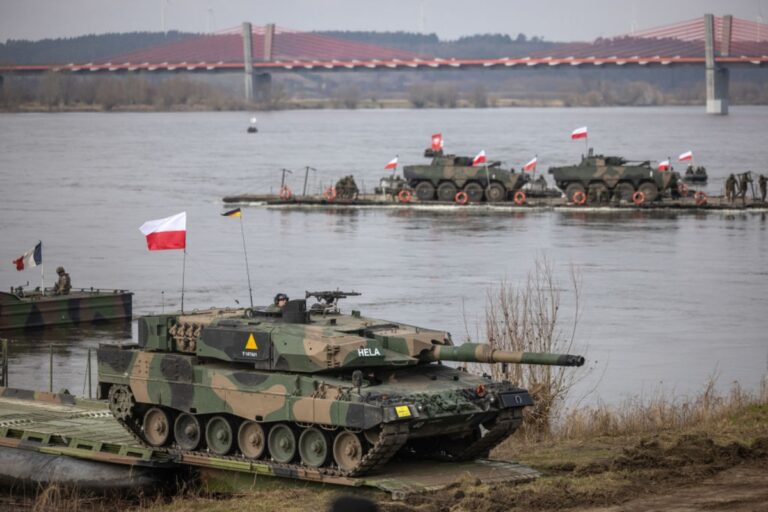
A Leopard 2A4 tank of the Polish armed forces arrives after crossing the Vistula river during the NATO DRAGON-24 military exercise in Korzeniewo, northern Poland, March 4, 2024. WOJTEK RADWANSKI/AFP via Getty Images
Austria’s Defense Minister Klaudia Tanner accepted the first fully modernized Leopard 2A4NV main battle tank and Ulan NV infantry fighting vehicle at a ceremony held at the Jansa Barracks in Großmittel on August 25, 2026 — and the technical engineering at the center of that handover has since become something more consequential than a single country’s procurement success. The upgrade methodology developed jointly by Austria and KNDS Deutschland has quietly become a standardized commercial offering that the Munich-based manufacturer is now marketing to other Leopard 2A4 operators, with potential demand reaching 300 tanks across the 22-plus-nation Leopard User Club.
The reason the Austrian approach is spreading is straightforward: it answers a question most Leopard 2A4 operators are quietly asking. The A4 was built between 1985 and 1992. Its hydraulic turret drives are a known fire hazard if ruptured under fire. Its first-generation WBG-X thermal imager — gunner’s sight only, no thermal for the commander, no thermal for the driver — has long since reached obsolescence, with spare parts effectively unavailable. And its electronics architecture predates the digital interconnect standards that make modern battlefield management systems work. But a full replacement with new Leopard 2A8-standard tanks costs roughly €21.6 million (approximately $25.2 million) per vehicle, as Lithuania’s €950 million deal for 44 tanks demonstrates. Austria found an answer that costs about €5.25 million (approximately $6.1 million) per vehicle: leave the hull, the gun, and the logistics chain exactly where they are, and replace everything inside that the enemy actually kills the crew with.
“A7 Internals, A4 Exterior”: How the Engineering Actually Works
The Leopard 2A4NV program is built around a specific engineering philosophy that KNDS personnel at the Großmittel ceremony described informally as “A7 inside, A4 outside.” Understanding what that means requires understanding where the A4 and A7 variants actually differ.
The Leopard 2A4 in its original configuration carries the 120mm L/44 smoothbore gun — still a competitive weapon, firing the same NATO-standard ammunition as the American M1 Abrams — but its fire-control electronics, its night-fighting systems, and its crew-safety architecture belong to the Cold War era. The turret is driven by hydraulic motors under high pressure. If a shaped-charge round punctures the hydraulic lines, the spraying fluid can ignite. The gunner’s thermal sight — the WBG-X first-generation device — gives the gunner a basic heat-map view of the battlefield, but only in narrowly limited conditions and without modern image resolution. The commander must rely on the gunner’s image or on optical periscopes for his independent situational awareness. The driver, at night, is effectively blind beyond what a white-light spotlight can reach, as Leopard 2 technical analysis has long documented.
The Leopard 2A7/A7V, introduced into Bundeswehr service from 2014 onward, addressed each of those gaps. Its commander’s station carries a PERI R17A3 stabilized panoramic periscope incorporating a Hensoldt ATTICA third-generation thermal imager — a 640-by-512-pixel Mercury Cadmium Telluride (MCT) focal-plane-array device operating in the longwave infrared spectrum (8–12 micrometers), optimized for European humid conditions. The gunner’s EMES 15A2 sight received the same ATTICA-GL thermal imager family. The driver received the SPECTUS II multispectral system, fusing thermal and low-light cameras for forward and rearward view. The hydraulic turret drives were replaced by Jenoptik electric motors. And all of these subsystems communicate over a CAN bus digital backbone — the military derivative of the Controller Area Network standard, specifically the MilCAN A higher-layer protocol developed for armored vehicle use — rather than through the analog wiring harnesses of the original A4. The full scope of those A7V upgrades is documented in detail in Bundeswehr introduction reporting.
The Austrian 2A4NV program takes the electronics and sensor suite of that A7-generation architecture and installs it inside the unchanged A4 hull and turret. The 120mm L/44 gun stays. The turret silhouette stays. The hull, the engine — the MTU MB 873 Ka-501 12-cylinder twin-turbocharged diesel producing 1,500 horsepower (1,119 kilowatts) — and the entire existing logistics chain stay. What changes is everything the crew interfaces with to survive and kill: new thermal imagers for all three crew positions restore night-fighting capability; electric turret drives replace the hydraulic fire hazard and give the fire-control computer direct digital command of gun traverse and elevation; and the CAN bus digital architecture replaces obsolete analog wiring, making the vehicle compatible with modern digital battlefield systems and enabling modular future upgrades without rewiring the entire vehicle. Full specifications for the A7-standard systems are documented at Army Technology’s Leopard 2A7 entry.
The result is a tank that weighs roughly what it always did — around 55,150 kilograms (approximately 121,600 lbs) in combat-ready configuration — rather than the 58,000-plus kilograms (approximately 127,900 lbs) of the A7V’s additional composite armor and active protection systems. What it does not get: the wedge-shaped spaced armor of the A5/A7 turret, the L/55 gun, or the Trophy active protection system. Austria evaluated a potential L44A1 gun upgrade from Rheinmetall, but as documented by Adria Defense’s program coverage, no decision to adopt it has been announced as of the ceremony.
The Ulan: A Parallel Life Extension in Vienna
The Ulan infantry fighting vehicle is receiving a structurally similar upgrade at a different facility. General Dynamics European Land Systems-Steyr (GDELS-Steyr), based in Vienna, is running the Ulan NV program — where NV, as with the Leopard, stands for Nutzungsdauerverlängerung, meaning “service life extension.” The program details and GDELS-Steyr’s role are covered in Defence Blog’s Ulan coverage.
The Ulan is based on the ASCOD (Austrian Spanish Co-operative Development) platform, jointly developed with Spain’s General Dynamics Santa Bárbara Sistemas subsidiary, which operates its version of the vehicle as the Pizarro. Austria’s 112 Ulans entered service between 2001 and 2004 to replace the aging Saurer 4K 4FA armored personnel carriers, and as of the Großmittel ceremony the upgrade program has been running at GDELS-Steyr for approximately three years. At any given time, 20 vehicles are at the Vienna facility simultaneously; three had already progressed to quality testing as of August 25, as Militär Aktuell’s ceremony coverage confirmed.
The Ulan work covers renewed optical systems, replacement of electronic components in the turret drive, electrical system renovation, and drivetrain component replacement. GDELS-Steyr Managing Director Martin Reischer emphasized at the ceremony that the program sustains significant Austrian industrial content — development, design, integration, production, and maintenance are conducted primarily within the country, supporting a supply chain of Austrian firms.
Why Four Times Cheaper Still Works: The Economics of Mid-Life Upgrades
The price differential between Austria’s upgrade approach and new-build procurement is stark enough to deserve specific technical explanation. A new Leopard 2A8 — Lithuania’s contract with KNDS covers 44 tanks for €950 million (approximately $1.1 billion), or roughly €21.6 million (approximately $25.2 million) per vehicle — comes with significant improvements the Austrian 2A4NV program explicitly does not include: the Rafael Trophy active protection system, improved frontal composite armor designed with lessons from Ukraine operations, the longer L/55A1 gun, and an auxiliary power unit allowing the tank to run its electronics silently without the main engine.
The Austrian upgrade path, at approximately €305 million (approximately $356 million) for 58 vehicles — or roughly €5.25 million (approximately $6.1 million) per tank — trades those additions for something specific: the ability to recapitalize the fleet’s most critical capability deficits without disrupting the logistics infrastructure that an army has spent decades building. The Doppeladler analysis of Austria’s contract confirms the 58-vehicle figure at €305 million. Every mechanic who already knows the A4’s engine and running gear, every spare part in the depot, every training course built around the L/44 gun — all of that remains valid. The upgrade is additive rather than replacement.
This matters especially for a constitutionally neutral nation like Austria, which is not a NATO member and therefore cannot rely on the alliance’s collective defense logistics for emergency sustainment. Maintaining a familiar and internally supportable logistics tail is not a secondary concern; it is the operational foundation on which any independent defense capability depends.
Austria’s Head Start and Its NATO-Scale Significance
Lieutenant General Harald Vodosek, Austria’s Chief of Defense Procurement, noted at the ceremony that his advocacy for preserving the mechanized forces began as early as 2015, when internal debate arose about whether Austria still needed heavy armored platforms at all. The formal decision to modernize both fleets was made in 2021 — based on an updated threat assessment — more than a year before Russia’s full-scale invasion of Ukraine began in February 2022. Contracts with KNDS and GDELS-Steyr were signed in December 2022, as Adria Defense’s program reporting confirms.
That early start produced an unexpected strategic benefit. When European defense demand surged after February 2022 and manufacturers’ order books filled rapidly, Austria had already secured capacity at KNDS’s Munich facility on favorable terms. According to Gerhard Greifenegger, Senior Vice President of KNDS Germany, the approach Austria developed in collaboration with KNDS has since evolved into a standardized program that the company now markets to other Leopard 2A4 operators — and the potential demand is substantial. Up to 300 additional Leopard 2 tanks from other operators could be modernized to this standard in coming years.
That 300-tank figure is worth examining in structural terms. European defense equipment inventories — despite a 14% surge in European defense spending to $864 billion in 2025 — were still below their 2021 levels as of a McKinsey analysis published in February 2026, because spending has not yet translated into delivered equipment at the required pace. The countries with the most Leopard 2A4 tanks in service — Poland (over 240 in inventory), Canada, Greece, Chile, and others — are exactly the operators facing this gap. An upgrade path that restores critical night-fighting and crew-safety capabilities at roughly one-quarter of new-build cost, without disrupting existing logistics systems, addresses a structural NATO problem rather than a single nation’s procurement preference.
What Other NATO Operators Are Watching
The Leopard User Club — the LEOBEN programme, a multinational framework covering more than 22 nations that collectively share training, simulation, spare parts procurement, maintenance planning, and combat systems modernization — means that the Austrian upgrade’s standardization has real operational weight for potential adopters. A nation that joins the Austrian upgrade standard inherits not just the technical solution but the shared logistics and training infrastructure that LEOBEN nations already share.
Vodosek noted that Austria’s early engagement with KNDS gave it influence over the technical specification that became the standard — a position that later adopters, arriving after demand had already surged, would not enjoy, as his Vodosek post-ceremony interview makes clear.
The broader European context frames the stakes. Global military spending reached $2.89 trillion in 2025, a record level, with European NATO members accounting for $864 billion — up 14% from 2024. At the NATO Hague Summit in June 2025, 31 member nations committed to a 3.5% of GDP defense spending target plus an additional 1.5% for security-related investment. As Breaking Defense’s SIPRI coverage notes, for a Western alliance under pressure to rebuild equipment inventories faster than new-build production can deliver, mid-life upgrades of this type are not a compromise — they are the most realistic near-term path to filling the gap.
Delivery Schedule: What Happens From Here
Austria’s planning documents identify 16 Leopard 2A4NV tanks for Panzerbataillon 14 (headquartered in Wels) and nine Ulan NV vehicles for Panzergrenadier Battalion 13 (Ried/Innkreis) and Panzergrenadier Battalion 35 (Großmittel) as among the armored systems scheduled to complete delivery during 2026, as Adria Defense’s delivery schedule reporting confirms.
The full program — covering all 58 Leopard 2A4NVs and all 112 Ulan NVs — is expected to run through approximately 2029 to 2030. The rolling delivery model, in which vehicles are transferred to upgrade facilities in batches while the remainder stay with operational units, is designed to ensure that training and readiness are maintained throughout. Vodosek acknowledged at the ceremony that technical modernization is only one dimension of the effort: infrastructure, training curricula, personnel structures, regulations, and maintenance logistics are all being updated in parallel to capture the full operational benefit of the upgraded systems, as his Großmittel ceremony remarks confirmed.
Austria has separately evaluated the Rheinmetall L44A1 as a potential gun upgrade for the fleet, but no decision to adopt it has been announced. The current KNDS contract leaves Austria’s tanks carrying the same 120mm L/44 weapon they have carried since entering service — a deliberate choice to maintain ammunition and training continuity, and one that leaves a potential future upgrade path open without committing to it prematurely.
How Austria Made the Case Internally
Defense Minister Tanner described the Großmittel ceremony as the beginning of a “new era” for the 4th Armored Infantry Brigade and the broader Bundesheer, but she was candid about what it took to get there. The internal debate about whether Austria even needed heavy armored forces was not resolved quickly or easily — and the €750 million-plus (approximately $875 million) total price tag for both programs demanded justification to a public accustomed to social spending as the default claim on that level of taxpayer commitment, as her Tanner ceremony address makes clear.
Her argument at the ceremony was structural: security and social stability are not in competition. National resilience requires a defense-industrial base that keeps high-technology manufacturing, apprenticeship programs, and engineering expertise within the country. The Ulan program at GDELS-Steyr — conducted almost entirely with Austrian labor, Austrian supply chains, and Austrian technical development capacity — is, in this framing, as much an industrial policy decision as it is a defense procurement decision.
Frequently Asked Questions
What is the “A7 inside, A4 outside” Leopard 2 upgrade approach?
It refers to a methodology developed by Austria and KNDS Deutschland that installs the electronics and sensor architecture of the more advanced Leopard 2A7 — third-generation thermal imagers for all three crew positions, a CAN bus digital backbone, and electric turret drives — into the unchanged hull and turret of the older Leopard 2A4. The tank’s external silhouette, its 120mm L/44 gun, and its entire logistics footprint remain identical to the original A4, which means existing spare parts, maintenance procedures, and ammunition stocks stay valid. The upgrade costs roughly one-quarter the price of purchasing a new Leopard 2A8.
Why does replacing hydraulic turret drives with electric motors matter for crew safety?
The original Leopard 2A4’s hydraulic turret drive system uses high-pressure hydraulic fluid to traverse and elevate the gun. If a shaped-charge warhead — the kind fired by anti-tank guided missiles or tank rounds — punctures the hydraulic lines, the fluid can spray and ignite, potentially killing or burning the crew from the inside. Electric turret drives eliminate that failure mode entirely, replacing the flammable fluid system with electric motors that present no ignition risk if penetrated. Electric drives also give the fire-control computer direct digital command of gun traverse and elevation, improving aiming precision particularly when the tank is moving.
Does Austria’s upgrade make the Leopard 2A4 equivalent to the Leopard 2A7 or A8?
No. The 2A4NV has A7-grade electronics and sensors, but it retains the A4’s hull armor — it does not receive the A5/A7’s wedge-shaped spaced armor package, the longer L/55A1 gun, the Trophy active protection system, or an auxiliary power unit. Austria deliberately chose not to include those elements to preserve logistics continuity and reduce cost. The upgrade addresses the most operationally critical gaps — night-fighting blindness, the hydraulic fire hazard, and digital obsolescence — without transforming the vehicle into a different configuration that would require new training, new ammunition, and a new support infrastructure.
Why might other NATO countries adopt the same upgrade standard Austria developed?
European defense equipment inventories remain below their 2021 levels despite a 14% surge in European defense spending in 2025, according to Stockholm International Peace Research Institute data published in April 2026. New-build Leopard 2A8 tanks cost roughly four times as much per vehicle as the Austrian upgrade approach. Countries like Poland, Canada, and Greece — which operate large fleets of Leopard 2A4s and face genuine capability gaps in night fighting and crew safety — can potentially close those gaps faster and at sustainable cost using the standardized KNDS program Austria helped design. KNDS has confirmed that up to 300 additional tanks from other operators could be modernized to this standard in coming years.