HomeAuto Australia’s Hottest Alpine Winter on Record Is Closing Six Ski Resorts Early
Australia’s Hottest Alpine Winter on Record Is Closing Six Ski Resorts Early
September 3, 2026:
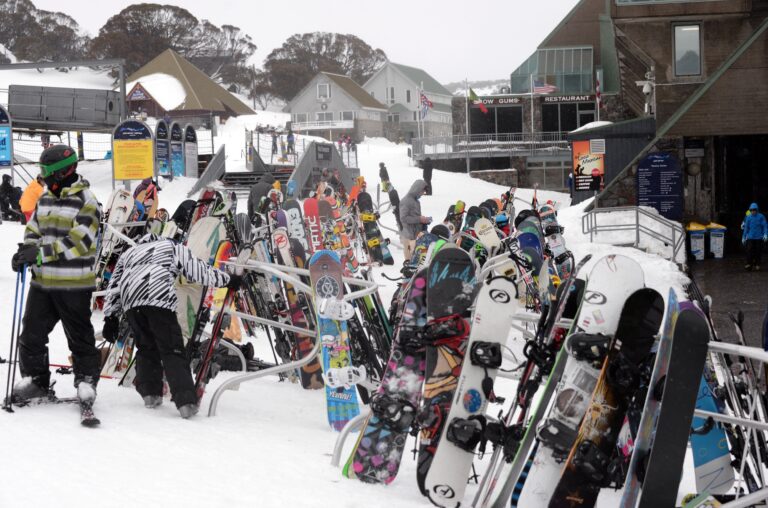
This picture taken on August 1, 2015 shows people getting ready to ski and snowboard at Perisher Valley located in the Snowy Mountains of southern New South Wales. Over the last 48 hours the peaks of the Snowy Mountains, also known as “The Snowies”, received over 70 centimetres of fresh snow across the four resort areas of Perisher Valley, Blue Cow, Smiggin Holes and Guthega. AFP PHOTO / Saeed KHAN SAEED KHAN/gettyimages.com
On the morning of September 3, Snowy Hydro measured just 12.3 inches (31.2 centimeters) of snow at Spencers Creek — Australia’s benchmark alpine monitoring site — against a 73-year average of 68.3 inches (173.4 centimeters) for this date, leaving the snowpack at just 18 percent of the long-term norm. That single figure effectively sealed the verdict on the 2026 Australian ski season. By Sunday, September 6, six Australian ski resorts are set to shut their lifts approximately one month ahead of the traditional October closing weekend — a near-simultaneous collapse with no modern precedent in the industry.
A Season That Never Got Going
The season’s problems arrived before the first chair spun. June was unseasonably warm and wet, and a striking statistic from the Perisher Valley weather station captures how hostile those opening weeks were: of the 11.9 inches (301 millimeters) of precipitation that fell between June 1 and July 2, just under 1 inch (25 millimeters) fell at temperatures below freezing. Rain, not snow, dominated Australia’s high country from the start.
A modest snowfall arrived in July and allowed a base to form on higher slopes, but the lower alpine zones never achieved full cover — an early signal that the season’s snowline had shifted upward. August brought no reprieve. Above-average temperatures and repeated rain-on-snow events stripped whatever had accumulated, and in the final days of the month, alpine maximum temperatures climbed above 41°F (10°C). On August 29, Perisher recorded an all-time winter maximum of 57.9°F (14.4°C).
The cumulative temperature records are historic by a margin that surprised veteran climate observers. Cabramurra — the longest-running Bureau of Meteorology station in the Australian alpine region — logged a winter mean of 39.2°F (4.0°C), well above its long-term average of 35.2°F (1.8°C) and nearly half a degree Celsius above the previous record set in 2023. Mount Buller similarly surpassed its previous record by almost half a degree Celsius, registering a seasonal mean of 35.4°F (1.9°C) against a long-term average of 32.2°F (0.1°C). Three warmer-than-normal months in succession made 2026 the hottest alpine winter on record — and by a clear margin.
The season’s peak snow depth — 37.2 inches (94.5 centimeters), recorded in mid-August — ranks as the third-lowest maximum in 73 years. In a normal year, snow is still accumulating at this point in the calendar, with the depth typically peaking in late August or early September.
Six Resorts Call Time
The cascade of closures began in mid-August. Selwyn Snow Resort in New South Wales shut on August 21 after heavy rain stripped its remaining cover. Selwyn general manager Abi Spackman described an early closure decision, noting conditions had made it impossible to recover the season. Mount Baw Baw in Victoria followed two days later, on August 23.
By September 3, four more resorts had confirmed they would follow. Falls Creek and Charlotte Pass announced closure dates of September 6 and September 5, respectively. Mount Hotham — which had originally planned to operate through October 4 and had received just over half its annual average snowfall — confirmed September 6 as its last day of operations. Mount Buller, which had been projecting an October close as recently as last month, set the same date, signing off with characteristic humor: “As we say at Mt Buller — that’s amore! Sunday will be our last day on snow.” Ticket proceeds from Buller’s final day, which falls on Father’s Day in Australia, will go to the Mansfield Men’s Shed.
By the time the lifts stop spinning on September 6, six of Australia’s best-known alpine resorts will have closed within approximately two and a half weeks — a near-simultaneous wind-down with no modern analogue in Australian skiing. Major resorts Perisher and Thredbo were, as of publication, projecting reduced-capacity operations into early October, though further rain forecast for this weekend may accelerate those closures too.
What Is Causing the 2026 Collapse?
Atmospheric scientists point to two overlapping drivers — one cyclical, one structural.
The first is El Niño, the well-documented Pacific climate cycle in which warming sea-surface temperatures in the central and eastern equatorial Pacific weaken the trade winds and reduce the flow of cold, moist air toward southeastern Australia. The Bureau of Meteorology officially declared an El Niño event on June 16. Historical Spencers Creek data shows that El Niño years typically deliver snowpack around 13.8 inches (35 centimeters) below the all-years average, with the productive ski season shortened by approximately two weeks.
The second driver is less well understood by the general public but is arguably more consequential for the long term: the Southern Annular Mode, or SAM — the belt of powerful westerly winds that encircles Antarctica at roughly 40°–65° south latitude. When SAM runs positive, those westerlies tighten toward Antarctica, deflecting the cold fronts that normally sweep snowfall into the Australian Alps away from the continent. In 2026, SAM has been persistently positive all season.
What makes the SAM pattern more alarming than El Niño alone is that it is no longer primarily cyclical. A peer-reviewed synthesis published in December 2025 in Nature Reviews Earth and Environment, led by Dr. Ariaan Purich of Monash University, found that the SAM hit a 1,000-year positive high — driven by ozone depletion and rising greenhouse gas concentrations. El Niño ends and reverses; the SAM’s structural drift does not. Future Australian alpine seasons will underperform historical averages even in neutral or La Niña years, not just El Niño years — because the underlying atmospheric plumbing that routes cold fronts to the Alps has shifted in a way that is not dependent on any single climate cycle.
Why Snowmaking Cannot Solve a Structural Problem
The ski industry’s response to the 2026 crisis illustrates the gap between what engineering can achieve and what the changing climate is demanding of it.
Josh Elliott, CEO of Snow Resorts Australia, pointed to the industry’s infrastructure investments as evidence of adaptability. “Continued investment in snowmaking and snow management has meant that skiing, snowboarding and snowplay have been available in NSW, Victoria and the ACT since the June long weekend,” he said. Modern all-weather snowmaking systems — the newest of which can produce snow at ambient temperatures of up to 68°F (20°C) — represent a genuine engineering achievement.
But the thermodynamics of snowmaking have hard limits. These systems rely on atomizing water into droplets fine enough to freeze before they land; when ambient temperatures rise well above freezing for extended periods, manufactured snow melts faster than it can be laid. Rain-on-snow events strip both natural and machine-made snow simultaneously, regardless of production rate. And the system’s water demand is enormous: at resort scale, snowmaking consumes millions of liters per day, meaning drought conditions create an additional constraint on how aggressively it can be deployed.
The 2026 season tested all three thresholds repeatedly and eventually exceeded them.
Elliott acknowledged that climate change projections exist but cautioned against applying them directly to resort operations: “While those projections may be relevant to understanding changes in the natural alpine environment, they are not forecasts of future skiable terrain, resort operating periods or the visitor experience.” Dr. Lily O’Neill, Board Director at Protect Our Winters (POW) Australia and Senior Research Fellow at Melbourne Climate Futures, offered the starker assessment: “Engineering our way through bad seasons is possible for now. Engineering our way through a permanently warmer climate is not.”
A 2025 POW Australia/ANU model found that the average Australian ski season will be 44 days shorter by 2050 under a mid-emissions pathway, and 55 days shorter under a high-emissions scenario. Critically, the modeling found that no Australian resort will have enough natural snow to sustain a 100-day season under those conditions — a threshold widely considered necessary for economic viability.
Are Australian Ski Resorts the World’s Most Vulnerable?
A 2024 study published in the journal Plos One by researchers at the University of Bayreuth in Germany examined projected snow cover loss across seven regions: the European Alps, Andes, Appalachian Mountains, Australian Alps, Japanese Alps, New Zealand’s Southern Alps, and the Rocky Mountains. Under a high-emissions scenario, average annual snow cover days at Australian Alps ski areas are projected to fall by 78 percent by 2071–2100 — a rate of decline greater than any other skiing region in the world. The Andes face a 43 percent decline; the European Alps 42 percent; the Rocky Mountains 23 percent.
Australia’s geographic situation amplifies its vulnerability: its alps are among the world’s lowest-elevation alpine zones and are positioned at the poleward edge of the cold-front track, meaning they sit precisely where warming’s effect on the rain-snow boundary is most pronounced.
Government investment has followed but not matched the scale of the problem. The Victorian state government’s 2026–27 budget allocated AUD $5 million (approximately $3.6 million USD) for resort water infrastructure upgrades at Mount Buller, Hotham, and Falls Creek. The New South Wales government directed AUD $130 million (approximately $93 million USD) into its national parks 2026–27 budget allocation. POW Australia argues both measures fall well short of addressing the structural driver.
What Happens to the Water That Should Be Snow
For most Australians, the alpine snowpack is an abstraction — a postcard from a distant mountainside. The consequences of its collapse are not.
The Australian Alps provide an average of 9,600 gigalitres of water per year to the Murray-Darling Basin — approximately 29 percent of annual flows, from an area that makes up less than 1 percent of the Basin’s total footprint. The Murray-Darling is widely described as Australia’s food bowl; the waterway system supports large portions of the nation’s irrigated agricultural output and supplies drinking water to communities across New South Wales, Victoria, South Australia, and the Australian Capital Territory.
The critical distinction between snowmelt and rainfall as water sources lies not just in volume but in timing. A healthy snowpack accumulates through winter and releases gradually through spring and early summer — a slow-drip delivery system that aligns naturally with the agricultural calendar and allows Snowy Hydro’s power generation schedule to be planned months in advance. When the same precipitation falls as rain instead, it runs off immediately in winter and autumn, arriving too early and too fast for either agriculture or hydropower to use optimally. A shrinking snowpack does not merely deliver less water; it delivers water at the wrong time.
CSIRO research documented that average annual precipitation in the Australian alpine zone has decreased by approximately 5.5 inches (140 millimeters) since 1950 — about 0.8 inches (20 millimeters) per decade — while temperatures have risen 2.5°F (1.4°C) over the same period. Combined, these shifts have pushed the snow-rain threshold upward in elevation with each passing decade, shrinking the zone of the Alps where precipitation reliably falls as snow.
The alpine ecosystem is registering the change in ways that reach well beyond hydrology. Research published in the journal Ecology and Evolution in April 2026 examined long-term population datasets spanning 19 to 43 years for small mammal species in Australian sub-alpine habitats. The study confirmed that populations of species reliant on the subnivean environment — the thermally stable space formed between the ground and the underside of a deep snowpack — decline measurably in years when the snowpack is shallow or transient. The mountain pygmy possum (Burramys parvus), a Critically Endangered species found only in Australia’s alpine zone, hibernates through winter and depends on an intact snowpack to maintain the near-freezing temperatures that make hibernation physiologically viable. In 2026, that insulating blanket largely failed to form.
The alpine region also carries deep cultural significance for First Nations peoples whose connection to the high country stretches back tens of thousands of years — a dimension of loss that research frameworks and economic assessments rarely capture, as POW Australia’s reporting has noted.
How Does the 2026 Damage Compare to the Long-Term Trend?
Decades of Spencers Creek data, analyzed by CSIRO and independent researchers, show that alpine snowfall has been declining at approximately 2.2 inches (5.5 centimeters) per decade since the 1950s. The numbers from individual sites illustrate the trajectory: between 1955 and 2000, the peak annual snow depth at Three Mile Dam — at 4,790 feet (1,460 meters) — averaged 21.7 inches (55 centimeters). Over the past 25 years, that figure has fallen to 13.4 inches (34 centimeters), a reduction of 38 percent. A few hundred meters higher at Mount Buller, the corresponding decline is 21 percent. Even at Spencers Creek, high on the Snowy Mountains at 6,004 feet (1,830 meters), peak depth has fallen 13 percent since the mid-twentieth century.
The 2026 season is the worst in 20 years and the fifth-poorest since records began in 1954. More telling is the clustering: three of the past four winters now qualify as “very lean,” a pattern researchers say reflects the underlying warming trend rather than natural variability.
Dr. O’Neill put the structural context directly: “El Niño is a natural cycle, but it is now performing on a climate stage made dangerously hot by coal, oil and gas projects.” The SAM research reinforces that framing: El Niño is amplifying a decline that will continue without it.
With heavy rain forecast for the weekend of September 6, there is little prospect that Perisher and Thredbo will reach their October targets. The season will end not with a powder day but with wet slopes and a closing gate swung shut a month too early.
The Spencers Creek gauge will be read again next September. Researchers note that the question is no longer whether the trend continues — the data make that answer plain — but whether Australia’s policy response will match the scale of what the data now demands.
Frequently Asked Questions
Why are six Australian ski resorts closing a month early in 2026?
Australia’s 2026 alpine winter combined two atmospheric drivers in the same season: an El Niño event that reduced cold-front frequency and rainfall in the high country, and an unusually persistent positive phase of the Southern Annular Mode (SAM), which deflected snow-bearing westerly fronts away from the Alps toward Antarctica. The result was the hottest three-month alpine period on record — confirmed across multiple Bureau of Meteorology stations — and a snowpack that peaked at just 37.2 inches (94.5 centimeters), the third-lowest maximum in 73 years. After repeated rain-on-snow events stripped the remaining cover through late August, six resorts had no remaining base to sustain operations. The season’s benchmark data is confirmed by Snowy Hydro’s monitoring at Spencers Creek.
How does the Australian Alps snowpack affect the Murray-Darling Basin’s water supply?
The Australian Alps funnel an average of 9,600 gigalitres of water per year into the Murray-Darling Basin — roughly 29 percent of Basin flows from an area covering less than 1 percent of the Basin’s footprint. Crucially, snowmelt releases this water gradually through spring and early summer, matching the agricultural calendar and enabling Snowy Hydro to schedule hydropower generation months ahead. When precipitation falls as rain rather than snow, it runs off immediately in winter, arriving too early and too fast for either farming or power-generation planning to use effectively. A contracting snowpack is not just a recreational loss — it is a water-security problem for communities and farms across southeastern Australia whose livelihoods depend on the timing as much as the volume of that spring flow. CSIRO’s research on alpine precipitation trends documents the scale of this long-term change.
Are Australian ski resorts more vulnerable to climate change than resorts in Europe or North America?
Yes, according to the most comprehensive global study available. Research published in Plos One in 2024 by a team at the University of Bayreuth, Germany, modeled projected snow cover across seven regions under a high-emissions scenario. Australian Alps ski areas face a projected 78 percent decline in annual snow cover days by 2071–2100 — the steepest rate of any region in the study. By contrast, the European Alps are projected to lose 42 percent and the Rocky Mountains 23 percent. Australia’s alps are among the world’s lowest-elevation alpine zones and sit at the edge of the Southern Ocean’s cold-front track, making them exceptionally sensitive to the upward shift in the rain-snow boundary that warming temperatures produce.
What can Australian ski resorts realistically do to adapt — and where does snowmaking reach its limits?
Modern all-weather snowmaking systems can now produce snow at ambient temperatures of up to 68°F (20°C), a genuine engineering achievement that has extended the viable season at major resorts. But snowmaking confronts hard physical limits: when ambient temperatures stay well above freezing for extended periods, manufactured snow melts faster than it can be produced; rain-on-snow events strip artificial cover simultaneously with natural snow; and the system’s enormous water demand creates supply constraints during drought conditions. The ANU and POW Australia modeling found that no Australian resort will be able to sustain a 100-day season on natural snow alone under a mid-emissions 2050 scenario, regardless of snowmaking investment. The industry’s own CEO, Josh Elliott, argues snowmaking technology will “mitigate” the impact without resolving the structural climate driver. Protect Our Winters researchers argue that the only mitigation that addresses the root cause is emissions reduction — not infrastructure investment, however sophisticated.