Ars Magica Definitive Edition Hits Retail: Open License Now Covers 40+ Sourcebooks

September 26, 2026:

Ars Magica Definitive Edition Hits Retail: Open License Now Covers 40+ Sourcebooks
Ars Magica Definitive Edition
Atlas-games.com

The Ars Magica Definitive Edition Set — one of tabletop RPG history’s most anticipated collector releases — has arrived at U.S. hobby retail, carrying with it a Creative Commons Attribution-ShareAlike 4.0 International license that renders the entire body of Ars Magica Fifth Edition sourcebooks permanently, irrevocably free for anyone to adapt, expand, and sell. That combination of retail availability and open license makes this week’s arrival more than a product launch: Atlas Games has handed the game’s future to the creator community in terms that cannot be undone.

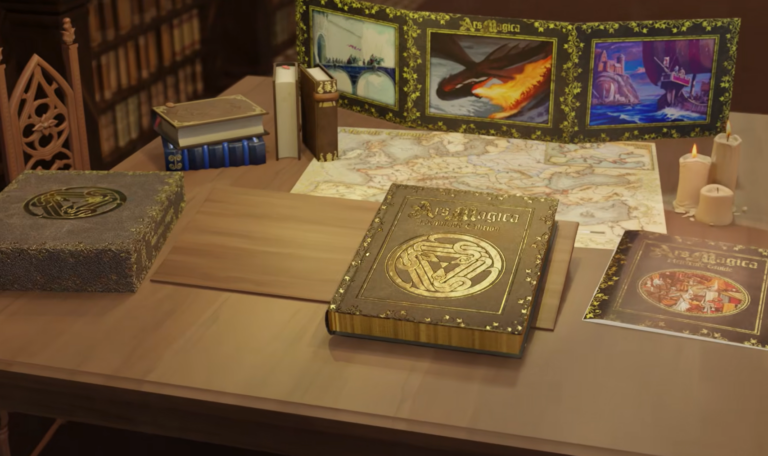
The boxed set, published by Atlas Games of Proctor, Minnesota, carries an MSRP of $159.95 and stock number AG0215. It arrives in a premium slipcover containing four items: the flagship Ars Magica Definitive Edition core rulebook, a Storyguide Screen, a 14-page Reference Guide booklet, and a full-color poster map of Mythic Europe. The centerpiece is the core rulebook — a gilded leatherette hardcover of more than 600 full-color pages, making it the largest and most complete version of the game ever published.

How a $15,000 Campaign Turned Into a $1 Million Mandate

The path to retail began in October 2024, when Atlas Games launched a crowdfunding campaign on BackerKit.com. The community response was immediate: the campaign reached its $15,000 goal in just three minutes. When the campaign closed on November 14, 2024, it had raised $1,076,696 from 5,485 backers — more than 71 times the original goal.

That result was not inevitable. In late 2024, Atlas Games warned backers that the retail phase of the project could be jeopardized if proposed tariffs of 60% to 100% on Chinese-manufactured goods were enacted — the Definitive Edition was printed by a partner in China, and retailer pricing requires a 50% wholesale discount from MSRP that leaves little room for a manufacturing cost that could effectively double. The crowdfunding margin turned out to be the buffer that absorbed the uncertainty. By April 2026, Atlas confirmed that mass production samples had passed inspection, and copies arrived at the company’s Duluth, Minnesota warehouse on August 14, 2026. The fact that a general retail run is now reaching hobby stores is a direct outcome of a crowdfunding campaign substantial enough to de-risk a print run that a standard retail distribution model might not have financed.

A Magic System That Changed the Industry

To understand why the Definitive Edition matters, it helps to understand what the Fifth Edition’s magic system actually does — and why it has been called the benchmark for RPG magic design for three decades.

Ars Magica‘s Hermetic Magic system is built on a grid of 15 Arts: five Techniques and ten Forms. The Techniques are Latin verbs — Creo (create), Intellego (perceive), Muto (transform), Perdo (destroy), and Rego (control). The Forms are Latin nouns — Animal, Auram (air), Aquam (water), Corpus (body), Herbam (plants), Ignem (fire), Imaginem (images and senses), Mentem (mind), Terram (earth and stone), and Vim (raw magical power). A mage’s skill is the sum of their scores in the applicable Technique and Form.

The result is a 5×10 combinatorial grid from which any magical effect can be derived: Rego Aquam controls water; Creo Ignem conjures fire; Perdo Mentem destroys memory. Rather than a fixed spell list, the system gives players a generative grammar of magic, producing Formulaic spells (scripted, written in texts, and learned through study) and Spontaneous spells (improvised on the fly from any Technique-Form combination the caster can articulate). This architecture — verb plus noun, each scored independently — is what game designers have called the benchmark for RPG magic systems since the game’s first edition in 1987.

The Definitive Edition is not a new edition of this system — it is the same Fifth Edition rules consolidated and expanded. What it adds is substantial: all errata corrections, all self-standing Virtues and Flaws from supplements, rules for Mythic Companions, all self-standing spell guidelines, Mystery Initiation rules for each Mystery Cult House, Laboratory personalization rules, Apprentice training rules, original research rules, and expanded supernatural creature examples. All of this material existed previously across more than 40 individual Fifth Edition sourcebooks — the Definitive Edition collects it under one leatherette cover, at more than twice the Fifth Edition core’s original page count.

Who Designed This Game — and Why It Matters

Ars Magica was first published in 1987 by Lion Rampant, designed by Tweet and Rein-Hagen. Both designers went on to reshape the broader industry in ways that are still felt today.

Tweet became lead designer of Dungeons and Dragons Third Edition, published by Wizards of the Coast in 2000. That edition introduced the d20 System and the Open Game License, which enabled the entire wave of third-party D&D publishing that defined the early 2000s hobby game market and, after the OGL crisis of 2023, prompted a new round of conversations about open licensing that the Ars Magica Definitive Edition now participates in. Rein-Hagen created Vampire: The Masquerade and the World of Darkness — arguably the second most influential line in the hobby’s history. Ars Magica was where both designers developed the storytelling mechanics, collaborative structures, and long-form campaign philosophy that those later games carried into the mainstream.

The game passed through several publishers — Lion Rampant, White Wolf, Wizards of the Coast — before arriving at Atlas Games, which published the Fourth Edition in 1996 and the Fifth Edition in 2004. The Fifth Edition won the Origins Award for Best Role Playing Game of 2004 and took the ENnie Award Gold for Best Rules and Silver for Best Production Values in 2005. John Nephew co-founded Atlas Games in 1990 specifically to produce Ars Magica adventures under license from Lion Rampant, before eventually acquiring the game outright from Wizards of the Coast.

The game is set in “Mythic Europe” — a historically grounded version of 13th-century Europe and the Levant in which the folklore and superstitions of the High Middle Ages are true in a literal, factual sense. Faeries steal children. Demons cause crop failures. The players take the roles of magi — members of the secretive Order of Hermes — supported by skilled companions and hired fighters called grogs. The game was also a pioneer of troupe-style play: a structure in which players rotate storytelling duties and each maintain multiple characters, reflecting the collaborative nature of a covenant of wizards rather than the traditional single-protagonist structure of most RPGs.

What Does “Open License” Actually Mean — and Why Now?

Perhaps the most consequential element of the Definitive Edition launch is what accompanied the retail box: a Creative Commons Attribution-ShareAlike 4.0 International (CC BY-SA 4.0) license covering the Ars Magica game system, the Mythic Europe setting, and the entire library of Fifth Edition sourcebooks. Selected Fourth Edition supplements are included as well.

The significance of CC BY-SA 4.0 is in its specific legal character. Unlike a publisher-controlled license that can be revoked or restructured — as Wizards of the Coast attempted with the OGL in January 2023 before community backlash reversed the move — the Creative Commons license is administered by the non-profit Creative Commons organization and is irrevocable. Any creator who builds on the licensed material today cannot have that permission taken away tomorrow, regardless of what happens to Atlas Games.

The “ShareAlike” clause adds a second layer: derivative works must themselves be released under CC BY-SA 4.0 or a compatible license. The Mythic Europe setting and Ars Magica mechanics cannot be used as the foundation for a proprietary, closed-license product — any adaptation stays open. Atlas Games effectively chose the most protective form of open license for the community’s long-term benefit rather than the least restrictive form that would maximize commercial reuse.

Line developer David Chart, who wrote the Fifth Edition text, stated at the time of the crowdfunding launch: “Their creativity will determine the game’s legacy, and it will be more than I can imagine.” That observation doubles as an explanation for why the timing is now: Atlas Games has finished its active commercial development of the line. The open license is not a marketing decision — it is a succession plan for a game the publisher considers complete.

What Is in the Box

For players coming to Ars Magica fresh or returning after time away, the Definitive Edition Set at $159.95 includes four items in a premium slipcover:

The core rulebook is the primary item — a 600+-page full-color hardcover bound in gilded leatherette, containing all Fifth Edition rules plus the expanded material described above. The Storyguide Screen is a three-panel reference screen for the game’s equivalent of the dungeon master; it is also available separately as a retail item for players who want a physical screen to pair with a digital edition of the book. The 14-page Reference Guide is a quick-reference booklet for rules lookups during active play without interrupting the session. The poster map of Mythic Europe is an 11-by-22-inch (28 by 56 centimeters) full-color cartographic spread of the game’s setting.

The set is rated for players 14 and up. The Definitive Edition rulebook is also available separately as a direct purchase through the Atlas Games web store.

Can You Play This Without Having Played Ars Magica Before?

Ars Magica‘s reputation for depth can be intimidating, and the Definitive Edition’s size does not make first contact easier. The BackerKit FAQ explicitly addresses this: Atlas recommends new players consider the standard Fifth Edition rulebook (shorter, same system) as an entry point before investing in the Definitive Edition set. The entire line of 40+ Fifth Edition sourcebooks remains available from Atlas Games, and because of the CC BY-SA 4.0 license, the full text of those books is now freely available online through community-hosted repositories. An entirely free path into the game now exists — the Definitive Edition Set is the premium physical collector experience for those who want it.


Frequently Asked Questions

What exactly does the Creative Commons license on Ars Magica allow creators to do?

The CC BY-SA 4.0 license permits anyone — including commercial publishers — to share, adapt, and build upon the licensed Ars Magica game system, the Mythic Europe setting, and all Fifth Edition sourcebooks, provided they attribute Atlas Games as the original creator and release their derivative works under the same CC BY-SA 4.0 license or a compatible open license. This means an independent designer can write, publish, and sell an Ars Magica sourcebook without any payment to or permission from Atlas Games. Importantly, this license is irrevocable: it cannot be withdrawn by Atlas Games or any future owner of the IP, meaning the game’s availability to creators is permanent regardless of what happens to the publisher.

How is the Definitive Edition different from just buying Ars Magica Fifth Edition?

The Fifth Edition core rulebook published in 2004 contained the base rules in roughly 240 pages. The Definitive Edition is the same foundational system — not a new edition or rules revision — but at more than twice the page count, incorporating decades of errata, rules from subsequent supplements (Virtues and Flaws, Mystery Initiations, Laboratory rules, Apprentice training, and more), all integrated into a single volume with new art and full-color production throughout. The Fifth Edition won the Origins Award for Best RPG in 2004; the Definitive Edition is the culmination of everything built on that foundation over the following 22 years.

Who designed Ars Magica, and what else have its creators worked on?

Ars Magica was co-designed by Jonathan Tweet and Mark Rein-Hagen and first published in 1987. Tweet went on to become lead designer of Dungeons and Dragons Third Edition (2000), whose d20 System and Open Game License shaped the hobby game market for more than a decade. Rein-Hagen created Vampire: The Masquerade and the World of Darkness, the foundational property for White Wolf Game Studio. The Fifth Edition text was written by David Chart, who served as line developer from 2004 through the Definitive Edition’s completion in 2026.

Is the Ars Magica Definitive Edition available digitally?

Yes. Digital editions of the Definitive Edition rulebook were made available through the Atlas Games web store and BackerKit pledge manager prior to the physical retail release. The CC BY-SA 4.0 license also means that community-hosted digital versions of the complete Fifth Edition library — including the Definitive Edition text — are now legally available through community repositories.

Source link