HomeAuto Ariane 6 Completes First Geostationary Mission, Carrying Europe Storm-Warning Satellite
Ariane 6 Completes First Geostationary Mission, Carrying Europe Storm-Warning Satellite
August 29, 2026:
Arianespace.com
Europe’s Ariane 6 rocket completed its most demanding mission to date on August 27, sending the MTG-I2 weather satellite to geostationary transfer orbit — the first time the rocket reached that destination — and confirming the vehicle’s full operational capability for the continent’s most strategically critical space programs. The satellite, which carries the first lightning-detection instrument ever flown on a European geostationary weather satellite, will give meteorologists the ability to track a dangerous thunderstorm from the earliest atmospheric instability through every lightning flash it produces, extending storm-warning lead times that could save lives across the continent.
Ariane 6’s Geostationary Milestone: Why This Delivery Matters
Geostationary transfer orbit is the standard destination for the largest, highest-value satellites — communications relays, Earth observation platforms, and the most sophisticated weather instruments — and it is a more demanding target than the low-Earth and polar orbits Ariane 6 had previously served. Reaching it requires the rocket’s upper stage to sustain multiple burns with precision, placing the satellite into an elliptical orbit whose highest point sits at roughly 36,000 km (22,369 miles) above the equator before the satellite uses its own propulsion to circularize into its final geostationary post. The full scope of that challenge becomes clear when comparing GTO to the lower-energy missions Ariane 6 had previously flown.
That profile is exactly what Ariane 5 spent its career doing — it was the workhorse of European GTO launch for more than 20 years — and it is the profile Ariane 6 was always built to inherit. Flight VA270’s clean execution of that profile, culminating in MTG-I2 separating from the upper stage 36 minutes after liftoff at an altitude of 2,778 km (1,726 miles), is the operational proof that the handover is complete.
“The success of the MTG-I2 mission, Ariane 6’s first launch to geostationary transfer orbit, marks a major milestone for the programme,” said David Cavaillolès, CEO of Arianespace, after the launch. He described it as “confirming the availability of a reliable, sovereign launch service aligned with Europe’s ambitions.”
How the Vinci Engine Makes Geostationary Delivery Possible
The technical achievement at the center of VA270 is Ariane 6’s upper-stage Vinci engine — a cryogenic expander-cycle engine that can restart up to five times in flight and delivers 180 kN of thrust. The expander-cycle design — in which heat drawn from cooling the combustion chamber drives the turbopumps, rather than a separate gas generator — gives the Vinci high reliability and the ability to reignite in microgravity, as described in the rocket’s technical documentation.
On VA270, the Vinci performed its burns without issue, a result that carries additional significance: the rocket’s July 2024 debut flight ended prematurely when an auxiliary propulsion unit — a small thruster used to settle propellant before Vinci restarts — failed to reignite on its third attempt, stranding two re-entry capsules and leaving the upper stage in an unintended orbit. The issue was an auxiliary system failure, not a Vinci failure, and all subsequent flights have performed nominally. VA270 is the definitive confirmation that the engineering correction held even under the added demands of a GTO profile.
Christophe Bruneau, CEO of ArianeGroup, called the result “another milestone in the ramp-up of Ariane 6 — the fastest ever achieved for a heavy-lift launcher.”
What MTG-I2 Actually Does: Scanning, Sounding, and Striking
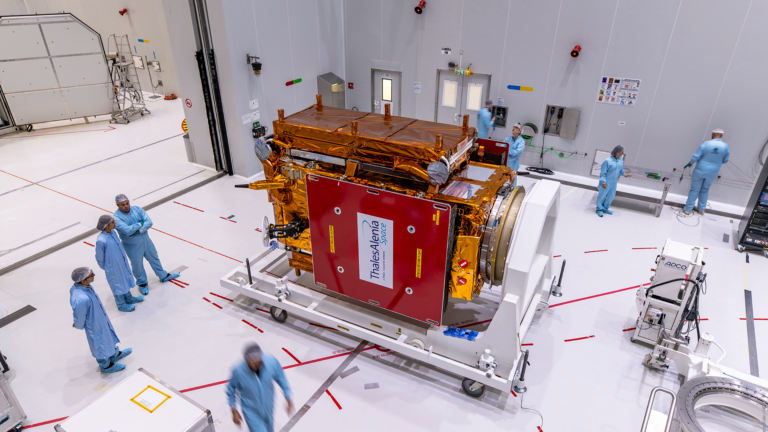
MTG-I2, formally designated Meteosat-14, is the second imaging satellite in the Meteosat Third Generation constellation operated by EUMETSAT, the European Organisation for the Exploitation of Meteorological Satellites. Weighing approximately 3,800 kg (8,378 lbs), the spacecraft was built by a European industrial consortium led by prime contractor Thales Alenia Space, with OHB System (Germany) and Leonardo (Italy) as principal partners.
Two instruments define its scientific mission. The Flexible Combined Imager (FCI) scans the full visible Earth disk every 10 minutes and delivers a rapid-scan service over Europe and North Africa every 2.5 minutes — a cadence that is the key to tracking fast-moving convective systems, overshooting cloud tops, and developing flood-producing precipitation. That 2.5-minute interval is particularly significant for overshooting tops, which are cloud formations that indicate severe convective updrafts and can warn of imminent hail, damaging winds, or flash flooding, but which currently elude reliable satellite tracking because they develop too quickly for older systems to capture.
The second instrument, the Lightning Imager, is the first of its kind on a European geostationary weather satellite, and it is where the most consequential scientific leap resides. Operating continuously from its vantage point 36,000 km (22,369 miles) above the equator, it detects all forms of lightning — cloud-to-cloud, cloud-to-ground, and intra-cloud — across more than 80% of Earth’s surface visible from its orbital slot. The Imager was built by Leonardo and uses four cameras covering Europe, Africa, the Middle East, and parts of South America.
Lightning Data and the Storm Warning Gap Europe Is Now Closing
For decades, European geostationary weather satellites — unlike their American GOES counterparts — could not detect lightning from orbit. The GOES satellites, operated by the US National Oceanic and Atmospheric Administration, have carried Geostationary Lightning Mapper instruments since GOES-16 entered service in 2017, giving American forecasters real-time visibility of lightning initiation and intensification as an early indicator of severe convective development. The MTG constellation is the first European geostationary system with this capability.
The MTG Lightning Imager closes that gap. Severe thunderstorms are reliably preceded by sharp increases in lightning activity, sometimes by 20 minutes or more before the storm reaches its most dangerous phase. Geostationary detection of those changes — continuous, global, requiring no ground sensor networks to fill coverage gaps — gives meteorologists a proxy for storm intensity that has no equivalent in prior European satellite capability. Forecasters using MTG data will, for the first time, be able to track the full storm lifecycle from initial atmospheric instability through its lightning phase, substantially improving nowcasting — the very short-range (0–6 hour) forecasting discipline on which aviation safety, emergency services, and public warning systems most directly depend. The scientific value of this capability for European meteorology cannot be overstated.
Europe’s Three-Satellite MTG Constellation Is Now Complete
MTG-I2 joins two satellites already in orbit: MTG-I1 (designated Meteosat-12), the first imaging satellite, launched on Ariane 5 in December 2022 and now fully operational, and MTG-S1, a “sounder” satellite launched in July 2025 that uses an infrared instrument to profile the chemical composition and temperature structure of different atmospheric layers — the data backbone for numerical weather prediction models. Together, the three-satellite first family represents what EUMETSAT describes as “the most powerful weather constellation in the world” for geostationary meteorological coverage.
The system works as an integrated ensemble. The two MTG-I imaging satellites divide responsibilities: one scans the full Earth disk every 10 minutes while the other concentrates on European rapid-scan service at the 2.5-minute cadence, a coordination that maximizes both global coverage and the high-frequency local monitoring that nowcasting demands. MTG-I2 will now enter a commissioning phase — calibrating its instruments and validating data quality against known meteorological conditions — before entering operational service.
How Does Ariane 6 Compare to SpaceX Falcon 9 at This Destination?
The GTO milestone also resets the competitive positioning of Ariane 6 within the commercial launch market. In its two-booster Ariane 62 configuration — used for VA270 — the rocket can deliver up to 4,500 kg (9,921 lbs) to GTO. In its four-booster Ariane 64 configuration, that capacity rises to 11,500 kg (25,353 lbs).
For comparison, SpaceX’s Falcon 9 in its expendable (single-use) configuration delivers approximately 8,300 kg (18,298 lbs) to GTO — but SpaceX routinely recovers and reuses Falcon 9 first stages, a practice that has substantially reduced its effective cost per kilogram. Ariane 6 is expendable in design, which means each mission requires a new rocket. ESA member states have acknowledged this structural cost gap and agreed to subsidize the program by up to €340 million per year (approximately $377 million per year at current exchange rates) between flights 16 and 42, in exchange for an 11% launch discount. The rocket’s developers argue that the 40% reduction in cost per kilogram versus Ariane 5 validates the program’s commercial trajectory, even as critics have argued that the absence of a reusability roadmap leaves Ariane 6 structurally exposed to Falcon 9 pricing over the long term.
What Ariane 6’s GTO Success Means for European Space Strategy
Beyond the weather mission itself, VA270 carries political weight that is difficult to overstate. Europe spent most of 2022 and 2023 in a launch-access crisis: Russia pulled its Soyuz rockets from Kourou following the invasion of Ukraine, Ariane 5 retired after 117 flights, Ariane 6 was not yet operational, and Vega C experienced a mission failure. That period forced ESA to buy launches from SpaceX for satellites it could not afford to wait on — a situation that European space policy officials described as untenable for the continent’s strategic independence.
Ariane 6, flight by flight, has been rebuilding that position. The nine launches logged to date span reconnaissance satellites for the French Ministry of Defence, Galileo navigation system satellites, Sentinel Earth observation satellites for the Copernicus programme, Amazon broadband satellites, and now Europe’s most sophisticated meteorological payload. VA270, the first GTO mission, is the most strategically significant of those flights because geostationary orbit is where the most critical institutional payloads — weather, communications, reconnaissance — spend their operational lives.
With the four-booster Ariane 64 variant already operational since February 2026, delivering up to 32 Amazon broadband satellites per flight, and the enhanced P160C solid-fuel boosters introduced earlier this year, the rocket’s increasing launch cadence targeting up to eight missions in 2026 and ten annually by 2027 is trending toward the schedule ESA needs to make the program financially viable. For European weather forecasters, the signal from VA270 is one of capability delivered. For European space strategists, it is one of autonomy restored.
Frequently Asked Questions
What is geostationary orbit, and why does it require more from Ariane 6 than previous missions?
Geostationary orbit sits at approximately 36,000 km (22,369 miles) above the equator — high enough that a satellite takes exactly 24 hours to complete one orbit, so it appears to hover over a fixed spot on Earth. Reaching it via geostationary transfer orbit requires the rocket’s upper stage to perform multiple burns delivering much higher energy per kilogram than low-Earth orbit missions. Ariane 6’s predecessor flights went primarily to low-Earth and polar orbits. VA270’s clean delivery to geostationary transfer orbit is the first confirmation that Ariane 6 can handle the most energy-demanding missions — the same class of launches that defined Ariane 5’s commercial and institutional career.
How will MTG-I2’s Lightning Imager actually improve storm warnings for people in Europe?
Severe thunderstorms — the kind that produce flash flooding, large hail, and dangerous lightning strikes — reliably generate a surge in lightning activity before they reach their most destructive phase. By detecting every lightning flash across Europe, Africa, and the Mediterranean from geostationary orbit, the MTG Lightning Imager gives forecasters a real-time indicator of storm intensification that ground-based sensor networks cannot replicate continuously. This capability — standard in US GOES satellites since 2017 but previously absent from European geostationary platforms — could extend effective warning lead times by 20 minutes or more for the most dangerous convective events, giving emergency managers, aviation controllers, and the public earlier notice to act.
What does “commissioning phase” mean, and when will MTG-I2 start producing operational weather data?
After arriving at geostationary orbit, a satellite undergoes a commissioning phase in which its instruments are switched on, calibrated against known sources, and validated before their data is fed into operational forecasting systems. For MTG-I1 (now Meteosat-12), the commissioning phase took approximately 12 months from its December 2022 launch before operational service began in 2024. MTG-I2 will likely follow a similar schedule, with operational imagery reaching national meteorological services in approximately a year — though EUMETSAT has not yet announced a specific operational service date.
Is Ariane 6 competitive with SpaceX Falcon 9 for geostationary launches?
Directly, in cost terms, the gap is significant: Ariane 6 is expendable, meaning each flight requires a new rocket, while SpaceX routinely recovers and reuses Falcon 9 boosters, substantially lowering its effective launch cost. ESA member states address this structural disadvantage by subsidizing the Ariane 6 program — up to €340 million per year (approximately $377 million USD) through the program’s ramp-up phase. For European institutional missions that require launches on a European vehicle for strategic and regulatory reasons, Ariane 6 is the only option; for commercial customers, the pricing gap with Falcon 9 remains a real competitive challenge that the Ariane 6 program has yet to fully resolve.