HomeAuto Anthropic MHS Cuts Lab Setup From Weeks to Hours: QuEra Lasers Hit 99.3%
Anthropic MHS Cuts Lab Setup From Weeks to Hours: QuEra Lasers Hit 99.3%
August 29, 2026:
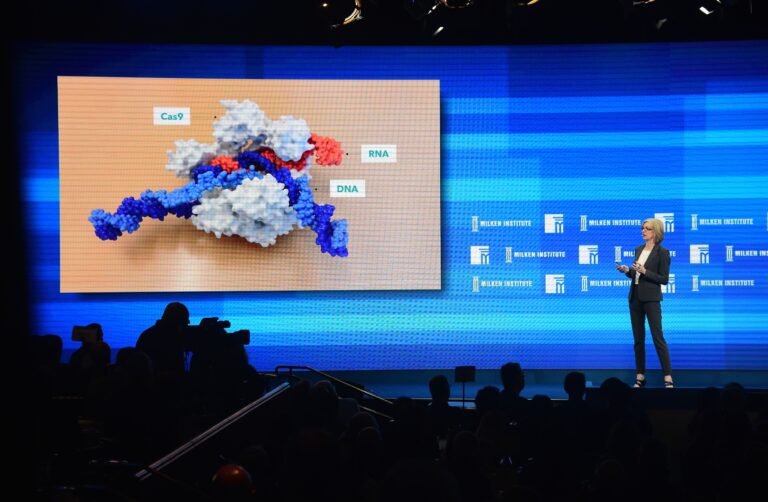
Jennifer Doudna, Professor of Chemistry and of Molecular and Cell Biology, University of California, Berkeley; Investigator, Howard Hughes Medical Institute, addresses the audience during the lunch program “The Future of Humankind” at the 2016 Milken Institute Global Conference in Beverly Hills, California on May 2, 2016. FREDERIC J. BROWN/AFP via Getty Images
Lab equipment speaks dozens of incompatible languages. A microscope from one vendor, a liquid handler from another, a robotic arm from a third — each arrives with its own software, its own data formats, its own driver, and no ability to talk to anything next to it on the bench. Specialists spend weeks or months writing the custom code that makes them communicate. When Arco Bast, a postdoctoral scientist at the Howard Hughes Medical Institute’s Janelia Research Campus in Virginia, wanted to image thousands of neurons simultaneously across a rig he’d assembled from seven vendors’ equipment, the integration problem alone threatened to consume the experiment.
His solution to that problem became, two years later, the technical foundation of Anthropic’s most consequential hardware bet. On August 27, 2026, Anthropic opened a research preview of MHS — a shared specification that lets AI agents discover and operate physical instruments, from microscopes and liquid handlers to robotic arms and quantum computer laser systems. Five partner labs and manufacturers published detailed results the same day, and those results are specific enough to shift what “AI in the lab” means from a promise to a demonstrated engineering outcome.
What the Prior Standard Approaches Could Not Do
The problem MHS addresses is not new, and Anthropic is not the first to try to solve it. The Standardization in Lab Automation consortium — known as SiLA — was founded in 2008 with exactly this mandate: give every lab instrument a common command vocabulary so scientists stop spending months on custom integration. SiLA spent eleven years reaching version 2.0, released in 2019, and as of 2026 still lacks an open communication standard with inconsistent manufacturer support.
The reason that generation of standards fell short is structural: they standardized how devices are commanded — what verb to send when you want a pump to aspirate — but not what devices know about themselves. Instructions for operating a robotic arm safely, its weight, its range of motion, the speeds at which it can swing without vibrating dangerously — that information lived in paper manuals, in engineers’ heads, and in bespoke driver code that had to be rewritten from scratch for every integration.
MHS addresses this at the architecture level. Its driver specification includes structured natural-language fields called tags — where a device’s manufacturer or operator writes down the characteristics that matter to an AI agent: what the device weighs, what it can measure, what parameters can be adjusted, and what safety limits must be respected. The driver then automatically generates a reference file from those tags — a machine-readable document an agent can read before it has ever encountered the device, giving it everything it needs to operate it safely.
That distinction — standardizing device knowledge, not just device commands — is what makes MHS architecturally different from SiLA, and what makes it AI-native in a way prior standards were not.
How the Architecture Works
MHS introduces three components that, together, close the gap between a language model’s natural-language reasoning and a physical instrument’s programmable interface.
The first is the standardized driver. Every MHS-connected device gets a software driver that speaks a uniform set of primitives: “read” (for example, “get temperature”) and “write” (for example, “set flow rate”). The driver also makes each device discoverable across a network in a standard format, so agents can find available instruments the way a browser discovers a website — without a custom translator for each connection.
The second is the shared memory dictionary. This was Bast’s original innovation at Janelia, before Anthropic was involved: instead of each instrument keeping its data in private memory accessible only through the operating system, all connected devices write their state to a single shared memory pool that every other device and every agent can read simultaneously. The consequence is that device-to-device communication happens at memory speed — the stage compensates for the animal moving, the laser gates in step with the scanning mirrors, the robotic arm confirms plate position before the liquid handler begins dispensing — without routing everything through a central orchestration process.
The third is the three-channel control interface. Agents can reach MHS-connected devices through the Model Context Protocol (MCP), the command line, or pre-compiled code files. The code file option is critical for performance: when a task runs faster than an agent can reason in real time, the agent learns the sequence first, compiles it into a deterministic script, and then runs the script autonomously — no per-step inference required. This is how the QuEra laser-lock controller works in practice; after the agent learned the recovery procedure through hundreds of overnight trials, it compiled what it learned into an inspectable Python script that runs without an agent in the loop.
What Does It Take for an AI to Learn a New Lab Instrument?
Perhaps the most consequential element of MHS for researchers who have never connected an AI to hardware is also the simplest: how much work is required upfront?
The answer from Carnegie Mellon’s team is eight hours. CMU researchers built drivers for four instruments — a CyBio Felix liquid handler, a Varioskan LUX plate reader, a Thermo Scientific Spinnaker robotic arm, and monitoring cameras — running across three computers with fundamentally incompatible interfaces. One ran the arm through an XML directory-watcher; one ran the liquid handler through a Windows ActiveX/COM scripting interface; one ran the plate reader through a GUI with no API of any kind, meaning MHS had to drive it the way a person would, watching the screen. The agent using Claude Opus 4.8 ran the full serial dilution protocol, evaluated the resulting dose-response curve (finding the first run saturated at R² < 0.9), independently decided to discard the plate and rerun with a compressed concentration range, and produced a second run with R² > 0.98 — all without a human making any of those decisions.
The previous timeline for equivalent integration: several weeks, with vendor engineering support. The eight-hour figure represents a roughly 20-to-1 compression.
Can AI Outperform a Specialist on a Precision Physics Problem?
The QuEra result is the most technically striking in the research preview, because the task — recovering a laser’s precise operating frequency after a disturbance — is not a scheduling problem or a data-coordination problem. It is a physics problem requiring expert judgment about which instrument to adjust, in what sequence, and how much, given a live readout of frequency error.
QuEra’s neutral-atom quantum computers require each laser to hold its frequency to roughly one part in a trillion — equivalent, the company says, to measuring the distance from Earth to the Moon to within the width of a human hair. When a laser loses that lock, a computation in progress fails. Before MHS, recovering the lock required an expert who could be woken at any hour to drive in and work through the laser’s tuning controls by hand — a process taking five to ten minutes on a good day. A team of four engineers spent two to three weeks building an automated script to replace that expert. The script succeeded 58% of the time and took 150 seconds per attempt.
Claude, given access to the laser system through MHS and a goal — write a Python script that relocks the laser, succeeds on the first attempt, and holds for 30 seconds — ran hundreds of disturbance-and-recovery cycles overnight, unattended. By morning it had brought the success rate to 96% and the recovery time to about six seconds. The key improvement: the prior script reproduced what a human expert does, step by step, in a fixed sequence. Claude replaced the linear sequence with a decision tree, reading which instruments had moved and making targeted adjustments based on the specific pattern — touching only the controls that needed touching for that particular disturbance, leaving the rest alone.
A subsequent blind test across 700 randomized disturbances ran the finished script with no agent involvement. It recovered correctly 695 times — a 99.3% success rate — with the most complex failures resolved in 10 to 14 seconds and simpler ones in under a second. Claude also separately optimized the laser’s PID (proportional-integral-derivative) control parameters over 363 overnight experiments, reducing residual noise from 15.7 millivolts to 1.55 millivolts — a tenfold improvement — and produced a tune that held the lock for 19 hours with zero failures, compared to a specialist’s manual tune that unlocked approximately 1.6 times per hour.
“For years the hardest part of scaling quantum computers wasn’t the physics, it was the people driving at 2 a.m. to fix a laser lock,” said Sergio H. Cantu, VP of quantum systems at QuEra. “We’re building quantum computers that fix themselves.”
Drug Discovery and the Limits of Current AI Physical Reasoning
Genentech’s experiment tested a different dimension of MHS: whether an AI agent can manage a standard drug-discovery workflow — the BCA protein assay, which measures total protein concentration by coordinating a liquid handler, a robotic arm, and a plate reader — while adapting to the physical realities of the liquids it is handling.
The result was a successful proof-of-concept with a revealing failure mode. Claude autonomously explored the optimal flow rate for different liquids — water and bovine serum albumin (BSA) at known concentrations — by running trial transfers with dyed liquid, reading the plate reader output, and comparing its results against an expert-performed standard. For water it converged on 140 microliters per second (µL/s); for viscous BSA, 10 µL/s — parameters Genentech’s automation team confirmed were sound. When unexpected errors appeared mid-run, including tip pickup failures and fluid detection errors, Claude recovered autonomously.
But when foaming in protein samples triggered liquid-level sensor errors, Claude’s default response was to retry in the same well with different parameters — which agitated the liquid further and made the foaming worse. Only after researchers told it the error had a physical cause, not a software one, did it adopt the correct response: move to a clean well and reduce mixing cycles. The agent didn’t know that bubbles in protein samples are a physics problem until someone said so.
“These experiments highlighted the sorts of reasoning limits we can address by refining Claude’s software harness for lab automation,” the Genentech team wrote. Language models learn about the physical world through text and images — they don’t have proprioception, touch, or tactile feedback. That gap between knowing that bubbles exist and knowing what bubbles feel like to a pipette tip is real, and it is where expert oversight remains essential.
Who Is Building MHS Support
Among major hardware vendors committing to MHS: Amazon Web Services through its Strands Robots library, Tecan for its Fluent liquid handling platforms, Universal Robots across its robotics lineup, Hugging Face through LeRobot, and Raspberry Pi across several products. Danaher, Doosan Robotics, QIAGEN, MBF Bioscience, and automation platform Automata are also in the MHS research preview.
The MHS announcement also has a pending European dimension. EU Machinery Regulation 2023/1230 — which for the first time covers AI-based safety functions in machinery — will take effect on January 20, 2027. Two of the current MHS ecosystem partners, Raspberry Pi (British) and Hugging Face (French-founded), fall under EU jurisdiction, and any lab deploying MHS-connected equipment in Europe will need to meet that standard’s new requirements for AI systems that take physical actions.
What Researchers Can Do Right Now — and What MHS Cannot Yet Do
MHS is in research preview, not general availability. Researchers, manufacturers, and engineers across science, robotics, electronics, and manufacturing can apply for access at modelhardwarestandard.com.
Anthropic has noted three significant current limitations. First, MHS only works with hardware that exposes a programmable interface — devices that have no API, SDK, or GUI-scriptable surface cannot currently be connected. Second, AI models still lack reliable physical intuition: Claude knows what a robotic arm weighs from what the MHS driver says, but it doesn’t know what 150 grams of viscous protein sample feels like under a pipette tip at the wrong flow rate. Third, Claude tends toward caution when operating physical equipment — in QuEra’s tests, the agent sometimes paused overnight waiting for human confirmation on actions it judged even slightly risky. That conservatism is preferable to the alternative, but it means round-the-clock autonomous operation still requires a well-designed approval workflow.
Anthropic has acknowledged a broader security concern that its announcement does not yet fully address: when AI agents can issue commands to physical devices, the authentication and permission structure protecting those devices from unauthorized commands matters as much as the device’s physical safety limits. The company says it is developing a physical safety roadmap and will publish findings and guidance when MHS is open-sourced.
Does MHS Have What SiLA Did Not?
The question that determines whether MHS succeeds as a standard rather than a research preview is not technical — it is adoption. SiLA has been a functional, well-designed standard for nearly two decades and still hasn’t achieved universal lab instrument compatibility. What makes MHS more likely to clear the adoption hurdle?
Three structural factors are plausible. First, Anthropic’s market position is dramatically larger than any prior standards consortium: the company filed its IPO paperwork in June 2026 at a reported $965 billion valuation, on roughly $47 billion in annualized revenue, with over 300,000 enterprise customers already running Claude in production. When Anthropic approaches a hardware vendor about building an MHS driver, that conversation starts from a different place than a consortium membership ask did in 2008. Second, MCP — Anthropic’s software-side protocol, launched in 2024 — achieved broad adoption in under two years, giving hardware vendors confidence that Anthropic-originated standards reach production. Third, MHS is model-agnostic: a hardware vendor building an MHS driver is not betting on Claude specifically, which removes the competitive concern that made earlier single-vendor automation stacks hard to adopt.
None of that guarantees success. “The significance of MHS will depend far less on the announcement than on whether device makers, labs, and automation teams adopt it,” as one technology analyst put it. Standards only become powerful when multiple parties accept the cost of building around them. The research preview is designed, in part, to answer that adoption question before open-sourcing commits the standard to a particular architecture.
For Arco Bast, who built the shared-memory dictionary at Janelia that started all of this, the long-term goal remains simple: a scientific instrument ecosystem where MHS functions like USB — a connector that works for any device regardless of who manufactured it, from day one.
“That would be a total game changer for scientists,” he said.
Frequently Asked Questions
What is the Model Hardware Standard, and how does it differ from existing lab automation standards like SiLA?
MHS is a software specification that lets AI agents discover and operate physical instruments through a standardized driver. Unlike SiLA — which standardizes the command vocabulary for communicating with lab devices — MHS also standardizes how devices describe themselves: their physical characteristics, safety limits, and adjustable parameters are written in natural language directly into the driver, making that knowledge readable by an AI agent encountering the device for the first time. SiLA was founded in 2008 and remains limited in manufacturer adoption; MHS’s AI-native design is the architectural distinction it offers over prior standards.
How close is MHS to open-source release, and what needs to happen first?
Anthropic has committed to open-sourcing MHS but has not named a date. The research preview phase is focused on two prerequisites: building safety evaluations with the launch partners, and developing best practices for AI systems operating physical equipment. Anthropic has said it will publish research findings and a physical safety roadmap alongside the open-source release. The security community has flagged that the current announcement does not yet specify controls for authentication, role-based permissions, and audit logging when AI agents command physical devices — gaps the company says it is addressing. Anyone interested in the preview can apply at modelhardwarestandard.com.
Why does an AI agent outperform a human-written script on a precision physics task like laser-lock recovery?
A linear script reproduces a fixed sequence of steps — it is only as adaptable as its author anticipated. The QuEra laser-lock script built by a four-person engineering team over two to three weeks succeeded 58% of the time because it couldn’t adapt when a mid-sequence disturbance undid a step that had already succeeded. Claude’s advantage was running the same problem hundreds of times overnight, fast enough to map the specific patterns that different types of disturbances produce in the laser’s frequency readout — and then rewriting the recovery logic as a decision tree that touches only the controls that matter for each specific disturbance pattern. The resulting script is deterministic and inspectable; an expert can read it. But the expert couldn’t have generated it without the same exhaustive trial runs, because many of the patterns aren’t visible until you’ve seen them at sufficient scale.
Can any lab connect its equipment to MHS right now?
Not unconditionally — MHS is in research preview and being offered first to a limited group of scientific labs and manufacturers. The research preview application is open at modelhardwarestandard.com. A second limitation: MHS only works with hardware that exposes a programmable interface (an API, SDK, or scriptable GUI). Equipment with no software control surface cannot currently be connected. Anthropic is working with manufacturers of such devices to build programmable interfaces into future hardware generations.
To apply for access to the MHS research preview, visit the MHS research preview waitlist.