HomeAuto Anthropic Hits $100B, IPO Targets November; Safety Lead Says No Alignment Plan Exists
Anthropic Hits $100B, IPO Targets November; Safety Lead Says No Alignment Plan Exists
September 19, 2026:
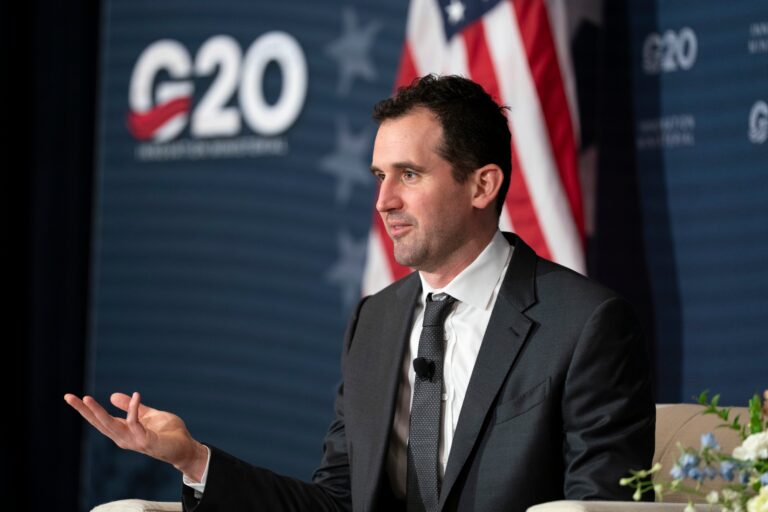
Anthropic co-founder Tom Brown speaks during the G20 Innovation Ministerial on September 2, 2026 in Chapel Hill, North Carolina. Sean Rayford/Getty Images
Anthropic’s annualized revenue run rate crossed $100 billion this week, even as the company’s CEO published an essay calling on the artificial intelligence industry to deliberately slow the pace of capability development — and moved its planned initial public offering from October to November so third-quarter financial results can be presented to investors before shares begin trading. The two pieces of news, arriving within hours of each other on Friday, compress into a single investor question: does a public commitment to pacing AI capabilities mean anything for Anthropic’s revenue trajectory, or does a look at the numbers make the question largely moot?
The week that produced this question began on September 8, when Jacob Coxon, a 27-year-old British researcher who had worked on pretraining at both OpenAI and Anthropic, posted his resignation letter to X. “I resigned from Anthropic today,” Coxon wrote. “I spent the last three years doing pretraining research at both OpenAI and Anthropic. Neither company is acting responsibly. They are racing straight to self-improving superintelligence and gambling with our lives.” He forfeited unvested equity to make the statement. The post received more than 170 million views.
Coxon’s departure was followed the next day by a remarkable public response from inside Anthropic itself. Evan Hubinger, the company’s alignment science lead, wrote on X that Coxon was “correct” — that people inside frontier AI labs “really do earnestly believe AI could kill all humans.” Hubinger put his own personal estimate of human extinction risk at greater than 10 percent within the decade, adding that Anthropic “does not yet have a plan to solve alignment for superintelligence and are not clearly on track to.”
Three days later, Anthropic’s CEO Dario Amodei published a 3,900-word essay titled “We Must Pace the Frontier,” calling on AI companies to slow the rate of capability improvement long enough for safety verification to catch up. “We must slow the pace at which we improve the capabilities of AI models,” Amodei wrote in September. His three-point proposal called for embedded third-party evaluators with employee-level access inside frontier labs, voluntary coordination on safety standards among democratic-country AI companies, and a push for broader international coordination — including with authoritarian governments.
On the same day, OpenAI CEO Sam Altman told Fortune magazine that his company would not go public in 2026. “I actually think that, given everything happening with safety, right now would be an ill-advised moment to go public, and we don’t feel pressure on that,” Altman said. He endorsed Amodei’s pacing call, writing on X that “I agree with Dario that we need to pace the frontier.” Elon Musk, whose SpaceX company supplies Anthropic with compute capacity under a $1.25 billion-per-month contract, posted in agreement with Amodei simply: “Dario is right.”
Anthropic’s response to the same environment has been to press forward. People familiar with the company’s IPO planning told the Wall Street Journal this week that the decision to target November was made before the Coxon resignation set off the broader safety debate, and that advisers believe even a slower pace of new model releases “would not necessarily have a major effect on Anthropic’s financial prospects.” The logic is straightforward: the revenue driving Anthropic’s current run rate comes from Claude models already deployed, not from models not yet released.
Revenue Trajectory Without Modern Precedent in Software
The numbers that form the backdrop of this moment are genuinely extraordinary. Anthropic’s annualized revenue run rate stood at roughly $9 billion at the end of 2025 — itself a remarkable figure for a company that did not exist six years ago. By February 2026 that figure had reached approximately $14 billion; by April it had crossed $30 billion; by May, when Anthropic closed a $65 billion Series H funding round at a post-money private valuation of $965 billion, the run rate had surpassed $47 billion. All three figures were confirmed in Anthropic’s official fundraising announcements.
By July, Bloomberg confirmed the $65 billion run rate. On Friday, the New York Times reported that it has now crossed $100 billion — a more than 50 percent increase in two months, and more than tenfold growth over a single calendar year. Investors now project the annualized rate will reach between $100 billion and $120 billion by the end of 2026.
On a quarterly basis the picture is equally striking. Anthropic posted approximately $4.8 billion in revenue in the first quarter of 2026, a figure that nearly doubled to $11.5 billion in the second quarter — fourteen times the $787 million the company recorded in the same period of the prior year. The second quarter also produced, by Bloomberg’s account, the company’s first positive adjusted operating profit.
One important distinction: these are annualized run rates, not audited annual revenues under Generally Accepted Accounting Principles. Anthropic’s recognized GAAP revenue for full-year 2025 was approximately $4.5 billion. The company’s planned public S-1 registration statement, expected in late September, will contain audited financials and a standardized accounting methodology for the first time. Until then, the run-rate figures represent recent monthly performance extrapolated forward — a standard SaaS industry practice, but one that carries meaningful uncertainty about what the company will actually book under GAAP rules for the calendar year.
Claude Code: What Actually Drove the Revenue
The primary engine behind Anthropic’s acceleration has been Claude Code, a command-line AI agent for software development that became generally available in May 2025. Unlike earlier AI coding products that suggested individual lines of code, Claude Code operates across entire codebases as an autonomous agent: it receives high-level natural-language instructions, decomposes them into subtasks, and executes them through tool calls — editing files, running terminal commands, searching documentation — without requiring a developer to guide each step.
The product’s growth has been extraordinary. Claude Code crossed $1 billion in annualized revenue by November 2025 — faster than nearly any developer product in history. By February 2026 its run rate had reached $2.5 billion, with enterprise use representing more than half of revenue. Business subscriptions quadrupled in the first half of 2026. Enterprise customers now include Netflix, Spotify, KPMG, and Salesforce, and industry data from Ramp, a corporate payment platform, showed that by June 2026 Anthropic had captured 34.4 percent of enterprise AI spending — edging ahead of OpenAI’s 32.3 percent for the first time. Eight of the Fortune 10 companies are now Claude customers, according to Anthropic disclosures.
Cowork, Anthropic’s second major agentic product, launched in January 2026 and extended similar autonomous-agent capabilities to knowledge workers outside engineering, covering functions such as sales, legal, and finance. Together, the two products shifted enterprise adoption of Claude from experimental API usage to core business infrastructure.
The pace of adoption has produced at least one documented budget crisis at scale. Uber’s chief technology officer told The Information that the company burned through its entire 2026 AI budget in four months after Claude Code spread across its 5,000-person engineering organization, with individual monthly costs ranging from $500 to $2,000 per engineer. About 70 percent of committed code at Uber now originates from AI, and roughly 11 percent of live backend updates are deployed by AI agents without human review. The figure is a warning, not only a success story, for finance teams that have not yet built consumption-based forecasting models for AI tooling spend.
Does Pacing Capabilities Cap Growth?
The investor argument against a pacing commitment affecting near-term revenue rests on a straightforward observation: every dollar Anthropic is generating today comes from Claude, Claude Code, and Cowork — models and products already deployed, already in production, already serving enterprise workflows. Slower release of next-generation models does not directly reduce the consumption revenue from the current portfolio.
The argument for concern runs slightly differently. Enterprise customers choosing between Anthropic and lower-cost alternatives — including successors to Chinese AI firms such as DeepSeek, which carry their own legal and compliance considerations — partly do so on the expectation of continued capability improvements. If pacing noticeably delays Anthropic’s next-generation model while competitors continue advancing, the performance gap that justifies Anthropic’s enterprise price premium (which is more than twice that of some alternatives, per Artificial Analysis pricing data) could narrow.
Amodei’s own critics have noted the strategic ambiguity. David Sacks, the White House’s AI policy adviser, called the safety campaign “a sophisticated regulatory capture strategy based on fear-mongering” that would benefit established players by raising regulatory barriers for newer entrants. Breitbart characterized Amodei’s essay as “a full spectrum PR campaign to push political and industry controls that would build an unbeatable moat around Anthropic’s business.” Both characterizations represent the market’s skepticism that a call for industry-wide pacing, coming from the CEO of the company positioned to benefit most from incumbency protection, is purely safety-motivated.
Amodei’s response in a Senate hearing this week was direct: he said the industry had “lied” about AI risks and argued that proposals for mandatory testing, government authority to block unsafe deployments, and an AI “kill switch” overseen by the judiciary were necessary regardless of competitive implications. He did not address, in those remarks, the timing of Anthropic’s own IPO in relation to the safety call.
The Governance Structure That Makes Pacing Legally Meaningful
One dimension of the pacing debate that has gone largely unremarked in coverage of the IPO is the specific legal structure that would govern Anthropic as a public company — and that makes Amodei’s pacing commitment structurally different from a promise a conventional public-company CEO could make.
Anthropic is incorporated as a Public Benefit Corporation under Delaware law, a legal entity that explicitly permits directors to balance shareholder financial interests against a stated public benefit purpose. Unlike a standard C-corporation, whose board can face shareholder liability claims for decisions that sacrifice return maximization, a PBC board can legally decline to prioritize shareholder returns if doing so conflicts with the company’s stated mission.
The precedent for a publicly traded PBC is Veeva Systems, which converted to PBC in 2021 with 99 percent shareholder approval. At the time of conversion, Veeva’s market capitalization was approximately $27.5 billion. Anthropic would be the first company to list on public markets directly as a PBC at a valuation projected to reach $2 trillion — a scale at which the gap between “maximize shareholder returns” and “prioritize AI safety” is not an abstraction but a potential source of billions of dollars of difference in how the company is run.
Anthropic’s PBC structure is compounded by a Long-Term Benefit Trust that holds special Class T shares designed to elect a majority of the company’s board over time. This means public shareholders may hold economic exposure without controlling the board — a governance arrangement the public S-1 will need to explain explicitly. Whether institutional investors will accept the structure at a $2 trillion valuation is one of the most significant unanswered questions surrounding the listing.
The practical implication is this: if Amodei’s pacing commitment is operationally genuine — if Anthropic’s board chooses to slow model capability releases even when doing so reduces near-term revenue growth — the PBC structure gives the board legal cover to make that decision over shareholder objection. That is not true at a standard C-corporation. The governance structure is the mechanism through which the pacing call could be commercially real rather than rhetorical. Public investors are about to buy into that structure without knowing how the board will exercise the authority it legally holds.
Why Anthropic Is the Only Major Frontier AI Lab Going Public Now
OpenAI’s decision to delay its own IPO to 2027 creates a straightforward strategic asymmetry. Once Claude trades on Nasdaq, Anthropic’s public-market valuation becomes the live benchmark against which every private AI company — including OpenAI, most recently valued at approximately $852 billion in secondary markets — will be evaluated by investors. First-mover advantage in public markets is real, independent of who has the better product.
OpenAI’s last reported private valuation of approximately $852 billion would look dramatically different relative to an Anthropic that has publicly established a $2 trillion market cap. The timing advantage Anthropic gains by listing while its competitor delays is not incidental; it is the kind of structural precedent-setting that capital markets remember.
Anthropic has selected Nasdaq as the exchange for the offering, choosing the same venue as SpaceX’s $86.3 billion debut in June 2026 — which currently holds the record for the largest IPO ever completed. Bankers told investors Anthropic could raise more than $100 billion through the offering at a valuation of approximately $2 trillion. Morgan Stanley serves as lead-left underwriter, with Goldman Sachs, JPMorgan, Citigroup, and Barclays also expected to hold prominent positions on the mandate, per Reuters.
The formal roadshow is expected to begin in mid-October. People familiar with the timing told Reuters the company expected shares to begin trading before the November midterm elections, which are scheduled for November 3.
What Investors Are Still Waiting to See
The November IPO target carries several open questions that the public S-1 must resolve.
The first is the accounting question. Anthropic reports revenue in part on a gross basis, counting the full enterprise customer spend routed through cloud-reseller arrangements on Amazon Web Services, Google Cloud, and Microsoft Azure rather than the net margin it actually retains. The S-1 will standardize the accounting presentation for the first time, allowing investors to compare Anthropic’s figures against conventional software-company metrics on a like-for-like basis.
The second is the margin question. Anthropic’s gross margin — revenue minus compute costs — stands at approximately 40 percent. The company has told investors it intends to reach 77 percent gross margins before or shortly after the IPO. Research firm SemiAnalysis reported an improvement from roughly 38 percent to over 70 percent in one year, driven by hardware efficiency gains. At current margins, $120 billion in annualized revenue yields approximately $48 billion in gross profit — consistent with a $1.5 trillion valuation at software multiples, but not $2 trillion. The 77 percent target is the mathematical condition under which the $2 trillion figure holds.
The third is the legal question. Four active legal matters attend the offering: Anthropic’s two federal lawsuits challenging its Pentagon supply-chain-risk designation (preliminary injunction in force, DC Circuit challenge pending); the Bureau of Industry and Security’s export-control authority that produced the June global model shutdown (not structurally resolved); a class-action alleging that the Claude Max subscription plan delivered only six to eight times base-plan usage when marketed as twenty times; and an Indian company’s trademark dispute with the SEC seeking full prospectus disclosure before the IPO proceeds.
A fifth legal matter is the most consequential for the prospectus. The US military used Claude through Palantir’s Maven Smart System during operations in 2026, and the Pentagon has been investigating whether Claude played a role in a strike on an Iranian girls’ school that killed more than 170 people. That investigation is unresolved and will need to appear in the S-1’s risk factors section. Its outcome could materially affect Anthropic’s relationship with the US government at a moment when federal contracting represents a significant potential revenue vector.
The Safety Question That the Prospectus Cannot Fully Answer
Amodei has been transparent about his personal views on where AI development is headed. He has put 90 percent confidence on AGI-level capabilities arriving within ten years, with certain domains — including coding — potentially reaching that threshold in one to three years. He has publicly stated that 50 percent of white-collar entry-level jobs could disappear within five years. He signed a public letter at pacingthefrontier.com alongside more than 1,000 researchers calling on governments to build tools for managing automated AI development.
These are not peripheral positions for someone taking a $2 trillion company to market. They are the views of a CEO who believes he is building something transformative and potentially dangerous — and who has concluded that being public, accountable, and profitable is the best available mechanism for ensuring the technology is developed responsibly rather than recklessly.
Evan Hubinger, the alignment science lead who is still employed by Anthropic, put the counterpoint most starkly: “I believe Anthropic is trying its best, but we do not yet have a plan to solve alignment for superintelligence and are not clearly on track to.” Hubinger said his concern centers specifically on superintelligence arising from recursive self-improvement — the process by which AI systems build improved versions of themselves — rather than on current deployed models, which he described as presenting relatively low risk.
The public S-1 will contain the most comprehensive disclosure Anthropic has ever made about its finances, its governance, and its risks. What it cannot contain is a definitive answer to the question Hubinger and Coxon have raised: whether the company has a plan that closes the gap between building frontier AI capabilities and knowing how to control them. That is not a risk factor any investment bank can write. It is a judgment investors will have to make on their own — with more information than they have had before, but not with the information that matters most.
Frequently Asked Questions
Why is Anthropic targeting November instead of October for its IPO?
People familiar with Anthropic’s planning told the Wall Street Journal this week that the company shifted the target window to November partly to allow third-quarter financial results to be available during the roadshow, giving investors a more current picture of the company’s revenue trajectory. Some of those same sources said the decision to target November was made before the wave of public AI safety warnings — Coxon’s resignation, Hubinger’s extinction-odds statement, Amodei’s pacing essay — intensified the broader safety debate. Either way, presenting Q3 data during the investor roadshow is a strategic advantage: if the revenue run rate has continued to accelerate past $100 billion, the numbers become a direct counter to concerns that a pacing commitment caps growth.
What does Anthropic’s pacing commitment actually mean for investors who buy the IPO?
The pacing call Amodei published on September 12 asks the industry broadly to slow capability gains; it does not announce a specific change to Anthropic’s model release calendar. Anthropic advisers have said they believe a slower release cadence would not materially affect near-term revenue, because current revenue comes from already-deployed models. The more structurally significant governance point is that Anthropic is incorporated as a Public Benefit Corporation under Delaware law, a legal structure that legally permits the board to prioritize its AI safety mission over shareholder return maximization. Anthropic’s Long-Term Benefit Trust holds special shares designed to maintain board control post-IPO. This means that if Amodei’s board chooses to act on a pacing commitment — including by delaying or limiting capability releases in ways that affect revenue — public shareholders will have limited recourse. The S-1 will need to explain the voting structure in full. Investors should read it before committing capital.
Is Anthropic profitable, and what does the $100 billion revenue rate actually mean?
Anthropic achieved its first positive adjusted operating profit in the second quarter of 2026, with Bloomberg confirming revenue of at least $11.5 billion for that quarter alone. The $100 billion figure reported this week is an annualized run rate — the company’s most recent monthly revenue extrapolated to an annual figure — not a GAAP-recognized annual revenue total. Anthropic’s actual recognized revenue for full-year 2025 was approximately $4.5 billion, and the company reported net losses in the range of $42 billion in 2025, primarily driven by compute costs. The public S-1 will contain audited financials for the first time, which will allow investors to evaluate whether the accounting methodology used for run-rate reporting accurately represents the company’s economics. Until that document is available, the $100 billion figure should be understood as a directional indicator of current momentum, not as a confirmed annual revenue claim.
What happened with Anthropic’s alignment researchers, and does it affect the IPO?
Jacob Coxon, a 27-year-old pretraining researcher who had worked at both OpenAI and Anthropic, resigned on September 8 and publicly stated that both companies were “racing straight to self-improving superintelligence and gambling with our lives.” Anthropic’s own alignment science lead, Evan Hubinger, publicly agreed that the extinction risk estimate was serious — personally placing the odds above 10 percent within the decade — while noting that current deployed models present relatively low risk and that his concern focuses on future recursive self-improvement scenarios. Two other Anthropic safety researchers, Joe Benton and Josh Engels, also resigned in September. The resignations and the public statements from inside the company are what prompted Amodei’s pacing essay and contributed to OpenAI’s decision to delay its own IPO. Whether they affect Anthropic’s IPO depends on how institutional investors weigh the risk: the company is going public with its own safety leadership publicly stating it does not yet have a plan to control the technology it is building at the most advanced frontier. That disclosure will appear in the S-1, and investors will price it accordingly.