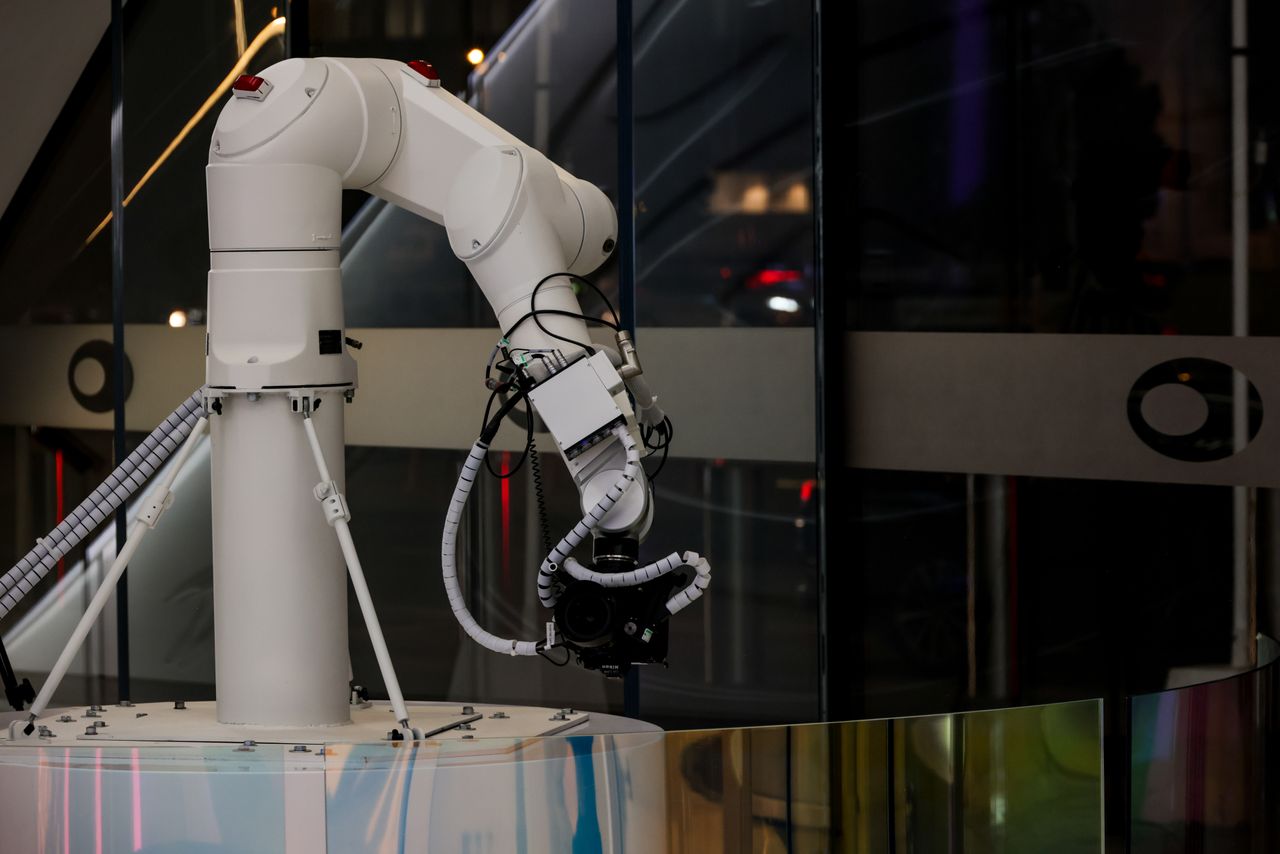
A researcher from AMI Labs — the Paris-based AI startup co-founded by Yann LeCun — presented a hierarchical world-model planning framework at Physical AI Tech Week in Seoul on Wednesday that raised a robotic arm’s pick-and-place success rate from zero to seventy percent without any additional training data, according to reporting from the event.
The result, derived from a system that repurposed V-JEPA 2-AC — Meta FAIR’s action-conditioned video world model, itself post-trained on fewer than sixty-two hours of unlabeled robot video — matched or exceeded vision-language-action models built on significantly larger robotic interaction datasets. For an industry that has channeled billions of dollars into robotic data collection infrastructure on the premise that more data produces better robots, that distinction carries real capital-allocation implications.
The presentation was delivered at the Korea COEX convention center during the morning session of Physical AI Tech Day, which covered the HWM (Hierarchical Planning with Latent World Models) framework — an approach developed by AMI Labs researchers alongside cross-institutional HWM paper authors at Meta FAIR, NYU’s Courant Institute, Mila, and Brown University. AMI Labs, which launched in January 2026 and raised $1.03 billion in March at a $3.5 billion pre-money valuation, has positioned world-model research for manufacturing and robotics as its initial commercial focus.
Seoul as a Physical AI Hub: Why Korea Is Hosting the Conversation
Korea’s MSIT organized this week as a two-day event designed to synchronize the country’s government, research institutes, and private sector around the transition from software AI to AI systems that act in the physical world. More than 500 participants attended, including roughly 400 companies and institutions affiliated with the Physical AI Alliance — a government-backed consortium the Ministry of Science and ICT established to coordinate national strategy on robotics and AI-enabled factories.
October 13 functioned as an alliance coordination session, with the Ministry of Science and ICT and the Ministry of SMEs and Startups outlining their physical AI business plans for 2027. October 14 — Physical AI Tech Day — brought together domestic and international experts for a focused technical program covering robot foundation models, AI factory infrastructure, and digital twin systems, alongside a live exhibition of AI semiconductors, manufacturing AI, and humanoid robots.
Seoul has become one of the more active global venues for physical AI programming in 2026. The city hosted the Seoul Humanoids Summit in late September, the Autonomous Driving Mobility Expo in August, and the AI Summit Seoul & Expo earlier in the year — events that drew speakers from NVIDIA, Hyundai Motor, Qualcomm, and Google. South Korea’s Ministry of Science and ICT has moved deliberately to embed Korea’s advanced manufacturing base into the emerging physical AI economy, citing the country’s industrial density as an advantage in scaling the real-world data collection and evaluation that world-model research requires.
Samsung — one of the AMI Labs seed round investors — is a direct expression of that alignment: South Korea’s largest industrial conglomerate holds a strategic stake in the European lab building the foundational technology its factories may eventually run on.
Two World Models, One Latent Language: How the Architecture Works
The framework presented in Seoul sits at the intersection of two active research strands: the JEPA (Joint-Embedding Predictive Architecture) lineage developed by LeCun and collaborators, which is represented in its most recent form by Meta FAIR V-JEPA 2, and the vision-language-action (VLA) model paradigm, in which large vision-language models are fine-tuned to produce robot control signals directly from visual and text inputs.
Both strands share a core problem researchers call non-greedy planning failure. A robot operating from a single goal image — say, a photograph of a cup placed in a specific location — will, if it plans by minimizing the distance between its current state and that goal state at every step, tend to move directly toward the goal zone.
The trouble is that reaching the goal often requires a detour: the robot must first move toward the cup, pick it up, and only then carry it to the target. A planner that greedily optimizes for proximity to the final goal drifts to the target zone and hovers, leaving the cup exactly where it started. This failure — zero percent success on a task any child could complete — is what the flat planner achieved zero percent on in the HWM experiments.
The hierarchical solution trains two world models on the same data rather than one. A high-level world model predicts outcomes across long time horizons using abstract macro-actions — sketching a coarse path from the current state to the goal. A low-level world model predicts outcomes one frame ahead, using primitive robot control actions, and executes the segment of the plan handed down from above.
The architectural insight that makes the handoff clean is a shared encoder. Both world models map their inputs — current observation images and goal images — into the same latent representation space. Because the two models operate in the same abstract vocabulary, the high-level model’s prediction of an intermediate state (gripper above the cup, ready to grasp) is, by construction, a valid target that the low-level model can act on directly.
No separate translation layer is required, no inverse dynamics model, and no manually engineered skill library to bridge the planning and execution levels. The high-level model says where to go in latent space; the low-level model figures out the primitive actions to get there.
At inference time, the system runs a continuous replanning loop: encode the current observation and the goal image into latent vectors; have the high-level model propose candidate subgoals and select the best; hand that subgoal to the low-level model, which searches over short action sequences to reach it; execute one action; and re-plan from scratch. The full plan is rebuilt at every step rather than committed to in advance, which prevents prediction errors from compounding across a long horizon.
How JEPA Learns Without Labels: Why This Matters for Factory Deployment
The technical foundation under both world models is JEPA — a self-supervised learning framework that LeCun formally proposed in 2022. Rather than training by reconstructing raw pixels—computationally expensive and prone to wasting the model’s capacity on task-irrelevant visual details like lighting variation and background texture—JEPA trains by predicting latent future-frame representations. This distinction forces the model to capture what actually changes when a robot performs an action: the arm configuration, the position of an object, the contact state. The model learns to ignore appearance details that carry no information about task success.
Because JEPA-based video prediction is self-supervised, the world models can be trained on raw, unlabeled robot video. No human annotators are needed to tag grasp events, label object identities, or trace motion trajectories. For manufacturing environments where robots accumulate hours of sensor data daily, this matters directly: the world model can be continuously updated from operational footage without the annotation bottleneck that supervised methods impose. Annotating robot video is slow, expensive, and skill-intensive. Removing that requirement changes the economics of deploying and improving robotic systems on a factory floor.
The HWM framework also incorporated VLA models as a natural-language interface. Rather than requiring goal images to specify tasks, a VLA layer accepted plain-language instructions — “place the housing component in the fixture at station three” — and converted them into goal representations that the hierarchical world-model planner then acted on. The architecture positions the world model as a predictive planning substrate for the VLA’s language-grounded flexibility, rather than replacing it.
From Zero to Seventy Percent: What the Benchmark Actually Means
The most concrete result from the Seoul presentation was the pick-and-place performance figure. On a real seven-degree-of-freedom Franka robotic arm, tasked with picking up a cup and placing it in a specified location based on a single goal image, a conventional flat planner operating a single world model without a hierarchy achieved a zero percent success rate. The HWM achieved 70% success on the same task.
The result sharpens considerably in context. The framework achieved seventy percent by applying HWM on top of V-JEPA 2-AC — Meta FAIR’s action-conditioned variant of its 1.2-billion-parameter video world model, post-trained on fewer than sixty-two hours of unlabeled robot video from the publicly available DROID dataset. The system was deployed entirely zero-shot in a new laboratory environment, with novel object-target pairings it had never seen during training. That seventy percent figure matched or exceeded VLA models that had been trained on substantially more robotic interaction data.
The hierarchical approach also improved performance while reducing computation. On long-horizon manipulation and navigation benchmarks, it achieved about three times lower planning compute than flat planners attempting to simulate the same horizon—because the high-level model covers long distances in single macro-action steps, leaving the low-level model only short, tractable segments to fill in.
On a two-dimensional manipulation task requiring seventy-five steps, the hierarchical system raised the success rate from seventeen percent to sixty-one percent. On out-of-distribution maze navigation with previously unseen layouts, it raised success to eighty-three percent from a flat-planner baseline of forty-four percent.
The framing offered in Seoul was direct: the most productive direction for factory robotics is not accumulating more data or training larger end-to-end models, but structuring how an existing model uses what it already knows. The bottleneck is planning architecture, not representation capacity.
What Happens When Planning Architecture Beats Data Scale
If that framing holds at industrial scale, it carries an implication the benchmarks point toward but do not explicitly state. The dominant paradigm in 2026 robotics is large-scale robotic data collection: companies and research programs have invested heavily in teleoperating robots to generate labeled manipulation data, building datasets orders of magnitude larger than the DROID corpus.
The bet underlying that investment is that more data, fed to larger VLA models, will close the gap on complex real-world tasks. HWM’s result challenges that bet—not by showing that data collection is useless, but by showing that a hierarchically structured planner using a fraction of the data can match models built on far larger corpora. The result raises a question not about whether data helps, but whether data was actually limiting performance. If the limiting factor was always planning structure, then scaling data while keeping a flat planning architecture is, in the language of industrial optimization, the wrong constraint to attack.
Whether this generalizes from a controlled pick-and-place benchmark to a working production line remains to be demonstrated. The HWM experiments used a single robotic arm in a laboratory setting with controlled objects and camera placement. Real manufacturing environments add noise, occlusion, lighting variation, object diversity, and safety constraints that laboratory benchmarks do not capture. The seventy percent figure is strong evidence for the planning-architecture hypothesis, not a proof of production readiness.
AMI Labs: World Models From a Research Lab, Not a Product Company
AMI Labs — formally Advanced Machine Intelligence Labs — was founded by LeCun following his departure from Meta, where he had served as Chief AI Scientist and led Meta’s fundamental AI research division (FAIR) for more than a decade. The startup AMI Labs closed its billion-dollar seed at a $3.5 billion pre-money valuation in March 2026, the largest seed-stage investment in European history at the time of reporting. Cathay Innovation, Graycroft, Hiro Capital, HV Capital, and Bezos Expeditions co-led the round, with strategic participation from NVIDIA, Samsung, and Toyota Ventures.
CEO Alexandre LeBrun has described AMI Labs explicitly as a project that begins with research rather than a startup positioned to ship a product within months. Its initial commercial focus — data-intensive industries where physical grounding matters most: manufacturing, biomedicine, and robotics — reflects LeBrun’s conviction that world models cannot be developed in isolation from real-world data and evaluation. The company’s plan to work directly with prospective customers before generating revenue is the operational expression of that philosophy.
LeCun’s public technology policy positions have framed this research agenda directly: he has argued consistently that the path to beneficial AI runs through physical world models and self-supervised learning, not through large language models or what he describes as the “autocomplete” paradigm. He has been critical of the EU AI Act’s approach to foundation models, and has advocated for open-source AI development — a position reflected in AMI Labs’ collaborative research structure and its cross-institutional paper authorship spanning Meta FAIR, NYU, Mila, and Brown.
The HWM result presented in Seoul is one thread in a broader research program. A companion paper, H-JEPA, extends the hierarchy to three or more levels trained end-to-end, with each level learning its own latent space and time interval rather than sharing a common encoder. In AntMaze simulations, H-JEPA topped HWM on navigation, achieving substantially higher success rates on visual navigation tasks compared with HWM, while higher-level representations allowed the robot’s spatial position to remain recoverable as fine-grained joint-configuration detail faded — implementing the classical control theory distinction between a route planner and a motion planner without manually engineering that separation.
Does Planning Architecture Belong in the Next Robot Procurement Conversation?
The framework presented in Seoul sits at a productive intersection in the 2026 robotics landscape. VLA models have become the dominant paradigm for instruction-following manipulation, building on large vision-language backbones and fine-tuning them on robot data to produce action tokens directly. Their strength is generalization: a well-trained VLA can follow natural-language instructions on tasks and objects it has not seen before. Their weakness is that they lack closed-loop predictive planning — they do not internally simulate what will happen before executing, and they struggle with tasks that require non-obvious intermediate steps.
The JEPA approach runs in the opposite direction: a closed-loop predictive model that can explicitly simulate action outcomes, but one that has historically required goal images rather than language instructions and has been harder to scale across diverse tasks. The architecture presented in Seoul — using the VLA as a language interface and the hierarchical world model as the planning substrate — is one of several attempts in the 2026 literature to combine these two complementary capabilities.
Published approaches with similar motivations include VLA-JEPA, which pretrains a VLA using JEPA-style latent prediction objectives to improve generalization, and JEPA-WAM, which connects generated visual instructions to world-action models through JEPA latent representations. The VLA-JEPA companion paper published earlier this year represents one of the more fully developed hybrid architectures.
AMI Labs’ contribution is planning-time intervention. Unlike methods that require architectural changes to the VLA during training, HWM requires no retraining of the underlying world model, no new reward function, and no task-specific fine-tuning. As the paper describes it, it is a planning abstraction that can be applied on top of whatever latent world model a team has already built. That property — if it holds across robotic platforms and environments — gives it a clear adoption path in laboratories and eventually in facilities that already have JEPA-trained models deployed.
For manufacturers and integrators watching the factory robotics landscape, the Seoul presentation crystallizes a shift in what technical progress looks like. The relevant question is no longer whether a robot can recognize objects or follow instructions — current VLA models clear that bar on benchmarks — but whether a robot can reliably execute the multi-step physical sequences that real industrial tasks require, using the compute and data budgets that factory environments actually provide. The HWM result suggests the answer depends at least as much on how planning is structured as on how much data was used to train the underlying model.
Frequently Asked Questions
What is a hierarchical world model, and why does it solve the pick-and-place problem?
A world model is a neural network that predicts what will happen in an environment when a robot takes an action — it lets the robot mentally simulate future states before committing to a physical move. A hierarchical world model runs two of these predictive models at different levels of abstraction: a high-level model that proposes intermediate subgoals using long-horizon macro-actions (for example, “move gripper above the cup”), and a low-level model that executes short sequences of primitive actions to reach each subgoal. The pick-and-place problem defeats a single-level flat planner because it greedily optimizes for proximity to the final goal and therefore hovers near the target location without ever picking up the object. The hierarchical planner solves this by explicitly proposing “pick up the cup” as an intermediate subgoal before heading for the final placement location — it plans the detour rather than ignoring it.
Why does it matter that the system matched data-heavy VLA models while using a world model trained on sixty-two hours?
The dominant approach to improving robot manipulation in 2026 involves collecting large volumes of robot demonstration data — sometimes thousands of hours of teleoperated robot video — to train or fine-tune vision-language-action models. The HWM result demonstrated 70% zero-shot pick-and-place success by applying a hierarchical planning strategy on top of V-JEPA 2-AC, a world model that Meta FAIR post-trained on fewer than 62 hours of unlabeled video from a publicly available dataset, matching or outperforming VLA models trained on substantially larger corpora. If the bottleneck for real-world robotic performance is planning architecture rather than training data volume, then the industry’s current emphasis on scaling data collection may be solving the wrong constraint — with significant implications for how research investment and engineering effort are allocated.
What is JEPA and how does it differ from how other AI models learn?
JEPA — Joint-Embedding Predictive Architecture — is a self-supervised learning framework in which a model is trained to predict the latent (abstract) representation of a future video frame, rather than reconstructing its raw pixels. The distinction matters because pixel-level prediction forces the model to allocate capacity to visually salient but task-irrelevant features like lighting and texture. Latent-space prediction instead teaches the model to represent what actually changes when a robot acts — arm configuration, object position, contact state. Because it requires no human-provided labels, JEPA-trained world models can be built and updated using raw operational footage from robot sensors, which removes the annotation bottleneck that makes supervised robotic AI expensive to maintain in manufacturing environments.
Is a seventy percent success rate on a lab benchmark enough to deploy in a factory?
Not yet, based on what the Seoul results demonstrated. The HWM experiments used a single seven-degree-of-freedom Franka arm in a controlled laboratory environment with known object types, fixed camera positions, and predictable lighting. Real production lines add object diversity, occlusion, vibration, variable lighting, and safety constraints that laboratory benchmarks do not replicate. The seventy percent result is strong evidence for the planning-architecture hypothesis—that restructuring how an existing model plans matters more than feeding it more data—but it is a proof of concept, not a production-readiness certification. AMI Labs’ stated approach—engaging directly with industrial partners before shipping a product—is the right path from this benchmark to the factory floor.