HomeAuto American Airlines Reverses Course: 4K Screens Return to Every Narrowbody Seat
American Airlines Reverses Course: 4K Screens Return to Every Narrowbody Seat
August 19, 2026:
Aa.com
In June 2026, American Airlines finished removing seatback entertainment screens from its last remaining aircraft — completing a multi-year cabin standardization project. Ten weeks later, on August 18, it announced it would reinstall screens on every narrowbody aircraft it operates. The gap between those two decisions is the story of an airline that reversed course before it had finished going in the original direction — and passengers who fly American domestically today get the worst of both outcomes: the old screens are gone, and the new 4K ones will not start arriving until 2028.
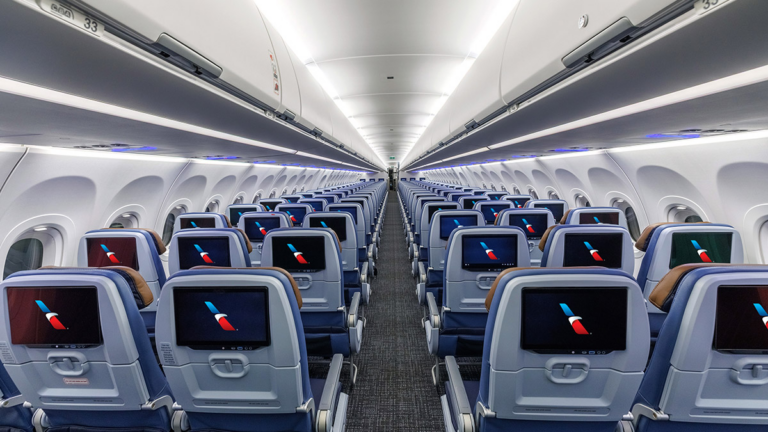
American Airlines’ August 18 announcement commits the Fort Worth-based carrier to installing state-of-the-art seatback entertainment at every seat across its entire narrowbody fleet of more than 800 aircraft, reversing a strategy it spent nearly a decade building and about two years finishing. The new system promises 4K displays with Bluetooth audio pairing, USB-C fast charging, personalized content recommendations, and an interactive flight map — features that will arrive on newly delivered Boeing and Airbus aircraft beginning in 2028 and on retrofitted planes through the early 2030s.
Why It Took a Decade to Get Here
American first removed seatback screens from new aircraft in 2017, when it began accepting Boeing 737 MAX deliveries without them. The reasoning was defensible at the time: most passengers were already carrying smartphones, tablets, and laptops; seatback screens cost as much as $10,000 each to install per seat; added measurable weight — and therefore fuel cost — to every flight; and required expensive content licensing and maintenance.
The airline then extended the no-screen philosophy to its existing fleet through Project Oasis, an interior standardization program that removed screens from Boeing 737-800s and Airbus A321s and replaced them with plastic device holders and power outlets. The program also squeezed additional rows of seats into cabins and shrank the lavatories, moves that generated sustained complaints about cramped lavatories and reduced legroom. United Airlines made a similar bet around the same time — and reversed it in 2021 when it unveiled its United Next program and committed screens to every narrowbody seat. American did not follow. It continued removing screens, including from its older Airbus A319 fleet, through 2025 and into 2026.
That last campaign — pulling the remaining screens from legacy A319s at a retrofit line in San Salvador — concluded just weeks before the reversal. The airline that had just finished becoming the only major U.S. legacy carrier without a single embedded seatback screen on any domestic narrowbody aircraft now announced it would install them everywhere.
Why the Technology Math Changed
The reversal is not simply an admission that the original call was wrong — it is also a reflection of how significantly the underlying technology economics shifted between 2017 and 2026.
The 2017 decision was made in the era of heavy, power-hungry legacy LCD panels that were expensive to purchase, install, and maintain, and slow to update as content delivery standards evolved. Modern 4K IFE panels are dramatically lighter and cheaper. Aviation and travel analyst Gary Leff, writing for View From the Wing, noted that IFE content and hardware costs have dropped by at least two-thirds since the original removal decisions.
The second and more consequential change is the arrival of Starlink. American struck a Starlink deal in May 2026 to install the LEO satellite internet system on more than 500 of its Airbus narrowbody aircraft, with rollout beginning in the first quarter of 2027.
This distinction matters technically. Legacy in-flight Wi-Fi used geostationary (GEO) satellites parked roughly 22,000 miles (35,406 km) above Earth. The extreme distance imposed a signal round-trip time — called latency — of 600 milliseconds or more, making live video calls unreliable and real-time streaming choppy under load. Starlink operates a constellation of more than 9,000 satellites in low Earth orbit (LEO) at approximately 340 miles (547 km) altitude — about 65 times closer than GEO systems. That altitude reduction brings latency down to 20–40 milliseconds, comparable to a ground-based broadband connection, and Starlink’s Aero Terminal hardware can deliver up to 1 gigabit per second per antenna to each aircraft. At that bandwidth and latency, a seatback screen is no longer just a dumb content player — it becomes a connected platform capable of streaming personalized recommendations, displaying live flight information, and integrating with a passenger’s profile from the moment they sit down. That is a product that a device-holder-and-smartphone combination cannot replicate.
What the New System Will Actually Include
The next-generation IFE platform American announced includes: 4K displays described as among the largest offered on narrowbody aircraft in North America; Bluetooth audio connectivity so passengers can pair their own wireless headphones and earbuds directly to the seat without a wired connection; USB-C fast-charging ports at every seat; expanded content partnerships covering movies, television, music, and games; personalized entertainment recommendations; and an interactive flight map with real-time destination and flight information.
American did not disclose the total program cost, the name of the IFE hardware vendor, or a detailed retrofit schedule.
American also did not specify whether Bluetooth integration will use the Bluetooth A2DP (Advanced Audio Distribution Profile) standard, though this is the industry-standard protocol for wireless stereo audio from a source device to wireless headphones. Pairing personal wireless headphones at the seat eliminates a persistent inconvenience of historic IFE systems, which required passengers to purchase on-board headsets or bring their own wired earphones with a 3.5mm jack.
Premium seat holders will receive larger display variants. The announcement did not specify exact screen sizes.
The Scale of What American Must Now Retrofit
The scope of the reversal is substantial. American’s narrowbody fleet encompasses approximately 890 aircraft, spanning Airbus A319, A320, A321, and A321neo variants along with Boeing 737-800s and 737-8 MAXs. Every one of these aircraft is currently flying domestic routes without a seatback screen.
New Airbus and Boeing deliveries will begin arriving with screens factory-fitted in 2028. Existing aircraft will cycle through retrofit lines, with the entire program expected to conclude by the early 2030s. That means a passenger booking a domestic American Airlines flight today — or in 2027 — will almost certainly fly on a plane without seatback screens. Starlink connectivity will begin arriving on American’s Airbus narrowbody fleet in Q1 2027, meaning there will be a window of roughly a year where Starlink is available but the new screens are not yet installed.
American’s Boeing narrowbodies are a separate case. The carrier’s Starlink deal specifically covers the Airbus fleet; Boeing narrowbodies remain on Viasat systems for the near term. The August 18 announcement did not specify a separate connectivity plan for Boeing jets alongside the new screens.
Premiums Expanding From 25 Percent to 40 Percent
The IFE overhaul is paired with an equally significant reshaping of the economics of American’s narrowbody cabin. Premium seating currently accounts for approximately 25 percent of seats on narrowbody departures. American committed to expanding premium seats to 40 percent — a 60 percent increase in the share of premium capacity.
The expansion will proceed through a combination of routes. American is currently retrofitting its A319 and A320 fleets to add an additional row of First Class. Upcoming Boeing 737 MAX 10 deliveries will be configured with 24 First Class seats. The A321neo fleet will also be reconfigured to add First Class seats. Main Cabin Extra — the extra-legroom economy tier that includes earlier boarding, dedicated overhead bin space, and a complimentary beverage — will expand across the majority of the narrowbody fleet.
The math for frequent flyers changes as a result. A larger absolute number of First Class and MCE seats means more upgrade opportunities for elite-status holders and more chances for non-elite passengers to purchase extra legroom seats without competing against a full elite upgrade list.
The Gap American Is Trying to Close
American’s decision cannot be separated from its financial position relative to Delta and United. In the second quarter of 2026, American reported $71 million in net income on record revenue. United Airlines posted $805 million. Delta Air Lines earned $1.6 billion. CEO Robert Isom has said the airline is working to close the earnings gap against its rivals, with premium seats and upgraded lounges as the primary levers.
The cabin experience gap and the financial gap are related. Delta maintained seatback screens throughout the BYOD era, making a deliberate and expensive bet that the hardware was worth keeping. United made the opposite call, recognized it was wrong in 2021, and has spent the years since building out its United Next cabin program — meaning American is now the last of the three legacy carriers to make this reversal, roughly four or five years behind United. Walk onto a newer Delta or United domestic narrowbody and the presence of a seatback screen gives the cabin an immediately more polished feel. Walk onto most American domestic flights today and there is a device cradle where the screen used to be.
One structural advantage American gains from being last to act: the screens it installs will be among the newest and most capable in the industry. It does not inherit aging hardware that competitors installed years ago and that may require its own refresh cycle by the time American’s fleet-wide retrofit is complete.
What Is the Starlink Technology Behind the Upgrade?
Starlink is a satellite internet constellation operated by SpaceX that uses a dense network of low-Earth-orbit satellites rather than the geostationary satellites that have powered in-flight connectivity for the past two decades. The key engineering distinction is altitude and its downstream effects.
Traditional geostationary satellite internet positioned a satellite at approximately 22,000 miles (35,406 km) above the equator, where it stays in a fixed position relative to the Earth’s surface. That fixed position is operationally convenient but physically costly: a signal traveling 22,000 miles to the satellite and 22,000 miles back accumulates 600 milliseconds of latency even at the speed of light — making real-time applications like video calls frustrating and live gaming impossible. Starlink’s LEO constellation orbits at about 340 miles (547 km) above Earth, reducing the signal travel distance by a factor of approximately 65, and cutting latency to the 20–40ms range that supports all real-time internet applications.
On an aircraft, Starlink’s Aero Terminal — a compact phased-array flat-panel antenna mounted on the fuselage exterior — communicates with whichever satellite in the constellation is in range, handing off between satellites as the aircraft moves. Because Starlink operates thousands of satellites, there is always overlap, and coverage is available gate-to-gate. For American, this means that by Q1 2027, passengers on Airbus-fleet flights will experience connectivity that, for the first time, can credibly support 4K video streaming, live video calls, and cloud-based productivity applications simultaneously across an entire cabin — before a single new seatback screen has arrived.
Broader Investments Accompanying the Screen Rollout
Beyond IFE and premium seating, American outlined several parallel investments in its August 18 announcement. The airline is undertaking what it described as its largest lounge footprint investment in company history, including elevated food and beverage programs featuring brands such as Champagne Bollinger and Lavazza coffee. Curated in-flight menus from award-winning chefs are being rolled out on select routes.
American also noted digital infrastructure improvements covering the booking-to-baggage-tracking end of the travel experience, though the announcement provided no specific detail on those systems.
What Passengers Should Actually Expect, and When
For travelers making booking decisions today, the practical timeline is straightforward but requires no illusions about near-term change. No American Airlines narrowbody aircraft flying domestic routes has a seatback entertainment screen as of August 2026. That condition will persist through all of 2027 on existing aircraft and into 2028 before the first new aircraft with screens begin to appear in the fleet. Full fleet installation will not be complete until the early 2030s — meaning the cabin experience on most American domestic routes will remain uneven for the better part of a decade from today.
Starlink Wi-Fi will arrive faster. American’s Airbus narrowbody fleet begins receiving Starlink in the first quarter of 2027, which will meaningfully improve connectivity quality for passengers who bring their own devices and use American’s free AAdvantage Wi-Fi offering. Boeing narrowbodies have no confirmed Starlink timeline.
For travelers who prioritize seatback entertainment on domestic flights right now, Delta and United both offer it across their mainline narrowbody fleets. American’s competitive position on this dimension will improve over the decade — but 2026 and 2027 passengers will not see it.
Frequently Asked Questions
When will American Airlines have 4K seatback screens on most flights?
New Airbus and Boeing aircraft will begin arriving with 4K screens starting in 2028. Existing aircraft will receive them through a retrofit program, but American has said full fleet installation will not be complete until the early 2030s. Passengers on domestic American Airlines flights in 2026 and 2027 will almost certainly not encounter the new screens, as no existing narrowbody aircraft currently has seatback entertainment and the first new-delivery planes with screens will not enter service until 2028.
Why did American Airlines remove seatback screens in the first place?
American removed screens starting in 2017 as part of a broader strategy to reduce costs and aircraft weight. Seatback IFE systems cost up to $10,000 installed per seat and required ongoing content licensing fees and maintenance. The airline bet that passengers who carried their own smartphones and tablets would prefer streaming over a cabin Wi-Fi network — an approach also briefly tried by United before it reversed course in 2021. American’s reversal comes after that bet failed to prevent a widening earnings gap versus Delta and United.
What is Starlink and why does it matter for the new screens?
Starlink is SpaceX’s low-Earth-orbit satellite internet constellation. Unlike older geostationary satellite systems that orbit at roughly 22,000 miles (35,406 km) above Earth and produce high-latency connections, Starlink orbits at approximately 340 miles — producing latency under 40 milliseconds that can support streaming, gaming, and video calls simultaneously across a full aircraft cabin. American signed a deal in May 2026 to install Starlink on more than 500 Airbus narrowbody aircraft beginning in Q1 2027 — before the new seatback screens arrive. Together, the two systems create a connected IFE platform rather than a standalone content player.
How does American’s new seatback entertainment compare to what Delta and United currently offer?
Delta has maintained seatback screens on its narrowbody fleet throughout the past decade and continues to invest in them. United began reinstalling screens on its narrowbody fleet in 2021 as part of the United Next program, giving it a four-to-five-year head start on American’s retrofit timeline. When American’s new 4K screens are eventually installed, they rank among newest industry hardware and include Bluetooth audio pairing — a feature that neither Delta nor United currently offers systemwide — along with USB-C fast charging and personalized content recommendations.