HomeAuto AMD Ryzen Z3 Leak: Semi-Custom Zen 6 Chip Delivers Desktop-Tier FSR 4 to Handhelds
AMD Ryzen Z3 Leak: Semi-Custom Zen 6 Chip Delivers Desktop-Tier FSR 4 to Handhelds
October 4, 2026:
Amd.com
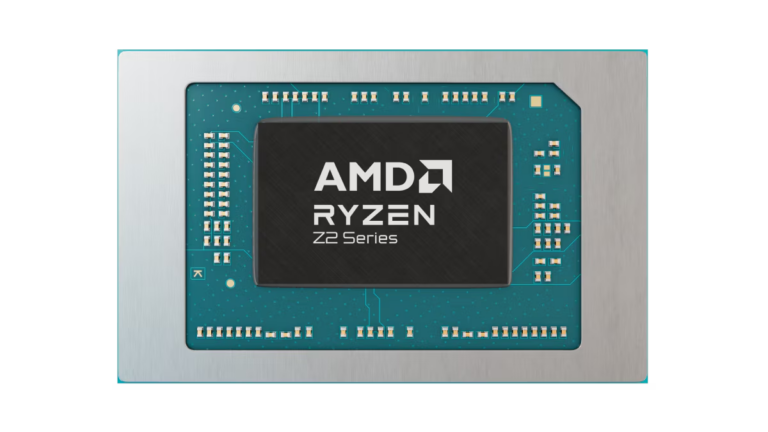
Hardware leakers posted specifications yesterday for what they say will be AMD’s next Z-series handheld chip, and the design makes a deliberate bet: fewer CPU cores in exchange for a more capable GPU — and, crucially, the matrix acceleration hardware that enables native FSR 4 upscaling on a handheld device for the first time. AMD has not confirmed the chip or commented on its existence. The company’s AMD Ryzen Z-series product page currently lists only the Z1 and Z2 families.
Leaked Specs: What Gotou_3rd and CaptainMcShotgun Described
On October 1, 2026, Gotou_3rd and CaptainMcShotgun posted details for a chip they identified as the AMD Ryzen Z3, described as a semi-custom variant of AMD’s upcoming Medusa Point APU architecture built specifically for the thermal and power constraints of Windows handheld gaming devices.
The leaked specifications describe two variants:
Variant
Optimized TDP
Target Use
Ryzen Z3
15W
Ultra-compact / mainstream handhelds
Ryzen Z3 Extreme
25W
Performance-tier handhelds
Both models are reportedly housed in a compact FF6 package measuring 25×25mm (9.8×9.8 in) — significantly smaller FF6 package dimensions than the FP8 package used by the current Ryzen Z2 Extreme.
CPU: Six Cores, Fewer Than the Z2 Extreme
On the processor side, the leaked CPU core configuration details describe four full-performance Zen 6 cores paired with two low-power cores, for a total of six cores and potentially 12 threads. The specific generation of the low-power cores is disputed between sources — some indicate Zen 5 LP, others Zen 6 LP — and the leakers themselves note the configuration may change before production.
That is fewer CPU cores than the Z2 Extreme eight-core comparison (three Zen 5 and five Zen 5c), and it removes the compact Zen 6c cores that the standard Medusa Point laptop APU is expected to carry in a 10-core arrangement.
The tradeoff is intentional, according to independent hardware analysis. “Most handheld titles are constrained more often by integrated-GPU throughput and memory bandwidth than by having fewer than eight CPU cores,” Guru3D’s Hilbert Hagedoorn noted in reporting on the leak. Six modern Zen 6 cores are expected to handle the CPU workloads typical of handheld gaming without meaningful performance loss, while the freed die area and power budget shift to the graphics subsystem.
GPU: RDNA 4m, What It Actually Is, and Why It Matters
The GPU specification is the most significant technical claim in the leak. The Ryzen Z3 is said to carry 12 compute units (CUs) based on AMD’s RDNA 4m architecture — a configuration that packs more GPU resources than the standard Medusa Point laptop APU’s expected eight CUs, representing a purposeful shift of die resources toward graphics at the expense of compact CPU cores. The RDNA 4m CU architecture differences from RDNA 3.5 are central to understanding why this chip matters for upscaling.
RDNA 4m is not the same architecture as the RDNA 4 powering AMD’s discrete Radeon RX 9000 desktop cards. To understand the distinction, it helps to know how AMD names its GPU architectures internally. The desktop RDNA 4 cards carry a “GFX12” identifier in AMD’s own driver code. RDNA 4m, by contrast, carries a “GFX11.7x” identifier — placing it in the same GFX11 lineage as RDNA 3 and RDNA 3.5. AMD has published firmware and driver commits for GFX1170, GFX1171, and GFX1172 configurations, and those entries have been merged into the open-source Mesa 26.3 graphics driver stack. The RDNA 4m GFX11 architecture distinction from full RDNA 4 is confirmed by AMD’s own driver commit history.
What RDNA 4m does add — and this is the architectural differentiator — is RDNA 4-class Wave Matrix Multiply Accumulate (WMMA) instruction support for FP8 (8-bit floating point) operations. RDNA 3.5 lacks native FP8 WMMA hardware, which is precisely what AMD’s FSR 4 upscaling technology was built to exploit when it launched alongside the Radeon RX 9000 series. The FSR 4 native FP8 hardware requirement has been confirmed by multiple technical analyses of AMD’s upscaling pipeline.
AMD officially announced FSR 4.1 for RDNA 3 cards via INT8 acceleration in July 2026, with RDNA 2 support to follow in early 2027. But the INT8 vs FP8 FSR quality comparison shows the INT8 implementation on older hardware, while functional, produces lower image quality than the native FP8 version at the same compute budget — particularly at the very low native resolutions (540p to 720p) that handhelds typically use for performance headroom. RDNA 4m’s native FP8 WMMA hardware puts the Ryzen Z3 in the same quality tier as AMD’s discrete RDNA 4 desktop cards for FSR 4 output, not the fallback tier.
For handheld gaming, that distinction is meaningful. Current Windows handhelds render many demanding titles at 540p or lower to stay within their power budgets, then display at 1080p or higher via upscaling. At those resolution ratios, FSR 4’s neural network model produces substantially sharper, more stable images than FSR 3’s spatial approach. The current Ryzen Z2 Extreme will receive FSR 4.1 via INT8; the Z3, if the leak is accurate, will receive full FP8-quality FSR 4 support natively.
How RDNA 4m’s 12 CUs Compare to the Z2 Extreme’s 16 CUs
Reducing the raw compute unit count from 16 (in the Z2 Extreme’s RDNA 3.5) to 12 (in the leaked Z3’s RDNA 4m) is the most immediately visible step-down, and it will surface prominently in early benchmarks. The comparison requires context.
Within the GFX11 architecture family, RDNA 4m’s compute units include the added matrix instruction hardware — they execute FP8 WMMA operations that RDNA 3.5 CUs cannot. Whether 12 units of the newer architecture match, exceed, or fall short of 16 units of RDNA 3.5 in raw rasterization throughput depends on implementation details the leak does not provide: base and boost clock frequencies, LPDDR6 memory bandwidth, cache configuration, and sustained thermal behavior.
Hardware analyst Hilbert Hagedoorn flagged the Hagedoorn memory bandwidth performance analysis as the central unknown: “A 12-CU GPU cannot maintain its theoretical throughput if paired with inadequate LPDDR bandwidth, narrow channels or conservative memory clocks.” The Z2 Extreme’s LPDDR5X at up to 120 GB/s was the Z2’s performance ceiling; whether Z3 handhelds ship with comparable or higher memory bandwidth will determine more of the performance outcome than the CU count delta.
The 25mm Package: What a Smaller Chip Enables for Battery Life
The reported FF6 package at 25×25mm (9.8×9.8 in) is smaller than the FP8 substrate used by Strix Point-derived products including the Ryzen Z2 Extreme. That difference matters primarily to the device designers at ASUS, Lenovo, and MSI — but its downstream effects reach consumers. The Guru3D Z3 hardware analysis notes confirm the FF6 package as a reported specification.
A smaller chip footprint on the mainboard leaves more volume available for battery cells within the same device chassis. Windows handhelds have consistently drawn criticism for battery life that delivers two to three hours of intensive play. A chip optimized for 15W — compared with the Z2 Extreme’s configurable 15-35W range — combined with a physically smaller mainboard footprint positions the standard Ryzen Z3 as a battery-life-forward chip, not just a performance successor.
AMD’s Handheld Lead Is No Longer Uncontested
The timing of the Z3 leak lands in a competitive landscape that looks materially different from the one the Z2 Extreme launched into. AMD has dominated the Windows handheld market since the first Ryzen Z1 chips powered the ASUS ROG Ally in 2023, with the Lenovo Legion Go 2 and the ASUS ROG Xbox Ally X both shipping Z2 Extreme handhelds in 2025.
Intel has now explicitly declared its intent to challenge that position. At CES 2026, Intel announced its Panther Lake processor family with a direct play for the handheld gaming market, reportedly claiming up to 77% better gaming performance than its prior Lunar Lake architecture. Intel VP Robert Hallock confirmed the company was providing dev kits to handheld manufacturers ahead of Panther Lake, describing it as a direct successor to Lunar Lake’s efficiency-focused design.
AMD’s response to Panther Lake is not yet on shelves. The main Medusa Point laptop APU family is expected to launch at or around CES 2027 based on AMD’s firmware development timeline, with a Z3 semi-custom handheld variant following within one to several product cycles thereafter. AMD has not confirmed any of this publicly.
Gainsborough: A Separate Valve-Linked Chip That Appeared the Same Day
The Z3 leak arrived alongside a separate disclosure that surfaced on the same day — a chip codenamed “Gainsborough,” found in AMD’s Adrenalin 26.9.2 graphics driver data and in customs records showing test units shipped from Asia in late July 2026. The Gainsborough Zen 6 RDNA 5 details are distinct from the Z3 specifications and suggest a separate semi-custom program.
Gainsborough is widely believed to be a Valve semi-custom chip for a potential Steam Deck successor. The codename connection is deliberate: the original Steam Deck’s chip carried the internal codename “Aerith” — a reference to the Final Fantasy VII character Aerith Gainsborough — and “Gainsborough” continues that naming pattern.
The reported specifications for Gainsborough differ substantially from the Z3: four to eight Zen 6c CPU cores, between 12 and 24 RDNA 5 compute units (a full architectural generation ahead of RDNA 4m), and manufacture on TSMC’s N3P process. If accurate, Valve’s successor chip would use AMD’s next-generation graphics architecture rather than RDNA 4m. Neither AMD nor Valve has confirmed Gainsborough, and the wide ranges in reported specifications suggest incomplete information.
What the Ryzen Z3 Would Mean for Buyers Waiting on the Next Generation
The question most relevant to the handheld gaming PC market right now is whether to buy a current Z2 Extreme device — the Lenovo Legion Go 2 or the ASUS ROG Xbox Ally X — or to wait for next-generation hardware. The Ryzen Z3 leak does not answer that question definitively, but it gives it shape.
On the basis of the leak, the Z3 offers: a newer CPU architecture (Zen 6), native FP8 FSR 4 support via RDNA 4m matrix hardware, a smaller package enabling potentially improved battery life, and an optimized 15W configuration targeting thinner handheld form factors. Against those gains sits a smaller raw compute unit count (12 vs. 16) and an unknown launch window that trails the main Medusa Point platform — placing the earliest realistic Z3 handheld devices in late 2027 or beyond. A buyer purchasing a Z2 Extreme device today would realistically use it for at least one to two years before Z3 hardware reaches market.
AMD has not verified any aspect of the Ryzen Z3 specifications. All information is derived from unconfirmed third-party leaks from sources Gotou_3rd and CaptainMcShotgun. The Guru3D Z3 specs disclaimer notes that no Ryzen Z3 processor has been announced by AMD and all information should be treated as an architectural leak rather than a buying roadmap.
Frequently Asked Questions
What is RDNA 4m and is it the same as RDNA 4?
RDNA 4m is not the same as the RDNA 4 architecture in AMD’s discrete Radeon RX 9000 desktop graphics cards. Desktop RDNA 4 belongs to AMD’s GFX12 driver family. RDNA 4m sits in the GFX11 lineage alongside RDNA 3 and RDNA 3.5, meaning it shares the same foundational shader architecture as prior integrated GPU generations — but adds RDNA 4-class matrix acceleration hardware (Wave Matrix Multiply Accumulate for FP8 operations). That addition is specifically what enables native, hardware-accelerated FSR 4 upscaling at full quality, without the INT8 fallback that RDNA 3 chips now use for FSR 4.1 support. The RDNA 4m GFX11 driver details confirm GFX1170, GFX1171, and GFX1172 all sit within the GFX11 family.
Does the Ryzen Z3 have worse gaming performance than the Z2 Extreme because it has fewer compute units?
Not necessarily, though the comparison is genuinely uncertain without real benchmarks. The Z3’s 12 RDNA 4m compute units are architecturally different from the Z2 Extreme’s 16 RDNA 3.5 units — each RDNA 4m CU includes matrix acceleration hardware that RDNA 3.5 CUs lack, and the underlying per-CU efficiency may differ. Whether 12 RDNA 4m CUs equal, exceed, or fall short of 16 RDNA 3.5 CUs in raw game rendering will depend on clock frequencies, memory bandwidth, and the specific workload. Hardware analysts have noted that the memory bandwidth provided by LPDDR6 pairing will likely determine the outcome more than the CU count delta. The Guru3D Z3 memory bandwidth warning specifically flags this as the central performance unknown.
What handheld gaming PCs will use the Ryzen Z3, and when?
No handheld devices have been confirmed for the Ryzen Z3. AMD has not acknowledged the chip exists. The main Medusa Point laptop APU platform — which the Z3 would be derived from — is expected to launch at approximately CES 2027 based on AMD’s firmware development timeline and the openSIL support rollout schedule the company has shared publicly. The AMD Medusa Point CES 2027 timeline is the most specific public confirmation of Medusa Point’s expected window. A semi-custom Z3 handheld variant would follow after the main platform launch. Realistically, Z3-powered devices are most likely a 2027 or later product.
How does Intel’s Panther Lake challenge the Ryzen Z3?
Intel unveiled its Panther Lake processor at CES 2026 with an explicit push into the handheld gaming PC market, where AMD has held near-total dominance since the first ROG Ally launched in 2023. Intel claims Panther Lake’s integrated graphics deliver up to 77% better gaming performance than Lunar Lake — the architecture currently powering the MSI Claw 8 AI+ handheld — and Intel Panther Lake handheld push coverage confirms Intel was actively distributing dev kits to handheld manufacturers. If Panther Lake devices reach market before or alongside Z3 hardware, AMD will face its first serious architectural competition in the handheld gaming PC segment.