HomeAuto ALMA Confirms Planet Gas Wake Beside Imaged Protoplanet for First Time
ALMA Confirms Planet Gas Wake Beside Imaged Protoplanet for First Time
September 26, 2026:
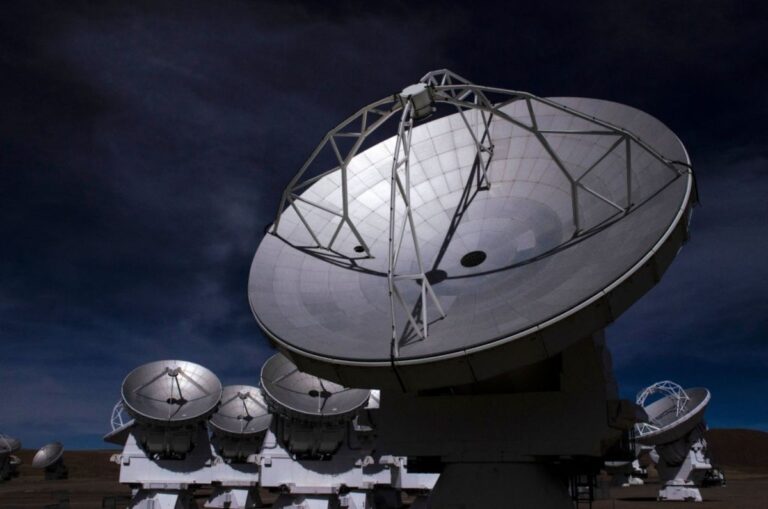
ALBERTO PENA/AFP via Getty Images
For more than a decade, astronomers have used the Atacama Large Millimeter/submillimeter Array (ALMA) to find what looked like ghost planets — puzzling kinks and twists in the velocity patterns of gas swirling around young stars, each one the predicted fingerprint of an unseen world sculpting its disk. They knew what those signatures were supposed to mean. What they lacked was a confirmed planet to prove it. Now they have one.
A team led by Myriam Benisty, director of the Planet Formation and Exoplanets department at the Max Planck Institute for Astronomy (MPIA), has mapped the gas environment of WISPIT 2b — a five-Jupiter-mass gas giant caught in the act of forming 430 light-years (about 4.1 × 10¹⁵ km) from Earth — with enough resolution to directly detect, for the first time, the gas velocity distortions a planet drives into its own disk. The result, newly published in Astrophysical Journal Letters, is not just a portrait of one growing world: it is the calibration point the entire field of kinematic planet detection has been waiting for.
Across roughly a dozen protoplanetary disk systems observed by ALMA in recent years — including HD 163296, HD 97048, and several targets from the DSHARP survey — scientists have reported “velocity kinks”: localized distortions of the carbon monoxide (CO) gas flow that theory says a massive embedded planet would produce. These detections by Pinte and colleagues in 2018 and by Andrews and the DSHARP collaboration produced mass estimates for planets that had never been seen directly. The method worked in theory. But without a single system where an independently confirmed planet also produced an independently confirmed kink, it was impossible to know how accurate those estimates were — or whether all the kinks were genuinely planetary in origin.
WISPIT 2b now supplies exactly that system. It is the only known protoplanet for which all four major observational diagnostics coexist: a directly imaged planet, the gap it carved in its disk, an active hydrogen accretion signal confirming ongoing growth, and now a directly resolved gas kinematic signature at its location — the “thunderbolt-shaped feature” that ALMA’s CO velocity maps revealed at sub-Hill-radius scales. Researchers studying all those other disk systems with tentative kinematic planet candidates can now, for the first time, benchmark their methods against a known reality.
“Hopefully, observations like this will teach astronomers to distinguish between disk features that indicate the presence of a protoplanet and features that don’t,” said Stefano Facchini of the University of Milan, who led the ALMA dust ring survey of the system earlier this year.
What ALMA Resolved
The Benisty team trained ALMA’s 66 radio dishes on the WISPIT 2 system during three observing sessions in September 2025, November 2025, and March 2026. They used the array’s highest-resolution configuration — achieving an angular resolution of about 19 × 13 milliarcseconds for the dust continuum signal, equivalent to distinguishing structures roughly 2.5 astronomical units (AU, the Earth-Sun distance) across at WISPIT 2’s distance. The gas observations, taken in the carbon monoxide J=3-2 spectral line, reached about 67 × 52 milliarcseconds. All observational details derive from Benisty et al. 2026.
Comparing those numbers to the distance involved: WISPIT 2 lies 133 parsecs from Earth (roughly 430 light-years, or about 4.1 × 10¹⁵ km), and 19 milliarcseconds at that distance corresponds to just 2.5 AU — approximately the distance between the Sun and the asteroid belt. The team was, in effect, reading the gas motions around a forming planet smaller than the inner solar system, from across the galaxy’s spiral arm.
What those maps revealed was a disk in full upheaval. WISPIT 2b, orbiting at about 57 AU from its host star (roughly 1.9 times Neptune’s distance from the Sun, or about 8.5 × 10¹² km), has carved a gap in the gas and dust surrounding it. Its sister planet, WISPIT 2c — a heavier world at approximately 8 to 12 Jupiter masses orbiting just 14 AU (about 2.1 × 10¹² km) from the star — has swept out an even more dramatic empty cavity in the inner disk. Between them sits a narrow gaseous ring, a remnant of material left stranded in the no-man’s-land between two gravitational bulldozers.
How Does the Kinematic Planetary Signature Work?
A planet embedded in a rotating disk of gas cannot help but disturb the gas around it. It launches spiral density waves — the disk analog of a boat wake — at locations called Lindblad resonances, where the planet’s orbital period matches simple fractions of the local gas orbital period. Those waves push gas away from pure Keplerian rotation (the smooth, predictable circular flow predicted by gravity alone), creating localized regions where the gas moves faster or slower than expected. The theoretical framework for this process was established by Goldreich and Tremaine in 1979.
When ALMA observes a disk edge-on or at an angle, those velocity anomalies show up as distortions in the CO channel maps — a specific moment in the radio spectrum where CO at a particular velocity appears brighter or displaced relative to its expected position. The distortion has a characteristic shape that both theory and simulation predict: a localized kink or twist in what should otherwise be smooth isovelocity contours.
What makes WISPIT 2b’s signature — described by the Benisty team as “thunderbolt-shaped” — exceptional is not that it fits the prediction. Many tentative kinematic signatures have fit the prediction. What makes it exceptional is that the planet producing it can also be independently photographed in infrared light, its mass independently estimated from that photometry, and its active accretion independently confirmed from hydrogen alpha emission. The shape of the kink, the location of the known planet, and the predictions from planet-disk interaction simulations all align.
The team also applied a technique called mirror folding: by inverting velocity channel maps about the disk’s systemic velocity and adding them together, they amplified faint signal that would otherwise drown in noise. What emerged was spatially resolved excess emission in the vicinity of WISPIT 2b that extends across the full Hill sphere of the planet — the region where the planet’s gravity dominates over the star’s. The Hill sphere of WISPIT 2b stretches roughly 2 to 4 AU across (about 300 to 600 million km), and the excess emission is larger than what a circumplanetary disk alone could produce.
How Is ALMA Detecting This at That Distance?
ALMA works by combining the signals from dozens of antennas spread across distances up to 16 km (about 10 miles) on the Atacama Plateau. This technique, called aperture synthesis interferometry, allows the array to simulate the resolving power of a dish 16 km wide while only collecting light from the individual antennas. The result: angular resolutions that can exceed those of the Hubble Space Telescope at the wavelengths ALMA operates in (millimeters to submillimeters). An overview of ALMA’s interferometric capabilities is maintained by the ALMA planet-forming disks science portal.
Carbon monoxide is the tracer of choice for kinematic studies because it is the second most abundant molecule in protoplanetary disks (after molecular hydrogen, which does not emit efficiently at these wavelengths), it emits at predictable spectral lines that ALMA can resolve across narrow velocity channels, and the disk is effectively transparent to its emission — meaning ALMA sees CO gas throughout the disk volume, not just on the surface. The ALMA interferometry technique page describes how these radio waves are combined to produce high-resolution maps.
By observing CO in narrow velocity slices — each covering a range of only a fraction of a kilometer per second — the team could map exactly where gas at each speed was located across the disk face, then subtract a model of pure Keplerian rotation to reveal the residuals. Where the planet perturbs the gas, the residuals light up in the pattern that simulations have predicted for two decades. The ALMA MAPS Large Program established the spectral-line techniques that underpin this approach.
What the Spirals Cannot Yet Tell Us
The Benisty paper is careful about one central ambiguity it cannot yet resolve. The excess emission around WISPIT 2b, larger than the Hill sphere, could reflect one or more of three overlapping phenomena: the spiral density wakes driven outward and inward from the planet into the surrounding disk; localized heating of disk gas by the planet itself, which would brighten the CO emission near the planet’s location; or a circumplanetary disk — a miniature disk of gas and dust orbiting the planet itself, from which moons would eventually form. All three possibilities are analyzed in the Benisty et al. 2026 paper.
Higher spectral resolution observations — capturing CO velocities in even narrower channels — will be needed to separate these contributions. But the paper notes that the framework is now in place: WISPIT 2b offers the first opportunity to calibrate the relationship between a planet’s known mass and the amplitude of the velocity perturbations it drives. Every future kinematic planet mass estimate will be able to use this system as a ground truth.
WISPIT 2b Compared to Its Only Close Predecessor
The most complete comparison case for WISPIT 2b is the PDS 70 system, located about 370 light-years (about 3.5 × 10¹⁵ km) from Earth, which contains two directly imaged planets embedded in a protoplanetary disk. PDS 70 provided the first confirmation that ALMA could detect a circumplanetary disk around an imaged planet, as reported by Benisty and colleagues in 2021. But the PDS 70 planets orbit inside a shared, wide-open cavity — a large region where both planets have collectively swept out all the surrounding disk material. WISPIT 2b occupies a structurally different environment: it sits inside a narrower gap, with ring material present on both sides. That means WISPIT 2b is actively interacting with disk material on its immediate flanks in a way PDS 70’s planets are not, producing a richer and more dynamically active accretion environment.
The distinction matters for interpreting what the new ALMA data shows. PDS 70’s kinematic planetary signature detection has been attempted but is complicated by the cavity structure. WISPIT 2b, sitting in its gap, is surrounded by disk material producing much cleaner kinematic signal.
The Third Planet Hint — and a Binary Surprise
Two unexpected complications in the WISPIT 2 system have emerged from follow-up work since the system was discovered in August 2025.
The first: the outer ALMA dust ring — a narrow band of pebbles at about 144 AU (about 2.2 × 10¹³ km) from the star — sits much farther from the star than WISPIT 2b’s gravitational influence alone can explain. The Facchini et al. dust ring study identified this geometric puzzle. The gap between WISPIT 2b’s orbit and this outer ring hints at a third, not-yet-directly-detected planet of sub-Jupiter mass hiding in the shadows, which Chloe Lawlor of the University of Galway described as “potentially of Saturn mass, owing to the gap’s being much narrower and shallower.” The full context of this third-planet hypothesis appears in the ESO press release eso2604 covering the WISPIT 2c confirmation.
The second: MPIA PhD student Cade Bürgy discovered in July 2026 that what appeared to be a single central star in the WISPIT 2 system is in fact a spectroscopic binary — two stars in close mutual orbit, revealed only by careful analysis of high-resolution spectra from ESO’s X-Shooter and FEROS instruments. That discovery, detailed in Bürgy et al. 2026, makes WISPIT 2 the first circumbinary system with two directly imaged protoplanets — a complication for planet formation modeling that has barely begun to be worked through.
What Comes Next
The methodologies developed for WISPIT 2 — the mirror-folding technique, the sub-Hill-radius gas mapping, the calibration of kinematic signatures against confirmed planets — are expected to become templates for future campaigns. ESO’s 39-meter (128-foot) Extremely Large Telescope (ELT), currently under construction in Chile’s Atacama Desert, will complement ALMA by providing direct infrared imaging at resolutions competitive with those achieved at radio wavelengths, enabling side-by-side comparisons of dust, gas, and planet light in the same system. The ELT’s capabilities are described on its dedicated project website.
ALMA itself is in the process of a major technical upgrade — the ALMA 2030 Wideband Sensitivity Upgrade — which will increase the array’s data collection speed and spectral fidelity, potentially enabling kinematic surveys of many more disk systems at the resolution achieved for WISPIT 2. The upgrade is documented on the ALMA Wideband Sensitivity Upgrade page.
The system will also continue to be watched. The two confirmed planets, the candidate third body, and the newly discovered binary star combine to make WISPIT 2 one of the most structurally complex young planetary systems known — and one where many questions remain open.
The study “Mapping the WISPIT 2 Planet-Hosting Cavity at Sub-Hill-Radius Scales” by M. Benisty et al. has been accepted for publication in Astrophysical Journal Letters (arXiv:2609.04946). A companion paper, “Planetary Gas Gaps and Kinematic Signatures in the Planet Forming Disk Around WISPIT 2” by N. van der Marel, J. Stadler et al., is available on arXiv (2609.05230).
Frequently Asked Questions
How is ALMA able to detect the gas motions around a planet 430 light-years away?
ALMA uses a technique called aperture synthesis interferometry, combining signals from 66 antennas spread up to 16 km (10 miles) apart to simulate a dish of that diameter. At millimeter wavelengths, this produces angular resolution fine enough to distinguish structures just 2 to 3 astronomical units (AU) across at WISPIT 2’s distance — comparable to the width of Earth’s orbit. Carbon monoxide (CO) molecules in the disk emit at predictable radio frequencies that ALMA can observe in narrow velocity slices, mapping where gas at each speed is located and revealing departures from smooth circular (Keplerian) rotation. Those departures, predicted for decades by theory, are what show up as the “thunderbolt-shaped” kinematic signature at WISPIT 2b.
Why does confirming one planet’s gas signature matter for detecting planets in other disk systems?
Until WISPIT 2b, all kinematic planet detections in other disk systems — roughly ten to a dozen tentative cases found via velocity kinks in ALMA CO maps — were made without an independently confirmed planet to compare against. Researchers had no way to verify whether the kink shape and amplitude correctly identified the planet’s mass or whether some kinks might be produced by other disk processes. WISPIT 2b provides the first ground truth: a planet with independently measured mass (~5 Jupiter masses), a directly confirmed kink at its location, and an accretion signature, all in the same system. Every future kinematic mass estimate can now be benchmarked against this calibration case, with the van der Marel companion paper providing additional kinematic analysis.
What is the difference between WISPIT 2b and PDS 70, the other well-studied forming planet system?
PDS 70’s two planets orbit inside a large, open cavity they have collectively carved in the disk, with little ring material immediately surrounding them. WISPIT 2b orbits inside a narrower gap, with dust rings present on both sides. This means WISPIT 2b is continuously interacting with disk material at close range — producing a richer accretion and kinematic signal. WISPIT 2b is also the first protoplanet for which all four formation diagnostics (disk, embedded planet, active accretion, and gas kinematic spirals) appear simultaneously in one dataset. PDS 70 supplied the first confirmed circumplanetary disk detection; WISPIT 2b supplies the first confirmed kinematic planetary signature beside a directly imaged planet.
Is a moon-forming disk forming around WISPIT 2b right now?
Possibly, but that cannot yet be confirmed. The excess emission that the Benisty team detected around WISPIT 2b extends across the planet’s full Hill sphere — the region where its gravity dominates — and is larger than what a circumplanetary disk alone would produce. The signal likely reflects a mixture of planet-driven spiral wakes, localized disk heating, and a circumplanetary disk. Higher spectral resolution observations, planned for future campaigns, are needed to separate these contributions. The outer boundary of where the planet’s gravity dominates is where moons eventually form; for now, ALMA is resolving that zone but cannot yet map its substructure cleanly.