HomeAuto Alien Comet 3I/ATLAS Photographed From Mars Carries Ice Ten Times Richer in Deuterium Than Ours
Alien Comet 3I/ATLAS Photographed From Mars Carries Ice Ten Times Richer in Deuterium Than Ours
October 3, 2026:
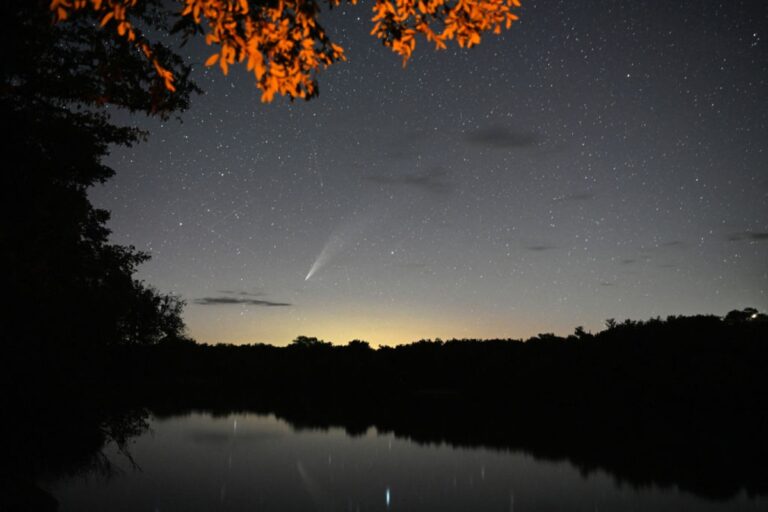
MARIANA SUAREZ/AFP via Getty Images
When the European Space Agency’s ExoMars Trace Gas Orbiter pointed its surface-imaging camera deep into space on October 3, 2025 — the first time any spacecraft orbiting another planet had ever trained its optics on an interstellar object — it captured nothing more dramatic than a fuzzy white dot. A year later, that dot has a story that rewrites the record books: the ice in comet 3I/ATLAS contains deuterium at concentrations more than ten times higher than those of any known solar system comet, and carbon with isotopic ratios outside the range of any body ever measured in our cosmic neighborhood. The comet’s ices formed roughly 10 to 12 billion years ago — more than five billion years before our Sun and planets existed — in a metal-poor early galaxy unlike the one we inhabit today.
Those findings, which the Paris Observatory’s Dominique Bockelée-Morvan presented this week at the international PIAZZI 200 conference in Palermo, Italy, close a year-long chain of discovery that began the moment the ExoMars Trace Gas Orbiter (TGO) swiveled its CaSSIS camera toward an object 18.6 million miles (30 million kilometers) away — a target 10,000 to 100,000 times fainter than the Martian surface it was built to photograph.
Those two data points — an ice chemistry unlike anything in our solar system, and a photograph taken by a spacecraft on another planet — are connected by a campaign unlike any in the history of planetary science. What began as a makeshift workaround for an observatory gap ended as the most thoroughly documented interstellar object humanity has ever studied.
What Is Comet 3I/ATLAS and Why Did It Matter Before Scientists Had Any Answers?
3I/ATLAS is only the third confirmed interstellar object ever observed passing through our solar system, following the asteroid-like 1I/’Oumuamua detected in 2017 and the cometary 2I/Borisov discovered in 2019. Its “3I” designation signals it as the third member of the International Astronomical Union’s interstellar-object numbering series, with “I” standing for interstellar. It was first spotted on July 1, 2025, by the Asteroid Terrestrial-impact Last Alert System (ATLAS) telescope in Río Hurtado, Chile, part of a five-telescope global network funded by NASA.
What immediately set 3I/ATLAS apart from its predecessors was the violence of its trajectory. Its orbital eccentricity measured roughly 6.1 — far beyond the eccentricity of 1 that marks the boundary between a bound and an unbound orbit — and it hurtled in at an inclination of approximately 175 degrees, meaning it orbited the sun in the opposite direction from nearly everything else in the solar system. Its velocity at infinity, the speed it carries independent of the Sun’s gravity, clocked in at approximately 58 km/s (about 130,000 mph), exceeding both ‘Oumuamua and Borisov. Within days of discovery, follow-up telescopes confirmed it was producing a coma — a cloud of sublimating gas and dust — meaning it behaved like a conventional comet, not a bare rocky object like ‘Oumuamua. Astronomers suspected immediately that its extreme trajectory and retrograde orbit pointed to an origin older and more distant than any solar system object previously studied.
How Mars Orbiters Captured an Interstellar Object for the First Time in Human History
As 3I/ATLAS swept through the inner solar system in late September and early October 2025, it passed behind the Sun from Earth’s perspective, leaving astronomers on the ground temporarily blind. But Mars was on the same side of the solar system — and humanity had robots there.
ESA’s TGO, which had orbited Mars since 2016 studying the planet’s atmosphere and surface, was the first to act. Between October 1 and 7, the mission team redirected the spacecraft’s Colour and Stereo Surface Imaging System (CaSSIS) — normally pointed at the Martian surface about 250 miles (400 kilometers) below — toward a target 30 million kilometers (18.6 million miles) away. “This was a very challenging observation for the instrument,” said Nick Thomas, a professor of experimental physics at the University of Bern and the CaSSIS principal investigator, in an ESA statement on the observations. The camera’s mirror measures only 13.5 centimeters (5.3 inches) across — roughly 300 times smaller in area than Hubble’s primary mirror — and its angular resolution of 2.34 arcseconds per pixel translates to a spatial sampling of about 340 kilometers (211 miles) per pixel at the comet’s distance. The faint, distant coma couldn’t be distinguished from the nucleus at that range.
To compensate, scientists stacked multiple five-second exposures — each 3,000 times longer than TGO’s standard 1.5-millisecond Mars imaging exposure — to accumulate enough light. The result was an animated sequence of 3I/ATLAS showing it as a slightly blurry white dot drifting against a background of stars on October 3, when the comet reached its closest point to the orbiter.
ESA’s older Mars Express orbiter attempted observations over the same period, but its camera’s maximum exposure time of 0.5 seconds — one-tenth of what TGO could achieve — proved insufficient to pull the faint comet out of the background. Scientists continued processing its imagery in the weeks following the flyby. TGO’s NOMAD spectrometer and Mars Express’s OMEGA and SPICAM instruments also attempted to measure the comet’s light spectrum for compositional hints, though results from those efforts were still being analyzed when ESA released its images on October 7.
NASA contributed three Mars assets to the effort. Its Mars Reconnaissance Orbiter captured 3I/ATLAS using the HiRISE high-resolution camera on October 2, 2025, one day before the closest approach. The MAVEN orbiter collected ultraviolet observations starting September 27. And Perseverance, on the floor of Jezero Crater, turned its Mastcam-Z cameras skyward on October 4, catching the comet as a faint smudge — a barely resolved signal from a visitor 38 million kilometers (23.6 million miles) away at the time of that observation. An earlier Perseverance navigation camera image showed what appeared to be a bright streak consistent with the comet’s track across the Martian sky, though NASA cautioned further analysis was needed to rule out alternative explanations. China’s Tianwen-1 Mars orbiter also captured images of 3I/ATLAS between October 1 and 4, according to the China National Space Administration’s report.
Triangulating From Another Planet: Why the Astrometry Was Bigger News Than the Photos
The images themselves, striking as a milestone, immediately revealed their limitations. At 30 million kilometers, CaSSIS could not separate the nucleus from the surrounding coma, and no tail was visible in any of the Mars-based imagery. Colin Wilson, the TGO and Mars Express project scientist at ESA, acknowledged the observations “alone don’t reveal any new insights” about the comet’s physical properties.
But what the TGO data produced that the photographs did not was something more durable: a dramatic improvement in the precision of 3I/ATLAS’s predicted path. Throughout the summer of 2025, trajectory calculations relied entirely on Earth-based telescopes, and uncertainties in the comet’s predicted position remained large. When TGO measured 3I/ATLAS’s position from Martian orbit — located roughly ten times closer to the comet than Earth at the time, and at a completely different angle in space — that second vantage point allowed scientists to triangulate with dramatically greater accuracy. ESA reported that combining Mars and Earth observations improved the predicted position of 3I/ATLAS by a factor of ten. Accounting for TGO’s own orbital velocity of up to 14,000 km/h (8,700 mph) around Mars while solving for the comet’s position relative to both Earth and Mars simultaneously required coordination across multiple ESA teams, including the Planetary Defense Team at ESA’s Near-Earth Object Coordination Centre (NEOCC).
The data ESA submitted to the Minor Planet Center — the Harvard-Smithsonian institution that serves as the official international archive for positional measurements of minor planets and comets — represented the first astrometric observations from a spacecraft orbiting another planet ever accepted by that organization. While 3I/ATLAS poses no threat to Earth, ESA officials described the exercise as an invaluable rehearsal for planetary defense scenarios in which a threatening object might require precise tracking from multiple points in the solar system — a scenario this campaign proved feasible for the first time.
How Did an Off-Label Camera Orbiting Mars Unlock a One-Year Discovery Campaign?
The TGO observations were not just a historical footnote. They served as the anchor point that anchored all subsequent trajectory work during the period when 3I/ATLAS was invisible from Earth — hidden behind the sun from September through mid-November 2025.
As the comet passed perihelion — its closest approach to the Sun — on October 29, 2025, at a distance of approximately 1.36 astronomical units (roughly between the orbits of Earth and Mars), a second ESA spacecraft stepped in. The Jupiter Icy Moons Explorer (JUICE), in cruise phase toward Jupiter and carrying five scientific instruments, was fortuitously positioned to observe 3I/ATLAS during this otherwise inaccessible stretch. Between November 2 and November 19, 2025, JUICE deployed its JANUS optical camera, MAJIS imaging spectrometer, ultraviolet imaging spectrograph, submillimeter wave instrument, and particle environment package on the comet from a distance of approximately 66 to 188 million kilometers (41 to 117 million miles).
The results, delayed by months because JUICE’s orbital geometry prevented antenna pointing toward Earth until February 2026, were published by ESA in April of that year. The MAJIS spectrometer detected 2,000 kilograms of water vapor escaping from the coma per second on November 2 — far exceeding the roughly 300 kilograms per second measured from comet 67P/Churyumov-Gerasimenko by ESA’s Rosetta mission at a similar distance, and approaching (though not reaching) Halley’s Comet’s peak rate of 20,000 kg/s. Carbon dioxide emissions were also detected. JUICE’s navigation cameras further refined the comet’s orbital solution, and the full dataset contributed additional astrometric measurements that improved the trajectory model even further.
What Does 3I/ATLAS Tell Scientists About the Early Galaxy?
The most significant scientific result of the campaign arrived in March 2026 when Martin Cordiner of NASA Goddard Space Flight Center and 18 collaborators submitted a paper to Nature reporting isotopic measurements of 3I/ATLAS made with the James Webb Space Telescope’s NIRSpec instrument. The paper was published in Nature June 2026.
The findings were startling. NIRSpec mapped the distribution of water (H₂O at 2.7 micrometers), carbon dioxide (CO₂ at 4.3 micrometers), and carbon monoxide (CO at 4.7 micrometers) across the comet’s coma. The water in 3I/ATLAS was enriched in deuterium — the heavy isotope of hydrogen — at a ratio (D/H) of 0.98 percent, plus or minus 0.06 percent. For reference, the D/H ratio in solar system comets typically runs around 0.05 to 0.08 percent. The 3I/ATLAS deuterium enrichment is more than ten times higher than any known solar system comet — and outside the range measured in nearby interstellar clouds and protoplanetary disks.
The carbon isotope ratios told an equally striking story. The 12C/13C ratio in 3I/ATLAS carbon dioxide ran between 141 and 191; in carbon monoxide, between 123 and 172. Solar system comets and interstellar molecular clouds generally fall within narrower, lower ranges. An elevated 12C/13C ratio indicates that the material has not been processed through multiple generations of stars — stellar evolution progressively enriches gas clouds in the heavier carbon-13 isotope over billions of years. Finding an object with so much more carbon-12 than carbon-13 implies it formed when the galaxy was young and stellar processing was minimal.
When Cordiner’s team applied models of Galactic chemical evolution to these isotopic signatures, they concluded 3I/ATLAS predates our solar system — predating our solar system by more than five billion years — following an early period of intense star formation in the young Milky Way.
“3I/ATLAS thus represents a preserved fragment of an ancient planetary system,” the team wrote, providing direct evidence of ice chemistry and volatile-rich planetesimal formation in the early galaxy. The precise formation temperature implied by the isotopic signatures was below 30 Kelvin (minus 243 degrees Celsius, or minus 406 degrees Fahrenheit) — consistent with the outer reaches of a cold protoplanetary disk forming long before our Sun ignited.
Why the Contrast Between 3I/ATLAS, ‘Oumuamua, and Borisov Matters
Scientists had hoped since ‘Oumuamua’s detection in 2017 that the growing catalog of interstellar objects would reveal something about the diversity of planetary systems across the galaxy. Three objects now tell a suggestive but still incomplete story. ‘Oumuamua — cigar-shaped, apparently bare of ice, and showing a non-gravitational acceleration whose cause remains debated — looked nothing like any known comet. 2I/Borisov, confirmed as a comet with a coma and a dust tail, behaved reassuringly like solar system comets and had isotopic compositions broadly consistent with them. 3I/ATLAS sits in a different category entirely: cometary in behavior, actively sublimating, but carrying ices so chemically distinct from anything in our solar system that they point not just to a different star but to a different era of the galaxy’s history.
The EPSC 2026 Conference and the Scope of the Full Campaign
The EPSC 2026 planetary science congress in The Hague, which concluded September 11, included at least six dedicated presentations on 3I/ATLAS data from JUICE instruments alone — covering JANUS imaging, MAJIS spectrometry, the submillimeter wave instrument, ultraviolet detection, astrometry, and a broader campaign lessons-learned review. That breadth reflects what happened when a campaign that began with a makeshift Mars-orbit photo ended up engaging at least 25 spacecraft across the inner and outer solar system. A dedicated session reviewed the lessons from the 3I/ATLAS spacecraft campaign for future interstellar object encounters.
Does 3I/ATLAS Prove the Galaxy Is Full of Comet-Like Travelers From Alien Systems?
Not yet — but the statistics are already striking. Astronomers estimate that thousands of interstellar objects pass within the orbit of Neptune on any given day, most far too faint to detect with current instruments. Three confirmed detections in nine years — ‘Oumuamua (2017), Borisov (2019), 3I/ATLAS (2025) — represent only the brightest and largest end of a population that likely includes objects of every size. The Vera C. Rubin Observatory, which began full science operations in late 2025, is expected to detect dozens of interstellar objects per year once it reaches full operational tempo, a prospect that makes the 3I/ATLAS campaign both a scientific triumph and a proof-of-concept for the machinery that will need to respond to future discoveries.
ESA’s Comet Interceptor mission, slated to launch in 2029 into a parking orbit at the Sun-Earth Lagrange point, is designed specifically to respond to newly discovered interstellar objects or dynamically new comets on short notice. Selecting a target remains impossible until one is found, but the 3I/ATLAS campaign demonstrated that spacecraft already in the solar system — at Mars, en route to Jupiter, in Earth orbit — can collectively substitute for a dedicated interceptor mission if coordinated quickly enough.
Frequently Asked Questions
What is unusual about the water in comet 3I/ATLAS?
Its deuterium-to-hydrogen ratio — a measure of how much “heavy water” the comet contains — is 0.98 percent, compared with 0.05 to 0.08 percent in typical solar system comets. That deuterium enrichment in 3I/ATLAS water makes it more than ten times richer in deuterium than any known solar system comet. High deuterium enrichment in water ice is a signature of formation at extremely low temperatures — below 30 Kelvin (minus 406 degrees Fahrenheit) — in the outer regions of a protoplanetary disk long before our solar system formed.
Why could the ExoMars Trace Gas Orbiter photograph 3I/ATLAS when Earth-based telescopes could not?
In October 2025, Earth and Mars were on the same side of the Sun, but from Earth’s perspective the comet was close enough to the Sun’s glare to make observations extremely difficult. Mars’s position gave spacecraft orbiting it a clear view and — critically — a vantage point roughly ten times closer to 3I/ATLAS than Earth was at the time. That geometry, combined with the different angle, allowed scientists to triangulate the comet’s position more precisely than ground-based observations alone. The tradeoff: TGO’s CaSSIS camera carries a mirror only 13.5 centimeters (5.3 inches) across and wasn’t designed for deep-sky observation. Capturing the comet required exposures 3,000 times longer than the camera’s standard Mars imaging setting.
Could this type of multi-spacecraft campaign be repeated for future interstellar objects?
Yes, and more effectively. The EPSC 2026 conference in The Hague in September included a dedicated session reviewing lessons from the spacecraft campaign, which ultimately involved at least 25 spacecraft. ESA’s Comet Interceptor mission, scheduled for launch in 2029, is specifically designed to sit at the Sun-Earth Lagrange point and respond to newly discovered interstellar objects. The Rubin Observatory’s much wider survey capability means that future interstellar objects may be detected with months or years of warning rather than days — allowing more time to coordinate spacecraft responses and potentially send a dedicated interceptor mission to rendezvous with such a visitor.
What does comet 3I/ATLAS tell scientists about how planetary systems form?
3I/ATLAS is, in the Cordiner team’s words, “a preserved fragment of an ancient planetary system” that formed in the early Milky Way when the galaxy was metal-poor and chemically under-evolved. Its isotopic fingerprint of ancient planetary formation — extreme deuterium enrichment and high 12C/13C ratios — implies that volatile-rich planetesimal formation was active in the young galaxy 10 to 12 billion years ago, long before our own solar system existed. That suggests planet-forming processes are not unique to chemically mature stellar environments like our Sun’s neighborhood, and that building blocks like those that may have seeded Earth with water were being manufactured across the galaxy from its earliest eras.