HomeAuto Air Force One Emergency Slide Fires Before Ireland Trip: Qatar Jet Lacks Confirmed Upgrades
Air Force One Emergency Slide Fires Before Ireland Trip: Qatar Jet Lacks Confirmed Upgrades
September 11, 2026:
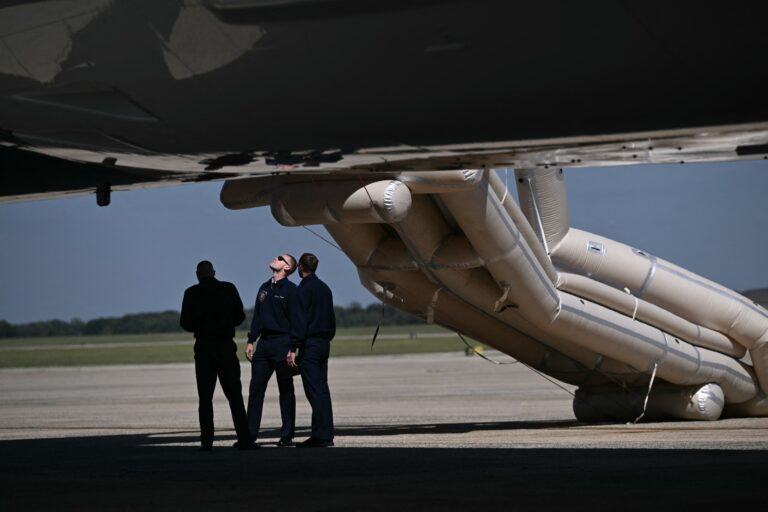
The emergency slide of the new Air Force One is deployed ahead of U.S. President Donald Trump’s departure for the Republican National Committee (RNC) midterm convention, at Joint Base Andrews in Maryland on September 9, 2026. Brendan SMIALOWSKI/AFP via Getty Images
An Air Force crew member accidentally triggered the emergency evacuation slide on the new presidential jet at Joint Base Andrews on Wednesday, September 9, trapping President Donald Trump aboard Marine One for roughly 20 minutes and delaying the flight to Dallas by approximately two hours — the latest operational anomaly on an aircraft that has been flying as Air Force One for just 70 days. The incident comes as the Boeing 747-8, donated to the U.S. government by Qatar and known in Air Force parlance as the VC-25B Bridge, is expected to fly to Ireland next week before a planned upgrade window that would add capabilities the aircraft is currently reported to lack.
The slide deployed from the front-right door of the aircraft while Trump was transferring from Marine One to the presidential jet for the flight to the Republican Midterm Convention in Dallas. Rather than walking directly across the tarmac as he normally would, Trump waited roughly 20 minutes inside the helicopter while Air Force ground personnel scrambled around the deployed slide — a fully inflated evacuation chute extending from the door to the ground. He eventually strolled over to the press pool and offered a characteristically breezy read of events: “They’re checking the slide over here. They were doing a check on the slide, you know, the emergency — so I think it takes about 15 minutes.” When asked directly whether the aircraft was safe to fly, his answer was brief: “Yeah, I am, or I wouldn’t be on it.” The slide was eventually deflated, detached from the aircraft, and hauled away in the bed of a pickup truck. The aircraft departed for Dallas and arrived around 5:15 p.m. ET, approximately two hours behind schedule.
White House communications director Steven Cheung’s statement leaned on the president’s framing. “As the President has said, the slide was checked out to make sure everything works perfectly,” Cheung said. But three sources familiar with the matter — speaking separately to NBC News, CBS News, and ABC News — each confirmed the same account: a crew member accidentally triggered the slide. Emergency evacuation slides are not typically checked by deploying them before departure, because deploying one requires removing, repacking, and certifying the slide before the aircraft can carry passengers again — a process that costs airlines approximately $12,000 in repacking labor alone under normal circumstances and can ground an aircraft for hours.
Why Evacuation Slides Deploy by Accident — and Why It Matters on a New Aircraft
The mechanics of an accidental slide deployment are straightforward and well-documented in aviation safety literature. Every door on a large commercial or military transport aircraft is equipped with a girt bar — a metal rod connecting the slide pack to floor brackets just inside the door frame. When the girt bar is engaged (“armed”), opening the door automatically triggers the slide: the door’s motion pulls the girt, the slide pack falls free of the door bustle, and a squib releases compressed gas at roughly 3,000 pounds per square inch, filling an 850-cubic-foot fabric chute in approximately five to seven seconds. The FAA mandates that slides deploy in under 10 seconds; the 747’s dual-lane main-door slides meet that standard, but the Boeing 747 design — unlike the Airbus A380’s Tribrid Inflation System — includes no automatic length-adjustment mechanism for unusual aircraft attitudes.
When the door is “disarmed,” the girt bar moves with the door and the slide stays packed. The entire sequence depends on a crew member remembering — or being prompted — to disarm the door before opening it. Studies by Airbus have found that most inadvertent slide deployments occur because crew members fail to follow the applicable standard operating procedure; distraction is the second most common cause, and human-factors pressures such as fatigue and time pressure are third. The International Air Transport Association has estimated that inadvertent slide deployments cost North American carriers approximately $20 million per year. Each repacking costs approximately $12,000; a 90-minute delay adds roughly $11,000 more; if a flight is canceled, total costs can reach $200,000.
None of this makes the September 9 incident uniquely alarming in isolation — accidental slide deployments happen at airports worldwide, regularly, on perfectly serviceable aircraft. What distinguishes this one is its context. The VC-25B Bridge entered service on July 1, 2026. As of the tarmac incident, the aircraft had been carrying the president for exactly 70 days. A crew operating a newly converted aircraft type — one that came from a Qatari royal configuration and was modified in approximately 10 months rather than the years typically required to qualify a presidential transport — is, by definition, less familiar with that aircraft’s specific operational procedures than a crew that has worked the same type for years. The Airbus research is clear on the point: distraction and unfamiliarity with standard operating procedures are the primary drivers of inadvertent deployment.
A Short Operational History, Already Eventful
The slide deployment is the most visible in a series of incidents that have attended the VC-25B Bridge’s brief operational life.
The aircraft — a Boeing 747-8 built in 2012 for the Qatari royal family’s Amiri Flight and donated to the U.S. Department of Defense in May 2025 — entered presidential service when the Air Force formally accepted it and L3Harris completed a roughly 10-month modification program. The modification was deliberately accelerated to meet delivery targets: faced with the long-term VC-25B replacement program slipping toward a 2028 delivery target and the existing VC-25A fleet approaching four decades of service, the Air Force made minimal changes to the previous head-of-state interior to get the aircraft into service faster. The result is a serviceable presidential transport, but one whose specific defensive capabilities remain classified and publicly unconfirmed.
In mid-July, less than two weeks after the aircraft’s inaugural presidential flight, the Secret Service reportedly urged Trump to switch aircraft as he departed the NATO summit in Ankara, Turkey — citing security concerns related to the Iranian threat environment and differences in the aircraft’s defensive configuration compared to the older VC-25A. The president and Air Force ultimately used a covert catering-truck transfer to move Trump to a C-32A military aircraft for the actual departure, leaving a VC-25A as a visible decoy at the airfield. Trump later told reporters that the VC-25A they flew on during the Turkey-to-UK leg was “a dangerous plane” because of Iranian threats — meaning the aircraft he had switched to, the more capable VC-25A, was the safer choice compared to the Qatar-gifted jet.
On July 19, returning from the FIFA World Cup final in New Jersey, Trump acknowledged upgrade gaps on record, telling reporters that the VC-25B Bridge “has a lot of capability but, as I understand it, in about a month or so, they’re going to send it to have it be maxed out.” He did not specify what “maxed out” means. The Air Force’s standard VC-25A defensive capabilities include infrared flare systems, radar-jamming capability, chaff dispensers, electromagnetic pulse hardening, and an aerial refueling capability. Which of those systems the VC-25B Bridge carries — and which it does not — has not been publicly confirmed by the Air Force.
As of September 4, five days before the slide incident, ABC News and the Washington Post reported that Trump was expected to fly the VC-25B Bridge to Ireland for an overseas trip the following week — its first international flight since the Turkey episode. At the time, sources said it was unclear whether any upgrades had been completed since Trump’s July “maxed out” comments. A senior administration official, when asked about the aircraft’s modification status, declined to comment on specific upgrades and said the administration “routinely evolve[s] the capability as required.”
The older VC-25A aircraft — one of the two blue-and-white Boeing 747-200Bs that have served as Air Force One since 1990 — was positioned at the ready behind the new jet on Wednesday as the slide was being dealt with, stairs already in place at the forward and rear doors, prepared to operate the flight if the VC-25B Bridge could not be cleared in time. A backup aircraft is standard practice on presidential missions; the optics of having that backup visibly staged on the tarmac while personnel managed a ground equipment failure on the primary aircraft were harder to miss.
What Happens When a Slide Deploys — and What Repacking Requires
Once an evacuation slide inflates on the ground, the aircraft cannot operate until the slide is removed, inspected, repacked, and certified serviceable by qualified technicians. On a commercial airliner, this process typically grounds the aircraft for at least several hours, at a minimum cost of approximately $12,000 in repacking labor alone, before accounting for delay costs. On a government aircraft without a commercial maintenance chain standing by, and on a type that has been in service for 70 days, the process is more complex. A functional check of this kind is not a standard pre-flight check item; slides are inspected at regular maintenance intervals, not deployed on the ground before departure.
FAR Parts 25.809 and 25.810 specify the design and performance requirements for transport category evacuation slides. The FAA requires that any aircraft demonstrate full evacuation using only half its available exits within 90 seconds, and that slides deploy in under 10 seconds. For a widebody aircraft like the Boeing 747, that means dual-lane main-door slides rated at 70 persons per minute per lane — systems that are designed to fire as fast and as reliably as possible, which is precisely why they are also capable of firing accidentally when an armed door is opened without the girt bar being disengaged first.
The Air Force has not announced any formal investigation of the September 9 incident. A formal safety review following an inadvertent activation of safety equipment on a government aircraft is standard Air Force protocol, but whether one will result in public findings is not yet known.
What the VC-25B Bridge Still Lacks — and When It Might Get It
The $400 million aircraft (approximate value at time of gift) is the United States government’s current primary presidential transport. It was acquired at no direct purchase cost to taxpayers, though the modification and security upgrade program is estimated to have cost hundreds of millions of dollars. Lawmakers suggested the conversion could cost more than $1 billion when accounting for the full scope of modifications required to bring it to presidential transport standards.
The two purpose-built VC-25B aircraft — being manufactured under a $3.9 billion fixed-price contract Boeing signed in 2018 — are not expected to enter presidential service until approximately 2028, and Boeing has repeatedly taken losses on the program due to supply chain disruptions and a shortage of cleared workers. The VC-25B Bridge is intended to cover the gap until the permanent aircraft arrive.
Trump has said the aircraft will be donated to his presidential library after its service life concludes, where it will likely be exhibited as the first Air Force One with a bold red-white-and-blue livery rather than the pale blue that identified the presidential jet for six decades under the Kennedy-era design.
The planned upgrade period — when the aircraft is expected to go offline for additional modifications — has not been formally confirmed by the Air Force. Trump’s July statement suggested it would happen “in about a month or so” from his comments on July 19, a window that has now passed without any announced commencement of the work. Whether those upgrades have begun, are scheduled to begin shortly, or have been delayed is not publicly known as of publication.
Frequently Asked Questions
Why did the Air Force One emergency slide deploy accidentally?
Emergency evacuation slides on large aircraft deploy automatically when the door is opened in an “armed” condition — meaning the girt bar (a metal rod connecting the slide to floor brackets) is still engaged. If a crew member opens the door without first disarming the girt bar, the slide fires exactly as designed. Aviation safety research consistently identifies failure to follow standard operating procedures, and general distraction, as the leading causes of inadvertent slide deployment. Because the VC-25B Bridge has been in presidential service for only 70 days, its crew is still relatively early in their operational experience on the specific converted aircraft type.
How does an airplane evacuation slide work?
The slide is packed inside the door’s slide bustle. When the door opens in armed mode, the girt bar’s attachment to the floor pulls the slide pack free. A compressed-gas cylinder (typically nitrogen or a nitrogen/CO2 mixture) pressurized to roughly 3,000 psi inflates the slide through aspirators that draw in outside air at a 500:1 ratio, filling approximately 850 cubic feet of fabric in roughly five to seven seconds. The FAA requires that large aircraft slides complete deployment in under 10 seconds, and requires that an entire aircraft be evacuable through half its exits within 90 seconds.
What are the security concerns with the Qatar-gifted Air Force One?
The VC-25B Bridge was converted from a 2012 Qatari royal-family aircraft in approximately 10 months — a fraction of the years typically required to equip a true presidential transport. The Air Force has confirmed that government specialists swept the aircraft for potential surveillance devices and installed classified communications and security systems, but has not publicly confirmed which defensive capabilities from the standard VC-25A suite — including infrared flare countermeasures, radar jamming, chaff dispensers, and electromagnetic pulse hardening — are present on the VC-25B Bridge. Trump himself acknowledged in July 2026 that the aircraft would need to be “maxed out” with upgrades. That work’s status remained unclear as of this report, and the jet is expected to make its first overseas flight to Ireland as soon as next week.
Is the new Air Force One missing anti-missile systems?
The Air Force has not publicly confirmed the VC-25B Bridge’s defensive suite, citing classification. The standard VC-25A carries infrared countermeasures against heat-seeking missiles, radar-jamming equipment, chaff dispensers, and electromagnetic pulse hardening. Whether those systems were installed during the 10-month conversion is officially unconfirmed. What is publicly known is that Trump acknowledged a capability gap in July 2026, the Secret Service reportedly urged him to switch aircraft when departing the NATO summit in Turkey in an elevated-threat environment, and planned upgrades have not been publicly confirmed as complete.