HomeAuto AHS: 13 Episodes 9-10 Explained: Devil’s Mortality Runs on Real Epigenetic Clock
AHS: 13 Episodes 9-10 Explained: Devil’s Mortality Runs on Real Epigenetic Clock
October 16, 2026:
Fxnetworks.com
American Horror Story: 13 delivered its most intellectually ambitious double-bill yet when Episodes 9 and 10 — “The Devil Is in the Details” and “The Prodigal Son” — aired October 15, 2026, on FX and became available on Hulu the following morning. The back-to-back installments did not merely advance a supernatural plot. They revealed a mythology built with serious precision from five real disciplines: game theory, biogerontology, number theory, temporal mechanics, and behavioral genetics. Mr. Nas — the frail 87-year-old at the center of the season — is the Devil operating under a genuine biological constraint, and his endgame exposes how rigorously creator Ryan Murphy has embedded real science inside his Gothic scaffolding.
What the 1939 Vatican Scene Gets Right About Principal-Agent Problems
The tenth episode opened in the Vatican in 1939, where a nun delivered a secret document to Pope Pius XII. The document recorded a wager struck between God and the Devil: if Satan survived in human form for 100 consecutive years, dominion over Heaven, Hell, and Earth would transfer to him permanently. The pope initially assumed the Devil’s vessel to be Adolf Hitler. He was wrong.
What AHS is dramatizing has a precise name in economics: a classic principal-agent problem with an intertemporal commitment flaw. The scriptural archetype is the Book of Job, the oldest recorded example of a divine principal-agent problem in Western literature. In Job, the Hebrew ha-satan — literally “the accuser,” not the Christian devil of later tradition — argues that a righteous man’s loyalty is purely transactional, and God permits a test. The wager in AHS:13 inverts the power structure: this time, the adversary wins the bet by enduring, not by breaking the subject.
The 1939 dating is historically pointed. Pope Pius XII’s real-world role during World War II remains one of the most debated questions in 20th-century religious history — whether his silence constituted covert resistance or moral complicity. By placing the divine wager’s revelation at exactly this moment, AHS:13 asks the theodicy question — why does a good God permit evil — in the sharpest possible historical register. If God made a deal that allowed an active devil to operate freely during the Holocaust and 80 subsequent years of human suffering, the show is engaging directly with Leibniz’s “theodicy” framework, coined in 1710 to reconcile divine goodness with the existence of evil.
From a game-theoretic standpoint, the wager also suffers from what contract theorists call a monitoring problem: a 100-year commitment between parties with asymmetric time preferences — one eternal, one aging — is structurally unstable. The pope’s misidentification of Hitler illustrates a real cognitive bias: humans anthropomorphize evil, projecting supernatural causation onto the most visible actors. The true threat operated below the threshold of historical attention. Mr. Nas’s Upper West Side apartment is the show’s argument that the most dangerous adversaries are the mundane ones nobody watches.
Mr. Nas’s Forced Mortality Maps Onto Real Biogerontology
The AHS:13 conceit — a supernatural entity subject to measurable biological aging — has a precise theological term: kenosis from Greek, meaning “emptying.” In classical Christian theology, kenosis describes Christ voluntarily emptying divine power to inhabit human biological constraints. AHS inverts the polarity: it is the adversarial entity, not the divine, that undergoes kenosis. Mr. Nas vomits black liquid when people die nearby, cannot leave his bed unassisted, requires living snakes and weekly blood draws — the material signs of a supernatural consciousness genuinely bound to biological processes it cannot override. Nineteenth-century theologian Gottfried Thomasius first formalized kenotic Christology; Pope Pius XII condemned one kenotic interpretation in 1951. AHS uses this contested theological framework and applies it to Satan.
What makes the show’s biogerontology precise is its use of “biomarkers” as Mr. Nas’s aging metric. Biomarkers of aging are a real and active research field, led by epigenetic clock research. Steve Horvath, a professor of human genetics and biostatistics at UCLA, published the first multi-tissue epigenetic clock in 2013 — a tool that estimates biological age by reading DNA methylation patterns at 353 CpG sites across tissue types. DNA methylation has been linked to aging since the late 1960s; blood-based methylation age predicts all-cause mortality in real populations. The show’s ritual sacrifices of groups of 13 function as external interventions that accelerate these clocks — the inverse of what modern anti-aging researchers hope to achieve by slowing or reversing methylation age through lifestyle and pharmacological interventions.
The analogy to parabiosis — circulating blood from young animals into older ones — is genuinely relevant here. Parabiosis is a real, if contested, research domain, and the metaphor of sacrifice-as-energy-extraction maps onto the same conceptual territory: that the vitality of one organism can be transferred to another through biological mechanisms. AHS literalizes what real science investigates cautiously.
Why 13? Prime Numbers, Group Theory, and the Anthropology of Sacred Arithmetic
The season’s formal structure — 13 episodes, a coven of 13 witches, sacrifices in groups of exactly 13 — is grounded in the mathematical and cross-cultural significance of 13. Thirteen is a prime number, divisible only by 1 and itself, which in number theory gives it structural indivisibility. It is also a Fibonacci number (1, 1, 2, 3, 5, 8, 13) and a happy prime — a prime that, when you repeatedly sum the squares of its digits, eventually reaches 1.
In group theory, prime-order cyclic groups are always simple — they have no non-trivial subgroups, making them “atomic” in algebraic terms. A coven of exactly 13 members is therefore not an arbitrary choice: it is the smallest structurally irreducible group above twelve.
The cultural fear of 13 spans multiple independent civilizations. The term triskaidekaphobia was used as early as 1910 by psychologist Isador Coriat. In Scandinavian mythology, Loki arrived as the uninvited 13th guest at Valhalla and engineered Baldr’s death — though it is worth noting that this version of the story does not appear in the Prose Edda and may be a later retelling. In the Christian tradition, 13 diners at the Last Supper preceded the Crucifixion. Yet 13 is considered lucky in Cantonese-speaking communities and was viewed positively in pre-World War I France — a reminder that the show’s use of 13 as a cosmological constant is drawing from a Western European folkloric tradition, not a universal one.
Anthropologist Robin Dunbar’s research on human social cognition places stable support cliques of up to about 15 people — the group size within which deep mutual trust and coordinated action are most efficient. Thirteen sits precisely in this “support clique” range, which means the Coven’s power is as sociological as it is supernatural.
Mallory’s Kill Demonstrates Causal Overdetermination, Not Victory
The most scientifically rigorous reveal in Episodes 9-10 is Mallory’s confession to the Coven: that in AHS: Apocalypse, she traveled back to 2015 and ran over Michael Langdon before he could trigger the nuclear apocalypse. The reset erased the nuclear apocalypse and appeared to work. What Season 13 reveals is that it did not.
General relativity permits closed timelike curves — theoretical paths through spacetime that return to their starting point — and the physics of time travel branches between two main frameworks. The Novikov self-consistency principle, developed by physicist Igor Novikov in the 1980s, holds that only self-consistent histories can occur — you cannot travel back and change events in a way that prevents the conditions that caused you to travel in the first place. Gödel demonstrated in 1949 that Einstein’s field equations permit closed timelike curve solutions, establishing the mathematical basis for time travel in general relativity. The Everett many-worlds interpretation offers a different model: time travel creates a branch point, spawning a new timeline where the change takes effect while the original timeline continues.
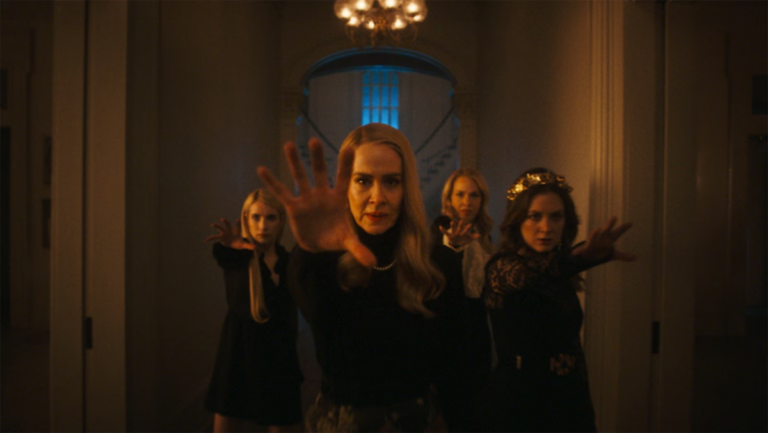
AHS follows an Everett-style model. Mallory’s intervention created a new branch where Langdon never grew to adulthood and the Apocalypse never happened. But she removed a consequence — the Antichrist — without removing the underlying cause: Mr. Nas had already been running his 100-year wager before Michael Langdon was conceived. This is causal overdetermination in action: a goal-seeking adversarial system with multiple redundant pathways to its objective. Removing one variable does not eliminate the system. It merely reroutes it. Now, with the designated heir erased, Mr. Nas turns to Ben DeSoto — his other biological son — as the replacement. The Coven, who killed his Antichrist, becomes both his target for revenge and the final sacrificial group needed to push his aging to 100.
The doctrine of double effect in moral philosophy asks whether an act with both good and harmful consequences can be permissible if the harm was unintended. Mallory prevented one catastrophe while creating the conditions for the next. AHS uses the Gothic horror tradition — every solution generates a deeper problem — to dramatize this philosophical dilemma at cosmological scale.
Demonic Heredity, the Inverted Prodigal Son, and Gematria’s Hidden Name
The revelation that Constance Langdon is Mr. Nas’s biological daughter retroactively reframes her entire arc across Murder House, Coven crossovers, and Season 13. Her children’s darkness — Tate’s ghost-murder spree, Beauregard’s confinement, the Antichrist Michael — was not merely Gothic melodrama. It was heritable predisposition with a supernatural source, which the show now maps onto the real science of behavioral genetics.
Behavioral genetics, built on Galton’s Hereditary Genius (1869) and advanced through twin studies and genome-wide association studies, confirms that complex behavioral dispositions have measurable heritable components. No single gene determines violent behavior, but predispositions toward specific traits travel through bloodlines in patterns that correlate with family relationships. AHS literalizes this: what real science observes as probabilistic correlation, the show renders as direct supernatural transmission through a demonic bloodline.
The episode title “The Prodigal Son” explicitly inverts the biblical Parable of the Prodigal Son from Luke 15:11-32, in which a father restores a wayward son through unconditional forgiveness. In the original, the return is redemption. In AHS:13, the “return” is Ben DeSoto’s summoning to a dark inheritance — not forgiveness but conscription. This inverted-parable structure is central to AHS’s tradition of theological horror: taking Christian symbolism and systematically reversing its valence. The season has consistently operated this way, presenting the Coven as a church, the Supreme as a madonna figure, and the Antichrist as a mirror-Christ.
The anagram reveal — the name Mr. Nas contains letters rearranging to identify him as Satan — belongs to a tradition of gematria and notarikon, in which supernatural entities encode their identities in names. Gematria traces to Assyrian inscriptions of the 8th century BCE and Greek isopsephy, and its Hebrew use in Kabbalistic tradition dates from 78 BCE. The practice of finding hidden divine or demonic meanings within text appeared in Renaissance hermeticism through figures like Agrippa and John Dee. AHS plays this both as genuine occult reference and as camp — acknowledging that it is working in a centuries-old tradition of encoded adversarial identity.
Why the Coven’s Collective Knowledge Outlasts Any Single Intervention
The deepest argument Episodes 9-10 make — one the season has been building since the premiere — is not supernatural at all. By the logic of the narrative, the Coven of 13 witches represents knowledge accumulated through generations of practice, transmission, and adaptation. Papa Legba and Marie Laveau represent the same principle in the Vodou tradition: inherited cosmological knowledge refined through continuous community engagement. The divine wager, by contrast, is a top-down commitment problem: a unilateral bet made by an omnipotent party that cannot be enforced continuously over 100 years. Mallory’s time-travel kill was a one-off targeted intervention. Both failed for the same structural reason: they assumed that removing a specific node from a complex adaptive system would terminate the system’s goal-seeking behavior.
Systems engineering has a name for this failure mode: single-point elimination in the presence of redundant pathways. The Coven does not try to eliminate Mr. Nas through a single heroic act. It tries to understand and disrupt the system — the 100-year wager, the sacrificial mechanism, the hereditary succession. Episodes 11 through 13 will determine whether collective earned knowledge proves more resilient than divine fiat and targeted intervention. The season finale, “Devil of a Good Time,” is scheduled for October 29, 2026, on FX.
Frequently Asked Questions
Who is Mr. Nas in American Horror Story: 13, and what is the 1939 wager?
Mr. Nas — played by Fedor Steer (elderly) and Paul Anthony Kelly (younger) — is the Devil living as a mortal human. In Episode 10, it was revealed that in 1939 the Devil struck a wager with God: survive in human form for 100 consecutive years and receive dominion over Heaven, Hell, and Earth. To accelerate his biological aging toward 100, Mr. Nas has been conducting ritualistic sacrifices of groups of exactly 13 people. He has approximately 13 years remaining as of the season’s present-day timeline.
How does Mallory’s time-travel kill in AHS: Apocalypse connect to Season 13’s story?
In the Apocalypse season finale, future Supreme Mallory traveled back to 2015 and ran over the young Michael Langdon — the Antichrist — before he could trigger a nuclear apocalypse. The timeline reset appeared successful. What Season 13’s Episodes 9-10 reveal is that Mallory’s intervention committed a causal overdetermination error: she removed a consequence (the Antichrist) without removing the underlying cause (Mr. Nas’s wager and his need for a biological heir). With Michael erased, Mr. Nas simply redirected his succession plan to Ben DeSoto, his other biological son — and the Coven, which killed his chosen heir, became his primary target.
Why does the number 13 function as a cosmological constant throughout the season?
Beyond the cultural traditions of triskaidekaphobia, 13 has specific mathematical properties that make it structurally resonant for a season built around an “atomic” unit of sacrifice. It is a prime number (indivisible), a Fibonacci number (appearing in natural growth patterns), and a happy prime. In group theory, prime-order groups are always simple — they have no non-trivial subgroups. A group of exactly 13 is therefore structurally irreducible. The season’s formal choice to run exactly 13 episodes and center its coven on exactly 13 witches is not incidental.
What real science does AHS: 13 draw on for Mr. Nas’s biological aging mechanics?
The show’s aging mechanics most closely map onto epigenetic clock theory in biogerontology. Steve Horvath’s 2013 epigenetic clock — developed at UCLA and measuring DNA methylation patterns at 353 CpG sites — is the real scientific basis for the idea that biological age can be measured independently from chronological age and, theoretically, accelerated or reversed by external interventions. The show’s ritual sacrifices function as the fictional equivalent of an external epigenetic accelerant: they push Mr. Nas’s biological clock toward 100 faster than natural aging would. This is the inverse of what contemporary anti-aging researchers pursue — slowing or reversing the epigenetic clock rather than accelerating it.